The Complete Guide to Global Business Services (GBS): Strategy, Structure, and Future Outlook
Global enterprises today are under immense pressure to reduce costs, increase agility, digitize operations, and deliver measurable value…
The Complete Guide to Global Business Services (GBS): Strategy, Structure, and Future Outlook
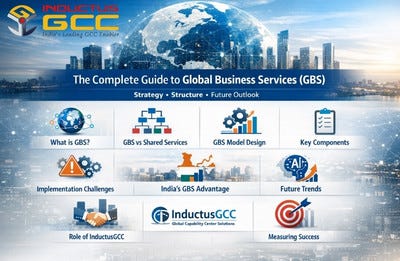
Global Business Services
Global enterprises today are under immense pressure to reduce costs, increase agility, digitize operations, and deliver measurable value. Traditional shared services models are no longer sufficient. This is where Global Business Services (GBS) emerges as a transformative operating model.
Rather than functioning as isolated support departments, **Global Business Services (GBS)** integrates multiple business functions into a unified, strategic, and technology-driven platform.

InductusGCC
In this comprehensive guide, we will explore:
- What Global Business Services (GBS) really means
- How it differs from shared services
- Why enterprises are moving toward GBS models
- How to design and implement a successful GBS strategy
- Key challenges and mitigation strategies
The future of GBS in a digital-first world
Chapter 1: Understanding Global Business Services (GBS)
Global Business Services (GBS) is an enterprise-wide operating model that centralizes and integrates support functions such as:
- Finance & Accounting
- Human Resources
- Procurement
- IT Services
- Legal & Compliance
- Customer Operations
- Data & Analytics
Core Characteristics of GBS:
- Multi-function integration
- Global governance framework
- Standardized processes
- Advanced automation & digital tools
- Performance-driven SLAs
- Outcome-based KPIs
GBS is designed to move from cost arbitrage to value creation.
Unlike traditional shared service centers, GBS operates as a strategic partner, not merely a transactional support function.
Explanation: Global Business Services (GBS) is an enterprise operating model that brings together multiple support and operational functions under a single, integrated framework. Unlike traditional shared services, which often focus on one function such as finance or HR, GBS combines several business functions and manages them through centralized governance and standardized processes.
The goal of GBS is not just cost reduction. Instead, it aims to deliver measurable business outcomes such as operational efficiency, agility, data-driven decision-making, and innovation. By leveraging digital technologies, automation, and analytics, GBS transforms back-office and middle-office operations into strategic value creators for the enterprise.
Chapter 2: Why Organizations Are Adopting Global Business Services (GBS)
The shift toward Global Business Services is driven by multiple strategic factors:
1. Cost Optimization Beyond Labor Arbitrage
GBS focuses on:
- Process standardization
- Automation through RPA & AI
- Global delivery models
This reduces redundancy and increases efficiency.
2. Enterprise-Wide Process Harmonization
Instead of fragmented regional teams, GBS ensures:
- Unified workflows
- Consistent reporting structures
- Centralized governance
3. Digital Transformation Enablement
Modern GBS models integrate:
- AI-driven analytics
- Intelligent automation
- Cloud ERP platforms
- Real-time dashboards
4. Improved Business Agility
GBS enables organizations to scale operations quickly across geographies.
Explanation: Organizations are increasingly adopting Global Business Services (GBS) because traditional operating models struggle to scale in a global, digital-first environment. As companies expand across geographies, decentralized functions often lead to duplicated efforts, inconsistent processes, and higher operational costs.
GBS addresses these challenges by creating a unified service delivery model. It allows organizations to standardize workflows, improve visibility across operations, and respond faster to changing business needs. Additionally, GBS enables enterprises to move beyond labor arbitrage by focusing on automation, process excellence, and analytics-driven insights that directly support growth and transformation objectives.

Inductus GCC
Chapter 3: Global Business Services (GBS) vs Shared Services
Shared Services
1.Single-function focus
2.Cost-driven
3.Regional execution
4.Transaction-focused
5.Limited digital maturity
Global Business Services (GBS)
1.Multi-functional integration
2.Value & strategy-driven
3.Global governance
4.Outcome-focused
5.Digital-first approach
Also Read: Global Business Services (GBS): India’s Rise as a Strategic Hub for Innovation and R&D Excellence
Explanation: While shared services and GBS are often used interchangeably, they represent fundamentally different approaches. Shared services typically consolidate transactional activities within a specific function to reduce costs and improve efficiency. Governance is often regional, and success is measured primarily through cost savings and service-level agreements.
Global Business Services (GBS), on the other hand, operates at an enterprise level. It integrates multiple functions, aligns them with business strategy, and uses advanced technologies to deliver outcomes rather than just services. GBS also introduces global governance, performance-based metrics, and a strong focus on continuous improvement, making it a more mature and strategic model.
Chapter 4: Designing an Effective Global Business Services (GBS) Model
Implementing GBS requires strategic clarity.
Step 1: Define the Vision
- What business outcomes are expected?
- Cost reduction? Digital transformation? Growth enablement?
Step 2: Identify Scope & Functions
Select which functions will migrate into the GBS structure.
Step 3: Location Strategy
India continues to be a leading destination due to:
- Skilled workforce
- Mature GCC ecosystem
- Cost competitiveness
- Strong digital capabilities
This is where advisory partners like InductusGCC support enterprises in designing, structuring, and scaling Global Business Services models in India.
Step 4: Governance Framework
- Central leadership
- Performance measurement systems
- Risk management structures
Step 5: Technology Backbone
A robust GBS model integrates:
- ERP consolidation
- Automation platforms
- AI-enabled analytics
Cybersecurity frameworks
Explanation: Designing a successful GBS model starts with defining a clear vision aligned to business goals. Organizations must determine whether their GBS initiative is focused on cost optimization, digital transformation, scalability, or all three. This clarity helps define the scope, structure, and success metrics of the model.
Equally important is selecting the right delivery locations. India has emerged as a preferred hub for Global Business Services due to its skilled talent pool, digital maturity, and robust GCC ecosystem. Companies like **InductusGCC** play a crucial role in helping enterprises design, set up, and scale GBS operations in India by providing location advisory, governance frameworks, and execution support.
Chapter 5: Core Components of a Mature Global Business Services (GBS) Organization
✔ Process Excellence
Standardization across geographies.
✔ Digital Enablement
Automation, AI, ML, analytics.
✔ Talent Strategy
Upskilling employees to move from transactional roles to analytical roles.
✔ Performance Management
KPIs tied to business outcomes, not just operational efficiency.
Explanation: Strategic advisory firms like InductusGCC help enterprises navigate these transformation complexities through structured frameworks and execution models.
A mature GBS organization is built on standardized processes, strong governance, and digital enablement. Process excellence ensures that workflows are consistent and efficient across geographies, while governance frameworks provide accountability and strategic alignment.

Inductus GCC
Technology is a critical enabler. Modern GBS organizations rely on automation, artificial intelligence, cloud platforms, and advanced analytics to improve productivity and decision-making. Talent strategy also plays a key role, as employees are upskilled to handle analytical, problem-solving, and value-added roles rather than repetitive tasks.
Also Read: Global Capability Centre in India
Chapter 6: Challenges in Implementing Global Business Services (GBS)
Even well-planned GBS initiatives can face obstacles:
1. Resistance to Change
Business units may hesitate to relinquish control.
2. Integration Complexity
Merging multiple systems and processes globally can be challenging.
3. Governance Gaps
Without strong leadership, GBS can become fragmented.
4. Talent Transformation
Moving from operational execution to strategic analytics requires capability upgrades.
Explanation: Despite its benefits, implementing Global Business Services (GBS) is not without challenges. Resistance to change is common, particularly when business units are asked to give up control over processes. This can slow adoption and reduce effectiveness if not managed carefully.
Integration complexity is another major challenge. Bringing together different systems, processes, and cultures requires strong leadership and clear communication. Organizations often partner with experienced advisors such as InductusGCC to navigate these challenges, establish governance structures, and ensure smooth execution across functions and regions.
India has become the backbone of the global GBS ecosystem.
Reasons include:
- Deep digital talent pool
- Strong STEM education pipeline
- Advanced GCC maturity
- Government support for global enterprises
Many multinational organizations leverage India to build next-generation Global Business Services (GBS) hubs focused on innovation and analytics — not just back-office support.
Chapter 7: India’s Role in the Global Business Services (GBS) Ecosystem
India has become the backbone of the global GBS ecosystem.
Reasons include:
- Deep digital talent pool
- Strong STEM education pipeline
- Advanced GCC maturity
- Government support for global enterprises
Many multinational organizations leverage India to build next-generation Global Business Services (GBS) hubs focused on innovation and analytics — not just back-office support.
Explanation: India plays a central role in the global GBS landscape. What started as a destination for cost-effective back-office operations has evolved into a hub for innovation, analytics, and digital transformation. Indian GBS centers now handle complex functions such as data science, cybersecurity, finance transformation, and customer experience management.
The country’s strong education system, large talent base, and mature GCC ecosystem make it an ideal location for scaling Global Business Services. Enterprises working with partners like InductusGCC are able to tap into this ecosystem while maintaining governance, compliance, and operational excellence.
Chapter 8: Future Trends Shaping Global Business Services (GBS)
The GBS landscape is evolving rapidly.
- AI-Driven Decision Support
GBS will increasingly shift toward predictive analytics.
- Hyperautomation
End-to-end process automation will become standard.
- Experience-Centric Design
Employee and customer experience will drive process redesign.
- ESG Integration
Sustainability metrics will be embedded into GBS KPIs.
- Outcome-Based Commercial Models
Shift from SLA-based to value-based metrics.
Explanation: The future of Global Business Services (GBS) is being shaped by rapid advances in technology and changing business expectations. Automation and AI will increasingly handle end-to-end processes, enabling GBS teams to focus on strategic and analytical work.
Experience-driven design will become more important, with GBS organizations focusing on both employee and customer experience. Sustainability and ESG metrics will also become embedded into GBS performance frameworks, reflecting broader enterprise priorities. As a result, GBS will continue to evolve from a support function into a core driver of enterprise transformation.
Also Read :[ Offshore Development Centers](https://sites.google.com/view/inductusgcc-com/home)
Chapter 9: How InductusGCC Supports Global Business Services (GBS) Transformation
Organizations exploring Global Business Services transformation often require:
- Location advisory
- Regulatory guidance
- Operating model design
- Talent acquisition strategy
- Governance structuring
- Digital integration roadmap
InductusGCC works with global enterprises to:
- Design scalable GBS frameworks
- Enable India-based Global Capability Centers
- Structure cost-efficient yet innovation-focused operations
- Align GBS strategy with long-term business transformation
Rather than offering transactional setup support, the focus is on sustainable value creation.
Explanation: Implementing and scaling Global Business Services requires more than operational execution — it requires strategic alignment, regulatory understanding, and long-term vision. InductusGCC supports enterprises throughout the GBS lifecycle, from strategy design and location advisory to governance setup and operational scaling.
By leveraging deep expertise in India’s GCC ecosystem, InductusGCC helps organizations build GBS models that are not only cost-efficient but also innovation-led and future-ready. The focus remains on sustainable value creation rather than short-term efficiency gains.
Chapter 10: Measuring Success in Global Business Services (GBS)
A mature GBS model tracks:
- Cost savings (%)
- Process cycle time reduction
- Automation rate
- Employee productivity metrics
- Business impact KPIs
- Innovation contributions
Success is no longer measured by cost alone — but by enterprise value creation.
Explanation: Success in a Global Business Services (GBS) model is measured by outcomes rather than activity. While cost savings remain important, leading organizations also track productivity improvements, process cycle-time reduction, automation levels, and business impact metrics.
Over time, the most successful GBS organizations demonstrate their value through innovation contributions, improved decision-making, and their ability to scale seamlessly with business growth. This shift in measurement reflects the true strategic role that GBS plays in modern enterprises.
Final Note
Global Business Services (GBS) is not a trend. It is a strategic operating model that redefines how enterprises manage global operations.
Organizations that implement GBS effectively gain:
- Greater operational efficiency
- Stronger governance
- Digital transformation acceleration
- Strategic business alignment
- Scalable global capability
As enterprises expand into India and other strategic markets, structured guidance from experienced partners like InductusGCC can significantly reduce execution risk and accelerate transformation outcomes.
Explanation: Global Business Services (GBS) represents a fundamental shift in how enterprises manage global operations. When designed and executed effectively — with the right strategy, technology, and partners like InductusGCC — GBS becomes a powerful enabler of transformation, agility, and long-term competitiveness.
메타데이터
- post_id
- aba5cc387c9a
- slug
- the-complete-guide-to-global-business-services-gbs-strategy-structure-and-future-outlook-aba5cc387c9a
- url
- https://medium.com/@gccinductus/the-complete-guide-to-global-business-services-gbs-strategy-structure-and-future-outlook-aba5cc387c9a
- canonical_url
- https://medium.com/@gccinductus/the-complete-guide-to-global-business-services-gbs-strategy-structure-and-future-outlook-aba5cc387c9a
- author_url
- https://medium.com/@gccinductus
- status
- ok
- fetched_at
- 2026-06-09 21:21:26