The Hidden Cost of Always Being the Strong One: Why Constant Resilience Can Quietly Lead to…
When you’re the person everyone depends on, it’s easy to ignore your own needs — until chronic stress, emotional exhaustion, and compassion…
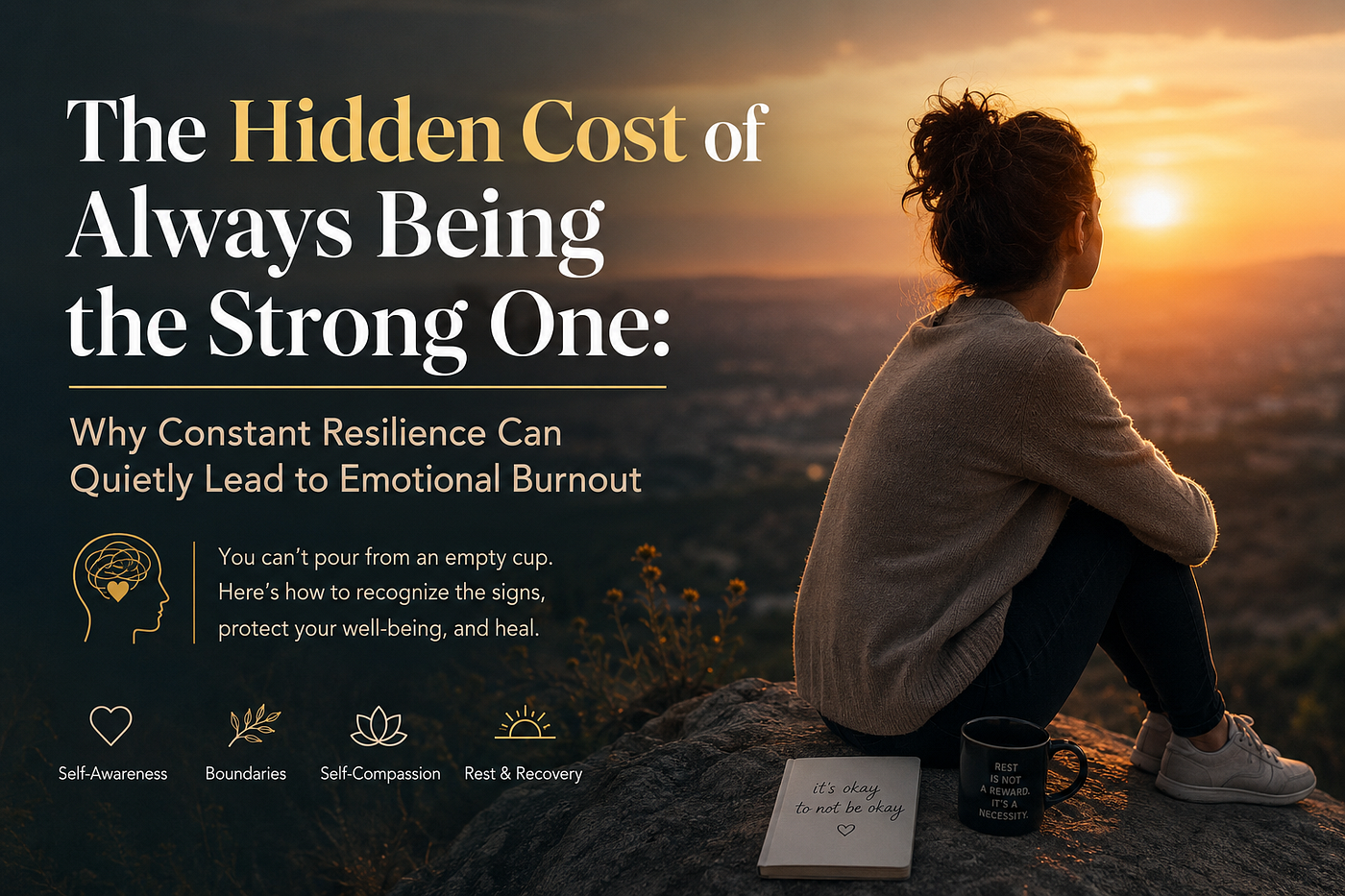
The Hidden Cost of Always Being the Strong One: Why Constant Resilience Can Quietly Lead to Emotional Burnout
When you’re the person everyone depends on, it’s easy to ignore your own needs — until chronic stress, emotional exhaustion, and compassion fatigue begin to take their toll.
Strength Is Often Misunderstood
From an early age, many of us are taught that strength means enduring hardship without complaint. We admire the people who keep going despite impossible circumstances, who show up for everyone else, who rarely ask for help, and who somehow continue carrying burdens that would overwhelm most people.
Society celebrates resilience, perseverance, and grit. These qualities undoubtedly have value. They help us survive adversity, adapt to change, and continue moving forward when life becomes difficult.
But there is another side to resilience that receives far less attention.
What happens when being “the strong one” stops being a temporary role and becomes your permanent identity?
What happens when everyone assumes you’re okay because you’ve always managed to handle everything before?
What happens when your own emotional needs become so buried beneath responsibility that you no longer recognize them yourself?
For countless people, strength slowly transforms from a valuable skill into a silent burden.
The Invisible Expectations That Come With Being “Strong”
Many people who are viewed as emotionally strong notice a recurring pattern.
Friends come to them for advice.
Family members lean on them during crises.
Coworkers depend on them to remain calm under pressure.
Communities often see them as dependable leaders.
While these roles can be deeply meaningful, they also create invisible expectations.
People begin assuming that because you’ve survived difficult experiences, you can survive anything.
They may believe you don’t need support because you’ve never openly asked for it.
Over time, this creates an exhausting imbalance.
You become the listener.
The problem solver.
The caretaker.
The peacekeeper.
The reliable employee.
The dependable parent.
The person everyone calls when life falls apart.
Yet few people stop to ask who supports the person carrying everyone else’s burdens.
Why Strong People Often Ignore Their Own Needs
One of the greatest paradoxes of emotional resilience is that resilient people frequently become experts at suppressing their own distress.
This doesn’t necessarily happen consciously.
Instead, it develops gradually.
Perhaps you’ve learned that expressing vulnerability made other people uncomfortable.
Maybe you grew up believing emotions should be hidden.
Some people discover early in life that being “easy” earns praise, while expressing pain is viewed as weakness or inconvenience.
Others become caregivers because circumstances demanded it.
Children who grow up in unstable homes, for example, sometimes adopt adult responsibilities long before they’re emotionally prepared. Psychologists refer to this phenomenon as parentification, where a child assumes caregiving or emotional responsibilities typically expected of adults. While these children often become exceptionally capable adults, they may also struggle to recognize when they deserve care themselves.
Over time, emotional suppression becomes automatic.
Instead of asking:
“How am I doing?”
the question becomes:
“What does everyone else need from me?”
The Difference Between Resilience and Emotional Suppression
At first glance, resilience and emotional suppression can look remarkably similar.
Both involve continuing despite hardship.
Both may appear calm on the surface.
Both can involve maintaining responsibilities during stressful periods.
The difference lies beneath the surface.
Healthy resilience acknowledges pain while continuing forward.
Emotional suppression attempts to ignore pain entirely.
Resilient people recognize difficult emotions, process them, seek support when necessary, and gradually recover.
People relying on suppression often convince themselves they are “fine” even when their bodies and minds are signaling otherwise.
The distinction matters because emotions don’t disappear simply because they are ignored.
Research in psychology consistently demonstrates that chronic emotional suppression is associated with increased physiological stress, reduced relationship satisfaction, greater emotional exhaustion, and a higher likelihood of anxiety and depressive symptoms over time.
Ignoring emotions may reduce discomfort temporarily.
Eventually, however, the mind and body often demand attention in other ways.
When Your Body Begins Speaking for Your Emotions
Many people first recognize burnout not emotionally, but physically.
Persistent fatigue.
Difficulty sleeping.
Frequent headaches.
Digestive problems.
Muscle tension.
Brain fog.
Reduced concentration.
Feeling emotionally numb.
These symptoms are sometimes mistaken as isolated medical issues, yet chronic psychological stress can contribute to physical symptoms through prolonged activation of the body’s stress response.
When stress becomes chronic, the nervous system may remain in a heightened state of alertness for extended periods.
Stress hormones such as cortisol and adrenaline are essential during genuine emergencies.
However, remaining in that state indefinitely places tremendous strain on multiple body systems.
This is one reason healthcare professionals increasingly recognize the close relationship between mental health and physical well-being.
Our minds and bodies are not separate systems.
They continuously influence one another.
Ignoring emotional needs does not eliminate stress.
Often, it simply changes the way stress expresses itself.
The Pressure to Never Fall Apart
Many people who identify as “the strong one” quietly carry a belief they rarely say aloud:
“If I stop holding everything together, everything else will fall apart.”
This belief may come from past experiences where others truly did rely on them.
Or it may simply be a perception shaped by years of responsibility.
Either way, the result is often the same.
Rest begins to feel irresponsible.
Boundaries feel selfish.
Asking for help feels like failure.
Even moments of grief, sadness, or exhaustion become something to schedule around instead of experience.
Ironically, this mindset often increases the very risk people are trying to avoid.
When chronic stress accumulates without opportunities for recovery, emotional resources become depleted. Decisions become harder, patience wears thin, creativity declines, and relationships may begin to suffer — not because the person lacks strength, but because no one can operate indefinitely without renewal.
The strongest bridge still requires maintenance.
The most reliable engine still needs downtime.
Human beings are no different.
The irony of being “the strong one” is that people often admire your resilience without ever seeing what it costs. Over time, constantly carrying the emotional weight of others can create a quiet loneliness — one that is difficult to explain because, from the outside, everything appears to be under control.
In the next section, we’ll explore why emotional burnout develops gradually, the warning signs many people miss until they’re overwhelmed, and what psychological research reveals about recovering before reaching a breaking point.
Burnout Doesn’t Happen Overnight
One of the biggest misconceptions about burnout is that it arrives suddenly.
People often describe reaching a breaking point as though it happened in a single moment:
“I woke up one day and just couldn’t do it anymore.”
In reality, psychological burnout is almost always a gradual process.
It develops quietly, often over months or years, while life continues moving forward.
Bills still need to be paid.
Children still need to be cared for.
Deadlines still arrive.
Relationships still demand attention.
Because responsibilities rarely pause, many people simply adapt.
They sleep a little less.
They stop exercising because they’re too busy.
Meals become whatever is convenient.
Vacations are postponed.
They convince themselves they’ll rest after the next deadline, after the holidays, after the children get older, after work slows down, or after one more crisis has passed.
The problem is that another crisis almost always arrives before recovery does.
Instead of recognizing these changes as warning signs, many people interpret them as evidence that they simply need to work harder.
They begin measuring their worth by their productivity.
If they’re exhausted, they assume they aren’t trying hard enough.
If they’re overwhelmed, they tell themselves other people have it worse.
If they struggle emotionally, they conclude they’re failing at being resilient.
This internal dialogue is remarkably common among individuals who have spent years being dependable for everyone around them.
The Brain Was Never Designed for Constant Crisis
The human stress response is extraordinary.
Without it, our ancestors would not have survived.
Imagine walking through a forest thousands of years ago when a predator suddenly appeared.
Within seconds, your brain would detect danger.
The amygdala — an almond-shaped structure deep within the brain associated with emotional processing — would signal that immediate action was necessary.
The hypothalamus would activate the sympathetic nervous system.
Adrenaline would surge through the bloodstream.
Your heart would beat faster.
Your breathing would become quicker.
Blood flow would shift toward large muscle groups.
Your pupils would dilate.
Pain sensitivity might temporarily decrease.
Every available resource would be redirected toward survival.
This response is remarkably effective when danger is temporary.
The problem is that the brain does not clearly distinguish between a charging predator and months of relentless psychological stress.
Financial uncertainty.
Relationship conflict.
Caregiving responsibilities.
Workplace pressure.
Trauma.
Chronic illness.
These experiences may not threaten physical survival in the immediate sense, yet the nervous system often responds as though they do.
When stress becomes continuous rather than temporary, the body’s recovery systems have fewer opportunities to return to baseline.
Instead of occasional activation, the stress response becomes a lifestyle.
Cortisol Is Not the Enemy
Discussions about stress hormones often portray cortisol as something harmful.
The reality is much more nuanced.
Cortisol plays essential roles throughout the body.
It helps regulate blood pressure.
It influences metabolism.
It contributes to immune function.
It assists with memory formation.
It supports the body’s daily wake-sleep cycle.
Without cortisol, human life would not be possible.
The problem is not cortisol itself.
The problem is remaining in a prolonged state of physiological activation.
Imagine revving a car engine to high RPMs every hour of every day.
Even a well-built engine eventually experiences wear.
Human physiology works similarly.
When stress becomes chronic, elevated cortisol patterns may contribute to sleep disruption, fatigue, impaired concentration, emotional reactivity, changes in appetite, and reduced immune functioning. While the exact effects vary widely between individuals, the cumulative impact of chronic stress on both mental and physical health is well documented.
This cumulative strain is sometimes described by researchers as allostatic load — the “wear and tear” that accumulates when the body repeatedly adapts to ongoing stress.
Allostatic load doesn’t develop because someone is weak.
It develops because the body’s adaptive systems were never intended to remain activated indefinitely.
The Emotional Labor No One Notices
Some forms of work are visible.
People notice the hours spent in meetings.
They recognize physical labor.
They see projects completed.
Emotional labor is different.
It often goes unnoticed because much of it happens internally.
Psychologist Arlie Hochschild introduced the concept of emotional labor to describe the effort involved in managing emotions to meet social or professional expectations.
For many people, emotional labor extends far beyond the workplace.
Smiling when you’re exhausted.
Remaining calm while someone else is angry.
Comforting others while privately grieving.
Pretending everything is okay to avoid worrying your family.
Managing conflict without revealing your own frustration.
Absorbing everyone else’s emotions while suppressing your own.
None of these tasks appear on a calendar.
Yet they consume enormous psychological energy.
Someone may finish the day feeling completely depleted without having accomplished anything physically demanding.
That’s because regulating emotions requires cognitive resources.
The brain is constantly evaluating social situations, inhibiting reactions, choosing appropriate responses, and monitoring how others are feeling.
Over time, this invisible work becomes exhausting.
When Caring for Others Begins to Drain You
People in caregiving professions have long recognized a phenomenon known as compassion fatigue.
Originally studied among nurses, physicians, therapists, emergency responders, and social workers, compassion fatigue describes the emotional exhaustion that can result from prolonged exposure to the suffering of others.
But professional caregivers aren’t the only people who experience it.
Parents caring for children with medical needs.
Adults caring for aging parents.
Partners supporting loved ones through illness.
Friends who become everyone’s therapist.
Community leaders.
Teachers.
Volunteers.
Anyone who consistently gives emotional support without adequate recovery can experience similar patterns of exhaustion.
Interestingly, compassion itself is not the problem.
Research suggests that empathy without healthy boundaries is often what becomes overwhelming.
When we absorb another person’s pain as though it were our own, our nervous system may begin responding as if we’re experiencing that suffering directly.
Over time, this can leave even the most compassionate individuals emotionally depleted.
One of the greatest misconceptions about compassion fatigue is that it means someone no longer cares.
In reality, many people experiencing compassion fatigue care deeply.
They’re simply running low on the emotional resources required to keep giving at the same level.
The High-Functioning Burnout Nobody Sees
When most people imagine burnout, they picture someone who can no longer get out of bed, has quit their job, or is visibly overwhelmed by daily responsibilities.
While that certainly happens, burnout often looks very different — especially in people who have spent years being dependable.
High-functioning burnout is exactly what it sounds like.
From the outside, everything appears normal.
The deadlines are still met.
The children still get to school.
The bills are paid.
The meetings are attended.
The house may even remain organized.
Friends continue describing the person as “having it all together.”
Internally, however, the experience can be entirely different.
Tasks that once required little effort begin feeling monumental.
Simple decisions become mentally exhausting.
Conversations require more energy than they used to.
Joy becomes increasingly difficult to access.
Even activities that were once relaxing begin to feel like obligations.
The person continues functioning — but only because every ounce of energy is being spent maintaining appearances.
Eventually, maintaining those appearances becomes exhausting in itself.
The Dangerous Habit of Saying “I’m Fine”
Perhaps no phrase is more common among emotionally exhausted people than:
“I’m fine.”
Sometimes it’s true.
Often, it isn’t.
For many people, “I’m fine” becomes less of an honest answer and more of a reflex.
It’s easier.
It avoids uncomfortable conversations.
It prevents worrying other people.
It keeps life moving.
But every time genuine emotions are replaced with automatic reassurance, something subtle happens.
The individual becomes increasingly disconnected from their own internal experience.
Psychologists sometimes describe this as reduced emotional awareness — the ability to accurately recognize and label one’s own emotions.
Research suggests that individuals who regularly suppress emotions may become less aware of what they’re actually feeling, making it harder to recognize stress until it reaches overwhelming levels.
Instead of noticing sadness, they notice fatigue.
Instead of recognizing anxiety, they describe themselves as “busy.”
Instead of acknowledging loneliness, they throw themselves into more responsibilities.
Over time, emotional vocabulary shrinks.
Everything becomes either “fine” or “stressed.”
The rich spectrum of human emotion disappears beneath survival.
Why Perfectionism Makes Burnout Worse
Perfectionism is often misunderstood as simply wanting things done well.
In reality, psychologists distinguish between healthy striving and maladaptive perfectionism.
Healthy striving involves pursuing excellence while accepting that mistakes are part of learning.
Maladaptive perfectionism, however, ties personal worth to flawless performance.
The internal dialogue sounds different.
Healthy striving says:
“I’d like to do my best.”
Perfectionism says:
“Anything less than perfect means I’ve failed.”
For individuals who have built their identity around being reliable, competent, or indispensable, perfectionism often becomes deeply intertwined with self-worth.
Mistakes feel catastrophic.
Criticism feels personal.
Rest feels undeserved.
Accomplishments provide only temporary relief before the next impossible standard appears.
Researchers have consistently linked maladaptive perfectionism with higher rates of anxiety, depression, burnout, eating disorders, and chronic stress.
Ironically, perfectionism rarely improves performance in the long term.
Instead, it often creates cycles of procrastination, self-criticism, overwork, and emotional exhaustion.
When Your Identity Becomes Your Responsibility
One of the most overlooked contributors to burnout is identity.
Consider how people introduce themselves.
“I’m the dependable one.”
“I’m the fixer.”
“I’m the caregiver.”
“I’m the responsible sibling.”
“I’m the one everyone comes to.”
These descriptions seem harmless.
In many ways, they’re compliments.
The problem arises when these roles stop describing behavior and begin defining identity.
If your identity depends on always being dependable, saying “no” becomes threatening.
If your identity depends on helping everyone, setting boundaries feels like abandoning people.
If your identity depends on strength, admitting you’re struggling can feel like losing yourself.
Psychologists refer to this as role engulfment — when one role becomes so dominant that it overshadows other aspects of identity.
Instead of being a person who sometimes helps others, someone becomes “the helper.”
Instead of being a parent who also has hobbies, friendships, and personal goals, someone becomes “only a parent.”
Instead of being an employee with a full life outside of work, someone becomes their job title.
The narrower our identity becomes, the more devastating burnout can feel because it threatens not only what we do, but who we believe we are.
Why Rest Feels So Uncomfortable
Have you ever finally had an afternoon with nothing scheduled…
…only to feel strangely guilty?
Many people assume this means they’re lazy.
In reality, there may be a psychological explanation.
When someone has lived in chronic stress for months or years, the nervous system becomes accustomed to constant stimulation.
Busyness begins to feel normal.
Stillness feels unfamiliar.
Some people even report becoming anxious during vacations.
Others find themselves creating unnecessary projects simply to avoid sitting quietly.
This isn’t because relaxation is inherently uncomfortable.
It’s because the nervous system has adapted to constant activation.
Think of it like walking off a treadmill after running for an hour.
Even though you’ve stopped moving, your body still feels as if it’s in motion.
The same principle can apply psychologically.
After years of functioning in survival mode, slowing down can initially feel unnatural.
This is one reason recovery often feels harder than people expect.
Healing isn’t simply the absence of stress.
It’s the gradual retraining of the mind and body to recognize safety again.
The Myth That Strong People Don’t Need Support
Perhaps one of the most damaging beliefs surrounding resilience is the idea that strength eliminates the need for help.
Nothing could be further from the truth.
In fact, decades of resilience research suggest the opposite.
One of the strongest predictors of resilience isn’t independence.
It’s connection.
Supportive relationships consistently predict better outcomes following adversity.
People recover more effectively when they have trusted individuals who listen without judgment, provide practical assistance, or simply remind them they don’t have to carry every burden alone.
Yet many highly resilient people hesitate to seek that support.
Some worry they’ll burden others.
Others fear appearing weak.
Some simply don’t know how to ask because they’ve spent so many years being the one everyone else relies on.
Over time, isolation becomes self-reinforcing.
The more capable someone appears, the less likely others are to check in.
The less others check in, the more the individual believes they should continue handling everything alone.
It’s a cycle that can quietly deepen emotional exhaustion.
Burnout Is Not a Personal Failure
This point deserves repeating because so many people struggle to believe it.
Burnout is not evidence that you are weak.
It is not proof that you lack discipline.
It is not a character flaw.
More often than not, burnout is the predictable outcome of prolonged stress without sufficient recovery.
If someone ran a marathon every day for months without adequate sleep, nutrition, or recovery, we wouldn’t criticize them for eventually collapsing.
We would recognize that the human body has limits.
The same principle applies psychologically.
The brain has limits.
The nervous system has limits.
Emotional resources have limits.
Recognizing those limits isn’t weakness.
It’s wisdom.
Recovery Doesn’t Begin With Doing More
One of the first mistakes people make when they realize they’re burned out is trying to solve it the same way they’ve solved every other problem: by working harder.
They download another productivity app.
They buy another planner.
They create a stricter schedule.
They promise themselves they’ll become more disciplined.
They add meditation, exercise, journaling, meal prep, reading, and a morning routine to an already overflowing calendar.
Ironically, recovery itself becomes another task to accomplish.
But burnout is rarely caused by a lack of productivity.
More often, it’s the result of giving more energy than the mind and body have available for an extended period.
Recovery, therefore, isn’t about squeezing more into the day.
It’s about restoring what chronic stress has gradually depleted.
That shift requires a fundamental change in perspective.
Instead of asking:
“How can I get more done?”
the healthier question becomes:
“What does my mind and body actually need right now?”
Recovery Is an Active Process, Not Passive Rest
Many people assume recovery simply means taking a vacation.
Time away can certainly help, but rest alone isn’t always enough.
Imagine breaking your leg.
Lying on the couch for six weeks without treatment wouldn’t restore function.
Healing would require appropriate medical care, rehabilitation, gradual strengthening, and patience.
Emotional recovery works similarly.
Burnout changes the way we think, feel, and respond to stress.
Simply removing stressors for a weekend rarely reverses months or years of accumulated strain.
Psychologists often describe recovery as involving several interconnected dimensions:
Physical recovery.
Sleep quality.
Nutrition.
Movement.
Medical care when necessary.
Emotional recovery.
Recognizing emotions instead of suppressing them.
Allowing yourself to experience grief, frustration, disappointment, or joy without judgment.
Cognitive recovery.
Reducing mental overload.
Creating opportunities for focused attention rather than constant multitasking.
Challenging unrealistic beliefs about productivity and self-worth.
Social recovery.
Reconnecting with supportive relationships.
Accepting help.
Allowing yourself to be cared for as well as caring for others.
When these dimensions begin improving together, recovery becomes far more sustainable than relying on temporary breaks alone.
Learning to Recognize What Your Body Has Been Trying to Tell You
For people who have ignored stress for years, one of the hardest parts of recovery is simply learning to notice internal signals again.
Many individuals become so accustomed to functioning on autopilot that they stop recognizing hunger until they’re starving.
They don’t notice tension until they develop a headache.
They ignore exhaustion until they become physically ill.
They overlook sadness until they suddenly begin crying over something seemingly insignificant.
None of these reactions are random.
They’re often signs that the body has been communicating for quite some time.
Recovery begins by becoming curious instead of critical.
Rather than asking,
“Why am I so emotional?”
Try asking,
“What has my body been trying to tell me that I haven’t had time to hear?”
This subtle shift encourages self-awareness instead of self-judgment.
The Power of Boundaries
Few words generate as much discomfort as the word boundaries.
Some people hear it and immediately think of conflict.
Others worry boundaries will disappoint people they love.
Some fear they’ll appear selfish.
In reality, healthy boundaries are not walls.
They are guidelines that protect relationships from resentment.
Imagine a phone battery.
If you continually allow every application to run at full capacity without ever charging the device, it eventually shuts down.
Human beings function similarly.
Every commitment consumes emotional energy.
Every conversation requires attention.
Every decision draws from a limited pool of cognitive resources.
Boundaries help determine where those resources are invested.
They allow us to say “yes” intentionally rather than automatically.
Healthy boundaries might include:
Leaving work at a reasonable hour whenever possible.
Turning off notifications during personal time.
Saying no to commitments that exceed your current capacity.
Asking family members to share responsibilities.
Scheduling regular time for activities that genuinely restore your energy.
None of these actions eliminate compassion.
They simply recognize that compassion cannot be sustained indefinitely without replenishment.
Why Saying “No” Feels So Difficult
If setting boundaries is healthy, why is it so uncomfortable?
Often, the answer lies beneath the behavior itself.
Many people unconsciously associate saying no with rejection.
Others fear conflict.
Some believe their value depends on being helpful.
Still others carry childhood experiences in which meeting other people’s needs was necessary for emotional safety.
As adults, these early patterns may continue long after the original circumstances have changed.
The result is automatic compliance.
Requests are accepted before they’re even considered.
Calendars become overcrowded.
Stress accumulates.
Eventually, resentment begins replacing generosity.
Ironically, constantly saying yes often damages relationships more than respectfully saying no.
When people consistently ignore their own needs, exhaustion eventually affects patience, empathy, communication, and emotional availability.
Healthy boundaries preserve the ability to care for others over the long term.
Self-Compassion Is Not Self-Indulgence
Many high achievers struggle with the concept of self-compassion.
It sounds soft.
Passive.
Even self-centered.
Research tells a different story.
Psychologist Dr. Kristin Neff, one of the leading researchers in self-compassion, defines it as responding to personal suffering with the same kindness, understanding, and perspective we would naturally offer a close friend.
Imagine your closest friend came to you and said:
“I’m exhausted.”
“I feel like I’m failing.”
“I’ve been carrying too much for too long.”
Very few of us would respond,
“You’re just lazy.”
“You need to work harder.”
“Everyone else has it worse.”
Yet many people speak to themselves exactly this way.
Self-compassion asks us to replace harsh self-criticism with realistic understanding.
This doesn’t mean lowering standards.
It means recognizing that being human includes making mistakes, experiencing limitations, and needing rest.
Studies have linked self-compassion to lower levels of anxiety and depression, greater emotional resilience, healthier coping strategies, and improved overall psychological well-being.
Far from encouraging complacency, self-compassion often provides the emotional safety people need to grow.
Redefining What Strength Really Means
Perhaps the greatest lesson burnout teaches is that our definition of strength needs to change.
Strength is not pretending you’re unaffected by pain.
Strength is not carrying every burden alone.
Strength is not sacrificing your health until nothing remains.
Real strength is more balanced than that.
It includes courage, yes.
But it also includes wisdom.
The wisdom to recognize limits before they become crises.
The humility to ask for help.
The confidence to establish healthy boundaries.
The insight to understand that your worth has never depended solely on what you produce for others.
The strongest people are not those who never struggle.
They’re often the people who learn to remain compassionate toward themselves while continuing to move forward.
Healing Is Rarely Dramatic
Many people expect recovery to feel like flipping a switch.
One day exhausted.
The next day completely restored.
Real healing is usually much quieter.
It’s sleeping a little better than you did last week.
Feeling genuine joy for a few moments.
Laughing without forcing it.
Realizing you handled a stressful conversation differently than you would have six months ago.
Recognizing your own emotions before they become overwhelming.
Choosing rest without apologizing for it.
These changes may seem small.
Over time, however, they accumulate into something remarkable.
A healthier nervous system.
More fulfilling relationships.
Greater emotional flexibility.
A life that no longer depends on constant survival mode.
You Were Never Meant to Carry Everything Alone
There is a quiet irony in being “the strong one.”
The very qualities that make someone dependable — resilience, empathy, responsibility, perseverance — can also become the qualities that slowly wear them down when left unchecked.
Many people spend years believing that strength means enduring every hardship in silence.
They become experts at solving problems, anticipating the needs of others, and remaining composed during crises.
Over time, however, they begin to lose sight of something equally important:
Even the strongest people have needs.
Even the most capable individuals become tired.
Even those who spend their lives supporting others deserve support themselves.
This truth can feel surprisingly difficult to accept.
For people whose identities have been built around helping, slowing down may feel uncomfortable.
Receiving help may feel unfamiliar.
Prioritizing personal well-being may even feel selfish.
But none of those feelings change a simple reality.
Human beings were never designed to function as inexhaustible resources.
We require rest.
Connection.
Purpose.
Recovery.
Meaning.
And compassion — including compassion directed toward ourselves.
The Courage to Live Differently
Choosing recovery often requires a different kind of courage than surviving hardship.
Survival asks us to endure.
Healing asks us to change.
It asks us to examine long-held beliefs about productivity, worth, responsibility, and success.
It challenges the assumption that our value depends on how much we accomplish or how many people rely on us.
It invites us to ask difficult questions:
What would happen if I stopped trying to earn my worth through constant productivity?
What parts of my identity exist outside of what I do for other people?
When was the last time I rested without feeling guilty?
What would I tell someone I love if they were living the life I’m living right now?
These questions don’t always produce immediate answers.
But they begin an important conversation.
One that shifts attention from simply surviving toward intentionally living.
Small Changes Create Lasting Change
Recovery rarely arrives through one dramatic decision.
More often, it emerges through dozens of small choices repeated consistently over time.
Choosing sleep instead of another hour of work.
Taking a walk without checking your phone.
Asking someone else to share a responsibility.
Scheduling your own medical appointment instead of postponing it again.
Turning down one commitment that exceeds your capacity.
Allowing yourself to cry instead of immediately distracting yourself.
Accepting help when it’s offered.
Speaking to yourself with patience rather than criticism.
None of these choices seem extraordinary on their own.
Together, however, they gradually teach the nervous system something many burned-out people have forgotten:
You are safe enough to slow down.
You are worthy even when you’re resting.
You don’t have to prove your value every single day.
Redefining Success
Modern culture often celebrates visible achievement.
Promotions.
Degrees.
Businesses.
Awards.
Public recognition.
These accomplishments can certainly be meaningful.
Yet they tell only part of the story.
Success without well-being is often difficult to sustain.
A thriving career means little if chronic stress leaves no energy to enjoy it.
Financial security feels different when accompanied by constant anxiety.
Even meaningful work can become overwhelming when there is no room for recovery.
Perhaps a healthier definition of success includes questions like these:
Am I physically healthy?
Do I experience genuine moments of joy?
Do my relationships feel supportive?
Can I rest without guilt?
Do I know who I am apart from what I produce?
Am I building a life that is sustainable — not just impressive?
These questions may never appear on a résumé.
Yet they often determine whether success ultimately feels fulfilling.
Strength and Vulnerability Can Exist Together
For generations, vulnerability has often been portrayed as the opposite of strength.
Psychological research increasingly suggests otherwise.
Healthy vulnerability allows people to build deeper relationships.
It encourages authentic communication.
It reduces loneliness.
It creates opportunities for mutual support.
Admitting, “I’m struggling,” does not erase resilience.
Asking for help does not eliminate competence.
Taking time to recover does not diminish dedication.
In many cases, these actions reflect remarkable emotional maturity.
The strongest trees bend during powerful storms.
Rigid structures often break.
Human resilience operates much the same way.
Flexibility — not constant rigidity — is often what allows people to endure life’s greatest challenges.
A Final Thought
If you’ve recognized yourself somewhere in these pages, know this:
You are not alone.
Many highly capable, deeply compassionate people quietly carry more than anyone realizes.
They smile while exhausted.
They encourage others while privately feeling discouraged.
They keep moving because they believe stopping isn’t an option.
But your value has never depended on how much you can endure.
Your worth is not measured by how many responsibilities you carry.
You do not have to earn rest.
You do not have to justify healing.
And you do not have to wait until you’re completely depleted before giving yourself permission to recover.
Real strength isn’t about carrying every burden forever.
It’s about knowing when to set one down.
Because resilience isn’t the absence of exhaustion.
It’s the ability to care for yourself with the same compassion you’ve so willingly given everyone else.
That may be one of the strongest choices you’ll ever make.
Key Takeaways
- Burnout usually develops gradually rather than suddenly.
- Chronic stress affects both the brain and the body.
- Emotional suppression is not the same as resilience.
- High-functioning individuals often hide burnout behind productivity.
- Healthy boundaries preserve — not diminish — compassion.
- Self-compassion is associated with greater resilience and psychological well-being.
- Recovery is an active process involving physical, emotional, cognitive, and social restoration.
- Asking for help is a sign of self-awareness, not weakness.
- Sustainable success includes well-being, not just achievement.
- True strength allows room for both resilience and vulnerability.
References
American Psychological Association. (2023). Stress effects on the body. https://www.apa.org
Hochschild, A. R. (1983). The managed heart: Commercialization of human feeling. University of California Press.
Maslach, C., & Leiter, M. P. (2016). Burnout. In G. Fink (Ed.), Stress: Concepts, Cognition, Emotion, and Behavior (pp. 351–357). Academic Press.
McEwen, B. S. (1998). Protective and damaging effects of stress mediators. New England Journal of Medicine, 338(3), 171–179.
Neff, K. D. (2003). Self-compassion: An alternative conceptualization of a healthy attitude toward oneself. Self and Identity, 2(2), 85–101.
World Health Organization. (2019). Burn-out an occupational phenomenon. World Health Organization.
메타데이터
- post_id
- aba62a50aa60
- slug
- the-hidden-cost-of-always-being-the-strong-one-why-constant-resilience-can-quietly-lead-to-aba62a50aa60
- url
- https://medium.com/the-samarticles-press/the-hidden-cost-of-always-being-the-strong-one-why-constant-resilience-can-quietly-lead-to-aba62a50aa60
- canonical_url
- https://medium.com/the-samarticles-press/the-hidden-cost-of-always-being-the-strong-one-why-constant-resilience-can-quietly-lead-to-aba62a50aa60
- author_url
- https://medium.com/@dr.samantha.chandler
- status
- ok
- fetched_at
- 2026-07-14 18:07:17