Movie Ticket Booking System Design Architecture — AWS Infra 99.99% Availability
Movie Ticket Booking Platform
Movie Ticket Booking (MTB) System Design Architecture — AWS Infra 99.99% Availability
Movie Ticket Booking Platform
- B2B Component: Theatre partners can onboard and manage their operations
- B2C Component: End customers can browse and book movie tickets
- Key Challenge: Handle concurrent bookings across multiple countries with high availability (99.99%)
POC Source Code: Github
1. Executive summary (Goals & constraints)
Primary goals:
- High availability (99.99%)
- low-latency booking
- consistent seat inventory handling across regions
- multi-country support
- secure payments and PCI compliance
- cost-efficient at scale.
Key non-functional requirements:
- P95 API latency < 200ms, booking confirmation < 3s
- booking success rate > 99%
- cache hit ratio > 90%, horizontal scalability
- multi-region active-active with automatic failover.
Traffic assumptions (design targets): 10M active users, 1M bookings/month, peak concurrent users 100k+, target >1k bookings/sec at peak.
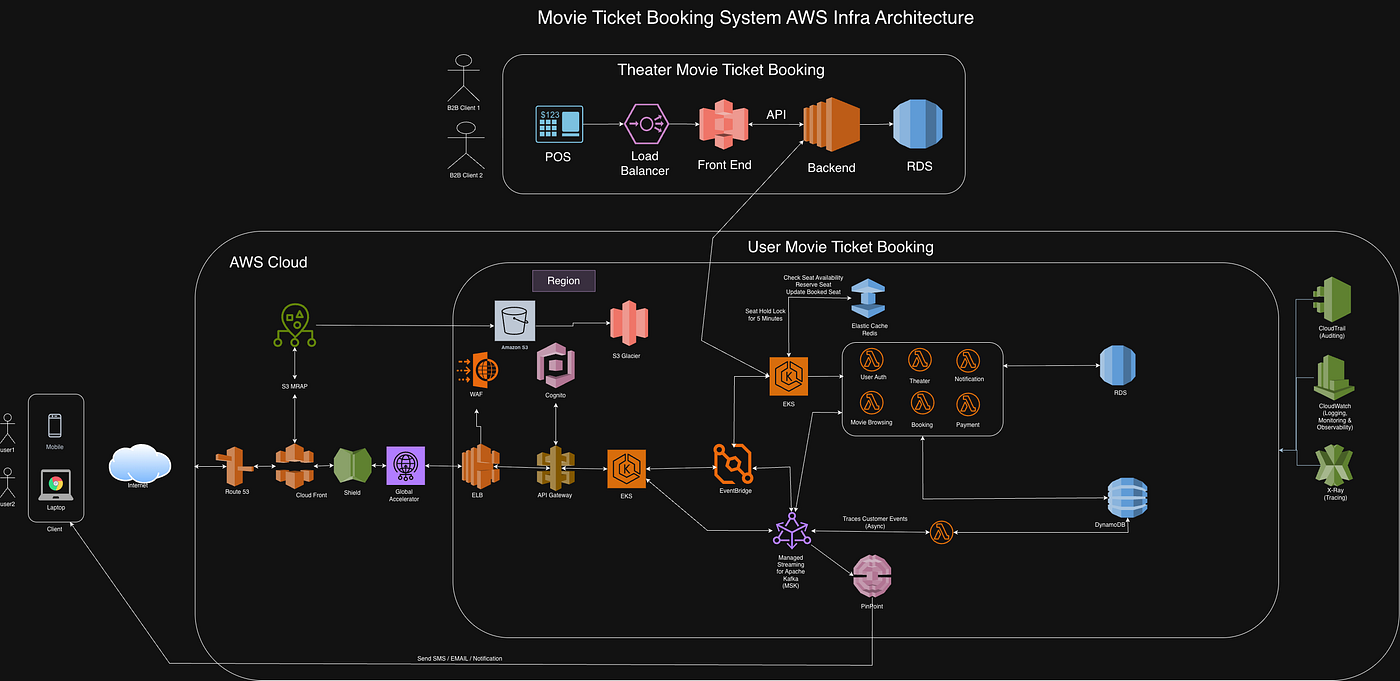
2. High-level architecture (components & AWS mappings)
Summary flow (user → services):
- Client (mobile / web) → Route53 → CloudFront (static + SPA) → AWS Global Accelerator / API Gateway → Regional ELB → EKS (microservices) / Lambda → Data stores (RDS/DynamoDB/Redis) + Event bus (MSK/EventBridge) → Notifications (Pinpoint/SNS/SES) → Observability & Security.
Key AWS services:
- Edge & DNS: Route 53, CloudFront, Global Accelerator
- WAF & DDoS: AWS WAF, AWS Shield Advanced
- API / Ingress: API Gateway (edge or regional), Elastic Load Balancer (ALB) fronting EKS.
- Compute: Amazon EKS for stateless & stateful microservices; AWS Lambda for asynchronous workers, webhooks, small tasks.
- Caching & locks: Amazon ElastiCache for Redis (Cluster Mode) — seat locks, session caching, leaderboard/metadata.
- Primary RDBMS: Amazon RDS (Postgres / Aurora Postgres) — transactional booking data, theatre metadata (multi-AZ).
- NoSQL: Amazon DynamoDB — high-scale lookup data (e.g., user session index, booking details, idempotency store).
- Streaming & events: Amazon MSK (Kafka) for event-driven flows + Amazon EventBridge for cross-account/region events.
- Messaging/notifications: Amazon Pinpoint
- Storage: Amazon S3 (static assets, DL archives, backups), Glacier for archival
- Observability: CloudWatch, X-Ray, CloudTrail, optional APM (Datadog/NewRelic).
- Security: AWS KMS for keys, Cognito for user auth (or custom OIDC), AWS Secrets Manager for credentials, IAM policies and SCPs.
Logging: Centralized logs via CloudWatch and an ELK / OpenSearch stack if required.
3. Detailed design
3.1 Deployment topology — Multi-region active-active
- Deploy full stack into at least 2 active regions per major geography (e.g., ap-south-1 & ap-northeast-1, us-east-1 & us-west-2, eu-west-1 & eu-central-1).
- Route53 uses Latency + Geolocation policies to send users to nearest healthy region. Health checks and failover policies configured per endpoint.
- Global Accelerator for a single static anycast IP and optimal routing to the nearest edge and regional endpoint.
- Data residency: some data (PII) is region-bound; design each region to accept local writes when necessary and replicate/synchronize where allowed.
3.2 Microservice boundaries
- Auth Service (Cognito or custom) — user sign-up, MFA, tokens (OIDC).
- Theatre Management (B2B) — theatre onboarding, screen/seat mapping, schedule management.
- Movie Browsing — catalog, search (Elasticsearch/OpenSearch), metadata.
- Booking Service — booking lifecycle (initiate, hold, confirm, cancel, refund). Core transactional service.
- Payment Service — integrates with PCI-compliant payment gateway (Stripe/Adyen etc.) — tokenize card data, not store CVV.
- Notification Service — email, SMS, push via Pinpoint/SNS/SES.
- Reservation Locker — seat locking & TTL using Redis (fast).
- Reporting / Analytics — streaming consumer that writes to data lake (S3/Glue/Redshift) or OLAP.
- Billing & Invoicing — partner settlements for B2B.
- Admin Panel & B2B Portal — separate UI & APIs for theatre partners.
3.3 Booking flow (HLD -> LLD)
Synchronous + Event-driven hybrid:
- Browse & Select Seats: Client requests seat map; service retrieves seat availability aggregated in Redis (fast). If cache miss, read DB and populate cache.
- Initiate Booking / Reserve Seats (fast path):
- Client calls POST /bookings/initiate with showId, seatIds, userId.
- Booking Service attempts to acquire locks on seatIds via Redis SETNX or Lua script (atomic): lock key = lock:showId:seatId with TTL (e.g., 5 minutes).
- If all locks acquired, create a provisional booking record with status PENDING_PAYMENT in RDS (transaction), and store idempotency token.
- Return booking reference + payment token to client; start countdown TTL.
- Payment: Client performs payment through Payment Service (tokenized). Payment Service returns success/failure and emits event to MSK and EventBridge.
- Confirm Booking: On payment-success event:
- Booking Service reconfirms locks; marks booking CONFIRMED in RDS, persists final seat occupancy, releases locks, writes event to MSK for analytics.
- Notify user via Notification Service.
- Reserve data synchronized to DynamoDB/Cache to support fast reads.
- Payment Failure / Timeout:
- If payment fails or timeouts: Booking Service cancels PENDING_PAYMENT, releases seat locks (Redis), updates DB; notify user. The seat becomes available.
- Idempotency & Retry: All write endpoints accept idempotency tokens and are idempotent. Payment webhooks and asynchronous event consumers must handle duplicate events.
Seat lock implementation details:
- Use Redis cluster with strong consistency in each region.
- Use Lua script to atomically check and set multiple seat locks in a single call (avoid race).
- Use TTL <= maximum payment timeout (e.g., 5–15 minutes). TTL expiry automatically frees seats.
3.4 Concurrency & consistency patterns
- Booking transaction uses pessimistic locking at seat-level (via Redis) to prevent double allocation.
- Eventual consistency for secondary views (analytics, search index) via Kafka/MSK consumers.
- Strong consistency for final booking state kept in RDS/Aurora with ACID transactions.
- Read scaling: read replicas and read-only caches (ElastiCache + CDN).
- Concurrent booking across regions: region-local seat locking, cross-region replication of booking events to central store. For global shows, use a single region ownership or central seat master to avoid split-brain for the same show. Prefer sharding shows to region owners per theatre (single source of truth).
3.5 Data stores & schema
- Primary transactional DB: Aurora PostgreSQL (Multi-AZ, read replicas). Partition bookings by region/country or by theatre (LIST partitioning) for scale and locality. Example table snippet (from your doc):
- DynamoDB: idempotency token store, quick lookup items, session index for mobile connectivity; global tables if needed cross-region.
- Redis (ElastiCache): seat locks, seat-availability cache (show inventory), session cache, rate-limit counters.
- OpenSearch / Elasticsearch: movie & theatre search & filter.
- S3: static content, backups, uploads, DL exports.
- Data lake: S3 + Glue for analytics.
3.6 API contract (summary)
- POST /v1/bookings/initiate — body: {userId, showId, seatIds[], idempotencyKey} → returns bookingReference, expiresAt, paymentUrl.
- POST /v1/bookings/confirm — body: {bookingReference, paymentId} → returns booked details.
- GET /v1/shows/{showId}/seats — returns seat map with status (available/held/booked).
- POST /v1/theatres (B2B) — onboard theatre; requires admin auth.
- POST /v1/payments/webhook — receives payment provider webhook (idempotent).
All APIs must support idempotencyKey, throttling headers, tracing headers (X-Trace-Id).

ER Diagram & Database Schema Design (PostgresSQL)

4. Reliability & 99.99% Availability strategy
4.1 Multi-region active-active
- Deploy to >=2 active regions per geography. Use Route53 and Global Accelerator for traffic steering and failover.
- Stateful components (RDS/Aurora) are replicated via cross-region read replicas and asynchronous replication for DR. Consider Aurora Global Database for low-latency cross-region read and fast recovery.
4.2 Availability patterns
- Autoscaling for EKS worker nodes (Karpenter / Cluster Autoscaler) and HPA for pods.
- Use multi-AZ for every stateful layer (RDS Multi-AZ, ElastiCache across AZs).
- Circuit breakers and bulkhead patterns in services to isolate failures.
- Chaos Engineering and regular failure drills.
4.3 Failover timelines (example)
- Health check detects region failure (10s).
- Route53 failover shift (TTL dependent): use low TTL (30s) + Global Accelerator reduces global time to failover.
- Warmed replicas in DR region (autoscaling) spin up within minutes; use pre-warmed capacity for critical paths.
4.4 Disaster recovery
- Backups: continuous automated snapshots (RDS), S3 lifecycle to Glacier.
- RTO & RPO targets: RTO < 15 minutes for core services, RPO < few minutes using cross-region replication and event streaming.
- Runbook: documented playbooks for DB failover, DNS failover, and manual rollback.
5. Scalability & performance optimizations
5.1 Caching
- Multi-layer caching: CloudFront (frontend), API Gateway caching, ElastiCache Redis, application-level caches.
- TTLs: inventory short TTLs (30s), show metadata 5–15 mins.
5.2 DB & query optimizations
- Partition bookings by region/theatre. Use composite indexes on (show_id, seat_id).
- Read replicas for read-heavy traffic, write masters per shard.
- Use prepared statements, batching, and connection pooling (HikariCP tuned as in doc).
5.3 Async processing
- Use MSK for events: booking.initiated, booking.confirmed, payment.success, booking.cancelled.
- Consumers: notification, settlement, analytics, search-index updates — decoupled for resilience.
5.4 Cost-optimizations
- Reserved instances & Savings Plans as baseline.
- Use spot instances for batch/analytics.
- Right-size DB instance classes and cache sizes.
- Archive old bookings to S3/Glacier.
6. Security & compliance
6.1 PCI & payment
- Use third-party PCI-compliant payment providers. Tokenize card data; do not store CVV nor raw PAN.
- Quarterly scans & annual audit.
6.2 Network & data security
- Use TLS 1.3 for all traffic. mTLS for service-to-service if feasible.
- IAM least privilege; use roles for services and KMS for encryption.
- PII: encrypt at rest (AES-256 via KMS), store EU data only within EU regions to meet GDPR.
6.3 DDoS protection & WAF
- AWS Shield Advanced + WAF rules to block common vectors.
- Rate limiting per IP and per user (API Gateway + app-layer counters in Redis).
6.4 Monitoring & observability
- Tracing: AWS X-Ray + distributed tracing headers.
- Metrics: CloudWatch custom metrics (booking success, lock latencies, cache hit ratio, DB Q time).
- Logging: centralized logs with retention & alerting. Set alerts for error spikes and availability drops.
- Security monitoring: CloudTrail for audit, GuardDuty for threats.
7. Operations, SLOs, Runbooks & Alerts
7.1 SLO / SLA targets
- Availability: 99.99% (monthly).
- Booking success: > 99%.
- P95 latency: < 200ms.
7.2 Key alerts & thresholds
- Critical: API error rate >1% for 5m, RDS connection exhausted, payment gateway down, overall availability <99.9%.
- Warning: P95 > 500ms, CPU > 80% for 10 min, Cache hit < 80%.
- Info: slow queries, unusual traffic patterns.
7.3 Runbooks (examples)
- Payment gateway outage: divert users to retry queue + show appropriate UI message; notify SRE; page on-call.
- DB failover: promote cross-region replica using Aurora Global DB failover playbook; run consistency checks.
- Cache cluster failure: failover to replicas; if full Redis cluster down, fallback to DB reads with throttling.
8. Observability & testing
- Canary deployments + feature flags for new features.
- Synthetic monitoring (booking flows) executed from multiple geographies.
- Load testing: run pre-release load tests to validate >1k bookings/sec.
Chaos experiments: periodic pod/region failure tests.
9. Cost estimate
Monthly baseline (10M users, 1M bookings): ~$50k–$60k (compute, DB, cache, storage, networking). With reserved instances & savings: ~$35k/month. (See your uploaded cost breakdown for details.)
10. Low-level artifacts (LLD pointers & code snippets)
10.1 Redis seat-lock Lua (pseudo)
- Attempt to lock multiple seats atomically
 - KEYS: lock keys for each seat
 - ARGV[1] = lock value (bookingRef)
 - ARGV[2] = ttl seconds
for i=1,#KEYS do
if redis.call('exists', KEYS[i]) == 1 then
return 0
end
end
for i=1,#KEYS do
redis.call('set', KEYS[i], ARGV[1], 'EX', ARGV[2])
end
return 1- Release script checks ownership before deleting lock.
10.2 Booking table partition example
Release script checks ownership before deleting lock.
11. Sequence diagrams (textual) — Booking success & failure
Success path
- Client → BookingService /initiate (idempotencyKey)
- BookingService → Redis (lock seats via Lua)
- BookingService → RDS create PENDING_PAYMENT booking
- BookingService → Payment gateway (create payment session)
- Client completes payment → Payment gateway → webhook → PaymentService
- PaymentService emits payment.success to MSK/EventBridge
- BookingService consumes payment.success → mark booking CONFIRMED in RDS → release seat lock
- BookingService → NotificationService → send ticket
- BookingService → produces booking.confirmed event for analytics
Timeout/failure
After TTL or payment.failed, BookingService cancels booking and releases locks; notifications sent.
12. Testing & validation
- Unit & Integration tests for seat locking, transactions, and idempotency.
- End-to-end tests for booking scenarios (concurrent holds).
- Load tests to validate expected TPS and latency.
Security tests including penetration testing and PCI compliance scans.
MOVIE TICKET BOOKING SYSTEM — PRODUCTION CHECKLIST
Service Design
• Stateless Spring Boot services
• Clear B2C (users) and B2B (theatres) boundaries
• Redis used only for ephemeral state (locks, cache)
• PostgreSQL used for source of truth
• Kafka used for async workflows only
• Outbox pattern implemented for event reliability
• No cross-service DB access
Domain Integrity
• Seat locking uses Redis SETNX + TTL
• Booking state machine enforced
INITIATED → PENDING_PAYMENT → CONFIRMED / EXPIRED
• All state transitions are idempotent
• No business logic in controllers
DATA & TRANSACTION SAFETY (POSTGRES)
Schema & Constraints
• Unique constraint on (show_id, seat_number)
• Unique booking reference
• Foreign keys for all relations
• Monetary values stored as NUMERIC
• UTC timestamps everywhere
Transactions
• Booking creation is single DB transaction
• Outbox event saved in same transaction
• No Kafka publish inside DB transaction
• Pessimistic locking avoided for hot paths
Data Lifecycle
• Booking expiry scheduler enabled
• Old bookings archived (partition / TTL strategy)
• GDPR deletion flow available
REDIS (LOCKING & CACHE)
Seat Locking
• Redis cluster (3+ nodes)
• SETNX + TTL used for locks
• TTL ≥ booking expiry time
• Ownership check before unlock
• Lock key format standardized
LOCK:SEAT:{seatId}
Cache Usage
• Cache only read-heavy data (shows, seats)
• Never cache booking state permanently
• Cache invalidation via Kafka events
• Redis eviction policy: allkeys-lru
KAFKA & OUTBOX PATTERN
Outbox
• Outbox table indexed by status
• Events written inside booking transaction
• Background publisher enabled
• Retry with exponential backoff
• Dead-letter handling for FAILED events
Kafka
• Topic partitioning by bookingReference
• At-least-once delivery acknowledged
• Consumers are idempotent
• Schema versioned (Avro / JSON schema)
• Message size limits enforced
Topics
• booking.initiated
• booking.confirmed
• booking.expired
• payment.completed
PAYMENT FLOW SAFETY
Payment Integration
• Payment is fully asynchronous
• Webhook endpoints are idempotent
• No blocking on payment gateway
• Duplicate payment protection via reference ID
• Automatic refund on confirmation failure
PCI Compliance
• No card data stored
• Tokenization only
• Secure webhook verification
• Audit logs enabled
SECURITY
API Security
• JWT authentication enforced
• Role-based authorization (USER / ADMIN)
• Ownership check for booking access
• Rate limiting enabled
• CAPTCHA for suspicious traffic
Data Security
• TLS everywhere
• DB encryption at rest
• Secrets stored in Vault / KMS
• Logs sanitized (no PII)
PERFORMANCE & SCALABILITY
Load Handling
• Tested for 10K+ concurrent users
• Booking latency < 200ms P95
• Seat lock acquisition < 50ms
- Connection pools sized correctly
Scaling
• Horizontal pod autoscaling enabled
• Redis and Kafka scaled independently
• Read replicas used for queries
• No N+1 queries
⸻
MONITORING & OBSERVABILITY
Metrics
• Booking success rate
• Seat lock failures
• Booking expiry rate
• Kafka lag
• Redis lock contention
• Payment failure rate
Logs & Tracing
• Correlation ID per request
• Structured logs (JSON)
• Distributed tracing enabled
• Slow query logs enabled
⸻
FAILURE & RESILIENCE
Failure Scenarios Tested
• Redis restart during booking
• Kafka outage
• DB failover
• Payment gateway downtime
• Partial network failure
Recovery
• Locks auto-expire
• Bookings auto-expire
• Outbox retries events
• Graceful degradation enabled
⸻
DEPLOYMENT & OPERATIONS
CI/CD
• Zero-downtime deployments
• Blue-green or canary rollout
• Database migrations versioned
• Rollback strategy defined
Config
• All configs externalized
• Feature flags for risky changes
• Environment parity ensured
BUSINESS & SLA READINESS
SLAs
• Availability ≥ 99.99%
• Booking accuracy 100%
• Zero double bookings
• Refund SLA defined
Reporting
• Booking revenue tracking
• Conversion metrics
• Seat utilization metrics
메타데이터
- post_id
- aba75ce616b8
- slug
- movie-ticket-booking-system-design-architecture-aws-infra-99-99-availability-aba75ce616b8
- url
- https://medium.com/@code.chandrashekhar/movie-ticket-booking-system-design-architecture-aws-infra-99-99-availability-aba75ce616b8
- canonical_url
- https://medium.com/@code.chandrashekhar/movie-ticket-booking-system-design-architecture-aws-infra-99-99-availability-aba75ce616b8
- author_url
- https://medium.com/@code.chandrashekhar
- status
- ok
- fetched_at
- 2026-06-21 15:33:18