Why Sake is More Than Just “Rice Wine”
Many people call sake “rice wine”.
Why Sake is More Than Just “Rice Wine”
Photo by Huang 211 on Unsplash
Many people call sake “rice wine”.
But as a scientist and a SAKE DIPLOMA holder, I see it differently. While wine is often defined by its terroir and vintage, the true magic of sake happens at the very moment you drink it — through the art of temperature.
In the world of beverages, sake is incredibly rare for the vast temperature landscape it invites us to explore. From ‘Reishu’ (chilled) with its crisp and refreshing finish, to ‘Hiya’ (room temperature) which reveals the true umami of the brew, and ‘O-kan’ (warmed) where the flavors soften and bloom — sake transforms its character in every glass. This is not just about preference. It is a dynamic design of flavor that happens after the brewing is complete.
Not All Sake are Created Equal
Does every bottle of sake belong in a warm bath? Not necessarily. Part of the joy is ‘curating’ the right temperature for the right brew. For instance, a delicate, aromatic Daiginjo might lose its floral elegance if overheated, while a robust Junmai can bloom into a soft, comforting ‘Nuru-kan’ (gentle warmth), revealing hidden layers of rice sweetness.
However, the world of sake is never black and white. Interestingly, some Daiginjo reveal a completely different, sophisticated character when gently warmed — a hidden complexity that stays dormant at lower temperatures.
Finding the ‘sweet spot’ for each specific bottle is like embarking on a sensory journey. This process of exploration — experimenting with degrees until the flavor perfectly blooms — is one of the greatest joys of the sake experience.
A Guide to Sake Temperatures
In the Japanese tradition, these shifts in temperature are so profound that we’ve given unique, poetic names to almost every 5-degree interval. From ‘Yuki-hie’ (Snow-chilled) to ‘Tobikiri-kan’ (Extra Hot), these terms reflect how we perceive the changing soul of the sake.
To navigate the vast spectrum of flavors, it helps to understand the traditional benchmarks. The following guide maps out the key temperature ranges, each offering a distinct profile — from crisp clarity at 5°C to the robust, expansive warmth of over 55°C.
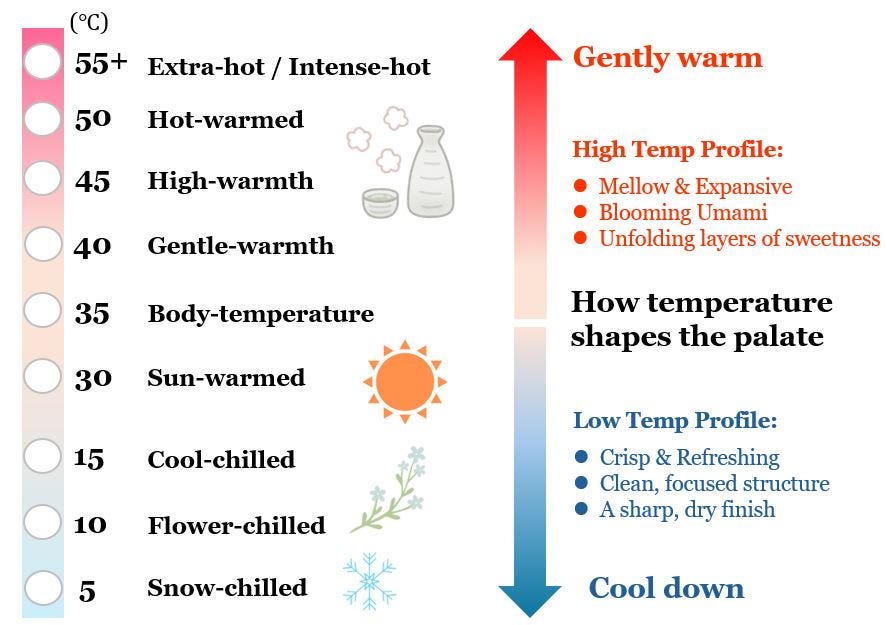
Sake is more than a static beverage. It is a living design that you complete in your own glass. When you understand this thermal spectrum, you are no longer just a drinker — you become a curator of flavor.
So, the next time you open a bottle, I invite you to embark on your own sensory journey. Don’t be afraid to experiment. Let the sake bloom, let it sharpen, and find the temperature where its story resonates most with you.
Kanpai! (Cheers!)
메타데이터
- post_id
- aba7858561a1
- slug
- why-sake-is-more-than-just-rice-wine-aba7858561a1
- url
- https://medium.com/@norikosake/why-sake-is-more-than-just-rice-wine-aba7858561a1
- canonical_url
- https://medium.com/@norikosake/why-sake-is-more-than-just-rice-wine-aba7858561a1
- author_url
- https://medium.com/@norikosake
- status
- ok
- fetched_at
- 2026-07-13 06:23:13