Clinical Trial Management System (CTMS): Features, Benefits & Importance
Introduction
Clinical Trial Management System (CTMS): Features, Benefits & Importance
Introduction
In the fast-growing pharmaceutical and healthcare industry, managing clinical trials efficiently is one of the biggest challenges. Clinical trials involve multiple teams, strict regulations, patient data, timelines, budgets, and site activities. Without the right system, this process can become complex, time-consuming, and prone to errors.
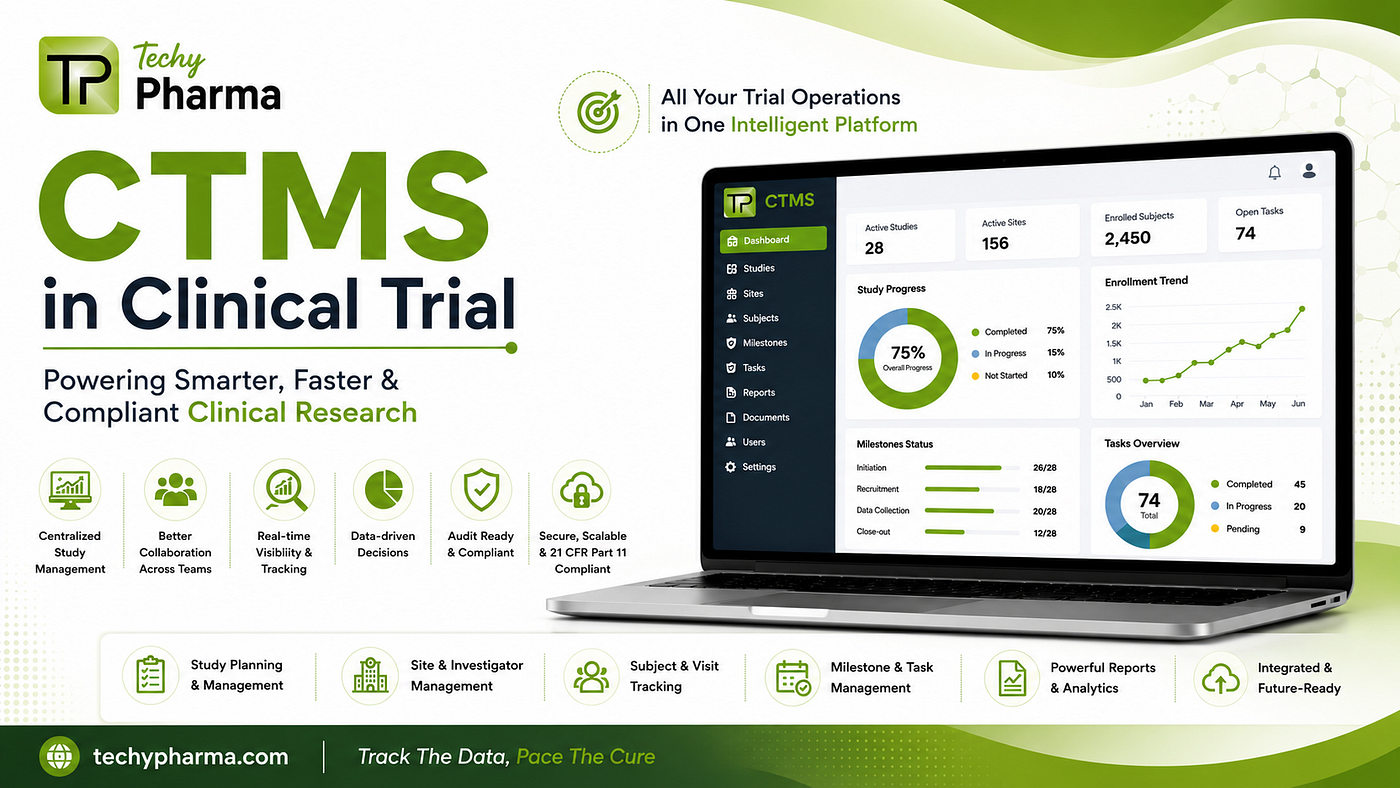
This is where a Clinical Trial Management System (CTMS) becomes essential. CTMS is a powerful software solution designed to help organizations plan, track, and manage clinical trials in a more organized and effective way. It improves visibility, supports compliance, reduces manual work, and helps research teams complete trials faster and more accurately.
As clinical research continues to grow in scale and complexity, CTMS has become a critical tool for pharmaceutical companies, biotechnology firms, CROs, hospitals, and research institutions.
What is a Clinical Trial Management System (CTMS)?
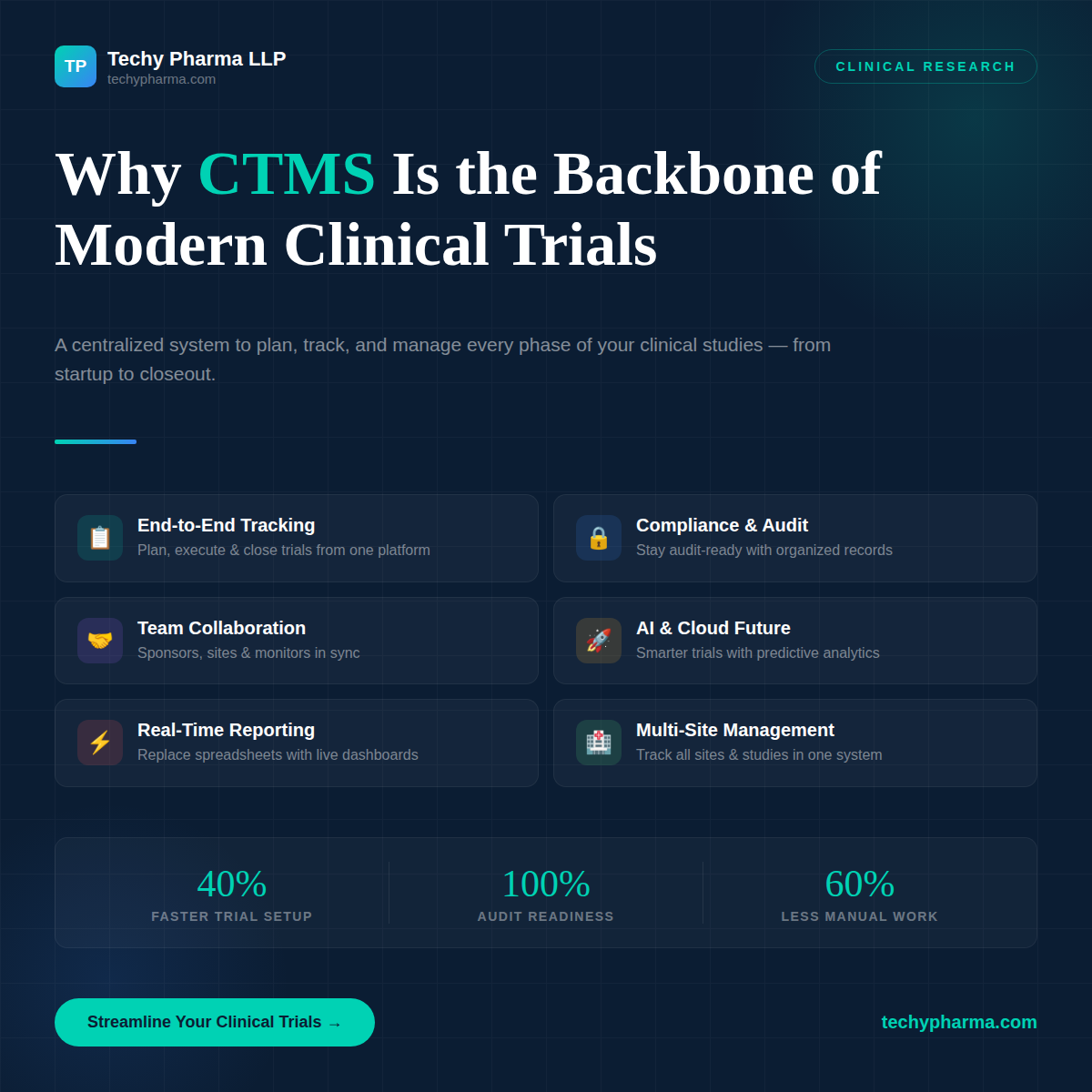
A Clinical Trial Management System (CTMS) is specialized software used to manage all major activities involved in a clinical trial. It acts as a centralized platform where research teams can store, organize, monitor, and analyze trial-related data.
CTMS helps organizations manage study planning, patient enrollment, site performance, regulatory tasks, financial tracking, and trial reporting from one place. Instead of handling everything manually through spreadsheets and paper files, teams can use CTMS to improve efficiency and maintain better control over the entire trial process.
In simple terms, CTMS makes clinical trials more structured, transparent, and manageable.
How CTMS Supports the Clinical Trial Lifecycle
A Clinical Trial Management System supports every stage of the clinical trial lifecycle, from startup to closeout.
During the planning stage, CTMS helps teams define trial objectives, prepare timelines, assign responsibilities, and organize essential documents. This ensures that the study begins in a structured and well-prepared way.
During the execution stage, CTMS helps monitor patient recruitment, site activities, study milestones, and progress across multiple locations. This real-time visibility allows teams to identify delays and take corrective action quickly. TechyPharma’s eClinical solutions page also highlights AI-CTMS as part of its clinical trial software suite.
During the closeout stage, CTMS helps ensure that all records are properly completed, documented, and stored. This makes the study closure process smoother and more compliant.
Because it supports the full lifecycle, CTMS plays an important role in improving overall trial quality and performance.
Key Features of CTMS
1. Study Planning and Management
CTMS helps research teams plan clinical studies efficiently. It supports protocol management, milestone tracking, and activity scheduling, making the study process more organized.
2. Patient Recruitment and Tracking
A major challenge in clinical trials is recruiting and retaining participants. CTMS helps track patient enrollment, participation status, and retention efforts, making recruitment easier to monitor.
3. Site Management
Clinical trials often involve multiple sites. CTMS allows teams to monitor site performance, investigator activities, communication, and site-specific progress in one central platform.
4. Financial Management
CTMS can help track budgets, payments, expenses, and financial performance. This improves cost control and supports better financial planning throughout the trial.
5. Compliance and Documentation
Clinical research must follow strict guidelines and standards. CTMS helps organizations maintain accurate records, manage documents, and stay aligned with regulatory requirements such as FDA guidelines and ICH-GCP standards. For validation and audit readiness, you can also connect readers to your Computer System Validation (CSV) page.
6. Reporting and Analytics
CTMS provides dashboards, reports, and analytics that help managers understand trial status, site performance, and study progress. This supports faster and better decision-making.
7. Real-Time Monitoring
With CTMS, teams can monitor activities in real time. This makes it easier to detect problems early and respond before they affect the trial timeline or quality.
Benefits of Using CTMS
Improved Efficiency
CTMS reduces manual work by automating many trial management tasks. This saves time and allows teams to focus more on research and execution.
Better Data Accuracy
By storing data in a centralized system, CTMS reduces the risk of duplicate records, missing information, and human errors.
Enhanced Compliance
Clinical trials require strong documentation and proper process control. CTMS supports compliance by keeping records organized and audit-ready. If you want to strengthen this section further, link to your QMS software page because it supports CAPA, deviation management, SOP control, and inspection-ready quality evidence.
Faster Decision-Making
With real-time dashboards and reports, teams can make informed decisions quickly instead of waiting for manual updates.
Better Collaboration
CTMS improves communication between sponsors, investigators, monitors, site staff, and project managers by giving everyone access to the same information.
Cost Optimization
By improving planning and reducing delays, CTMS helps organizations manage budgets more effectively and avoid unnecessary expenses.
Greater Transparency
CTMS gives a clear view of trial progress, helping teams monitor performance and accountability across all activities.
Common Challenges in Clinical Trial Management
Managing clinical trials without a proper system can create many problems. Research teams often face scattered data, poor communication, delayed updates, limited visibility into site performance, and manual reporting errors.
These issues can increase workload, slow down trial timelines, and raise operational costs. In many cases, they can also affect compliance and data quality.
A CTMS helps solve these challenges by bringing all trial information into one centralized platform. This creates better coordination, more accurate records, and smoother trial execution.
Role of CTMS in Compliance and Risk Reduction
Compliance is a major part of clinical research. Every trial must follow strict rules, guidelines, and documentation standards to ensure safety, quality, and reliability.
CTMS helps organizations stay compliant by keeping all essential trial data properly tracked and documented. It supports audit readiness, reduces the chance of missing records, and ensures that critical tasks are completed on time.
It also reduces operational risk by giving teams better control over deadlines, site activities, and reporting. This is especially important for organizations that manage multiple studies at once.
CTMS and Improved Collaboration
Clinical trials involve many different stakeholders, including sponsors, investigators, site staff, clinical monitors, data teams, and project managers. Without a centralized system, communication can become confusing and slow.
CTMS improves collaboration by allowing all team members to access up-to-date trial information in one place. This reduces miscommunication, improves coordination, and helps everyone work toward the same trial goals.
When communication is smooth, trials move faster and more efficiently.
Why Businesses Are Choosing CTMS Software
Organizations are increasingly choosing CTMS software because it helps them manage clinical studies in a smarter and more scalable way.
Instead of relying on spreadsheets, email chains, and manual reports, businesses can use a digital system that improves visibility and control. This is especially useful for companies handling multiple sites, large data volumes, or complex study protocols.
CTMS also supports professional trial management, which helps organizations improve productivity and maintain better operational standards.
Who Uses CTMS?
CTMS is widely used across the clinical research ecosystem, including:
Pharmaceutical companies Biotechnology firms Contract Research Organizations (CROs) Academic research institutions Hospitals and healthcare providers Clinical research centers
These organizations use CTMS to manage studies more effectively, improve compliance, and enhance trial performance.
CTMS vs Traditional Trial Management
Traditional trial management often depends on manual processes, spreadsheets, and disconnected files. This can create confusion and increase the risk of errors.
CTMS, on the other hand, offers a centralized and digital solution. It provides real-time tracking, better accuracy, automated reporting, and stronger compliance support.
FeatureTraditional MethodCTMSData ManagementManual or spreadsheet-basedCentralized systemAccuracyMore prone to errorsHigher accuracyTrackingLimited visibilityReal-time trackingComplianceHard to manage manuallyBetter documentation and controlEfficiencyTime-consumingMore efficientCollaborationDisconnected communicationBetter team coordination
This comparison shows why CTMS is becoming the preferred choice in modern clinical research.
Future Trends in Clinical Trial Management Systems
The future of CTMS is becoming more advanced with technology. Cloud-based CTMS platforms are making it easier for teams to access data securely from anywhere. Automation is reducing repetitive work, and artificial intelligence is helping with smarter analysis and trial forecasting.
In the coming years, CTMS is expected to integrate more closely with other eClinical systems, electronic health records, and data analytics tools. This will make clinical trial management faster, smarter, and more efficient.
Conclusion
A Clinical Trial Management System (CTMS) is no longer just an optional software solution. It has become a vital part of modern clinical research.
By improving efficiency, supporting compliance, enhancing collaboration, reducing manual work, and providing better visibility into trial operations, CTMS helps organizations conduct clinical trials in a more reliable and effective way.
For pharmaceutical companies, CROs, research institutions, and healthcare organizations, CTMS is a powerful tool that supports better outcomes and smoother trial execution.
As the clinical research industry continues to evolve, CTMS will remain one of the most important systems for managing trials successfully.
FAQ Section
What is the main purpose of CTMS?
The main purpose of CTMS is to manage, track, and organize clinical trial activities in a centralized and efficient way.
Who uses CTMS?
CTMS is used by pharmaceutical companies, CROs, biotech firms, hospitals, and research organizations.
Why is CTMS important in clinical research?
CTMS is important because it improves efficiency, supports compliance, reduces errors, and provides better visibility into trial progress.
Is CTMS useful for multi-site trials?
Yes, CTMS is especially useful for multi-site trials because it helps track site performance and study progress from one platform.
Does CTMS improve compliance?
Yes, CTMS helps maintain proper records, manage documents, and support audit readiness, which improves compliance.
메타데이터
- post_id
- abc2d3cc3a36
- slug
- clinical-trial-management-system-ctms-features-benefits-importance-abc2d3cc3a36
- url
- https://medium.com/@bd_56967/clinical-trial-management-system-ctms-features-benefits-importance-abc2d3cc3a36
- canonical_url
- https://medium.com/@bd_56967/clinical-trial-management-system-ctms-features-benefits-importance-abc2d3cc3a36
- author_url
- https://medium.com/@bd_56967
- status
- ok
- fetched_at
- 2026-06-17 10:21:25