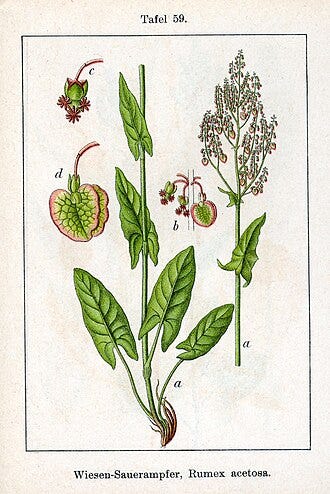
Victorian Folklore of Spring Flowers
The language of flowers and bouquet making were significant traditions in the Victorian era, and interest in the folklore of flowers is…
Victorian Folklore of Spring Flowers
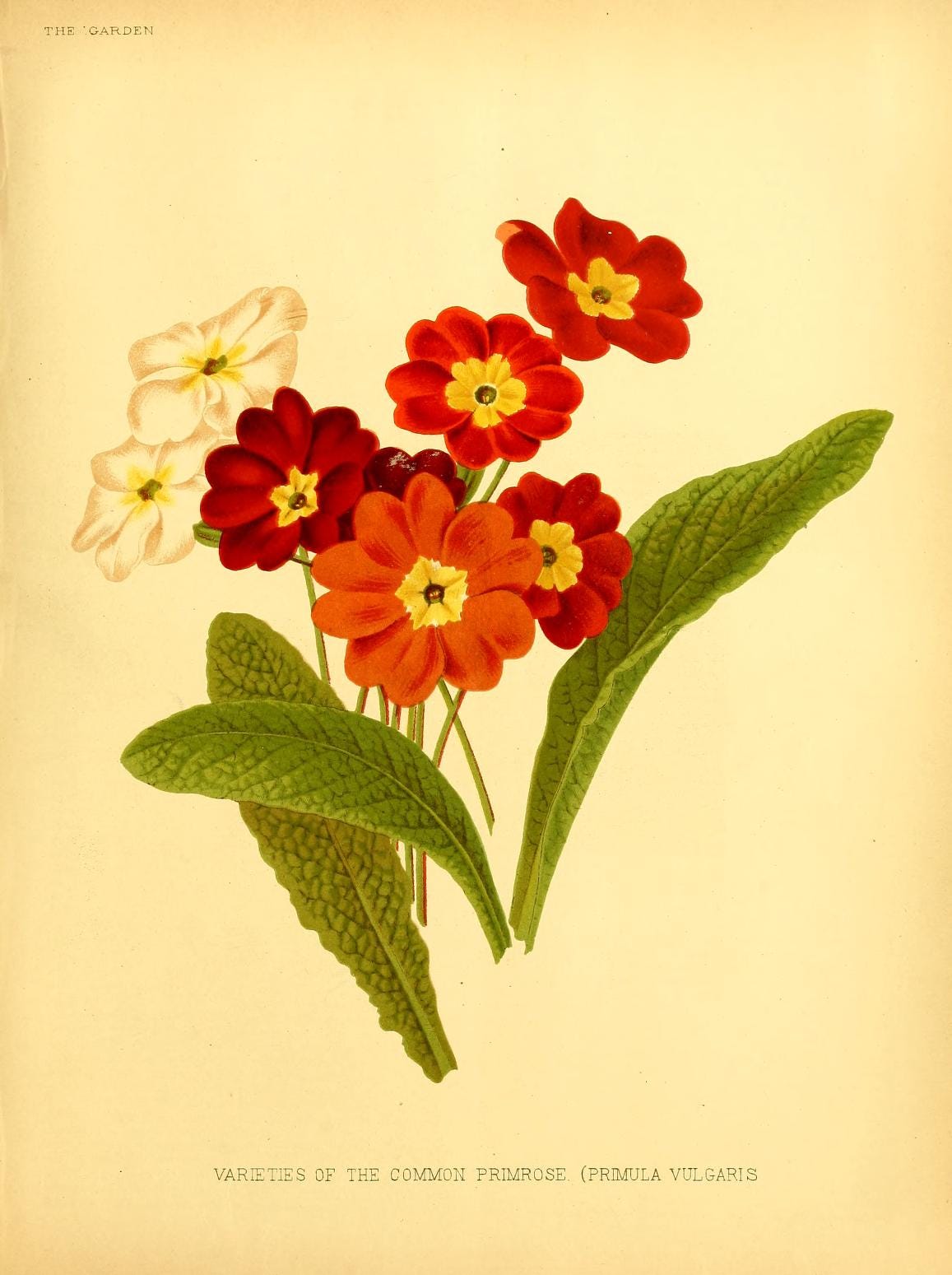
Hardy Primroses (Primula vulgaris) (1877) by Mary Elizabeth Duffield (1819–1914) (Wikimedia Commons Image License
The language of flowers and bouquet making were significant traditions in the Victorian era, and interest in the folklore of flowers is evident in antique books and other published works that recorded floral traditions and symbolism. Here are a few examples of folklore of Spring flowers from the Victorian era.
Violets, the common name for dainty spring flowers of the Viola genus, make regular appearances in Victorian floral dictionaries. Blue violets symbolized modesty in the language of flowers, while white violets could represent a variety of sentiments depending on the dictionary, including candor, innocence or constancy. Violets were also frequently featured in original fairy stories and poetry published in the Victorian era. Poetic works like the verses written by Anna Swan Reynolds published in an 1890 issue of *Godey’s Lady’s Book* combined fairy imagery with mentions of violets.
[…]My blue one says, “Till day is done/I list to the stories of the sun.”/O violet sweet!/O violet blue!/Tell me the tales he told to you;/Of children of the lotus land,/ And wondrous birds on every hand./O violet blue!/O violet sweet!/Does he tell of the desert sands?/ My flower white!/Midsummer night/ From covert dark by fire-flies light./ (O violet sweet!)/(O violet white!)/Could you see the elf and sprite? (p. 381)
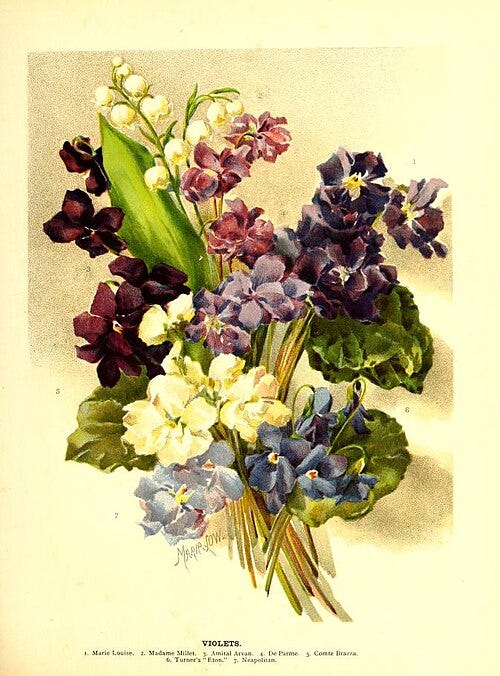
Violets by Marie Low Wikimedia Commons Image License
Elderflowers, the lacy clusters of that blossom that bloom before elderberries make their appearance, are part of the genus of 10 species of shrubs and small trees called Sambucus, in the family Adoxaceae. An 1874 issue of *The Gardener’s Chronicle described the folklore of many plants, including elderflower’s use in baking cakes, noting that the fragrance of elderflowers is believed to cause giddiness. Elderflower was also connected to the otherworldly, an 1895 issue of [Folklore](https://www.google.com/books/edition/Folklore/VYMZAAAAYAAJ?hl=en&gbpv=1&dq=elderflower%20folklore&pg=PA21&printsec=frontcover)* describing a traditional belief about elderflower tea’s ability to grant dreams of the Elder-Mother, a dryad from Danish mythology.
The special superstitions attaching to the elder are perhaps explained by the effects of drinks such as are prepared from its berries and blossoms. We learn from one of Andersen’s fairy tales that those who drink of elderflower tea see the “Elder-Mother” (Hyldemoer) herself in their dreams, seated amidst her sweet-scented flowers and foliage. (p. 21–22)
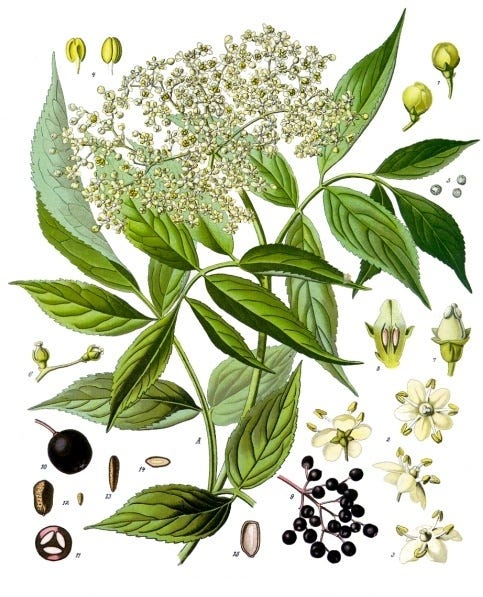
Sambucus by Franz Eugen Köhler (1897) Wikimedia Commons Image License
Primrose, the common name for plants of the Primula genus, is a spring-blooming flower that symbolized childhood in the Victorian language of flowers. Primrose meant childhood. Picking a primrose could be good or bad luck depending on its use. According to Victorian folklorists, bringing a solitary primrose into a house is unlucky, and could prevent chicken or duck eggs from hatching. Carrying a primrose in your pocket during an eclipse however, was potentially lucky. An 1895 issue of *The Illustrated American* recorded German folklore about primroses as a good luck charm to find hidden treasure.
During an eclipse all hidden treasures are open, and if you are wise enough to carry a primrose with you, you will be able to help yourself to any of them […] (p. 61)
Hardy Primroses (Primula vulgaris) (1877) by Mary Elizabeth Duffield (1819–1914) (Wikimedia Commons Image License
A similar superstition about ducks and daffodils was recorded by other Victorian folklorists. Volume I of *Flowers and Flower Lore*, published in 1884 described this folk belief.
In 1877 a gentleman wrote to a Devonshire paper respecting the same kind of superstition, an illustration of which he afforded in the following narrative : — A friend was staying at a farmhouse near Christow, and one day plucked a Daffodil and placed it in his button-hole. On his return he laid the flower on the table; but the servant coming in soon after, demanded who had brought in the Daffodil, adding “We shall have no ducks this year.” The writer adds, “I am informed that a single flower is unlucky for the ducklings ; but if a handful is brought in, it is in their favour, and the season will be fortunate.” (p. 581)
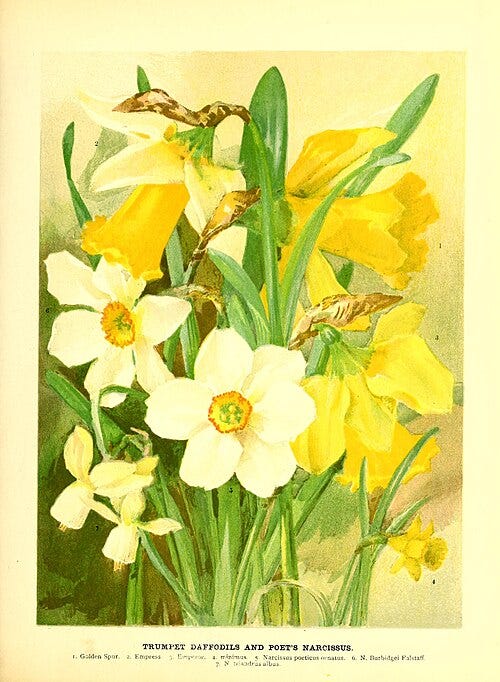
Trumpet Daffodils and Poet’s Narcissus (1898) by Gertrude Hamilton Wikimedia Commons Image License
Cowslip, another springtime flower, is also a relative of the primrose. Cowslip flowers were used in divinatory practices, as recorded in *A Dictionary of British Folklore*, published in 1898.
The cowslip heads are strung on a piece of thread and tied into a “posty,” and the play is to throw it up a tolerable height, catching it on the distended palm with a blow that sends it up again, while the player sings : —
Pisty, posty, four and forty,/
How many years shall I live?/
One, two, three, four &c.
Of course, if it falls to the ground uncaught, or even if caught in the clenched hand, there is an end of the player’s “life.” There is a good deal of emulation amongst the children as to who shall live the longest (Notes and Queries, 3rd ser., iii 172). Miss Burne (Shropshire Folk-lore, p. 530) mentions the same custom, giving the rhyme as —
Toss-a-ball, toss-a-ball, tell me true/
How many years I’ve got to go through,
and she she says the cowslip is thence called a “tissy-ball.” (p. 194)
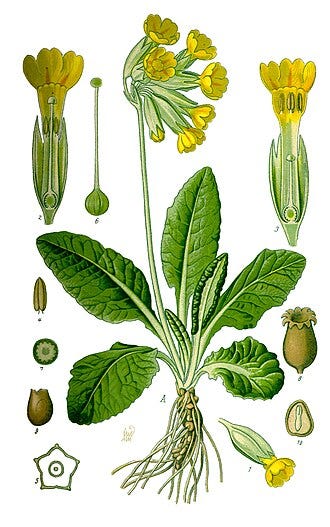
Primula veris, Primulaceae (1885) by Dr. Otto Wilhelm Thomé Wikimedia Commons Image License
Hawthorn, a flowering tree or shrub of the genus Crataegus, is part of the *Rosaceae or Rose family. Its other common name, Mayflower, reflects the plant’s typical late-spring-blooming pattern. Traditions around collecting hawthorn branches on the first of May were still being recorded in the Victorian era. [Folklore of Scottish Lochs and Springs](https://www.google.com/books/edition/Folklore_of_Scottish_Lochs_and_Springs/j1jmOIyqNDsC?hl=en&gbpv=1&pg=PA299&printsec=frontcover)*, published in 1893 mentioned hawthorn’s dual purpose as a protection charm and mystical beauty aid.
In our own country, too, hawthorn branches were formerly used on May Day as a charm against witches. The hawthorn had likewise another mystic property attributed to it. The dew on its branches on the first of May had the power of giving beauty to the maiden who washed her face with it. (p. 299–300)
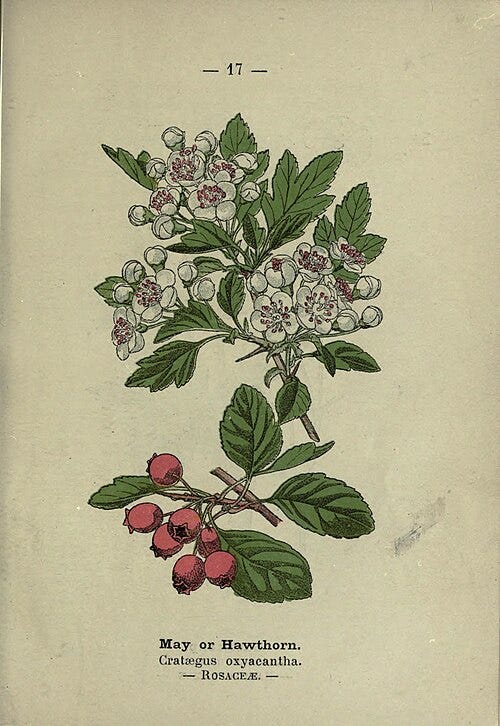
Wayside and Woodland Blossoms: A Pocket Guide to British Wild-flowers for the Country Rambler by Edward Step Wikimedia Commons Image License
Flowers inspired a litany of customs, beliefs and meaning in the Victorian language of flowers. The interest in recording these botanical traditions allows contemporary historians and folklorists alike to rediscover a bouquet’s worth of folklore from the Victorian era.
If you love history, plants or the history of plants, consider supporting Plant Based Past by buying me a coffee!
For more vegan, vegetarian, and botanical histories, follow *Plant Based Past* on Medium.
You can sign up for email alerts to receive the next story when it becomes available, just by clicking the envelope icon. Receive a bonus historical recipe not seen in the publication, article recaps with free friend links to read, save or share once a month in your inbox by subscribing to Plant Based Past’s newsletter, Nutshell.
Next Week: Garden Vinegar: Sorrel — A Botanical History
메타데이터
- post_id
- abcdb1cb5fdc
- slug
- victorian-folklore-of-spring-flowers-abcdb1cb5fdc
- url
- https://medium.com/plant-based-past/victorian-folklore-of-spring-flowers-abcdb1cb5fdc
- canonical_url
- https://medium.com/plant-based-past/victorian-folklore-of-spring-flowers-abcdb1cb5fdc
- author_url
- https://medium.com/@plantbasedpast
- status
- ok
- fetched_at
- 2026-06-13 12:55:53