Cultural Bazaar
Ujamaa Collective uplifts Africana women using cooperative economics and a fair-trade marketplace for cultural, artistic exchange.
Cultural Bazaar
Ujamaa Collective uplifts Africana women using cooperative economics and a fair-trade marketplace for cultural, artistic exchange.
By B. Denise Hawkins

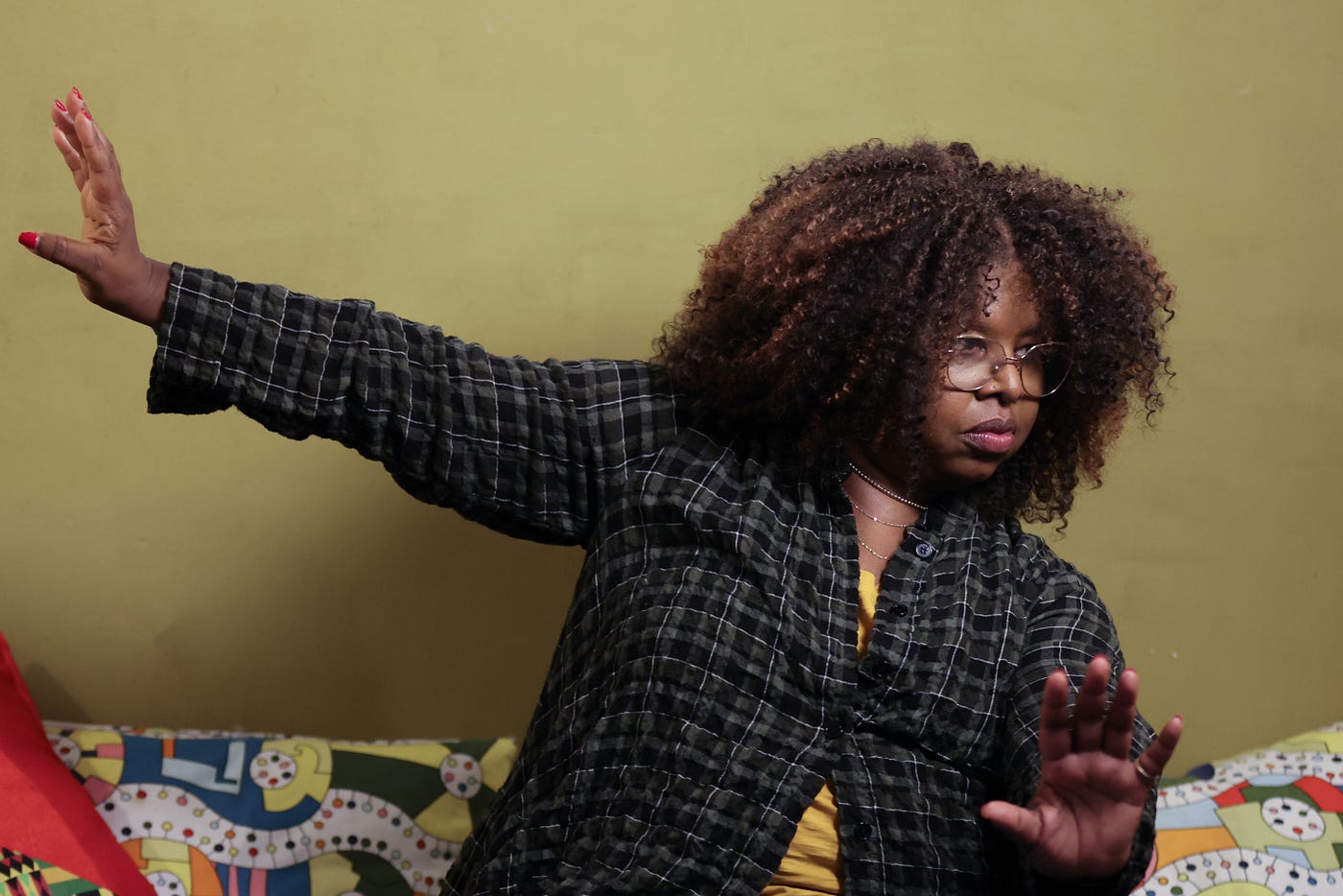
LaKeisha Wolf and Frankie Harris | Image by Brian Cook/Golden Sky Media
At the busy market in Korogwe, a rural town in Tanzania, East Africa, shoppers mill through narrow dirt paths to get to stalls full of ebony carvings, elaborate basket weaving, pottery, and colorful khangas, the local cotton clothing worn by women.
The markets are overflowing with cultural treasures. They are also full of “market mommies,” the mothers, wives, and aunties, who are the craftspeople, wholesalers, retailers, entrepreneurs, and sellers who, for generations, have been the life pulse of this open-air market and others like it in cities and villages across the African world.
The women of the market conducted the trade, selling goods, learning the value of money, and more. In these spaces, women became central to economies — moving goods from fields into society — and their roles in the market survived enslavement, colonialism, and stretched into modern Africa. If you look closely, at their struggles and successes, lessons of sharing, self-reliance and philosophies of economic uplift are embedded in their stories and transactions.
Pittsburgh’s Celeta Hickman, a teaching artist and a longtime advocate for Black families and children, was one of those who took a closer look. About 15 years ago, Ms. Hickman, like others, was aware of Pittsburgh’s boast of its economic resurgence. But where, she wondered, was the economic gain for residents and business owners — particularly for Black women — in the Hill District, a historically Black community.
To solve the problem, she believed that people of African descent should look to Africa for models of how to move Black women toward economic empowerment.
In 2007, Ms. Hickman looked to the continent for a solution and then she issued a call to action.
She reached out to a network of local Black women activists, creatives, friends, vendors, and those in the healing arts. One of those who heard the call was LaKeisha Wolf, an artist with a background in small business, community and economic development, and nonprofit management.
“Celeta was interested in finding ways in which Black people participated in economics, before colonization,” Ms. Wolf recalled. ”So, before white folks showed up, what we were doing on the continent of Africa to buy, save, trade, and economically empower each other, especially as African women.”
A year after she reached out, Ms. Hickman and the women, in 2008, created the nonprofit Ujamaa (pronounced oo-JAH-mah) Collective, naming it for the fourth of seven principles of the African-centered holiday Kwanzaa and for the East African philosophy of self-sufficiency.
Ms. Wolf, who has served as the Collective’s executive director for more than a decade, said Ujamaa means “cooperative economics: to build and maintain our own shops, stores and other businesses and to profit from them together.”
The Ujamaa Collective — a retail and advocacy center of specialty Africana crafts and arts — grew out of taking a closer study of women in the African marketplace. What was found there, said Ms. Wolf, was a centuries-old practice, a kind of savings and loan, known as the “esusu or susu.”
The informal community banking takes place among trusted family and friends and circulates money that allows many of its members to start a new business, generate a down payment for a home, purchase cattle, or put a child through college.
Similarly, in one of its first collective efforts, Ujamaa members used a shared purchasing program to help lower the costs of doing their individual craft businesses. For Ujamaa, cooperative programs like this represent the way they do business — African-centered, not Westernized, said Ms. Wolf.
Ujamaa Collective does this business from its boutique in One Hope Square, a building on the Centre Avenue business corridor of the Hill District, a community that Ms. Wolf calls “a gem.”
First, it’s a hub of Black creatives and entrepreneurs, she said. And second, it sits between Oakland, a community full of universities, and Downtown, two of the most significant economic generators in the city and county. And, over the years, these areas have sandwiched the Hill District into highly politicized economic development that hasn’t been friendly to Hill residents.
And, when it comes to development, Ms. Wolf said, “the input of [people in] the Hill District has been ignored, with someone else making economic decisions with little regard to [Hill residents’] best interests.”
Part of the work of the Ujamaa Collective is fostering self-empowerment to help turn the tide on this lack of engagement.
“We are focused on providing equity and self-determination outside a capitalist system that has historically exploited the needs of marginalized communities like the Hill District,” Ms. Wolf said.
For Black women creatives in the Ujamaa Collective, that means being a part of a fair-trade marketplace for cultural, entrepreneurial, and artistic exchange.

LaKeisha Wolf | Image by Brian Cook/Golden Sky Media
Getting Noticed
When Ujamaa Collective opened its retail boutique in 2010, it was another step toward its goal of fostering cooperative economics — and proving that Black women artisans and crafters can both work and be entrepreneurs. It’s what Black women have done for centuries, Ms. Wolf said, despite their work and art being invisible to “the dominant culture.”
Looking beyond the retail store, Ujamaa is putting its members and their goods where they can be seen — in front of the public. Recently, during a run of “A Raisin in the Sun” at Pittsburgh’s O’Reilly Theater, Ujamaa hosted a one-night pop-up market in the lobby for theatergoers to shop and meet the artisans.
“This is one way of offering an opportunity for expression and independence in a city that is so challenging for Black women,” Ms. Wolf added.
A 2019 report, “Pittsburgh’s Inequality Across Gender and Race,” written by University of Pittsburgh researchers, documents the experiences that Ms. Wolf and so many Black women in the region live every day. Compared to those in demographically similar cities, Black women in Pittsburgh face higher rates of maternal mortality and poverty along with lower rates of employment and college readiness.
It was these dire circumstances that led researchers to conclude that the best thing Black women living in Pittsburgh can do to improve their quality of life is to move away. Automatically by just leaving the place they’ve called home, their life expectancy as Black women, “would go up, their income would go up, [and] their educational opportunities for their children would go up,” Junia Howell, who worked on the report, told the Pittsburgh Post-Gazette.
The Hill District’s Frankie Harris decided to stay in her community despite hard times. A few years ago, this mother, grandmother, and lover of “everything Afrocentric,” was living in a shelter. Today she lives just blocks away from Ujamaa Collective, where she’s now the boutique merchandiser.
“At this stage in my life, I have learned and done more things than I could have ever imagined,” said Ms. Harris, who frequented the boutique, browsing and buying the global and local treasures that filled the space long before she was hired to sell them and style the store’s windows and displays.
“Ujamaa, this community,” said Ms. Harris, “is my heartbeat.”
Once inside the boutique’s double-glass doors, there is a wealth of beautiful things to buy, touch, and see. But many come inside the welcoming space to just soak up the energy, savor the peace to “get a hug from Sister Frankie,” to talk things out, or just to sit and rest without being pressured to purchase anything.
During a tough time in her life, Tia Baker, an entrepreneur and Hill District resident, remembers heading to Ujamaa one day in 2010. She found there what she needed — the support of sisters and to be enveloped in a hug.
“That’s exactly what I got,” said Ms. Baker, who is now Ujamaa’s director of membership. “Being there was healing for me. And that’s what Ujamaa continues to be for so many people who walk through our doors.” Ms. Baker’s mother, LaVerne Baker Hotep, helped found Ujamaa.
Beyond the art, jewelry, books, and bags that line the shelves and generate revenue for the 150 women who are a part of the collective, are “the intangible things we do that people can’t even imagine,” said Ms. Wolf of Ujamaa’s place in the Hill District — and in the lives of Black women creatives.
Ms. Wolf said the Collective has about 20 members who pay a small fee to sell their products and art through the boutique, but many more are involved in this “super strong network” and can enjoy some benefits even if they aren’t financial.
Ujamaa organizes public art classes and health and wellness events. It hosts pop-up markets and entrepreneurship programming through which Ms. Wolf and her team offer a steady drumbeat of encouraging Black women to see their value in a system that doesn’t value them.

LaKeisha Wolf | Image by Golden Sky Media
What’s Next
As Ujamaa remains dedicated to fostering an economically thriving Hill District, it also wants to continue to expand economic cooperation beyond the Pittsburgh region, across the United States and abroad.
The nonprofit already has a fair-trade collaboration with female craftspeople and artisans in Korogwe, Tanzania, to provide clothing for its boutique. With support from The Heinz Endowments and The Pittsburgh Foundation, Ujamaa Collective created the African-Centered Cooperative Research Project in 2022 to inform its outward look.
The idea: Create “a living, breathing, open-source platform and space that all Africana people and Black businesses can use,” Ms. Wolf said. It will be a place to build shared economic models for creating wealth to meet the community’s most pressing needs.
She is also excited about the nonprofit’s potential to ignite and lead “a national movement” for Black America. With members of the Collective, she’s moving toward that goal, using virtual and in-person conferences and social media to start conversations in Black communities and educate Black-led cooperative organizations.
“In the work we’re doing now with the research project,” we’re talking about cooperatives operating with multiple models and systems,” Ms. Wolf said. “All of them function differently in terms of how Africana people get together to meet mutual economic needs,” but they’re all important to listen to because of the values and governance they can offer about work and wealth-building.
Ujamaa, a national cooperative leader, is spearheading the project along with Pittsburgh’s Black business directory Cocoapreneur Pgh, LLC and the Houston-based Sankofa Research Institute.
“Black cooperation is about protecting the Black community and its future,” said Assata Richards, who directs Sankofa Research Institute. “We want to engage Black people who are participating in Black cooperation, keep the conversation going, and awaken others to this concept.”
In the research project’s second phase, the virtual “Sankofa Circles,” or forums, are being planned around the principle of cooperative economics — Ujamaa.
In many ways, the work that “market women” helped to initiate on the African continent is also work that is calling the Collective into a future that is global. The racks of ready-to-wear fashions with bold designs and vibrant colors, the large selection of intricately woven baskets that line the floor, the smooth soap-stone sculptures, and the many other made-in-Africa products the Ujamaa boutique carries, said Ms. Wolf, are the result of cultivating years of fair-trade partnerships and cultural relationships with creatives and communities of women-led cooperatives in Tanzania, Ghana, and elsewhere across the continent.
“I think what’s next for us is more of that global reach,” Ms. Wolf added.
A reach that will be helped along by a recent $150,000 grant from The Heinz Endowments and the Ford Foundation through the Pittsburgh’s Cultural Treasures Initiative. The grant affirms the creative work that Black women in Pittsburgh have long been doing, Ms.Wolf said.
The Collective launched a new membership campaign last fall, and to better serve its growth, the organization plans to either expand its current space or acquire a new building. Doing so will fulfill a long-held dream of providing a shared space where members can engage in light manufacturing, share equipment such as sewing machines, a 3D printer and a vinyl cutter, as well as other tools, and arts and craft supplies.
It would allow members of the collective to “grow, create, produce,” and draw inspiration as they work together. But practically speaking, said Ms. Wolf, “We want all these Black women to be able to move their businesses out of their homes.”
Ms. Harris, who never considered herself a creative before joining with Ujamaa Collective, is eager to help usher in that future.
“This is our time. This is our place, we work together,” she said. “And we carry each other, lifting as we climb.”
B. Denise Hawkins is a writer living in Northern Virginia. Twitter: @BDenisewrites
Ujamaa Collective: www.ujamaacollective.org; ttps://www.instagram.com/ujamaacollective15219/; https://www.facebook.com/ujamaacollective
메타데이터
- post_id
- abd3753cd4c3
- slug
- cultural-bazaar-abd3753cd4c3
- url
- https://medium.com/@pcti/cultural-bazaar-abd3753cd4c3
- canonical_url
- https://medium.com/@pcti/cultural-bazaar-abd3753cd4c3
- author_url
- https://medium.com/@pcti
- status
- ok
- fetched_at
- 2026-07-26 06:59:45