AI agents are not for customer service. Let me prove to you.
AI agents are now a buzzword across all social media platforms, which is quite obvious because AI has passed the phase of experimentation…
AI agents sound good for repetitive tasks, but not for customer service.
AI agents are not for customer service. Let me prove to you.
AI agents are now a buzzword across all social media platforms, which is quite obvious because AI has passed the phase of experimentation, and now customization is the new phase. All previous inventions and discoveries passed through these phases and ultimately set the ground for new advancements. Just type the words “AI agents” on Upwork, and you will find their growing relevance.
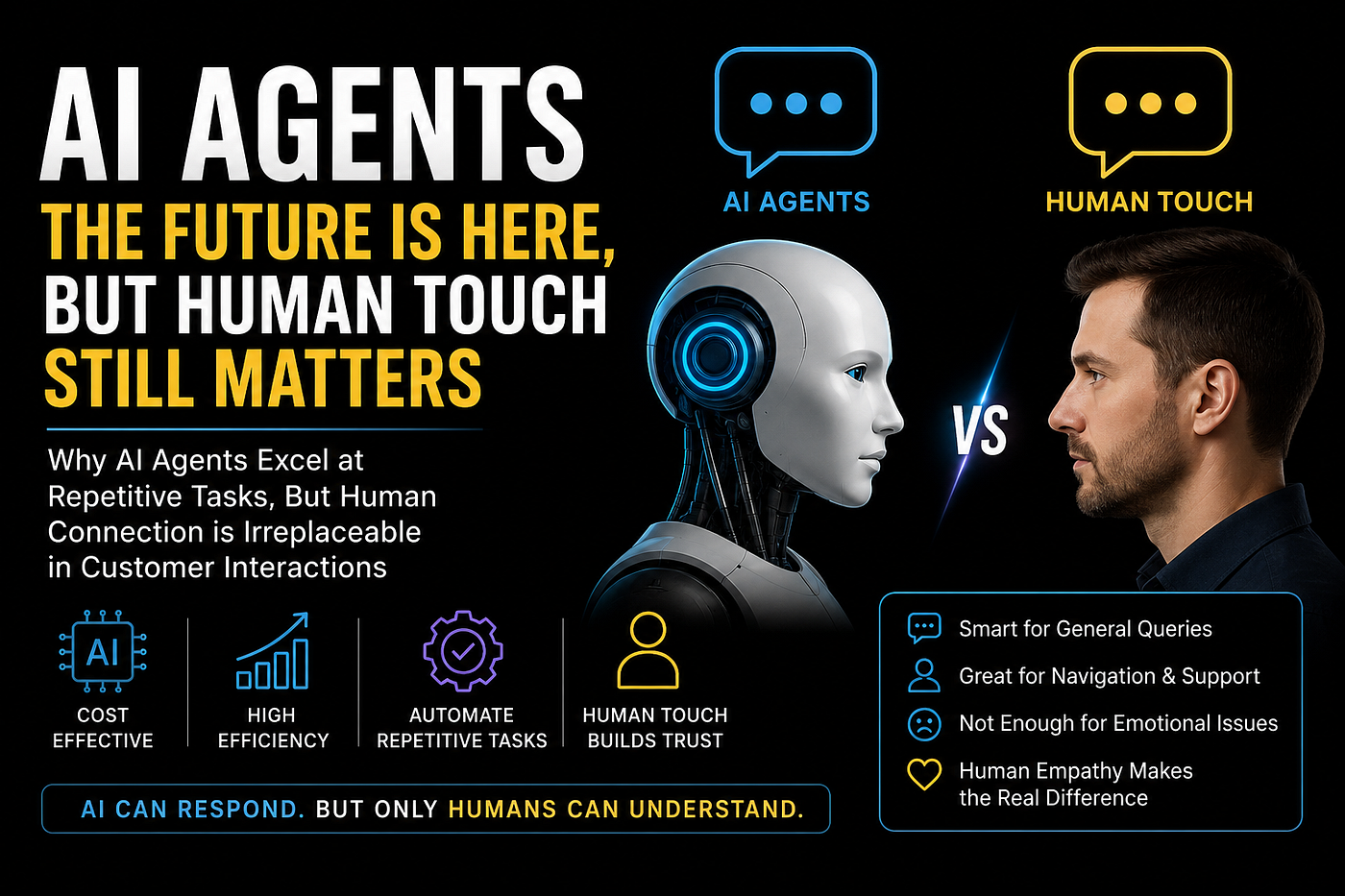
One of the major advantages attributed to AI agents is the cost-effective performance of repetitive tasks. There are many tasks that are repetitive in nature, such as invoicing, attendance management, salary slips, and rejection emails to job applicants. Yes, even that is a repetitive task. Typically, in most organizations, these repetitive tasks are performed by humans who earn salaries that are at least equivalent to the minimum wage of their country.

AI agents can perform such work more efficiently, at a lower cost, and with less supervision. You might need two or three people to process invoices, whereas agents might need just one person to oversee their operations. So instead of paying salaries to two employees, you are paying one employee along with a relatively small subscription fee for AI agent tools. It is a saving that many businesses can enjoy through these agents.
Therefore, we are witnessing a whole wave of AI agent adoption around us, even though there is still some skepticism. Many businesses remain reluctant to adopt AI because of concerns about data breaches, which is indeed a legitimate concern. However, some organizations are still willing to take the risk as early adopters.
One of the major tasks where AI agents are becoming quite prevalent nowadays is automated responses to customer queries. We can see that almost every website now has a dedicated chatbot popup to help users navigate the site. You enter your queries into these bots, and they guide you to the relevant section of the website.

For example, if you open an e-commerce site and want to see T-shirt options, instead of searching through the entire website, you can simply enter your requirement into the chatbot, and it will direct you to the relevant page. This saves time and effort while also allowing the website to retain customer interest for a longer period, potentially increasing conversion rates.
Generally, you will find two types of bots on websites. The first type follows a fixed set of instructions. Technically, they are not true chatbots; they are website guides. If you ask them anything outside their predefined instructions, they will not respond appropriately. They mostly provide predefined functions to customers.
For example, if you visit utility company websites, their chatbots often provide predefined options under which they can respond. If you enter any command outside those options, they either fail to respond or repeatedly emphasize following their instructions. These chatbots can sometimes be very frustrating.

Customers do not always have fixed queries. They may have random questions that do not fit within the predefined instructions of these chatbots. In such situations, customers may become frustrated and leave negative comments about the company. Psychologically, these bots can develop a sense of irritation in customers’ minds, causing them to treat every chatbot with the same frustration.
Unfortunately, in many companies, the majority of chatbots are designed to follow a specific set of instructions. They do not have the capability to customize their responses, which often leaves frustrated customers feeling that they need a human on the other side. This is why we continue to see many situations where customers prefer human involvement in handling their queries. They do not want robotic responses that cannot understand human emotions.

Although developers are working on agentic bots that can both follow specific instructions and provide customized responses, one important point must always be kept in mind. Emotions are like pain, a psychological pain, which requires warmth to ease it. AI agents may respond to the query, but not necessarily to the pain behind it, because pain is something that is felt, and only humans can truly do that.
In my opinion, AI agents are excellent for handling general queries such as navigating a website, helping users find products, displaying schedules, or checking inventory. However, when it comes to complaints that involve frustration, disappointment, or emotional distress, human involvement is still needed on the other end.
Human beings are social creatures. They tend to trust other humans, even when they suspect that their issue may not be resolved immediately. Sometimes, the mere presence of another person is enough to reduce frustration.
Have you ever noticed that when you are under pressure and frustrated with a service, you might raise your voice at a customer service representative, even though you know that doing so will not solve your problem? Yet their presence itself can sometimes provide relief.
Now imagine if a robot were sitting there instead, following a strict set of instructions. Deep down, you would know that shouting at it would change nothing. You might not even bother expressing your frustration. Instead, you might simply decide to leave that company forever.
Therefore, in my opinion, AI agents are beneficial to a certain extent. They are excellent for performing repetitive tasks, but not necessarily for handling customer complaints and emotionally charged interactions. Businesses will always require humans on the other side to understand the emotional needs of customers.
This human connection helps retain customers and allows them to release their frustration. It is fundamentally a psychological issue. If there is only a robot on the other side, a frustrated customer may not even bother expressing their dissatisfaction. Instead, they may quietly carry that frustration and take revenge by unsubscribing from the company forever.
I do not think any company can afford that in today’s highly competitive environment.
메타데이터
- post_id
- abd4f8b66bbd
- slug
- ai-agents-are-not-for-customer-service-let-me-prove-to-you-abd4f8b66bbd
- url
- https://medium.com/@20202.26886.minhal/ai-agents-are-not-for-customer-service-let-me-prove-to-you-abd4f8b66bbd
- canonical_url
- https://medium.com/@20202.26886.minhal/ai-agents-are-not-for-customer-service-let-me-prove-to-you-abd4f8b66bbd
- author_url
- https://medium.com/@20202.26886.minhal
- status
- ok
- fetched_at
- 2026-07-20 07:01:03