Furniture at His Master’s Side
UMINEKO CHARACTER STUDY
Furniture at His Master’s Side
UMINEKO CHARACTER STUDY
Ronove, Repressed Desire, and a Queer Reading of Genji Ronoue in Umineko no Naku Koro ni
A cumulative case from the visual novel, the Episode 8 manga, and official supplementary material
CRITICAL ESSAY | FULL-SERIES SPOILERS
By Giancarlo Vanzzini
July 2026
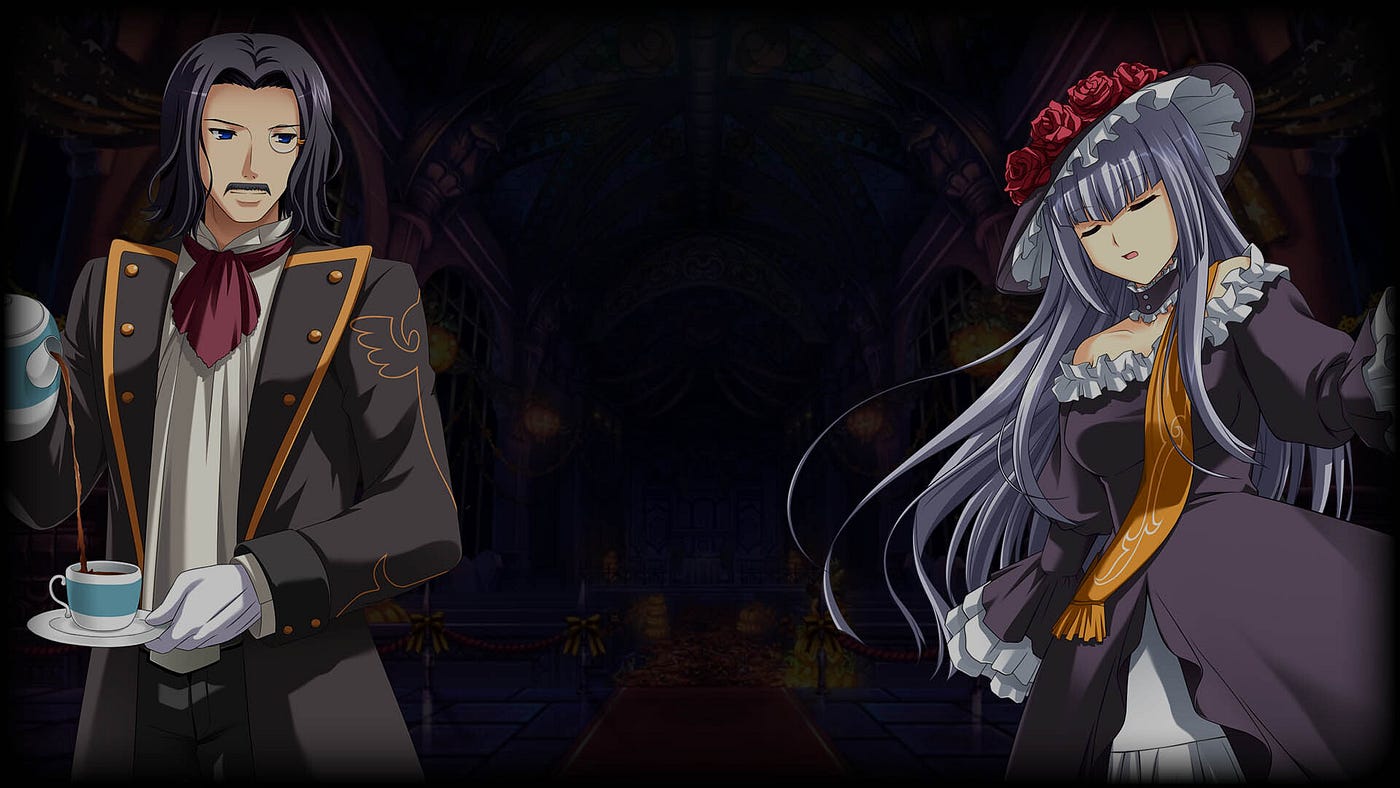
Golden Fantasia tradable Steam background
Abstract
I read Genji Ronoue as a man who felt romantic and sexual desire for Kinzo Ushiromiya, then converted that attachment into the discipline of lifelong service. Ronove gives the buried desire a body and a voice. The case develops across several linked choices: Genji and Kinzo begin as peers; Genji later calls himself “furniture”; Sayo uses the same term for a life barred from reciprocal love; Ronove shares Genji’s name, position, service ethic, powers, and vessel relation; the Episode 8 manga gives young Genji Ronove’s exact appearance; Battler repeatedly recalls the young Kinzo; and Ronove addresses Battler with deliberate erotic play. The manga’s design carries special weight because Sayo never knew Genji in youth. A strictly Sayo-centered account therefore needs an unseen photograph, undocumented testimony, or an accidental reuse of the design. The page itself may disclose the likeness to its audience, while the magical level permits a genuine correspondence between Genji and Ronove. Both routes place the likeness in Genji’s life. Taken together, the evidence supports queer subtext about desire, repression, and displacement. Mutuality, an affair, and an exclusive identity label remain open questions.
I. The claim and its standard of evidence
The claim worth defending is precise:
Ronove’s erotic interest in Battler gives dramatic form to Genji’s repressed desire for Kinzo.
As an interpretation, its strength depends on explanatory reach. A good reading should gather deliberate details into a coherent account, avoid invented facts, and retain the uncertainties left by the text. Here, the proposed connection explains the paired visual likenesses, Ronove’s attachment to Genji, Genji’s severe idea of service, and the erotic register of Ronove’s encounters with Battler.
Episode 2, taken by itself, supports a class-based reading of “furniture.” Genji speaks for the household servants while Rosa suspects them, and the scene concerns trust, keys, and obedience. The later material changes the scope of that word. Once Ronove and Battler recreate the younger forms of Genji and Kinzo, Genji’s self-erasure acquires a possible romantic history.
The argument also draws on more than one version of Umineko. The visual novel establishes the name and vessel links, the Battler-Kinzo comparison, the furniture ethic, and Ronove’s conduct. The Episode 8 manga provides the clearest image of young Genji. Readers who exclude manga additions will reach a more tentative conclusion. Readers who accept the manga’s account of Genji’s past should also reckon with the way that account draws him.
The available evidence supports desire and repression. It leaves the private details of Genji’s sexual history beyond recovery. That boundary gives the thesis its proper size.
II. “Furniture” as a discipline of self-removal
In Turn of the Golden Witch, Rosa treats the servants as possible conspirators and demands their master keys. Genji defines their relation to the family:
“Whether we are trusted by you or not, that is not our concern. . . . We will only continue to serve until our final hour.”
He surrenders his key and presents even death as an acceptable way to recover the family’s trust. In this scene, furniture possesses no claim against its owner. It remains useful, silent, and disposable.
Genji’s language goes far beyond ordinary professionalism. He strips the servant’s judgment, dignity, safety, and desire to be believed of any practical force. Others may suspect or discard the servant; the servant answers with continued usefulness. “Furniture” names this surrender of personal standing.
Sayo gives the term an intimate severity. Their tragedy is driven by the ability to love and the conviction that their body and history bar them from the sexual, marital, and familial future attached to love. “Furniture” becomes a sentence passed upon the self: desire exists, yet the desiring person has forfeited the right to choose and be chosen. Shannon, Kanon, and Beatrice divide possible futures because Sayo cannot imagine one embodied self entering any of them safely.
Genji and Sayo bring different histories to the same word. Its shared core can be stated simply:
“Furniture” names a person who grants service every claim and grants personal desire none.
For Sayo, bodily shame and anticipated rejection make the doctrine explicitly sexual and romantic. For Genji, debt, class, loyalty, and masculine reserve make it look like flawless service. Ronove eventually identifies the romantic object concealed within Genji’s version.
Episode 3 carries Genji’s doctrine into Ronove’s speech. Asked why he remains loyal to an unreasonable Beatrice, Ronove answers,
“To continue serving despite that is furniture’s joy.”
His devotion proves itself through endurance against his own judgment. The master’s failure becomes the servant’s chance to display constancy.
This ethic already has the emotional grammar of love stripped of reciprocity. Ronove’s relation to Battler gives that grammar a personal direction.
III. From friendship to service
The Episode 8 manga begins Genji and Kinzo as peers. They meet in Taiwan as sons of prosperous families, become friends, and share a rivalry in which Genji can compete with Kinzo, deceive him, and answer him freely. Political upheaval destroys Genji’s former life. Kinzo later offers escape, Genji accepts, and the survivor interprets his future as a debt to Kinzo and the Ushiromiya succession.
The rescue is Genji’s stated reason for service. It also creates the social form in which every other attachment can hide. Gratitude, trauma, dependence, guilt, and desire can all sustain the same vow. Kinzo’s intervention explains the vow’s origin; Genji’s later conduct shows how thoroughly the vow consumed him.
The lost equality is the emotional hinge. Young Genji had standing enough to rival Kinzo. Old Genji disclaims even the right to care whether Kinzo’s family trusts him. The text gives him no separate household or public intimate bond, and his chosen surname belongs to Kinzo’s occult system. His adult life has the shape of permanent proximity purchased through self-subordination.
Absence from the record carries little weight by itself. Genji is a private supporting character, and Umineko withholds much of his inner life. The later doubles make that absence meaningful. Ronove restores Genji’s youth, authority, and wit, then directs erotic attention toward the young-Kinzo figure. Through another body, the work restores the missing emotional register.
Debt remains essential to this reading. It gives Genji an honorable language for staying beside Kinzo and allows desire to survive as duty. What begins as rescue becomes a lifelong arrangement in which equality can never be asked for again.
IV. Ronove bears Genji’s youth
The Genji-Ronove connection is unusually dense. Their surnames nearly coincide: Ronoue and Ronove. Both serve as chief butler and head furniture. Both turn extreme loyalty into dignity. Episode 4 identifies Genji as Ronove’s vessel during Jessica’s test. Episode 3 grants Genji a rose-based power like Ronove’s and lets Ronove give him a peaceful death. Genji’s magical profile describes Kinzo’s earliest furniture, created for Kinzo alone.
The Episode 8 manga makes the connection visible. Young Genji has Ronove’s face, hair, bearing, and elegant beauty. The likeness is a recognition cue: before age and service harden him into the familiar butler, Genji looks like the demon already associated with him.
This exactness changes Ronove’s meaning. A shared occupation could produce a generic ideal butler. A temporary vessel relation could remain a device for a single scene. The young-Genji design gathers those earlier links into a portrait. Ronove preserves the man who existed before debt became identity.
The contrast between old Genji and Ronove then becomes psychologically legible. Genji restrains his speech; Ronove plays with words. Genji erases his wants; Ronove turns desire into wit. Genji accepts distance; Ronove moves close enough to make Battler blush. Genji stands beneath Kinzo’s authority; Ronove possesses rank, beauty, and command of his own. Ronove releases qualities that service has trained Genji to suppress.
The word “avatar” can obscure this point if it implies a costume freely invented by Sayo. Ronove works better as Genji’s ideal or metaphysical counterpart: youth, intelligence, authority, style, and desire restored to view.
V. Battler in young Kinzo’s place
Battler completes the arrangement. Genji remarks early that Battler reminds him of Kinzo in youth, and later accounts reinforce the comparison. Family inheritance makes the likeness plausible inside the story. Artistic emphasis gives it a second purpose.
Its placement matters. The manga draws young Genji as Ronove while young Kinzo resembles Battler. Two generations and two levels of reality align:

Substitution governs the arrangement. Battler remains himself, and Ronove treats him as Battler, yet the art places each man in the visual position once occupied by the other pair. Their scenes reprise a lost relation in younger bodies with greater freedom.
The paired design also raises the cost of a coincidence theory. A single resemblance could arise from heredity or artistic economy. Here, two coordinated resemblances join a vessel relation, matched household roles, shared language, and erotic conduct. Any rival account must explain why these choices converge on the same four characters.
Through this arrangement, Ronove can approach the Kinzo figure in a way that Genji’s human role forbids. The scene between Ronove and Battler becomes the expressive counterpart to the silence between Genji and Kinzo.
VI. Ronove’s erotic address to Battler
Ronove’s first substantial exchange with Battler is staged as flirtation. Battler proposes a friendship ritual borrowed from youth drama: two opponents fight, exhaust themselves, and shake hands. Ronove turns the proposal into courtship. They should “exchange body language and sweet words that ring true to the heart,” he says, bringing his face close enough that their noses nearly touch. Battler blushes and pushes him away.
Comedy is the scene’s delivery system. Ronove sexualizes Battler’s language, Battler understands the advance, and the direction of the joke depends on same-sex intimacy. Physical distance, embarrassment, and romantic diction all receive explicit attention.
Ronove’s refinement gives the approach plausible deniability inside the scene. Desire can appear as impeccable wit, then retreat behind a smile. That is precisely the freedom his human counterpart lacks. Genji makes feeling safe by withholding it; Ronove makes feeling safe by making it funny.
Official supplementary material confirms the intended register. Golden Fantasia, written and directed by Ryukishi07, develops the Battler-Ronove pairing through stronger sexual comedy. The Ange-Virgilia route uses bed imagery and a dispute over sexual roles. A fighting-game branch carries limited biographical authority, but it shows the author returning to the same erotic charge and heightening it.
The main series already permits the relevant inference. Ronove embodies Genji’s younger and less inhibited form, while Battler recalls Kinzo’s. Ronove’s desire for Battler therefore restages Genji’s desire in the position where young Kinzo now appears. The evidence supports displaced erotic attachment. The historical questions of consummation and reciprocity remain unanswered.
VII. The knowledge problem
Sayo knew Genji only in later life, and the work records no photograph or detailed description. This fact determines where the manga’s likeness can originate.
An unseen photograph offers one logical possibility. It also adds a fact solely to protect a prior theory, so it has little explanatory value. An accidental reuse by the manga artist remains possible as well. Yet the reused design happens to complete an existing series of links: name, role, service ethic, vessel status, rose power, and the pairing with a young-Kinzo likeness. Accident becomes an expensive explanation when the alleged error fits the surrounding pattern so neatly.
Two stronger accounts remain. On a fully human level, the Episode 8 manga speaks to its audience with resources unavailable to Sayo. The past sequence can reveal through composition and character design what no in-world memoir records. Young Genji’s face then acts as an authorial gloss on Ronove: the artwork tells us whose buried self the demon carries.
On a magical level, Ronove may have a genuine bond to Genji as vessel, soul-image, ideal form, or posthumous counterpart. His appearance would arise from that bond. Magic can register a truth beyond Sayo’s conscious knowledge.
These accounts disagree about the reality of magic and agree about the source of the likeness. Both root Ronove’s face in Genji’s actual character. Sayo’s knowledge limits conscious design; the manga’s composition and the magical level operate beyond that limit.
The knowledge problem thus moves Ronove’s erotic conduct closer to Genji. A Sayo-only projection leaves the exact young-Genji face unexplained.
VIII. A composite Ronove
Sayo still contributes to Ronove. His wit, theatricality, and interest in Battler fit her magical authorship. Umineko, however, often builds a magical figure from several sources at once. Virgilia grows from Kumasawa while also expressing Sayo’s idea of a teacher and the audience’s sense of an older woman’s care. Gaap can embody a trick, a friend, an escape, and part of Sayo’s divided mind. Beatrice can be culprit, author, lover, role, memory, and witch in the same work.
Ronove admits the same layered construction. Sayo may write his dialogue and choose how he behaves on her stage. Genji contributes the human relation that gives the performance its hidden history. Projection explains the choice of Battler as target; young Genji’s face requires another source.
The combined account is concise:
Sayo builds the stage and writes the role; Genji’s life contains the desire the role exposes.
If Sayo once saw a photograph, her use of Genji’s face becomes intentional and the link grows more direct. If she lacked that knowledge, the manga completes the connection for its audience or magic derives it from Genji. Every viable route preserves the semantic force of the resemblance.
This composite reading gives Sayo full credit as creator of the gameboard while respecting the exact design chosen for Ronove. A character written by Sayo can still reveal a truth about Genji.
IX. Love recoded as service
Within this chain of correspondences, Genji’s self-title acquires its romantic force. “Furniture” begins as a servant doctrine. Genji’s history and Ronove’s conduct show what the doctrine does to his desire.
Genji recodes love as service. Friendship once allowed equality; desire would seek recognition; furniture authorizes proximity on the condition of silence. As furniture, Genji may remain at Kinzo’s side while renouncing every claim that could disturb their hierarchy. Attachment becomes duty, jealousy becomes discretion, and self-denial becomes virtue. Kinzo’s failures even give Genji further occasions to prove his constancy.
Ronove reverses that discipline from inside the same role. He remains a butler, yet he speaks with authority, mocks his mistress, judges strategy, and chooses how to help Battler. Service becomes an aesthetic choice, freed from inner servility. He can also turn intimacy into a spoken joke. Humor protects the flirtation without emptying it of desire.
The manga’s treatment of Ronove’s beauty matters for the same reason. Young Genji appears as a desirable man with wit, social force, and a life before debt. The design invites the audience to see what “perfect old furniture” has cost him. Ronove preserves the self Genji surrendered.
The emotional logic condenses into a line invented for this argument:
If I cannot stand beside you as the person who wants you, I will remain beside you as the object that wants nothing.
That line is an interpretive paraphrase. It joins the furniture doctrine, the lifelong service, and Ronove’s liberated desire into one psychology.
X. Counter-readings
Objection 1: “Furniture” as a servant term
Episode 2 uses “furniture” collectively. Gohda, Shannon, and Genji are servants under suspicion, so the immediate scene defines professional self-effacement. On its own, the word belongs to servant ideology.
That first meaning remains intact. The queer force arrives through later context: Sayo demonstrates the term’s capacity to express romantic self-disqualification, while Ronove and Battler identify an object and a displaced form for Genji’s desire. The senses meet in a shared doctrine of personhood surrendered to service.
Objection 2: Debt as a sufficient motive
The Episode 8 manga openly grounds Genji’s vow in rescue from political violence. Gratitude offers an economical explanation for his loyalty.
Debt and desire can coexist. Rescue creates the obligation and gives it a public language. The paired doubles explain why the relationship later returns in erotic form. A debt-only account must set aside Ronove’s young-Genji appearance, Battler’s young-Kinzo appearance, and the flirtation between them. The queer reading gathers those choices while preserving gratitude as a central motive.
Objection 3: Ronove as demon and comic butler
Ronove draws on a Goetic demon and performs many functions unrelated to Genji. His flirting also suits the cultivated wit of a comic butler.
An independent magical identity can carry human correspondence. Virgilia exceeds Kumasawa, yet Kumasawa remains essential to her meaning. Ronove’s Goetic source accounts for his rank and infernal pedigree. Genji accounts for his youthful face, household role, vessel relation, rose ability, service ethic, and place beside Kinzo’s younger likeness. Comedy is the mode through which the desire becomes speakable.
Objection 4: Visual shorthand in adaptation
The manga artist may have reused Ronove’s design simply to make the vessel relation easy to recognize.
That purpose already grants the likeness semantic force: Ronove’s face tells the audience to connect the demon with Genji. Once established, the connection brings Ronove’s characterization into view. The sexual implication arises from the full pairing, since the same manga also places Battler’s appearance on young Kinzo. Visual shorthand is part of the argument because it coordinates both sides.
Objection 5: A photograph or family story
Rokkenjima may have held old photographs, and Sayo knew Genji long enough to hear stories about his youth.
The possibility lacks direct support, but it offers no refuge from the central inference. A knowledgeable Sayo who chooses young Genji’s face for Ronove has linked Genji to Ronove’s sexuality intentionally. The hypothetical photograph changes who authored the resemblance; it leaves the resemblance itself in place.
Objection 6: Genji’s protection of Sayo
Genji conceals Sayo’s survival and true identity from Kinzo after witnessing Kinzo’s abuses. This defiance may seem incompatible with enduring love.
Desire can survive beside moral revulsion, guilt, and altered allegiance. Genji may love the young friend he lost, remain bound by debt to the older man, and still recognize Kinzo as a danger to Sayo. His feelings may also change across decades, moving from desire into grief, resentment, duty, or mourning. Ronove can preserve an earlier attachment after Genji’s daily loyalty has acquired a different emotional texture.
His protection of Sayo becomes especially legible once love and service are separated. Genji finally acts on a judgment that his furniture doctrine had long required him to suppress.
Objection 7: Limits of an identity label
One desired man establishes the object of desire, not the full range of a person’s orientation. Genji’s private life is largely absent from the record.
The exact conclusion is same-sex romantic and sexual desire for Kinzo. “Gay Genji” remains useful fan shorthand, while an exclusive orientation exceeds the evidence. The thesis needs neither exclusivity nor a modern label.
Objection 8: Fan reception
Shipping culture and wordplay can encourage certainty from sparse material, and this interpretation has circulated in fan discussion.
Authority comes from the primary works. Fan discussion matters here as reception history because readers independently noticed the same linked design: Battler as young Kinzo, Ronove as young Genji, Ronove’s flirtation, Genji’s furniture identity, and Genji’s forfeited life. Popularity cannot prove the reading, and skepticism cannot dispose of its evidence.
XI. The cost of Genji’s silence
Genji often appears as a plot mechanism: keeper of Kinzo’s secrets, protector of Sayo, accomplice, master-key holder, and reliable body for closed-room construction. A queer reading gives those functions a personal cost.
The split between young and old Genji gains emotional content. Young Genji is a rival and friend. Old Genji speaks of death as honorable service. Ronove occupies the life between them: mature, beautiful, articulate, and capable of treating desire as his own.
It also deepens Genji’s complicity without excusing it. Love and debt can lead a person to guard secrets, rationalize harm, and surrender moral agency. “Furniture” offers an alibi against responsibility: an object obeys and bears no guilt. Genji nevertheless makes consequential choices throughout the story. His self-objectification helps him avoid examining what loyalty has enabled.
Genji’s relation to Sayo then becomes one of recognition as well as guardianship. Both respond to bodily or social impossibility by treating themselves as less than fully human. Both separate desire from the self permitted to act in public, and both use service to remain near a family that injured them. Genji may understand Sayo’s crisis because he has practiced another form of the same renunciation.
Their differences remain decisive. Sayo’s crisis involves their body, parentage, gendered roles, incestuous origin, and competing promised futures. Genji’s involves class, debt, same-sex desire, age, and the collapse of friendship into service. The shared word reveals a common strategy across distinct lives: make the self into an object so that wanting loses its power to threaten the beloved or the household.
Genji’s silence therefore carries structure and purpose. It is the method by which he makes feeling safe. Ronove’s speech reveals the personality disciplined out of daily view: judgment, sarcasm, pride, tenderness, and erotic play. The perfect servant has required the burial of a whole person.
XII. Degrees of confidence
An adversarial reading benefits from sorting the claims by evidentiary strength.
Confirmed by the work
- Genji and Kinzo were friends before their master-servant relation.
- Kinzo’s rescue creates the debt by which Genji explains lifelong service.
- Genji calls himself furniture and defines furniture through self-denying loyalty.
- Ronove closely matches Genji in name, role, ethic, ability, and vessel relation.
- The Episode 8 manga gives young Genji Ronove’s appearance.
- Battler is compared with and drawn like the young Kinzo.
- Ronove’s approach to Battler has deliberate same-sex romantic and sexual content.
Strongly supported interpretation
- Ronove restores traits and desires suppressed by Genji’s human role.
- Ronove’s attraction to Battler restages Genji’s attraction to Kinzo through the paired likenesses.
- Genji’s furniture identity turns impossible desire into permanent, one-sided service.
- Genji is a bottom and Kinzo is a toxic top (trust me bro)
Open questions
- The identity terms Genji might have used for himself.
- The full range of his sexual orientation.
- Kinzo’s recognition or return of the desire.
- A sexual relationship between them.
- The kind and intensity of Genji’s feeling in 1986.
This hierarchy protects the central conclusion from excess. Desire, repression, and displacement have strong support. Mutuality, consummation, and identity remain outside the claim.
Conclusion: Desire in the demon
The case for Genji’s desire arises from a designed relation among four figures.
Genji gives up equality with Kinzo and turns a rescued life into permanent service. He calls that service furniture, a state in which judgment, safety, and the need for recognition cease to count. Sayo’s use of the term reveals its romantic capacity, while Genji’s history traces a different route to the same self-removal. Ronove then appears as Genji’s name-double, role-double, vessel, magical analogue, and restored young face. Battler occupies the corresponding position of the young Kinzo. Within that reconstructed relation, Ronove flirts openly, physically, and sexually.
Sayo’s lack of access to young Genji clarifies where the likeness originates. The manga may address its audience beyond Sayo’s awareness; magic may disclose a real bond to Genji; a hypothetical photograph would make Sayo’s choice deliberate. The remaining error theory asks us to treat the visual decision that completes every other link as an accident.
The most economical synthesis joins Sayo’s authorship, the manga’s visual disclosure, and Genji’s buried life. Ronove is the form in which Genji becomes young, equal, witty, and openly desiring again. The demon preserves what the servant surrendered.
Genji remained beside Kinzo by insisting that he wanted nothing. Ronove exposes the cost of that insistence.
Appendix: The inference chain

Works cited and source note
Primary works carry the argument. Web transcriptions are linked to make short quoted passages easy to verify. The final item records the theory’s reception history; the conclusion draws its authority from the primary material.
Ryukishi07. Umineko When They Cry: Turn of the Golden Witch. 07th Expansion, 2007. English edition published by MangaGamer. Official Question Arcs edition. The servant-key exchange is reproduced with screenshots in “Let’s Read Umineko: Episode 2, Part 18”.
Ryukishi07. Umineko When They Cry: Banquet of the Golden Witch. 07th Expansion, 2008. English edition published by MangaGamer. Ronove’s introduction and bodily approach to Battler are reproduced in Episode 3, Part 3; his furniture statement appears in Episode 3, Part 4.
Ryukishi07. Umineko When They Cry: Alliance of the Golden Witch. 07th Expansion, 2008. Jessica’s test identifies Genji as Ronove’s vessel.
Ryukishi07, and Kei Natsumi. Umineko WHEN THEY CRY Episode 8: Twilight of the Golden Witch. Translated by Stephen Paul, Yen Press, 2019–2020. The Taiwan account and young-Genji design appear in the English omnibus edition. Volume 1; Volume 2; Volume 3.
Vivid hallucinations and wishful thinking.
07th Expansion. Umineko: Golden Fantasia and Golden Fantasia Cross. Written and directed by Ryukishi07, 2010–2011; worldwide release by MangaGamer, 2017. Publication and credit details.
“Genji Ronoue.” 07th Expansion Wiki. Used as a cross-reference for episode locations, the missing Tip, vessel status, and the manga-only Taiwan background.
Bancho. “Umineko — Ronove Character Discussion.” Rokkenjima, 6 July 2017. A fan formulation of the same linked reading and part of its reception history.
메타데이터
- post_id
- abd5ff6f7326
- slug
- furniture-at-his-masters-side-abd5ff6f7326
- url
- https://medium.com/@giancarlovanzzini/furniture-at-his-masters-side-abd5ff6f7326
- canonical_url
- https://medium.com/@giancarlovanzzini/furniture-at-his-masters-side-abd5ff6f7326
- author_url
- https://medium.com/@giancarlovanzzini
- status
- ok
- fetched_at
- 2026-07-29 11:52:52