What Nobody Tells You About Developing Energy Projects in Africa
When people talk about Africa’s energy sector, the conversation is often filled with optimism.
What Nobody Tells You About Developing Energy Projects in Africa
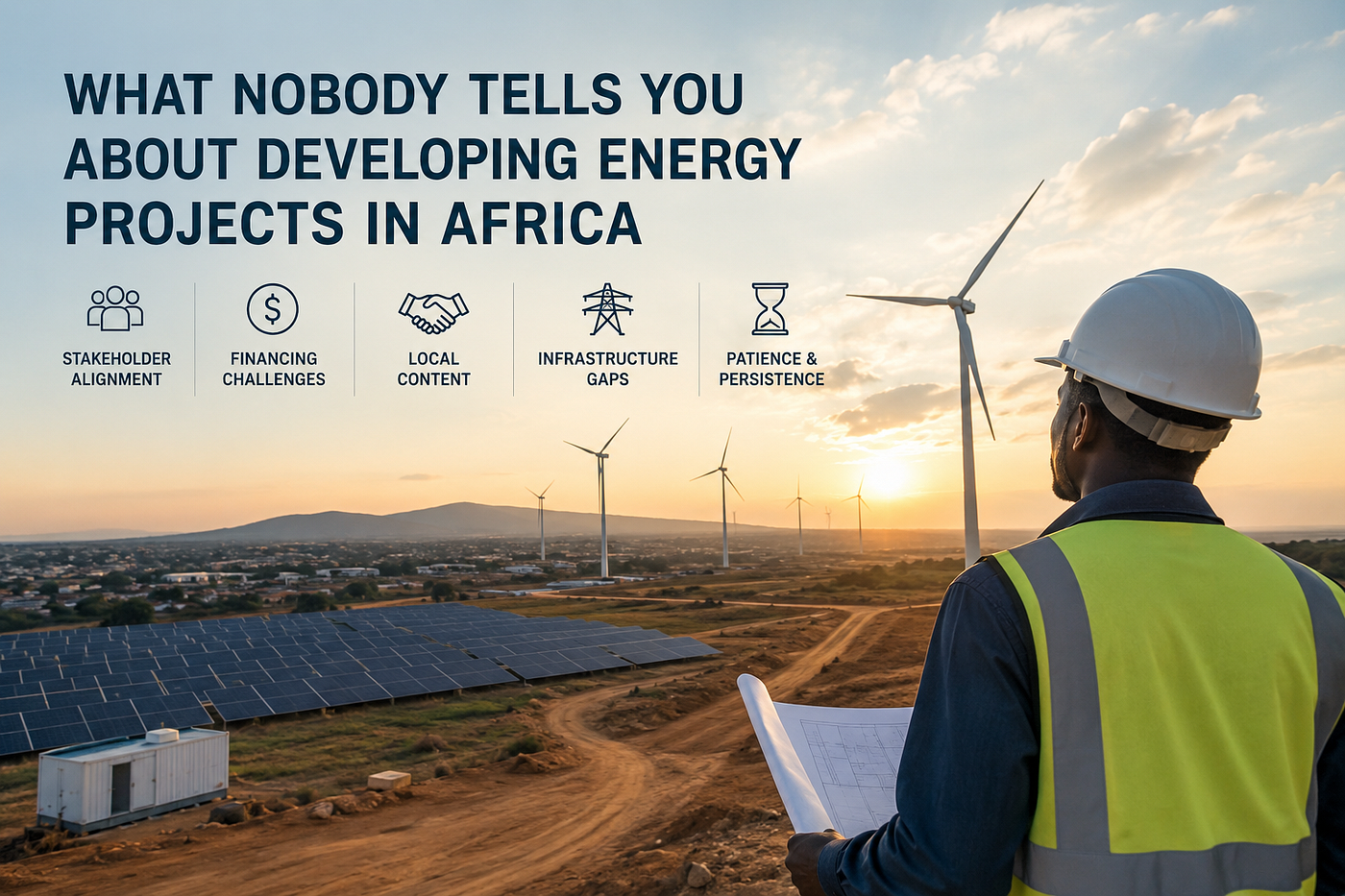
When people talk about Africa’s energy sector, the conversation is often filled with optimism.
The continent has some of the world’s fastest-growing populations, abundant renewable energy resources, and significant unmet electricity demand. Reports frequently highlight the enormous potential of solar, wind, hydro, battery storage, and green hydrogen projects across Africa.
All of that is true.
However, after spending time working on energy project development in Africa, I have come to realize that the reality is often more complex than many people imagine.
The biggest challenges are not always technical.
In fact, modern energy technologies are becoming increasingly mature. Solar panels are more efficient than ever, wind turbines continue to grow in capacity, and battery storage systems are rapidly improving.
The real challenge often lies elsewhere.
Projects Move at the Speed of Stakeholders
One lesson that surprised me is that projects rarely move at the speed of engineering.
They move at the speed of stakeholder alignment.
A typical energy project may involve developers, lenders, EPC contractors, OEM suppliers, local authorities, utilities, environmental consultants, legal advisors, and local communities.
Each stakeholder has different priorities.
A lender focuses on risk.
A developer focuses on project returns.
An EPC contractor focuses on delivery and cost control.
A supplier focuses on commercial terms.
A utility focuses on grid stability.
A government agency focuses on compliance and local development.
Keeping all of these parties aligned is often far more challenging than solving technical problems.
Financing Can Be More Difficult Than Construction
Another reality is that financing remains a major hurdle.
Many African countries have excellent renewable energy resources, but investors often assess projects through the lens of political risk, currency risk, regulatory uncertainty, and off-taker creditworthiness.
A technically viable project is not necessarily a bankable project.
As a result, project developers frequently spend years working through financing structures before construction can begin.
In many cases, financial close is a greater milestone than groundbreaking.
Local Content Is Becoming Increasingly Important
Across the continent, governments are placing greater emphasis on local participation.
This is understandable.
Energy projects are not only expected to generate electricity; they are also expected to create jobs, transfer knowledge, and support economic development.
For international developers and contractors, this means that success increasingly depends on building strong local partnerships.
Technical capability alone is no longer sufficient.
Understanding local business environments and developing long-term relationships can be just as important.
Infrastructure Challenges Extend Beyond Generation
Generating power is only part of the equation.
Transmission networks, substations, roads, ports, and logistics chains all play critical roles in project execution.
In some regions, the challenge is not whether energy can be generated, but whether it can be delivered reliably to consumers.
For developers, this means that project planning often requires looking beyond the power plant itself and considering the broader infrastructure ecosystem.
Patience Is Not Optional
Perhaps the most important lesson is that patience is a professional skill.
Project timelines often change.
Meetings get postponed.
Approvals take longer than expected.
Responses that seem urgent may arrive weeks later.
For those accustomed to fast-moving environments, this can be frustrating.
Yet successful project development often depends on maintaining momentum while accepting that certain factors remain outside your control.
The Opportunity Remains Enormous
Despite these challenges, I remain optimistic about Africa’s energy future.
Electricity demand continues to grow.
Governments are investing in energy infrastructure.
Renewable technologies are becoming more competitive.
International investors continue to explore opportunities across the continent.
The path is rarely straightforward, but the long-term potential is difficult to ignore.
Africa is not an easy market.
It is not a simple market.
But for those willing to understand its realities, it may become one of the most important energy growth stories of the coming decades.
메타데이터
- post_id
- abe2ca1c646b
- slug
- what-nobody-tells-you-about-developing-energy-projects-in-africa-abe2ca1c646b
- url
- https://medium.com/@ashplankwei/what-nobody-tells-you-about-developing-energy-projects-in-africa-abe2ca1c646b
- canonical_url
- https://medium.com/@ashplankwei/what-nobody-tells-you-about-developing-energy-projects-in-africa-abe2ca1c646b
- author_url
- https://medium.com/@ashplankwei
- status
- ok
- fetched_at
- 2026-06-24 23:31:39