Market Risk Reimagined: The Global Implementation Journey of FRTB
The Fundamental Review of the Trading Book more popularly known by its acronym FRTB is the new Market Risk Capital Requirement which…

Market Risk Reimagined: The Global Implementation Journey of FRTB
The Fundamental Review of the Trading Book more popularly known by its acronym FRTB is the new Market Risk Capital Requirement which represents a paradigm shift in how banks compute Market Risk Capital Charge. Born from the ashes of the 2008–09 Global Financial Crisis, this Basel IV (or Basel 3.5 or Basel III depending upon which side of the world you reside and convention used) initiative aims to remedy the critical shortcomings exposed during that turbulent period and fundamentally redesign Market Risk Capital requirement. From its conceptual beginnings in May 2012^ to the publication of final guidelines in January 2019 (post the 2016 draft^^ version), FRTB has evolved into a comprehensive framework that fundamentally redesigns market risk capital measurement.
This revamped framework is heavily data-intensive and complex regulatory requirement that introduces sophisticated methodologies aimed at better capturing market risk sensitivities, addresses correlation impacts across asset classes, and eliminates capital arbitrage opportunities that exist in the previous regime. What began as a targeted implementation for January 2023 has seen varied adoption timelines across jurisdictions, with some regulatory bodies now operational while others remain in developmental stages awaiting the Day one Go live 😊.
Rationale behind the genesis of FRTB:
The 2008–09 financial crisis exposed critical flaws in how financial institutions measure and capitalize market risk and foundational issues that warrant an overhaul. Some noteworthy ones include but not limited to:
· Under-capitalization of Trading Book Exposures: The crisis revealed that banks held insufficient capital against their trading activities, particularly for complex structured products.
· Yield Curve Assumptions: Standardized approaches used prescribed yield shifts that significantly underestimated actual price impacts observed during stress events.
· Correlation Effects: Previous approaches failed to appropriately capture correlation effects between different asset classes during stress periods.
· Better Calibration between SA and IMA: Better calibration of Standardized Approach and Internal Model Approach and strengthen the relationship between them and allow the Standardized Approach to be a reliable alternate for Banks which doesn’t have complex business models requiring Sophisticated Model Approach or those which failed the criteria (P&L Attribution Test and Backtesting requirement) to apply the IMA approach.
· Jurisdictional Inconsistencies: Substantial variations existed in how different regulatory jurisdictions applied market risk approaches:
o US supervisory authorities permitted Internal Model Approach (IMA) application for General Market Risk only
o EU authorities allowed IMA for both General and Specific Risk.
o These inconsistencies created regulatory arbitrage opportunities and much more.
Global Implementation timeline
Based on the mostly recently published Regulatory Capital Assessment report by Basel updated till Sep’24 globally there is a staggered implementation timeline (green colour denoted by adoption completed is very less) creating further challenges for global banking organizations that must navigate different requirements across their geographic footprint. Add further to that local implementation of FRTB across different jurisdictions fuels further complexity that can lead to disproportionate treatment for the same risk positions leading to unintended Capital Arbitrage potentially requiring parallel calculation methodologies and systems.
FRTB Adoption status:
Global View:

Country-wise View

Overview of Approaches:
As part of Basel IV guidelines, the FRTB framework offers three distinct approaches for market risk capital calculation, each with specific eligibility criteria and application considerations:

The Approach names referred above are the ones specified in Basel Accord, for some specific jurisdiction the naming convention used are different, but the framework remains as above ( example EBA as a case in point).
Standardized Approach (FRTB-SA)

The Standardized Approach (Also known as Revised Standardized Approach, Alternative Standardized Approach and more popularly FRTB-SA) represents a complete redesign of the previous standardized methodology, introducing a sophisticated sensitivity-based method (SBM) that incorporates liquidity horizon and introduce correlation parameter for different risk classes with different level granularity at both Bucket level and cross bucket level across risk classes
· Risk Sensitivity Calculations: Delta, Vega, and curvature risk measurements across seven risk classes:
- General Interest Rate Risk (GIRR)
- Credit Spread Risk (CSR) for non-securitization
- Credit Spread Risk (CSR) for securitization (non-CTP)
- Credit Spread Risk (CSR) for securitization (CTP)
- Equity Risk
- Commodity Risk
- Foreign Exchange (FX) Risk
· Correlation Factors: Different correlation parameters at bucket and cross-bucket levels
· Liquidity Horizons: Varying horizons based on risk factor characteristics
· Default Risk Charge (DRC): Separate measurement for default risk not captured by SBM
· Residual Risk Add-on (RRAO): Additional capital for exotic products and risks not captured by SBM or DRC
All banks must implement this approach unless explicitly permitted to use the simplified alternative. Even banks using IMA must calculate FRTB-SA for approved trading desks to establish output floor requirements.
Internal Model Approach (FRTB-IMA)

Internal Model Approach (Also known as Alternative Internal Model Approach and more popularly FRTB-IMA) is a supervisory approval-based approach and is an extension of the Internal Model Approach as per the existing Market Risk approach.
· Expected Shortfall (ES) Replacement: Replaces Value at Risk (VaR) methodology
· Confidence Interval Shift: Moves from 99% (VaR) to 97.5% (ES)
· Variable Liquidity Horizons: Introduces risk-class specific horizons ranging from 10–120 days
· Risk Factor Eligibility Testing: Formal criteria determining modellable vs. non-modellable risk factors
· Non-Modellable Risk Factor Charges: Additional capital requirements for factors failing eligibility tests
· Trading Desk Level Approval: Desk-specific qualification based on P&L attribution and backtesting
· Continuous Compliance: Ongoing requirements to maintain IMA eligibility
Each Trading desk must mandatorily compute Market Risk Capital charge using a Standardized Approach irrespective of the fact that it meets all the requirements of Model approval and inclusion under IMA which will be used as a threshold level for Output Floor requirements.
Simplified Standardized Approach (SSA)
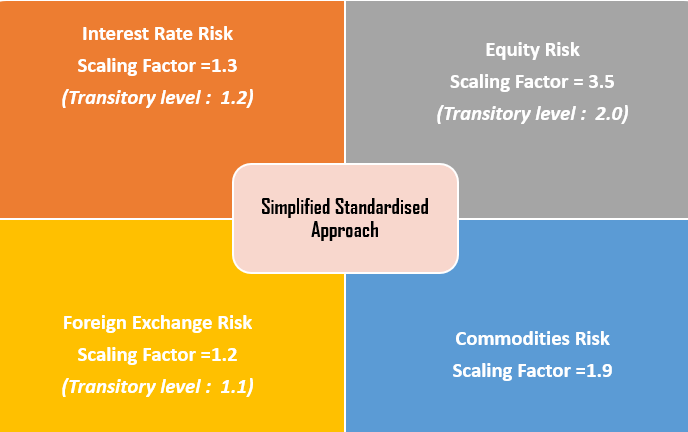
Simplified Standardized Approach (Also known as R-SBM) was published first as a draft guideline in 2017 with the final publication in Jan 2019 as an alternate for Smaller Banks that can’t handle the complex data requirements and computational capability in terms of IT infrastructure required to perform Standardized Approach as well as comprise of less complex trading book positions.

· Eligibility Criteria: Specified size thresholds and trading activity limitations.
· Reduced Complexity: Simplified calculations requiring less granular data.
· Capital Conservation: Higher capital requirements through scaling factors (1.2x to 3.5x) based on risk class:
- Interest Rate Risk: 1.2x
- Credit Risk: 1.5x
- Equity Risk: 3.5x
- FX Risk: 1.5x
- Commodity Risk: 1.7x
· Jurisdictional Variations: Different qualification criteria across regulatory regions.
Challenges and Opportunities- Practical Insights:
FRTB brings along a host of challenges as well as offers opportunities for Banks to overhaul their entire Trading Book and rebuild the way Market risk is measured and analyzed. One of the foremost challenges revolves around data requirements and IT infrastructure to handle the complex regulatory calculation efficiently across all approaches:
· Instrument Classification Granularity: Precise sector allocation determining bucket classification
· Attribute Completeness: Comprehensive data attributes affecting correlation factor application
· Historical Market Data: Extensive time series data for internal model calibration
· Real Price Evidence: Documentation of observable transactions for risk factor modellability else falling under add on capital requirement for being assigned a NMRF.
· Data Lineage and Governance: Traceable data flows meeting regulatory scrutiny.
The capital impact of data gaps can be severe, with conservative fallback treatments applied to exposures with insufficient information.
Another challenge that has grown over the years is the cross jurisdictional complexity that has expanded over the years as more and more jurisdictions make modification to meet/ promote local industry. (Refer my post for a detailed overview and the situation that has unfolded: https://www.linkedin.com/pulse/fundamental-review-trading-book-frtb-challenges-manoj-iz1qe )
There are plenty of instances where we can observe variations leading to unintended arbitrage opportunity such as :
· Differential Treatment of Similar Exposures: Same risk positions receiving different capital treatment across regions.
Example 1: EU jurisdiction permits certain index components to be assigned Large Cap status with lower risk weights, while other jurisdictions use market capitalization thresholds.
Example 2: Certain currency pairs receive preferential risk weights in some jurisdictions but not others.
· Inconsistent Eligibility Criteria: Different thresholds for approach eligibility across regions.
· Timeline Misalignment: Operational challenges when implementing at different times across regions.
Despite these challenges, FRTB implementation offers significant strategic opportunities provided the regulation is handled less as a compliance and more as an opportunity to rebuilt the Trading Books:
- Enhanced Risk Management Capabilities: Improved market risk measurement enabling better strategic decisions.
- Trading Book Optimization: Opportunity to restructure trading activities for capital efficiency.
- Data Quality Improvements: Catalyst for addressing long-standing data quality issues.
- Technology Modernization: Justification for modernizing risk technology infrastructure.
- Competitive Advantage: Potential for capital efficiency advantages against less prepared competitors.
RWA impact (SA vs IMA comparison)
The overall impact on Market RWA is a considerable increase irrespective of the type of approach adopted by the Bank across various jurisdictions. However, the finer details lie in the wide variation observed across banks within and across jurisdictions.
Additionally, Internal Model Approach which is usually associated with lower capital charge than Standardized Approaches have also observe significant increase due to the non-modellable risk factor (NMRF) charges that have emerged as a significant component of IMA capital requirements:
NMRF contribution for Group 1 Banks: 37.5% of total IMA capital.
NMRF contribution for Group 2 Banks: 62.4% of total IMA capital.
Concluding Remark:
The FRTB implementation journey has evolved from a theoretical regulatory change to an operational reality for many institutions, with remaining banks facing imminent deadlines. While the compliance burden is substantial, forward-thinking organizations recognize FRTB as more than a regulatory exercise — it represents an opportunity to fundamentally enhance market risk management capabilities.
The path forward requires a balanced approach that addresses immediate compliance needs while building toward longer-term strategic objectives. Banks that successfully navigate this transition will emerge with:
- More risk-sensitive capital frameworks
- Enhanced data management capabilities
- Modernized risk technology infrastructure
- Optimized trading strategies aligned with capital efficiency
The competitive landscape will increasingly differentiate between institutions that treated FRTB as a compliance checkbox and those that leveraged it as a catalyst for strategic transformation. As implementation deadlines continue to extend, but it is imminent that the FRTB Day one will arrive soon after the long decade wait, the time for strategic action is now before Day one becomes a reality.
메타데이터
- post_id
- abe9de323c5f
- slug
- market-risk-reimagined-the-global-implementation-journey-of-frtb-abe9de323c5f
- url
- https://medium.com/@manojrathifrm/market-risk-reimagined-the-global-implementation-journey-of-frtb-abe9de323c5f
- canonical_url
- https://medium.com/@manojrathifrm/market-risk-reimagined-the-global-implementation-journey-of-frtb-abe9de323c5f
- author_url
- https://medium.com/@manojrathifrm
- status
- ok
- fetched_at
- 2026-07-20 03:01:46