Fixing a Broken Toaster with Python: Automating Everyday Problems
A Humorous Dive into the Practical (and Impractical) Uses of Code in Daily Life.
Fixing a Broken Toaster with Python: Automating Everyday Problems
A Humorous Dive into the Practical (and Impractical) Uses of Code in Daily Life.

Intro
The majority of us can toast our bread without Python, let’s face it. However, imagine being able to see the precise time it appears, have a webcam take a photo, and receive a Slack notice that reads, “Your breakfast is served.” Crazy? Of course. Have fun? Definitely.
Welcome to the delightfully superfluous realm of using Python to over-engineer everyday tasks. It’s reasonable to ask, “What else can I automate?” in a time when smart refrigerators can alert you when milk is running short and your phone is more aware of your sleep schedule than you are.
No matter how unrealistic, that curiosity has turned into a playground for both enthusiasts and programmers. The ridiculousness is half the idea, whether you’re creating a system that uses your Outlook calendar to start the coffee maker or that SMS your roommate when the toilet paper roll is empty. It’s more than simply solving issues; it’s about coming up with challenges that are worthwhile to solve, if only to test your coding prowess.
Real advantages may be gained from even the most simple tasks, such as managing real-time input and output, learning about sensors, experimenting with APIs, and troubleshooting edge situations that arise from real-world devices. It’s interactive education disguised as comedy.
Indeed, this post is about “fixing a toaster with Python,” but in a metaphorical sense, it’s about adding a little magic driven by code to the everyday. Automating the routine might become your next strangely fulfilling fixation, regardless of whether you’re a novice seeking a lighthearted project or an experienced developer in need of a respite from serious tasks.
Let’s toast to that.
2. Why Automate the Mundane? — Philosophy Behind It
The phrase “Work smarter, not harder” is almost a motto in the computer industry. That ideal — freeing up time by letting computers tackle predictable, repetitive tasks — is frequently embodied by automation. It lowers human error and saves money in business systems. in private endeavors? It’s frequently motivated by curiosity, sloth, or, let’s face it, a geeky feeling of accomplishment.
However, not all tasks require automation. Nobody really needs a Python script to restock peanut butter from Amazon when the jar weight falls below 200g, or to turn down the lights when their cat enters the room. However, some of the most enjoyable — and surprising — learning takes place in these “solutions.”
Saving time is not the only benefit of automating the routine. It’s a justification for playing. You create the task for yourself, free from deadlines, pressure, or Jira tickets. You’re finding out how to get your ceiling fan to spin faster when your favorite music comes on, not streamlining a business process. That is creative discovery, not waste.
You may experiment with hardware and software, sensors and APIs, logic flows, and exception handling with these bite-sized projects. Failure simply means “the light didn’t turn on” rather than a system crash or a missed salary. Lessons can be significant, but the stakes are minimal.
The concept of “overkill coding” enters the picture here. It involves purposefully using considerably more technology than is really needed for a task in order to test your ability. When you’ve learned about GPIO, motor controllers, and real-time input processing, it’s like designing a robot to turn a light switch when you could just use your finger.
And that’s what matters. You hone the same abilities required for automation in the real world by taking on the ridiculous. You develop your intuition. You become more accustomed to failing. While you giggle at the fact that you just written 100 lines of code to see whether your plant needs watering, you debug, restructure, and find new tools.
So yes, it’s silly. And that’s exactly why it’s worth doing.
3. Real Examples of Absurd Automation
Let’s get started with some incredibly pointless yet truly instructive Python projects. These examples blend code, hardware, and comedy in a way that emphasizes exploration above efficiency, yet they all teach you something valuable.
3.1 Coffee Scheduler: Brew by Calendar
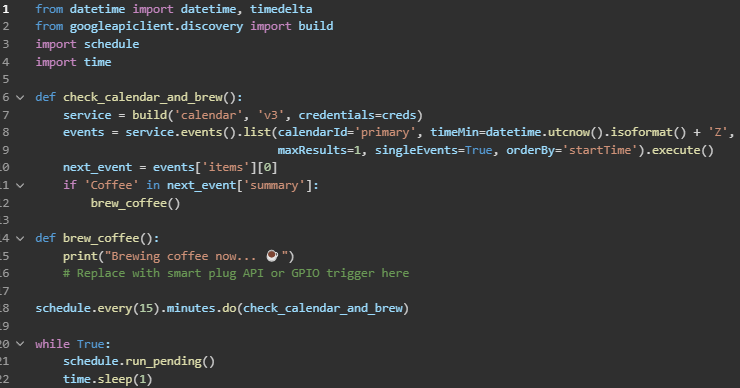
Before your first meeting, what if your coffee maker could check your Google Calendar and make a new cup? Excessive? Of course. But helpful? Possibly.
Reading calendar events with the Google API Python Client and activating a Raspberry Pi relay or smart plug:
3.2 Toaster Monitor: Toast Readiness Detection
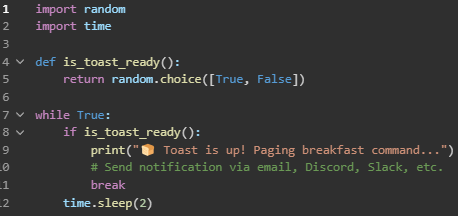
Cold bread is disliked by everybody. So why not construct a monitor for your toaster that will notify you as soon as your bread ejects?
A light sensor or a pressure sensor placed underneath the toast slot can be used to mimic toast detection. Alternatively, for a completely made-up version:
3.3 Laundry Timer: Slack Alerts from a Washing Machine
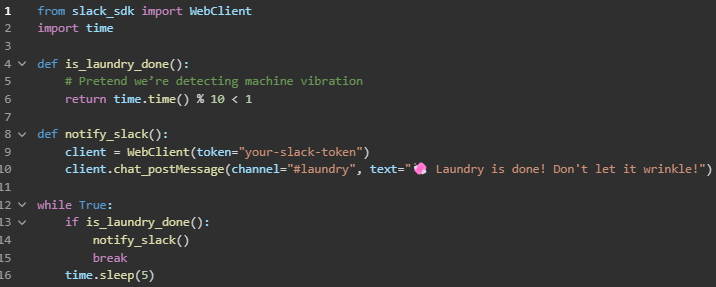
You will be able to relate to this if you have ever left wet clothing in the washing machine. Connect a vibration sensor (or use time to imitate one) and use Slack to let you know when the shaking stops.
Use a fake vibration function and slack_sdk for messaging:
3.4 Fridge Inventory Tracker: Never Run Out of Mayo
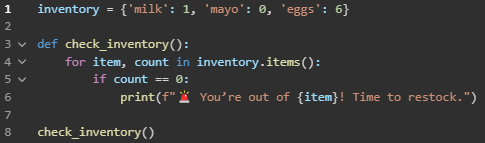
You can create a fridge inventory tracker that notifies you when you’re running out on necessities using a Raspberry Pi, a Python script, and a basic barcode scanner (or the camera on your phone).
Emulate inventory levels and product scanning:
In Summary
Despite their purposeful impracticality, these “absurd automations” offer a surprisingly efficient method of improving your Python abilities. Every project has scheduling, alerts, sensors, APIs, and logic flows that are similar to those found in professional applications. stuff’s okay if stuff goes spectacularly wrong here, though. That’s actually half the enjoyment.
4. Tools and Libraries to Use
Every ridiculous automation is supported by a toolkit of surprisingly strong (and frequently user-friendly) Python modules. With the correct tools, even the most ridiculous projects can be made educational, like making your refrigerator into a barcode-scanning inventory bot or mimicking a smart toaster.
Core Python Libraries
- schedule – Perfect for time-based automation. Run scripts every morning, every hour, or whenever you feel fancy.
- pyttsx3 – Add voice output to your project and have your toaster say “Good morning!” when breakfast is ready.
- smtplib – Send emails from your script. Great for automated reminders, like “Your socks are still in the washer.”
Hardware-Related Libraries
- gpiozero – Designed for Raspberry Pi GPIO pin control. Great for lights, buttons, buzzers, and sensors.
- RPi.GPIO – More manual but widely used; gives you deeper control over pin logic.
- OpenCV – Yes, you can use computer vision to detect toast browning or fridge emptiness. Overkill? Definitely. Awesome? Also yes.
Third-Party APIs & Integrations
- Slack API — Use slack_sdk to send laundry alerts or daily coffee encouragements to your workspace.
- IFTTT / Webhooks — Connect your scripts to smart home devices, social media, or even your lights via simple triggers.
- Google APIs — Tap into Calendar, Sheets, or Gmail to schedule and react to real-life events.
Hardware Recommendations
- Raspberry Pi — Your go-to for fun physical automation; affordable and endlessly extensible.
- Arduino — Better for low-level control and simple sensor interactions.
- Sensors — Vibration sensors, PIR motion detectors, temperature probes, and light sensors all add real-world interaction to your code.
When combined, these resources make it simpler than ever to conflate cleverness with absurdity. Python can help you with everything from creating a smart spice rack to automating a coffee ritual.
5. A Walkthrough Example — The Broken Toaster
Let’s assume your toaster breaks one morning — not in a spectacular, sparkly fashion, but simply quietly, like it’s saying, “I’ve done enough.” Most individuals would either replace it or throw it away. Not you, though. You have a dream and much too much spare time as a Python coder.
Your objective? Use Python to replicate every aspect of toasting, including timing, notifications, and mechanisms. Of course.
Step 1: Detect the Bread
Since you no longer have a heating element, you rig a simple bread slot detection system using a light sensor. Bread blocks the light? Toaster engaged.
def bread_inserted(sensor_value): return sensor_value < 0.5 # Lower value = light is blocked
Step 2: Simulate Toasting
Without actual heat, toasting becomes a timer. For realism, you add “crispness levels.” These range from “Pale Anxiety” to “Charcoal Regret.” The user can select their preferred level.
crispness_levels = { ‘light’: 5, ‘medium’: 8, ‘burnt_offering’: 12 }
def toast_bread(level=’medium’): duration = crispness_levels.get(level, 8) print(f”🔥 Toasting for {duration} seconds…”) for i in range(duration): print(f”Toasting… {i+1}s”) time.sleep(1)
Step 3: Detect Toast Readiness
To mimic toast ejection, you use a small servo motor to gently push the bread upward. You pair this with a distance sensor to confirm that toast has “popped.”
def toast_ready(sensor_distance): return sensor_distance < 5 # Bread has popped up within range
Step 4: Alert the Human
When the toast is done, you want the user to know immediately — because nobody deserves cold toast. You send a Slack message, play a celebratory sound, and have a Python voice engine say something reassuring.
import pyttsx3
def alert_user(): print(“🔔 Your toast is ready!”) pyttsx3.init().say(“Toast is served. Enjoy your masterpiece.”) pyttsx3.init().runAndWait()
Putting It All Together
if bread_inserted(sensor_value=0.3): toast_bread(level=’medium’) if toast_ready(sensor_distance=4.8): alert_user()
This could be the most pointless application of Python ever. However, you have only discussed time, motor control, input detection, alerts, and even speech output. Additionally, you may respond, “I automated a toaster,” when someone asks you what you did this weekend. It’s Pythonic, not strange.
6. Risks, Rewards, and the Joy of Coding Useless Stuff
Developing a system that can recognize toast, schedule coffee, and notify you to laundry might not get you a job at NASA, but it will improve your programming skills. These “useless” automations are really very effective learning tools. Real-world inputs and outputs, APIs, sensors, and the unavoidable, character-building delight of debugging things that shouldn’t have been built in the first place are all practical experiences that you get.
In contrast to standard tutorials, these projects push you to think critically, solve issues imaginatively, and experiment with new libraries or platforms. Are you curious in how asynchronous tasks operate? Consider integrating a coffee timetable with toast timing. Are you interested in hardware? Connect the light sensor. Just being interested is OK; there’s no expectation to be flawless.
Let’s face it, though, there are drawbacks. Solving an issue that didn’t exist until you made it up can easily take hours. Writing 200 lines of code won’t solve the laundry problem. You may even end up with a drawer full of half-baked code, tangled cables, and tech debt from projects that began as jokes but somehow never got finished.
Nevertheless, the benefit exceeds the danger. Building for joy is liberating in a world where so much programming is built for scalability, profit, or efficiency. There isn’t a manager requesting KPIs or a client breathing down your neck. You, your creativity, and a toaster that can now speak Python fluently are all that are required.
So feel free. Automate a request that was not made. Create an app that will notify your plant when it needs water. Even if it’s useless, creating code is the most enjoyable thing you can do.
Who knows? Your pointless endeavor may one day inspire a creative idea or, at the very least, amuse someone.
Conclusion
It’s simple to forget that programming can be a lot of fun in a society that is fixated on productivity and optimization. Sometimes a script that only makes your toaster say “Good morning” in a robotic British accent is sufficient; it doesn’t have to alter the world.
These ridiculous automations offer more than simply novelty; they allow you to experiment with new tools, practice problem-solving techniques, and recall your initial motivation for learning to code. creating something just for the purpose of creating it may be enjoyable, particularly when the risks are minimal and the results are wonderfully bizarre.
Here’s your task: choose a small annoyance in your everyday routine that doesn’t require automation and automate it despite the fact that it just takes five seconds. When you receive a new email, make your light flicker. Every morning, set your printer to spit out a dad joke. Set up your refrigerator to greet you with a compliment when you open it.
It need not be beneficial. It must just bring a grin to your face.
Because sometimes the line of code that reminds you why you enjoy creating in the first place is more significant than the one that saves you time.
Thank you for being a part of the community
Before you go:
- Be sure to clap and follow the writer ️👏️️
- Follow us: **X | [LinkedIn](https://www.linkedin.com/company/inplainenglish/) | [YouTube](https://www.youtube.com/@InPlainEnglish) | [Newsletter](https://newsletter.plainenglish.io/) | [Podcast](https://open.spotify.com/show/7qxylRWKhvZwMz2WuEoua0) | [Differ](https://differ.blog/inplainenglish) | [Twitch](https://twitch.tv/inplainenglish)**
- **Start your own free AI-powered blog on Differ** 🚀
- **Join our content creators community on Discord** 🧑🏻💻
- For more content, visit **plainenglish.io + [stackademic.com](https://stackademic.com/)**
메타데이터
- post_id
- abf05ab8c32c
- slug
- fixing-a-broken-toaster-with-python-automating-everyday-problems-abf05ab8c32c
- url
- https://python.plainenglish.io/fixing-a-broken-toaster-with-python-automating-everyday-problems-abf05ab8c32c
- canonical_url
- https://python.plainenglish.io/fixing-a-broken-toaster-with-python-automating-everyday-problems-abf05ab8c32c
- author_url
- https://medium.com/@kgiannopoulou4033
- status
- ok
- fetched_at
- 2026-06-24 23:31:39