Everything You Must Know about Integrating AOP with Spring Boot in Java
Everything You Must Know about Integrating AOP with Spring Boot Java
Aspect-Oriented Programming, or AOP, helps you move repeated code out of your business logic and into one place.
In Spring Boot, this is a clean way to handle logging, security checks, transactions, retries, and metrics.
What does AOP mean?
AOP is about separating cross-cutting concerns from the main application code.
My articles are free for everyone. Non-members can read this full article for free **HERE**.
These are the things you need in many places, but do not want to repeat in every service method.
Common examples are audit logs, permission checks, performance timing, retries, and transaction handling.
In a Spring Boot app, AOP works by wrapping method calls with extra behavior.
You write the main business logic in one class, then place the extra behavior in an aspect. This keeps the code easier to read and maintain.
Core Terms
Here are the main AOP terms in simple language:
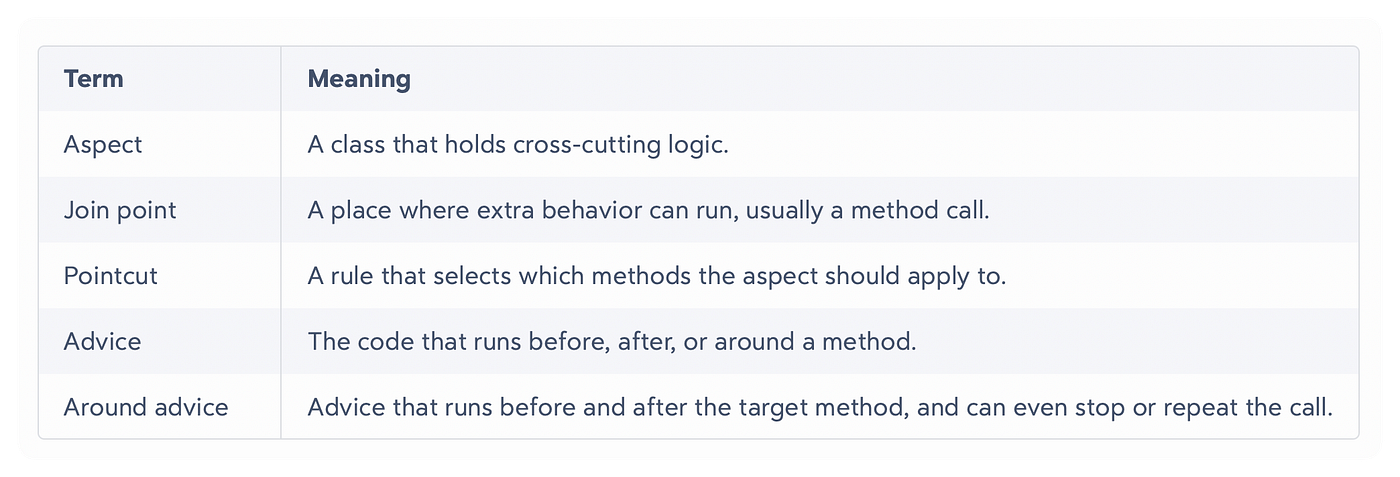
Created by Saquib Aftab
Why Use AOP?
An AOP is useful when the same logic appears in many classes. Instead of copy-pasting that logic, you centralize it in one aspect. That makes changes safer and faster.
- Logging method entry and exit.
- Measuring execution time.
- Checking user roles or permissions.
- Retrying failed operations.
- Adding custom audit records.
- Handling exceptions in a standard way.
AOP is not meant for core business rules. Keep business rules in services.
Use AOP to support behavior that cuts across the application.
How does Spring Boot wire it?
Spring Boot has built-in support for AOP. In many cases, you only need the AOP starter on the classpath and an @ Aspect class in your app.
Spring Boot auto-configures the proxy setup for you.
By default, Spring Boot uses CGLib proxies if you prefer interface-based JDK proxies, set spring.aop.proxy-target-class=false.
If AspectJ is available, Spring Boot can automatically enable AspectJ auto proxy.
For most Spring Boot projects, that means the setup is simple:
- Add the AOP dependency.
- Create an aspect class.
- Define a pointcut.
- Add advice methods.
- Let Spring manage the proxy.
Example Project Setup
Add the dependency in pom.xml:
<dependencies>
    <dependency>
        <groupId>org.springframework.boot</groupId>
        <artifactId>spring-boot-starter-aop</artifactId>
    </dependency>
</dependencies>
You do not usually need extra proxy configuration. Spring Boot will handle the basic AOP setup for you.
A simple logging aspect
A common first use case is logging. You may want to log every method in a service layer without adding System.out.println() in many places. A small aspect can do that cleanly.
package com.example.demo.aop;

import org.aspectj.lang.ProceedingJoinPoint;
import org.aspectj.lang.annotation.Around;
import org.aspectj.lang.annotation.Aspect;
import org.springframework.stereotype.Component;

@Aspect
@Component
public class LoggingAspect {

    @Around("execution(* com.example.demo.service..*(..))")
    public Object logExecutionTime(ProceedingJoinPoint joinPoint) throws Throwable {
        long start = System.currentTimeMillis();
        try {
            return joinPoint.proceed();
        } finally {
            long end = System.currentTimeMillis();
            System.out.println(joinPoint.getSignature() + " took " + (end - start) + " ms");
        }
    }
}
This aspect runs around every method in the service package. It measures time and logs the result after the method completes. That keeps timing logic away from your business code.
Service code example
Here is a simple service class that the aspect can wrap:
package com.example.demo.service;

import org.springframework.stereotype.Service;

@Service
public class UserService {

    public String getUserProfile(Long id) {
        return "User profile for id " + id;
    }
}
Your service class stays focused on business work. The aspect handles the timing or logging around it. That is the main value of AOP.
Before and after advice
Spring AOP supports several advice types. The most common ones are @Before, @After, @AfterReturning, @AfterThrowing, and @Around. Each one fits a different need.
- @ Before: run before the method starts.
- @After: run after the method finishes, whether it succeeds or fails.
- @AfterReturning: run only when the method succeeds.
- @ AfterThrowing: run only when the method throws an exception.
- @Around: wrap the method and control its execution.
If you only need a log line before a method runs, @Before is enough. If you need the method result, use @AfterReturning. If you need to retry or time the method, use @Around.
What are Point-cuts?
Point-cuts tell Spring which methods should be intercepted. You can match methods by package, class, method name, annotation, or argument pattern.
Examples of useful pointcut styles:
- `execution(* com.example.demo.service..*(..))` for all methods in a package.
- `@annotation(...)` for methods with a specific annotation.
- `within(...)` for methods inside a class or package.
- `args(...)` for methods with certain argument types.
A point-cut should be narrow enough to avoid affecting unrelated code. A very broad point-cut can make debugging harder. Keep it clear and purposeful.
Annotation-driven control
You can also control AOP with a custom annotation. This is useful when only some methods need special behavior.
package com.example.demo.aop;

import java.lang.annotation.Retention;
import java.lang.annotation.RetentionPolicy;

@Retention(RetentionPolicy.RUNTIME)
public @interface Idempotent {
}
Then you can apply it to selected service methods:
package com.example.demo.service;

import com.example.demo.aop.Idempotent;
import org.springframework.stereotype.Service;

@Service
public class OrderService {

    @Idempotent
    public String placeOrder(Long orderId) {
        return "Order placed: " + orderId;
    }
}
This keeps the aspect targeted. Only methods marked with the annotation will be intercepted. That is often cleaner than matching everything in a package.
Retry example
AOP is also useful for retry logic. We can use a retry-style aspect with @ Around advice that calls proceed() multiple times if needed. That is an example of when around advice is the right choice.
A simple retry aspect can look like this:
package com.example.demo.aop;

import org.aspectj.lang.ProceedingJoinPoint;
import org.aspectj.lang.annotation.Around;
import org.aspectj.lang.annotation.Aspect;
import org.springframework.stereotype.Component;

@Aspect
@Component
public class RetryAspect {

    @Around("@annotation(com.example.demo.aop.Idempotent)")
    public Object retry(ProceedingJoinPoint joinPoint) throws Throwable {
        int attempts = 3;
        Throwable lastError = null;

        for (int i = 1; i <= attempts; i++) {
            try {
                return joinPoint.proceed();
            } catch (Throwable ex) {
                lastError = ex;
            }
        }

        throw lastError;
    }
}
This is useful for idempotent operations, where repeating the call does not create duplicate side effects.
When to use AOP?
An AOP is a strong fit when the same support logic appears in many places, and you want a single clean implementation.
It is especially good for logging, auditing, security, retries, and timing.
It is less useful when the logic is needed only once or is deeply tied to a single business process.
In those cases, a normal method or helper class is often better. AOP works best when the concern truly cuts across the application.
Here are More Contents You Might Like
Thanks for reading. If you enjoy my content and want to show support, you can check out my other articles, give a few claps, and follow me for more. I write on Java, Productivity, and Technology.
Until Next Time Saquib Aftab
메타데이터
- post_id
- abf218b28e1b
- slug
- everything-you-must-know-about-integrating-aop-with-spring-boot-in-java-abf218b28e1b
- url
- https://medium.com/javarevisited/everything-you-must-know-about-integrating-aop-with-spring-boot-in-java-abf218b28e1b
- canonical_url
- https://medium.com/javarevisited/everything-you-must-know-about-integrating-aop-with-spring-boot-in-java-abf218b28e1b
- author_url
- https://medium.com/@saquibdev
- status
- ok
- fetched_at
- 2026-07-11 08:03:13