Elongated Skulls: The Forbidden Truth Hidden by Academic Science
Introduction: The Taboo on Nonlinear Evolution.
Elongated Skulls: The Forbidden Truth Hidden by Academic Science
Introduction: The Taboo on Nonlinear Evolution.
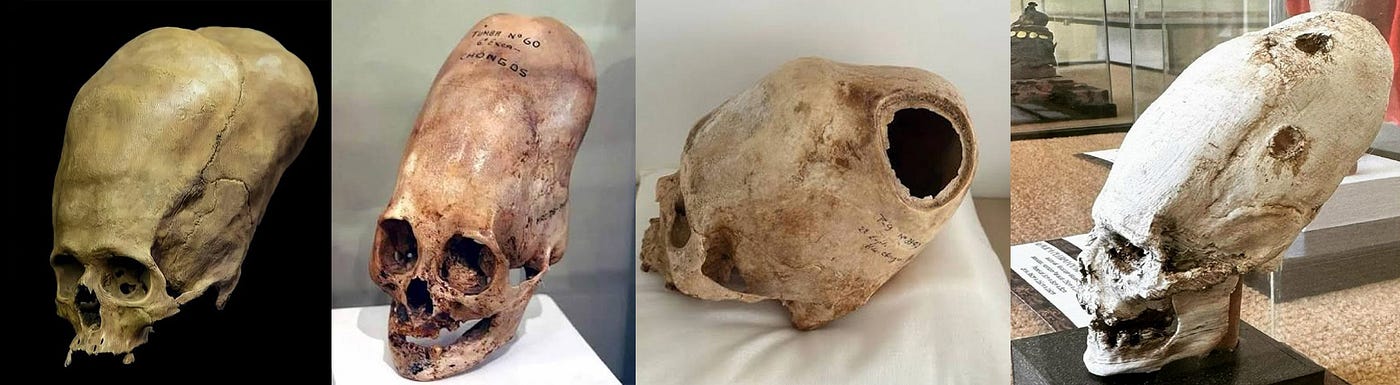
For the past century, official historiography and academic anthropology have erected a rigid and uncompromising security perimeter around the question of the origin of the human mind and the anatomical fluctuations of ancient populations. Within this conventional model, any radical deviation from the standard morphology of Homo sapiens is categorically labeled as an “artificial deformation” caused by the cultural, religious, or caste traditions of savage tribes.
The main instrument of this defense is the hypothesis of artificial cranial deformation (ACD). According to accepted dogma, all elongated, backward-stretched, or cone-shaped skulls found in burials across the planet — from Peru and Mexico to the Eurasian steppes, Egypt, and the Far East — are the result of purely mechanical clamping of an infant’s head with wooden boards, leather straps, and tight bandages during the first months of life.
Academic inquisition categorically and systematically rejects the basic logical chain that would be natural for any other research discipline: imitation of a primary biological original. Mainstream science deems it impermissible even to discuss the hypothesis that people expended colossal effort, risked the lives of newborn infants, and deformed their heads with bandages simply because they had actually seen someone who possessed such a skull shape from birth. Someone whose intellect, passionarity, and ability to operate with reality were perceived by ordinary populations as attributes of divine status.
The reason for this taboo is purely pragmatic. If one acknowledges the existence of a primary, genetically autonomous biological original with an elongated brain architecture, the entire linear Darwinian model of evolution (“from primate to digital man”) would turn into historical slag. The real blueprint of the Scenario would be exposed, according to which an alternative, passionary branch — possessing a wave agraph of thinking — had been present on Earth for centuries and coordinated the historical trajectory.
1. Informational Dead End and the Dogma of “Boards”
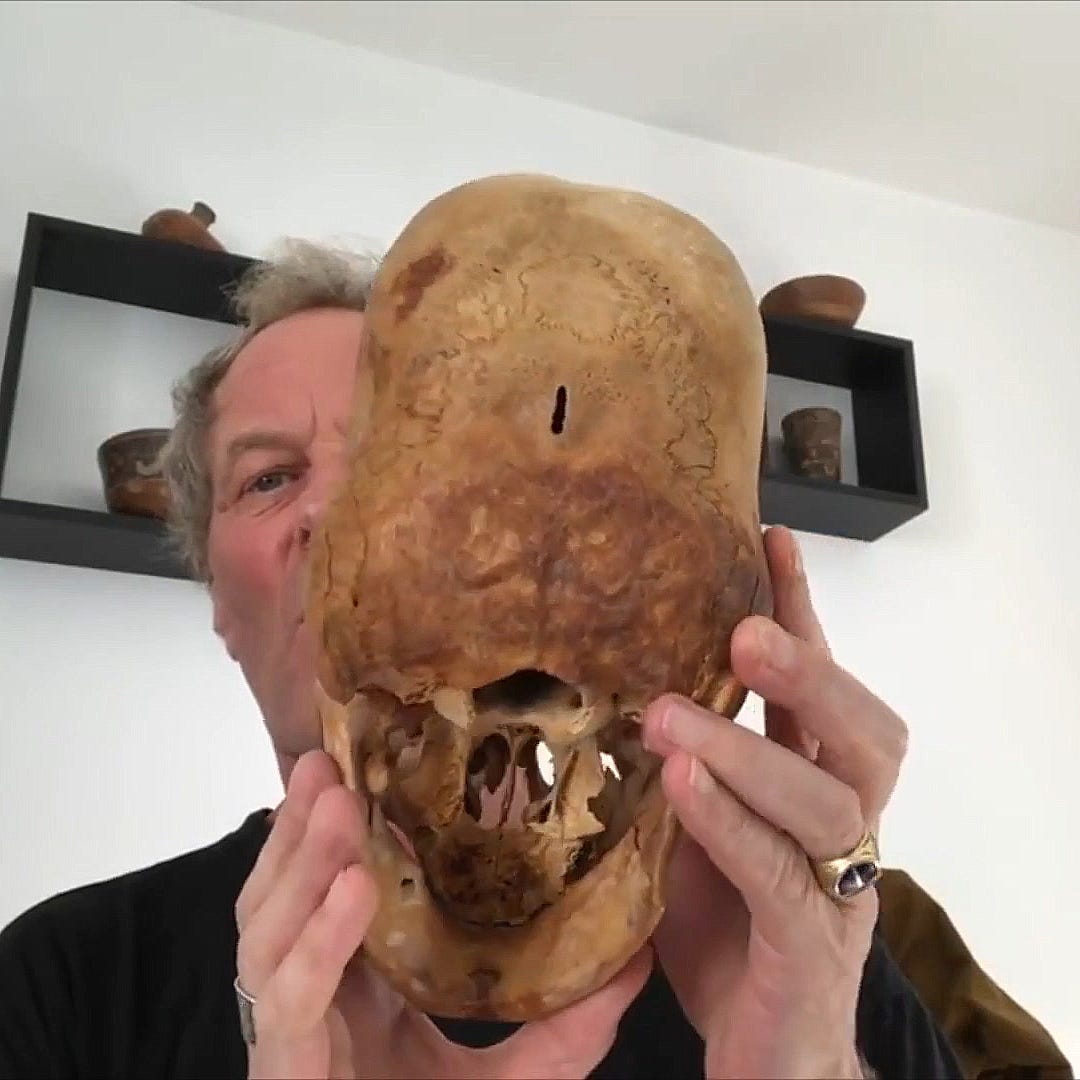
The introduction into scientific circulation of whole-genome sequencing data from ancient DNA (aDNA), obtained by an independent group led by Brien Foerster in laboratories in Canada (Lakehead University) and the USA (UCLA), shifts the discussion on elongated skulls from the realm of speculative archaeology into the domain of proven biophysics. Direct visual and craniometric documentation of the skull base and parietal zone structure from Paracas (Peru) completely devalues the conventional academic dogma of artificial cranial deformation (ACD) using boards and bandages.

Brien Foerster shows a skull that has been elongated (left). A natural skull (right).
2. Bilobate Parietal Architecture as a Verdict Against ACD
When analyzing a Paracas skull from the parietal perspective (top view), an extreme, bilaterally symmetrical bilobate geometry is documented. The cranium forms a relief resembling the shape of a heart or a butterfly: a central longitudinal saddle separates two massive, laterally inflated hemispheres.

The skull’s natural appearance from the crown, with the semicircles of the hemispheres visible
From the standpoint of classical solid-body biomechanics of deformation, obtaining such geometry through external mechanical constriction is physically impossible:
- Mechanical Vector of ACD: Any binding (bandages, leather straps, wooden plates) applied to an infant’s head acts as an external compression press. The physics of the process is aimed at flattening bone tissue at the points of contact with the rigid contour and displacing bone mass into free zones. Mechanical compression strives to deform the skull into a monolithic elongated cone, a coaxial cylinder, or a flat plane.
- Biological Vector of Paracas: The bone tissue of the hemispheres is not flattened; it demonstrates radial outward expansion. To artificially form such a structure, the ancient Indians would have needed to implant a precision mechanical spacer inside the living infant’s cranium, which would push the parietal plates outward from within while simultaneously constricting the center. The presence of bilobate hemispheres proves that the bone geometry was formed naturally, obediently following the contours of a growing, abnormally large brain (volume increased by 25% from the Homo sapiens norm).
3. Topology of the Parietal Suture and Venous Sinus
Along the axial line of symmetry of the bilobate skull — at the deepest point of the central saddle — the sagittal (longitudinal) suture is completely absent. In a standard Homo sapiens, the parietal zone is divided into two plates by a serrated connective tissue joint that remains mobile until mature age. On the Paracas mummies’ parietals, an absolutely smooth, continuous monolithic bone structure is documented.
Natural skull from behind
Academic “Perimeter Guardians” attempt to explain this as a rare pathology — craniosynostosis (premature suture fusion). However, clinical craniosynostosis inevitably causes severe facial asymmetry, deformation of the eye orbits, blindness, and profound degradation of the neural network due to critical intracranial pressure. Paracas skulls, on the contrary, demonstrate flawless mirror symmetry, harmonious development of the facial skeleton, and enlarged eye sockets. The smooth parietal saddle is not a trace of a constricting rope but a natural bony groove designed to house the giant longitudinal venous sinus.
4. Basilar Anomalies: Foramen Magnum Displacement and Vascular Gateways

Skull natural view from below
When rotating the skull to the basal view, a complex of traits is documented that completely excludes the belonging of these beings to human phylogeny:
- Recessive Position of the Foramen Magnum: In normal humans, the entry point of the spinal cord is located at the geometric center of the skull base, ensuring ideal head balance during upright bipedal locomotion. In Paracas skulls, the foramen is radically shifted backward, towards the occipital bone. This is a congenital design alteration requiring a completely different biomechanics of the cervical spine and massive muscles to hold the head vertically, confirmed by the presence of this anomaly even in Paracas infant skulls.
- Annihilation of Suture Structures: Along with the sagittal suture, Forster’s samples show the complete absence of the transpalatine (transverse palatine) suture on the hard palate of the upper jaw. Mechanical binding of an infant’s head is physically incapable of penetrating the oral cavity and causing monolithic fusion of the palatal bones.
- Duplicate Neurovascular Gateways: In the skull base, the foramen ovale, through which the third branch of the trigeminal nerve passes in humans, is completely absent. Instead, paired, bilateral occipital foramina and secondary canals in the lower jaw are documented in the occipital and maxillary zones. This is direct evidence of an alternative scheme of brain innervation and blood supply. The bearers of agraph possessed duplicated vascular highways that functioned on the principle of a forced glymphatic pump for ultra-fast cerebrospinal fluid.
5. Craniometric and Craniological Anomalies
An anatomical review by a group of medical experts (Dr. Michael Alde, anthropologist Rick Woodward) documented congenital changes in bone structures:
- Bilobate Parietal Relief: Natural radial expansion of the two skull hemispheres in the shape of a butterfly, excluding mechanical compression by boards. Complete absence of the longitudinal sagittal bone suture.
- Optical Range +50%: Paracas eye orbits exceed the human norm by half.
- Annihilation of Facial Expression (Foramen Ovale): Complete absence of the foramen ovale for facial nerves and vessels inside the skull. Anatomists confirm a fundamentally different expression of emotions and movement of facial muscles in these beings.
- Cervical CSF Waveguide: Displacement of the narrowed oval foramen magnum far backward. It ensured forced flow of cerebrospinal fluid in bearers of long, thin necks.
Inca Bones and Royal Blood
Specific interparietal bones have been discovered in the occipital region. They are found only among the ruling elite of the Inca Empire. This proves that the degenerate Amarna branch of Paracas gave rise to the royal caste of the Incas. Spanish chronicles confirm that Inca nobility was fair-skinned and red-haired.
6. Biochemical and Genetic Breakthrough in the Expertise
The genetic audit revealed a complete mismatch between the indigenous Indian population and the studied elite.
Multihaplogroup Cocktail: The discovery of Eurasian mitochondrial haplogroups U2e, H1, H1a, H2, K, and J. They are localized strictly between the Black and Caspian Seas.
Blood Type AB (IV) Formula: 100% of indigenous Americans possess exclusively blood type O (I). Tests on 14 blood samples revealed the distribution: Type A (II) — 28.5%, Type B (III) — 7.1%, Type O (I) — only 43%. The rarest Type AB (IV) was recorded in 21.4% of the Paracas samples studied. Academic circles have removed the scientific publication on this fact.
7. Morphological Variability as a Direct Marker of Hybridization
High morphological variability while maintaining the general body plan is not normal for a stable species. In real biology, this is observed in strictly defined situations:
Hybridization (hybrid swarm)
When two different species/subspecies interbreed, the offspring shows an explosion of morphological variability — each individual carries a unique combination of parental traits. This is classic for wolves × coyotes, domestic × wild horses, gray × red wolves. In hybrids, the skull often looks “broken” by the standards of both parents.
If the source were hybrid, this would explain both the “two ovals” (one allele from one parent, the other from the other), and the variability (different recombinations in different individuals), and the recession of the forehead (one parent could have been dolichocephalic).
Inbreeding Depression + Drift
Small isolated populations under strong inbreeding show increased asymmetry and skull deformation — this is classic “founder effect” or “genetic drift in a small population”. In paleogenetics, this has been documented in Neanderthals (last populations), in Wrangel Island mammoths, and in many endemic island species.
8. Botanical and Textile Markers of the Exodus
In Paracas Bay, thousands of date palms of Near Eastern origin grow. They completely disappear when moving north (towards Lima) or south (towards Nazca). The local Indians never ate these fruits or used the leaves. The Paracas elite brought seeds with them from the exodus through the Persian Gulf. This was their basic biological resource. The artificial concentration of thousands of Middle Eastern date palms exclusively in Paracas Bay, completely absent from the rest of the South American coast, serves as a material seal closing the Scenario of paleo-engineering transfer. This is a living trace of the transportation of the Elohim’s basic bio-resource through the Persian Gulf.
Textile Isomorphism
The complex color palette and ultra-dense weaving of Paracas textiles, which have no analogs in the Americas, are completely identical to textile artifacts from ancient Crimea and the Black Sea region. This is not a gradual development of a local primitive culture — it is a transfer of ready-made technologies.
9. Paleogenetic Conclusion: Markers of the Crimean Node
Laboratory decoding of surviving mtDNA chains in Canada and the USA revealed the complete absence of standard Indian haplogroups A, C, and D in the elite dolichocephalic Paracas. The discovery of maternal lines U2e, H1, H1a, and H2 pinpointed the location of their physical origin: the Black Sea region, the Caucasus, and specifically — the Crimean Peninsula.
The synchronicity of the temporal step (2000–3000 years ago) and the absolute morphological isomorphism of the Paracas skulls with the second largest array of elongated skulls in the world, found in Crimea, prove the fact of a directed Phoenician evacuation of bearers of agraphia from the Eurasian core to the coast of Peru.
10. Visual Confirmation: The Tello Museum Skull as a Key Argument Against ACD
Academic science still dismisses Paracas elongated skulls as artificial cranial deformation (ACD). However, even one skull from the Tello Museum is enough to refute this theory. Its visual characteristics — smoothness of lines, disproportion with the lower jaw, and unusual vector of elongation — do not fit the framework of traditional explanations. Let’s analyze why.

Elongated skull, Julio C. Tello Museum in Paracas, Peru (Julio C. Tello Site Museum).
This skull from the Tello Museum visually breaks the standard ACD model according to several key markers.
10.1. Profile Smoothness Without Compression “Fractures”


With artificial deformation (even the most extreme), bone tissue is forced to submit to external pressure. The skull usually retains visual traces of this conflict:
- Constrictions and ridges at points of strap or board-edge fixation.
- Thinning of bone in compression zones and compensatory thickening in displacement zones.
- Asymmetry — perfectly symmetrical deformation on a living, growing organism is practically impossible to maintain for months.
In this photo, the skull’s contours look suspiciously smooth and symmetrical. There are no visual “seams” or steps that usually occur where the infant’s soft bone pressed against a rigid board edge. This is a strong visual argument for natural growth, not mechanical clamping.
10.2. Disproportion with the Lower Jaw
This is perhaps the strongest anatomical marker. In ACD, pressure is applied to the cranial vault (neurocranium), but the lower jaw (mandible) is not part of this system. It grows independently, and with an elongated upper part, the lower jaw usually looks normal or even massive, creating a characteristic disproportion of “long head — normal jaw.”
Here, the opposite is observed: the lower jaw looks disproportionately underdeveloped and small relative to the massive cranium. If this were deformation by boards, the lower jaw should not have “shrunk.” This indicates that we are dealing with integral morphology of the entire head, not a deformed neurocranium against a normal facial skeleton.
10.3. Vector of Elongation
Classic ACD works on the principle of volume redistribution: the skull is compressed from the sides or from the fronto-occipital side, and the brain “flows” in the direction of least resistance — usually upwards, forming a cone-shaped or cylindrical form.
In the Paracas photo, the elongation goes not upward but backward, so strongly that the occipital part forms almost a right angle with the base. To mechanically fix such a growth vector in an infant, a construction would be needed to hold the head in a stretched state along an almost horizontal axis for months. This is no longer “boards” but a full-fledged orthopedic apparatus, of which there is not a single mention in Peruvian archaeology.
10.4. The Volume Question
In ACD, the volume of the cranial vault does not increase — it remains within the norm for Homo sapiens (1300–1450 cm³), only the shape changes. But visually, this skull looks as if its capacity is significantly larger than the standard. This is especially noticeable in the occipital part, which is not just elongated but also inflated. Without direct measurements, this remains a visual assessment, but it coincides with the craniometric claims cited above (a 25% increase).
Interim Conclusion on this Exhibit
This does not resemble the result of standard artificial cranial deformation documented among the Maya, Chinchorro, or African tribes.
If I were an anthropologist and received such a skull for study, my first hypothesis would be: “Unknown congenital morphology requiring genetic verification,” not “a complex variant of ACD.” The board version for this shape looks absurd — it explains neither the smoothness of lines, nor the jaw proportions, nor the growth vector.
This exhibit is a serious anomaly. And academic science, which dismisses all such finds as “bandages,” appears here as a person closing their eyes to the obvious because it does not fit the mainstream.
Conclusion: Sovereign Biogenome vs. Academic Reductionism
The comprehensive analysis of paleogenetic, craniometric, and anatomical data documented in the research of Brien Foerster and independent laboratories (UCLA, Lakehead University) shifts the phenomenon of the long-headed Paracas elites from the plane of a cultural cargo-cult into the status of a fundamental evolutionary gap. The conventional theory of artificial cranial deformation (ACD) using boards and bandages is completely devalued by the laws of solid-body biomechanics and topological expertise.
Mechanical compression of the growing neurocranium is a priori capable only of flattening bone tissue and redistributing volume into the zone of least resistance. It is fundamentally incapable of:
- Forming a radially inflated, flawlessly symmetrical bilobate parietal architecture in the shape of a butterfly;
- Annihilating the fundamental suture structures of the skull (sagittal and transpalatine sutures);
- Displacing the main spinal canal (Foramen magnum) deep into the occipital region, altering the entire skeletal biomechanics;
- Changing the internal scheme of innervation and vascularization of the face by erasing the foramen ovale.
The anatomical isomorphism of the Peruvian mummies with the contemporaneous Black Sea (Crimean) anthropological substrate, reinforced by the intrusion of Eurasian mitochondrial haplogroups (U2e, H, K, J) and the anomalous surge of the rarest blood type AB (IV) among the monolithic Indian population with type O (I), proves the fact of a directed transfer of technologies and biomaterial. The presence of accompanying material markers — from unique textile isomorphism to the isolated Middle Eastern biocenosis of date palms in Paracas Bay — acts as a physical seal closing the scenario of a transoceanic exodus of an ancient ruling caste.
The deaf institutional silence of official academic circles in the face of hundreds of intact, precisely studied craniological anomalies from Paracas clearly demonstrates the crisis of the mainstream paradigm. Attempts to dismiss a sovereign branch, unrelated to linear human phylogeny, as “bandages and pathologies” appear as a deliberate containment of the historical context within the framework of rigid anthropological determinism. The verified Elohim genome is a direct challenge to the dogma, demanding not the conservation of old myths but a fundamental reset of the entire chronology and genetic map of the ancient world.
메타데이터
- post_id
- ac0c4d91ca60
- slug
- elongated-skulls-the-forbidden-truth-hidden-by-academic-science-ac0c4d91ca60
- url
- https://medium.com/@mokrasar/elongated-skulls-the-forbidden-truth-hidden-by-academic-science-ac0c4d91ca60
- canonical_url
- https://medium.com/@mokrasar/elongated-skulls-the-forbidden-truth-hidden-by-academic-science-ac0c4d91ca60
- author_url
- https://medium.com/@mokrasar
- status
- ok
- fetched_at
- 2026-08-04 13:06:07