The Right Level for Every Job: How to Choose Between Laser Levels and Toolbox Levels
TL;DR: Whether you’re framing walls, laying tile, or tightening up your toolbox kit, choosing the right leveling tool makes the difference…
The Right Level for Every Job: How to Choose Between Laser Levels and Toolbox Levels
TL;DR: Whether you’re framing walls, laying tile, or tightening up your toolbox kit, choosing the right leveling tool makes the difference between precise results and costly rework. This guide breaks down how laser levels and toolbox levels differ, where each one excels, and what features to look for before you buy.
What Makes a Leveling Tool Essential on the Job
Precision is not optional in construction, renovation, or trade work — it’s the baseline. A wall that’s off by a single degree compounds into a misaligned doorframe, a sloped countertop, or a tile run that drifts visibly across a floor. The tools responsible for preventing these errors are leveling instruments, and despite the wide variety available, most professionals rely on two core categories: electronic laser systems and traditional spirit-based levels.
What separates these tools isn’t just technology — it’s the job they’re designed to do. Laser systems project reference lines across open spaces. Spirit levels confirm alignment at the point of contact. Both are essential. Both have distinct strengths. And understanding when to use each one is what separates a professional finish from a frustrating redo.
The market has expanded significantly over the last decade, with manufacturers producing tools for every niche — from compact pocket sizes to full rotary systems that can cover an entire construction floor. But the fundamentals haven’t changed: you need a tool that reads accurately, holds up to site conditions, and fits how you work.
How Laser Levels Work — and When They Outperform Everything Else
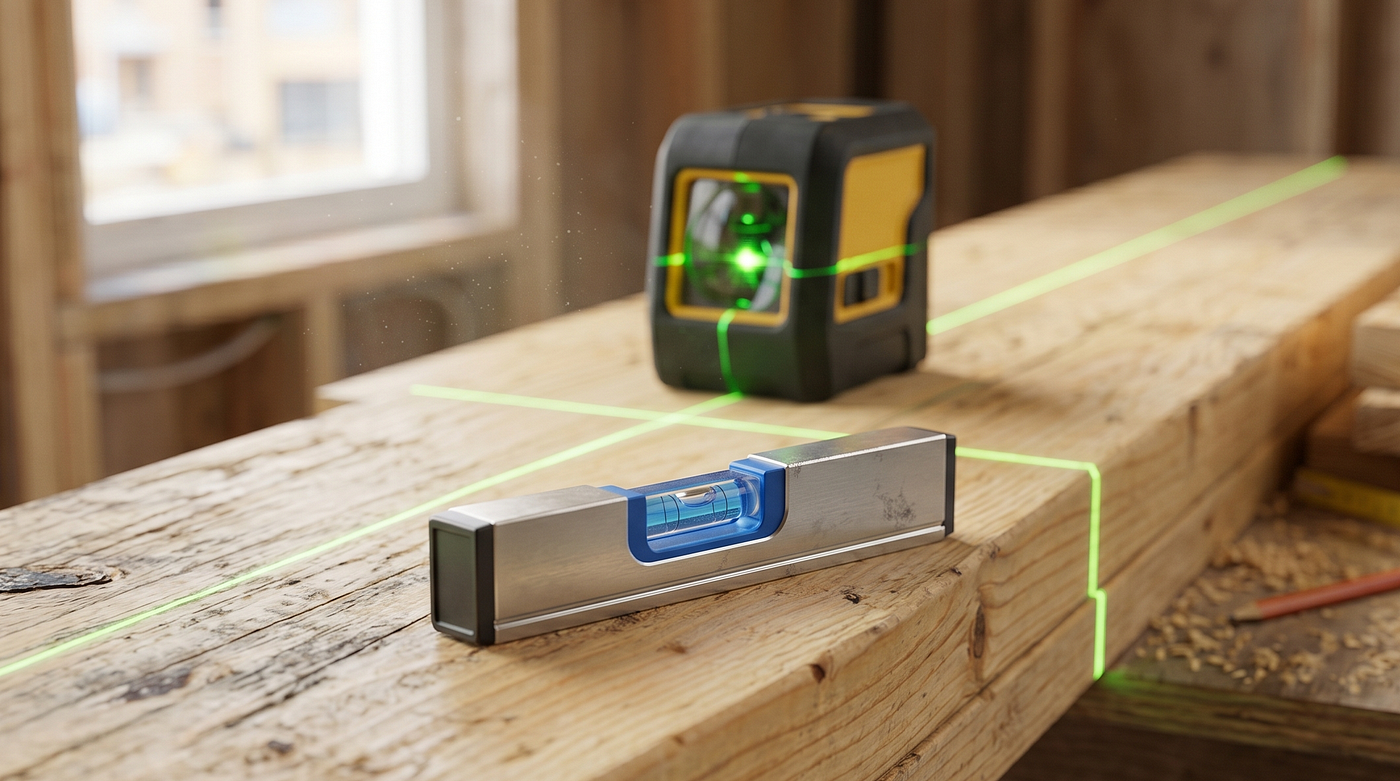
A laser level uses a beam of coherent light — either red or green — to project a perfectly level or plumb reference line across a surface. The best laser levels use a self-leveling pendulum mechanism that automatically compensates for minor placement errors, meaning you don’t need a perfectly flat surface to get an accurate line. You set the tool down, wait a few seconds for it to settle, and the beam locks into a true horizontal or vertical plane.
The key advantage of laser tools is range. A good cross-line laser can project a reference across an entire room — 30, 50, even 100 feet — without the user needing to reposition or re-check alignment. This makes them indispensable for tasks like suspended ceiling grid installation, long tile runs, kitchen cabinet hanging, and stud layout across wide walls. The laser doesn’t care about the distance; the beam stays true.
There are several main categories worth knowing. Point-to-point lasers transfer level points between two locations. Cross-line lasers project horizontal and vertical beams simultaneously, covering a full wall plane. Rotary lasers spin the beam 360 degrees, covering an entire floor or ceiling in one setup. For most residential and light commercial work, a quality cross-line model handles the majority of tasks with speed and precision that would take significantly longer with manual tools.
The Case for the Toolbox Level — Compact, Durable, Always Within Reach
Not every task calls for a laser setup. When you’re checking a single shelf, verifying a door jamb, reading a pipe slope, or confirming a stud is plumb before fastening — pulling out a laser and tripod is overkill. This is exactly where a reliable toolbox level earns its place in every professional’s kit.
A toolbox level is a compact spirit level — typically between 9 and 12 inches — designed to fit in a tool bag, an apron pocket, or directly in a toolbox tray. The defining feature is the vial: a sealed, curved tube filled with liquid and a bubble that floats to indicate level or plumb. When the bubble sits centered between the lines, you’re aligned. It’s a technology that’s been refined for over three centuries, and for good reason — it’s immediate, requires no power, and works equally well in full sun or complete darkness.
Modern toolbox levels are built with aluminum or composite frames, machined accuracy to within 0.5mm per meter, and reinforced end caps that survive drops. Many include magnetic edges for hands-free use on metal surfaces — particularly useful for HVAC installers, electricians, and plumbers who need a reading while both hands are occupied. The best models include both horizontal and vertical vials, and some add a 45-degree vial for quick miter and diagonal work.
According to the U.S. Bureau of Labor Statistics, construction and extraction occupations represent one of the largest trade employment categories in the country, with millions of workers who rely on leveling tools daily as part of their core kit. The sheer volume of users underscores why both laser and spirit level technology continues to evolve in parallel — each serving a distinct function that the other cannot fully replace.
Key Differences: Speed, Setup, and Use Case Fit
The decision between laser and spirit-based tools usually comes down to three factors: setup time, task scale, and working conditions. Laser levels require a stable mount or tripod, a charged battery, and for outdoor use, often a detector to pick up the beam in bright light. They’re powerful but they have prerequisites. A spirit level has none of these — it’s pick-up-and-read.
For large-scale interior work — installing drop ceilings, laying long runs of hardwood, tiling a full bathroom floor — the laser delivers efficiency that no spirit level can match. One accurate reference line eliminates dozens of measurement steps and all but removes cumulative error over distance. But for quick checks, tight spaces, and fieldwork where setup time is a constraint, compact spirit tools are faster and more practical.
There’s also a durability consideration. Laser tools have electronic components that can fail — sensors, batteries, calibration mechanisms. A well-made spirit level, by contrast, has almost no failure modes. The vial can crack under extreme impact, but short of that, the tool works indefinitely. For tradespeople who need a backup or a primary tool that never goes dead, a solid spirit level is irreplaceable. Adhering to recognized site safety standards also means having tools that perform reliably under job site conditions — a factor that favors both redundancy and durability in your leveling kit.
Choosing the Right Tool: A Practical Framework
Start with the task, not the tool. Ask three questions: How long is the run? How often will I reposition? Does the job require hands-free operation? If the run is long and repositioning is frequent, a laser saves hours. If the task is quick and localized, reach for the compact spirit model. The calibration benchmarks maintained by national standards bodies provide a useful reference point when evaluating accuracy claims from manufacturers — especially when comparing tools across price tiers.
For a complete professional kit, carry both. A cross-line laser for layout and installation, a precision toolbox-size spirit level for verification and quick checks. This combination covers the full range of situations a tradesperson or serious DIYer encounters, from rough framing to finish carpentry.
Pay attention to accuracy ratings. For spirit levels, look for vials certified to 0.5mm/m or better. For lasers, check the self-leveling range (usually ±3–4°) and the accuracy at working distance. Many manufacturers publish these specs clearly; if a product doesn’t, that’s reason for caution.
Features Worth Paying For — and Features That Aren’t
On the laser side, green beam models are significantly more visible to the human eye than red — roughly four times brighter in perception — making them worth the premium for daylight or high-ambient-light work. Self-leveling is non-negotiable for consistent results; manual lasers exist but they require user-level calibration that introduces error. Pulse mode — which makes the beam detectable by an external sensor at distances over 30 feet — is worth having if you work outdoors or on large sites.
For spirit levels, the vial count matters more than frame length for toolbox models. A three-vial layout (horizontal, vertical, 45-degree) handles more jobs than a single-vial model. Magnetic edges are worth the slight price premium for metal-intensive trades. And always look at end-cap construction — toolbox levels get dropped, and reinforced ends are the difference between a tool that survives a concrete floor fall and one that doesn’t.
Brand reputation matters for calibration retention. A level that reads accurately out of the box but drifts after six months of use is worse than a slightly cheaper model with proven long-term accuracy. Buy from manufacturers who publish calibration specs and back their tools with service support.
Putting It All Together on the Job Site
Leveling tools are among the most used instruments in any trade or DIY workflow, and the investment in quality pays back quickly — in time saved, rework avoided, and results that hold up to professional scrutiny. Whether you’re running a laser across a full room for a suspended ceiling job or pulling a compact spirit level to confirm a bracket is plumb before drilling, the right tool for the right task is what makes the difference between a fast, clean result and an expensive correction.
The decision isn’t laser versus spirit — it’s laser and spirit. Understanding the strengths of each format, and equipping your kit accordingly, is what separates tradespeople who work confidently from those who second-guess their work after the fact.
메타데이터
- post_id
- ac2e6bd8b284
- slug
- the-right-level-for-every-job-how-to-choose-between-laser-levels-and-toolbox-levels-ac2e6bd8b284
- url
- https://medium.com/@yossi1/the-right-level-for-every-job-how-to-choose-between-laser-levels-and-toolbox-levels-ac2e6bd8b284
- canonical_url
- https://medium.com/@yossi1/the-right-level-for-every-job-how-to-choose-between-laser-levels-and-toolbox-levels-ac2e6bd8b284
- author_url
- https://medium.com/@yossi1
- status
- ok
- fetched_at
- 2026-06-12 07:40:50