Ellipses: Generative Rotation as Computational Ornament
Source Code: https://github.com/reyrove/Generative-Art-on-fxhash/tree/master/Ellipses
Ellipses: Generative Rotation as Computational Ornament

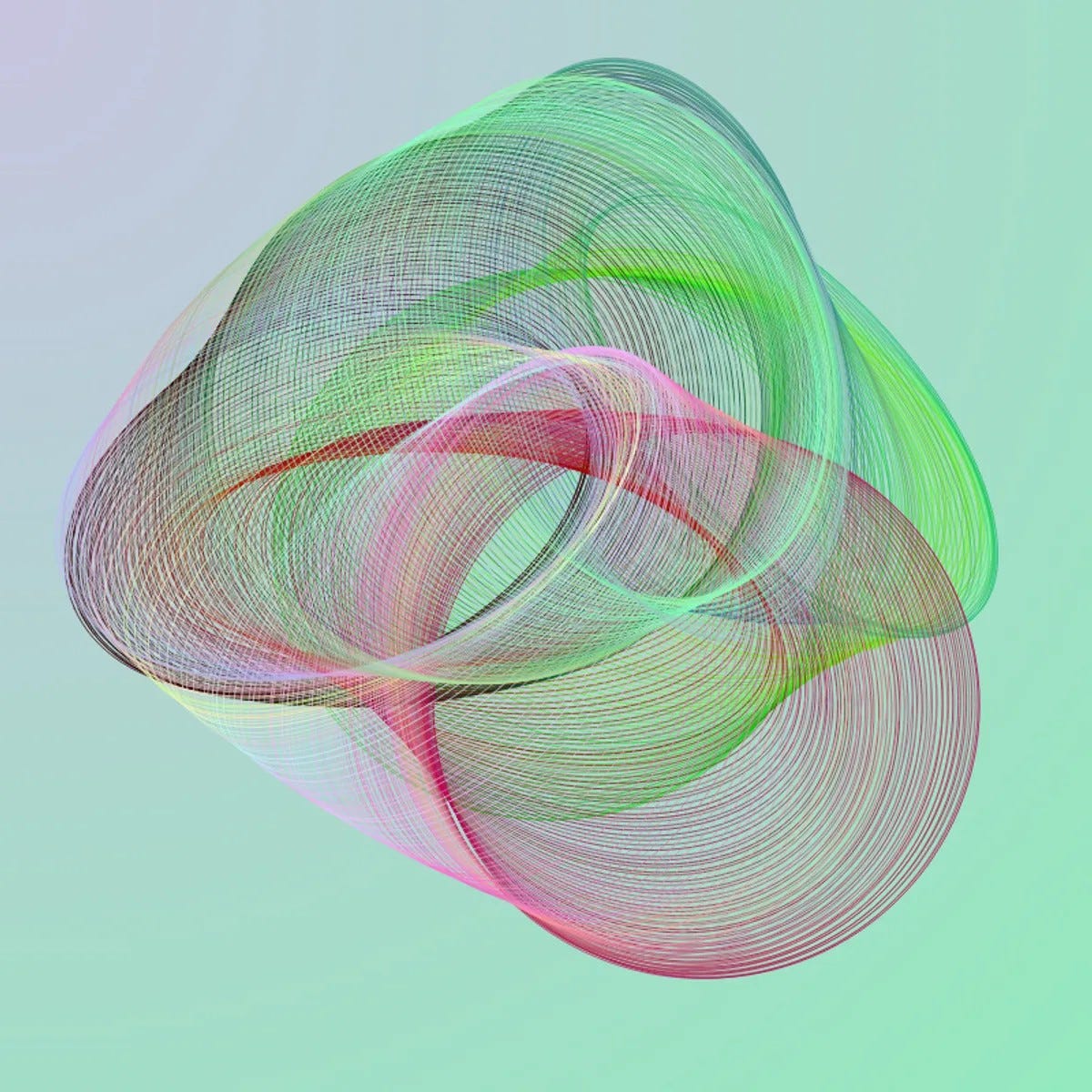
Figure. Parametric ellipses generated with harmonic functions, showcasing smooth, continuous loops and algorithmic variation.
Source Code: https://github.com/reyrove/Generative-Art-on-fxhash/tree/master/Ellipses
fxhash Mint: https://www.fxhash.xyz/project/ellipses
Introduction
Ellipses is a generative artwork that explores repetition, rotation, and chromatic contrast through parametric elliptical forms. Rooted in computational geometry and post-digital ornament, the project constructs a layered visual field where concentric and radial ellipses intersect, producing a hybrid of optical vibration and structural symmetry. Each output is uniquely determined by a cryptographic seed, ensuring both reproducibility and singularity within the system.
Conceptual Framework
The ellipse, historically associated with planetary motion, optics, and classical geometry, is repurposed here as a modular glyph in a computational system. Rather than representing physical motion, the ellipse functions as a symbolic unit of algorithmic ornamentation — echoing theories of digital baroque, algorithmic patternism, and procedural aesthetics.
By rotating multiple ellipses around a central axis, the work constructs a visual field reminiscent of interference patterns, architectural mandalas, and speculative data diagrams. The project situates itself between minimal generative abstraction and decorative computational excess.
Technical Structure
The system is implemented in JavaScript using the HTML Canvas API and the fxhash generative framework. Two independent parametric layers are defined:
- Big Ellipses — large rotational structures forming the primary compositional skeleton
- Small Ellipses — secondary ornamental strata generating visual density and optical rhythm
User-adjustable parameters control:
- Number of big ellipses
- Number of small ellipses
- Background color palette
- Two contrasting ellipse color palettes
Ellipses are drawn via procedural functions that define width, height, rotation angle, stroke weight, and shadow blur. Rotation is discretized across parametric steps, producing radial symmetry while retaining stochastic variation in scale and chromatic selection.
Chromatic System
Color is selected from curated palettes divided into:
- Pastel background fields
- High-saturation accent colors
- Dark structural tones
This triadic chromatic hierarchy generates depth and perceptual layering, with shadow blur acting as a post-digital glow, referencing neon aesthetics and synthetic visuality. The result oscillates between scientific visualization and ornamental digital textile.
Generative Aesthetics and Parametric Authorship
Each token instance is the outcome of deterministic rules modulated by stochastic parameters. The artist defines the system, while the collector triggers a unique realization. This distributed authorship aligns with post-conceptual generative art theory, where the code is the artwork and each output is an instantiation rather than a fixed object.
The use of param sliders further introduces participatory control, allowing viewers to co-compose structural density within the artist-defined system boundaries.
Art-Historical Context
Ellipses dialogues with multiple traditions:
- Op Art and optical vibration (Vasarely, Riley)
- Algorithmic ornament and computational craft
- Minimalist seriality and rotational symmetry
- Post-internet digital glow aesthetics
By combining strict geometric repetition with stochastic chromatic variation, the work situates itself within contemporary computational abstraction, where structure and chance coexist.
Conclusion
Ellipses investigates how simple geometric primitives can generate complex ornamental systems through code. By treating rotation, repetition, and color as programmable parameters, the project frames generative art as both a visual system and a conceptual inquiry into algorithmic authorship, procedural aesthetics, and the future of digital ornament.
메타데이터
- post_id
- ac370c8be88b
- slug
- ellipses-generative-rotation-as-computational-ornament-ac370c8be88b
- url
- https://medium.com/@reyhanehdaneshdoost/ellipses-generative-rotation-as-computational-ornament-ac370c8be88b
- canonical_url
- https://medium.com/@reyhanehdaneshdoost/ellipses-generative-rotation-as-computational-ornament-ac370c8be88b
- author_url
- https://medium.com/@reyhanehdaneshdoost
- status
- ok
- fetched_at
- 2026-07-13 06:23:13