Why AI Medical Coding Will Replace Manual Pre-Authorization Workflows
Every physician in the United States knows the feeling. You’ve seen the patient, made the diagnosis, chosen the optimal treatment — and…
Why AI Medical Coding Will Replace Manual Pre-Authorization Workflows
Every physician in the United States knows the feeling. You’ve seen the patient, made the diagnosis, chosen the optimal treatment — and then comes the wall. A fax machine. A phone queue. A prior authorization form with 47 fields. Three to five business days of waiting. Possibly a denial. Possibly an appeal. Possibly a peer-to-peer review call with a payer-employed physician who has never met your patient.
This is prior authorization in 2025. And it is, by every objective measure, a system designed for a world that no longer exists — built on manual processes, paper logic, and human-to-human telephone arbitration. The cost isn’t just financial. It’s clinical. Patients don’t start treatments. Conditions progress. Physicians burn out.
What’s changing — faster than most healthcare administrators realize — is that AI medical coding is becoming the infrastructure layer that makes prior authorization automation finally work. Not as a workaround. As a replacement.
The Pre-Authorization Problem, Precisely
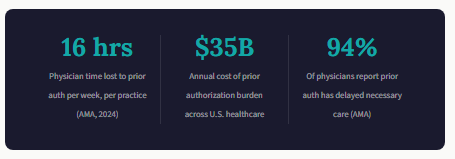
Prior authorization (PA) — also called pre-authorization or pre-approval — is the process by which a health insurer requires a provider to obtain advance approval before delivering specific services, procedures, or medications. In theory, it controls costs and ensures medically necessary utilization. In practice, it has become an adversarial administrative system that extracts enormous labor costs from the care delivery side while delivering questionable clinical value.
The manual PA workflow looks like this in most practices today:
-
Provider identifies a treatment requiring authorization and pulls up the payer’s PA requirement list (which changes quarterly without consistent notification)
-
Staff gather clinical documentation — diagnosis codes, clinical notes, lab values, prior treatment history — and organize it for submission
-
Submission happens via fax, payer portal, or phone (70% of PA requests still involve fax as of 2024)
-
Provider waits 1–14 business days for a decision — during which the patient is in limbo
-
If denied, staff code the appeal, gather additional clinical support, and resubmit. Average denial appeal takes 45–90 minutes per case
-
If still denied, a physician peer-to-peer review call is scheduled. A physician spends 30–60 minutes on hold and in discussion for a single authorization
“The prior authorization problem is fundamentally a coding and documentation matching problem — and that is exactly what AI medical coding is built to solve.”
— Healthcare IT Executive, 450-bed regional health system
Why Coding Is the Root of the PA Problem
Here’s what most healthcare administrators don’t fully appreciate: the primary reason prior authorization requests fail or require extensive back-and-forth is coding misalignment between the clinical documentation and the payer’s authorization criteria.
Payers build their PA criteria around specific ICD-10 diagnosis codes, CPT procedure codes, and clinical criteria combinations. When a provider submits a PA request, the payer’s system — increasingly automated — checks whether the submitted codes match the policy criteria for the requested service. If they don’t match precisely, the request is denied or pended for manual review.
The irony is brutal: a physician may be making the exactly correct clinical decision, but if the supporting documentation doesn’t translate into the precise code sequence that matches the payer’s criteria, the authorization fails. Not because the care is inappropriate — because the coding didn’t align.
📋 Key Insight
Studies show that 75% of prior authorization denials that are appealed are ultimately overturned — meaning the care was appropriate all along. The denial was an administrative artifact, not a clinical judgment. AI coding eliminates the coding misalignment that triggers these preventable denials before submission.
This is precisely where AI medical coding intervenes. By extracting the clinical picture from physician notes with NLP accuracy, mapping it to the highest-specificity ICD-10 and CPT codes, and then cross-referencing those codes against the specific payer’s PA policy library in real time — AI coding turns PA submission from a guessing game into a structured match.
How AI Medical Coding Dismantles the Manual PA Workflow — Step by Step
Let’s map the AI replacement against each manual PA step to show exactly where automation enters and what it changes:
Step 1: Automatic PA Requirement Detection
Traditional workflow: a staff member looks up whether the ordered service requires PA for the patient’s specific plan. This lookup is manual, error-prone, and often skipped under time pressure — leading to “retro-auth” nightmares when unauthorized services are discovered post-delivery.
AI replacement: When a provider orders a procedure or medication, the AI coding system instantly cross-references the CPT code, the patient’s payer/plan, and the current PA requirement library. If PA is required, a workflow is triggered automatically — before the order is placed, not after the claim is filed.
Step 2: Clinical Documentation Extraction and Code Assembly
Traditional workflow: a prior auth coordinator manually reads the chart, interprets the clinical picture, selects diagnosis codes, and assembles the clinical justification packet — a process that takes 20–40 minutes per complex case.
AI replacement: Clinical NLP reads the patient’s notes, extracts the diagnosis narrative, supporting signs and symptoms, lab values, prior treatment history, and contraindications. It assembles this into a payer-formatted PA request packet — coded precisely to match the payer’s criteria — in under 60 seconds. The coordinator reviews, not assembles.
Step 3: Real-Time Payer Criteria Matching
Traditional workflow: staff submit based on their understanding of criteria, which may be outdated (payers update policies quarterly without consistent provider notification).
AI replacement: AI systems maintain continuously updated payer policy databases — including LCD/NCD criteria, step therapy requirements, and specialty-specific PA thresholds — and check every submission against the current policy before it leaves the system. A submission that doesn’t meet criteria is flagged with the specific gap identified, so the provider can close it before submission rather than after denial.
💡 Critical Differentiator
The most effective AI PA systems don’t just check codes — they check clinical criteria completeness. If a payer requires documentation of “at least two prior treatment failures” for a specific oncology therapy, the AI reads the chart to verify that documentation exists before submission. This is not rule-based automation. It’s clinical comprehension at scale.
Step 4: Electronic Submission via FHIR-Based PA APIs
Traditional workflow: fax. Still fax. In 2025. Because payer portal interoperability is fragmented and phone queues are the fallback.
AI replacement: CMS’s FHIR Prior Authorization requirements (HL7 Da Vinci Project’s CRD, DTR, and PAS implementation guides) are being mandated for commercial payers under the CMS Interoperability and Prior Authorization Rule finalized in 2024. AI coding platforms built on FHIR R4 submit PA requests electronically in seconds, receive real-time approval decisions for qualifying requests, and track pending decisions without manual follow-up.
Step 5: Automated Denial Appeal Generation
Traditional workflow: denied PA request sits in a work queue. A coordinator reads the denial reason, pulls additional documentation, drafts an appeal letter, and resubmits — 45–90 minutes of work per denial.
AI replacement: The denial reason code is parsed automatically. The AI identifies what specific clinical evidence the payer requires for reconsideration, extracts that evidence from the chart, and auto-drafts a compliant appeal letter with the supporting documentation attached. The coordinator reviews and submits in under 10 minutes. Appeal win rates improve because the appeal directly addresses the specific denial criteria, not a generic rebuttal.
The Numbers: Manual PA vs. AI-Automated PA
The case for automation isn’t theoretical. Here’s what health systems and large practices are reporting after deploying AI-assisted PA workflows:

Sources: AMA Prior Authorization Physician Survey 2024; CAQH Index 2024; peer-reviewed RCM case studies, Health Affairs 2023–2024.
The Regulatory Tailwind: CMS Is Forcing the Transition
This isn’t just a technology story. It’s a regulatory inevitability. In January 2024, CMS finalized the Interoperability and Prior Authorization Final Rule, which mandates that impacted payers — Medicare Advantage, Medicaid, CHIP, and federally facilitated marketplace plans — implement FHIR-based PA APIs by January 2026.
Specifically, payers are required to implement three HL7 Da Vinci APIs:
- Coverage Requirements Discovery (CRD): Allows provider EHR systems and payer platforms to exchange prior authorization requirements in real time before the order is placed.
- Documentation Templates and Rules (DTR): Enables payers to electronically deliver the specific documentation requirements and questionnaires for a PA request directly into the provider’s EHR workflow.
- Prior Authorization Support (PAS): Enables electronic PA request submission and decision receipt — enabling real-time approvals for qualifying requests.
These three APIs, when implemented together, create the infrastructure for end-to-end AI-automated PA. The payer side will be ready for automation by 2026. The question for health systems is whether their coding and RCM infrastructure will be ready to send structured, AI-coded requests through these APIs — or whether they’ll still be manually assembling requests to feed into a now-automated submission channel.
⚠ Compliance Risk
Providers who don’t upgrade their PA workflows to FHIR-compatible, AI-assisted systems before 2026 will face a widening operational gap. Payers will be processing structured electronic PA requests at scale; providers still using manual, fax-based submissions will face longer turnaround times, higher denial rates, and no access to real-time approval pathways.
The Technology Stack Behind AI PA Automation
For healthcare IT and engineering leaders evaluating what it takes to build or integrate this capability, here’s the honest technology picture:
Layer 1 — Clinical NLP Engine
Document Understanding
Fine-tuned transformer models (clinical BERT, BioMedLM, or GPT-4 with clinical fine-tuning) that extract diagnoses, procedures, symptoms, medications, and temporal relationships from unstructured clinical notes with >94% Named Entity Recognition accuracy. This is the foundation — everything else depends on getting the clinical picture right.
Layer 2 — Medical Coding Engine
ICD-10 / CPT Code Assignment
ML classifiers trained on ICD-10-CM and CPT hierarchies that map extracted clinical entities to the highest-specificity codes supported by the documentation. Rule-based post-processing validates NCCI edits and CMS coding guidelines before any code is surfaced to a user or submitted to a payer.
Layer 3 — Payer Policy Intelligence
Authorization Criteria Matching
A continuously updated knowledge base of payer-specific PA criteria, LCD/NCD policies, step therapy requirements, and quantity limits. This database must be maintained by clinical policy analysts and updated within 72 hours of payer policy changes — it’s the most operationally intensive component of a PA automation system.
Layer 4 — EHR Integration
FHIR R4 + HL7 v2 Connectivity
Bidirectional EHR integration via FHIR R4 (for modern EHRs and the new CMS-mandated payer APIs) and HL7 v2 ADT/ORU (for legacy systems). SMART on FHIR for OAuth authorization. This layer determines your interoperability ceiling — PA automation is only as fast as your data pipeline.
Layer 5 — Workflow Orchestration
Human-in-the-Loop Review Interface
A coder/coordinator-facing interface that presents AI-assembled PA requests, highlights supporting clinical evidence, flags gaps, and routes exceptions. Designed to make review fast — 3–8 minutes per case — not to remove humans from the loop entirely.
Layer 6 — HIPAA Compliance Infrastructure
Audit, Encryption, and Access Control
AES-256 encryption, RBAC, immutable audit logs, and BAA coverage for all infrastructure components. Non-negotiable for any system handling PHI in an authorization workflow. (See our deep-dive on HIPAA-compliant AI coding architecture below.)
Specialty-Specific Impact: Where AI PA Automation Matters Most
Prior authorization burden is not evenly distributed. Three specialties bear disproportionate PA volume — and stand to gain the most from AI coding-driven automation:
Oncology
Cancer treatment PA is among the most complex, time-sensitive, and consequential in all of medicine. Chemotherapy regimens, targeted therapies, and immunotherapies all require authorization — often weekly or with each cycle change. A 2023 ASCO study found that 93% of oncologists reported PA delays compromised continuity of care for at least one patient in the prior month.
AI coding automation is particularly impactful here because oncology PA criteria are highly structured: specific biomarkers, prior treatment history, ECOG performance status, pathology findings. These are exactly the clinical data elements that clinical NLP extracts with high reliability — enabling same-day authorization for the majority of oncology PA submissions.
Behavioral Health
Mental health and substance use disorder treatment PA is notoriously inconsistent — payer criteria are often vague, documentation requirements vary wildly, and denial rates are 2–3x higher than medical/surgical PA. AI coding helps by standardizing the clinical documentation framework — consistently surfacing the diagnostic criteria (DSM-5 codes, functional impairment ratings, treatment history) that payers require — rather than relying on individual clinicians to know each payer’s preferred documentation format.
Radiology and Cardiology
High-volume imaging (MRI, CT, PET) and interventional cardiology procedures generate enormous PA workloads. These are also the most amenable to AI automation because the PA criteria are highly code-driven: specific CPT codes for procedures, ICD-10 codes for indications, and defined appropriateness criteria (ACR Appropriateness Criteria for radiology, AHA/ACC guidelines for cardiology). A well-configured AI system handles these at near-zero marginal cost per authorization.
The Transition: What This Means for PA Staff
The honest conversation that healthcare administrators need to have internally is about workforce transition. PA coordinators, prior auth specialists, and utilization management staff are legitimate roles that AI coding automation will restructure — not eliminate overnight, but significantly reduce in headcount over a 3–5 year horizon.
What remains after automation is the higher-judgment work:
- Complex case advocacy: When AI flags a case as outside standard PA criteria, a skilled human advocate — armed with AI-assembled clinical evidence — handles the peer-to-peer or escalated appeal
- Payer relationship management: Navigating the informal channels and relationship dynamics that still influence authorization decisions in the real world
- Edge case review: New drugs, rare conditions, and atypical presentations where AI confidence is appropriately low
- System oversight and quality: Auditing AI decisions, monitoring denial patterns, and flagging when payer policy changes need to be pushed to the AI’s knowledge base
- Appeals strategy: Building and refining the appeal playbooks that inform the AI’s appeal generation templates
The skills that survive are judgment, advocacy, and relationship — not form-filling and fax management. Healthcare organizations investing in modern healthcare technology solutions will navigate the transition better than those who don’t.
📌 Workforce Insight
The analogy to other healthcare automation transitions is instructive. Radiology PACS systems eliminated the film library technician role — but created medical imaging informatics specialists. AI PA automation will follow a similar pattern: fewer manual coordinators, more clinical policy analysts and AI oversight specialists. The transition window is approximately 3–5 years.
Build, Buy, or Partner? The Decision Framework
For health system CIOs and revenue cycle leaders evaluating how to get to AI PA automation, there are three paths:
Buy: Off-the-Shelf PA Automation Vendors
Companies like Olive, Cohere Health, Waystar, and others offer pre-built PA automation platforms. These are fastest to deploy (3–6 months) and require minimal internal AI/ML capability. The tradeoff: limited customization for specialty-specific criteria, payer policy libraries that may lag your specific contract mix, and ongoing vendor dependency for the clinical intelligence layer.
Build: Custom In-House Development
Health systems with significant internal engineering capacity — major academic medical centers, integrated delivery networks — can build proprietary PA automation systems tuned precisely to their specialty mix, EHR environment, and payer contracts. Timeline: 12–24 months to full deployment. This path produces the highest long-term accuracy for complex cases but requires sustained ML engineering investment.
Partner: Custom Development with a Specialized Vendor
The middle path — and often the highest-value for mid-to-large health systems — is partnering with a healthcare AI development firm to build a custom system that you own, deployed on your infrastructure, tuned to your clinical and payer context. This eliminates the customization limitations of off-the-shelf products while reducing the internal engineering burden of a full in-house build.
The Timeline: How Fast Is This Transition Happening?
For healthcare leaders asking “how urgent is this?” — here’s the realistic adoption curve:
2024
CMS Rule Finalized — Infrastructure Mandate Set
CMS finalizes the Interoperability and Prior Authorization Final Rule, mandating FHIR-based PA APIs for impacted payers by January 2026. Commercial payers accelerate API development to meet compliance deadlines.
2025–2026
FHIR PA API Deployment at Scale
Major payers (UnitedHealth, Cigna, Anthem, Humana, Aetna) complete CRD, DTR, and PAS API deployments. Early-adopter health systems begin processing PA requests via real-time FHIR APIs. Manual PA for these payers becomes a competitive disadvantage.
2026–2028
AI PA Automation Becomes Standard of Care
Health systems without AI coding-powered PA workflows face structurally higher denial rates and longer authorization timelines as payer systems optimize for structured electronic submissions. Vendor consolidation accelerates — 3–5 dominant AI PA platforms emerge.
2028–2030
Manual PA Is Effectively Eliminated for High-Volume Use Cases
Outpatient, radiology, oncology, and cardiology PA is fully automated for compliant payer-provider pairs. Manual PA persists only for rare, complex, or experimental cases. PA coordinator roles restructure toward clinical policy and AI oversight functions.
The Bottom Line
Prior authorization is not going away — payers will continue to require clinical justification for high-cost services. What is going away is the manual, fax-based, phone-queue administrative theater that currently executes that justification process.
The replacement infrastructure is already clear: AI medical coding that reads clinical documentation with NLP precision, assembles payer-formatted PA requests with code-level accuracy, submits electronically via FHIR APIs, predicts denial risk before submission, and auto-drafts appeals when denials occur. Each component of this stack is proven in production at leading health systems today. The integration of these components into a seamless PA automation workflow is what the next 18–36 months will deliver at scale.
For healthcare organizations, the strategic question is not whether this transition happens. It’s whether you build the infrastructure to lead it — or react to it after your competitors already have.
“Prior authorization isn’t a clinical problem. It’s an information routing problem. And information routing is exactly what AI solves.”
— Health system CMO, 2024 HIMSS session on AI in revenue cycle
Ready to Automate Your Prior Authorization Workflow?
Peerbits builds custom AI medical coding and PA automation platforms — HIPAA-compliant, FHIR-ready, and tailored to your specialty mix, EHR, and payer contracts. Let’s map the right solution for your organization.
메타데이터
- post_id
- ac3cf515ec32
- slug
- why-ai-medical-coding-will-replace-manual-pre-authorization-workflows-ac3cf515ec32
- url
- https://medium.com/@peerbits/why-ai-medical-coding-will-replace-manual-pre-authorization-workflows-ac3cf515ec32
- canonical_url
- https://medium.com/@peerbits/why-ai-medical-coding-will-replace-manual-pre-authorization-workflows-ac3cf515ec32
- author_url
- https://medium.com/@peerbits
- status
- ok
- fetched_at
- 2026-06-24 18:57:25