Your Brain, Concussed.
While recovering from a concussion that briefly landed me in the emergency room and clocked me out of work for several weeks, I began to…
Your Brain, Concussed.
While recovering from a concussion that briefly landed me in the emergency room and clocked me out of work for several weeks, I began to fixate on what was happening in my brain.
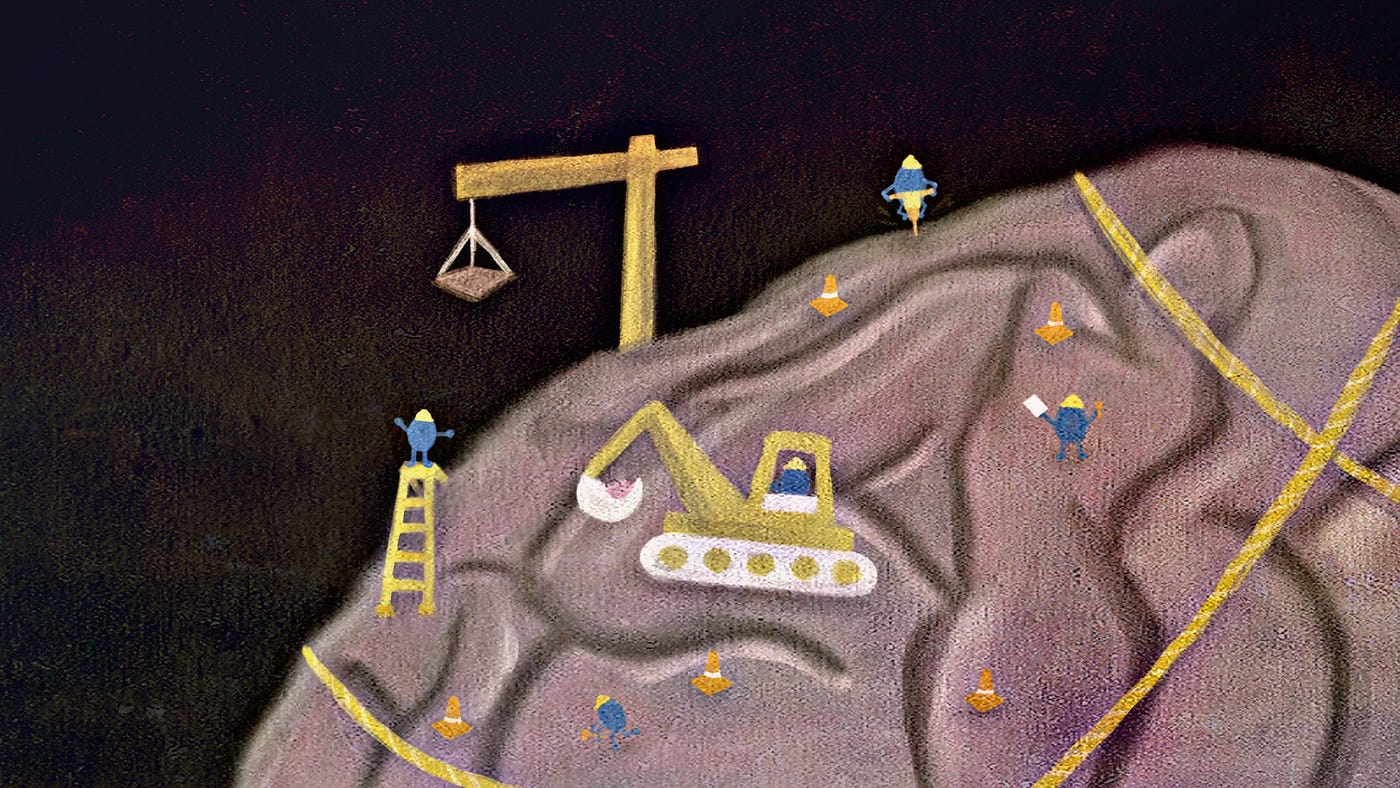
What’s all the ruckus in there? (Artwork by Kaleigh Ballantine)
Due to the sabbatical from screen time and cognitive endeavors prescribed by my condition, I was left to my imagination. I had some vague knowledge of neurons and synapses, but the scene that resonated in my mind over and over again was a much simpler one: little construction workers rummaging around my left temple, slowly addressing damage and building my battered little brain back up.
Throughout visits with various doctors and therapists, several other colorful analogies were passed on to me. “It’s like your brain is a filing cabinet, and the concussion just upturned all those files into a mess on the floor that it’s now resorting,” said my occupational therapist. “Your brain is a big highway intersection where there’s been a big crash,” explained one physical therapist. “It’s like a faulty cell phone battery,” another simply put. “You’re just going to have to let it recharge more.”
I love similes as a science communication tool, and their importance for helping connect and explain to patients what’s happening in their bodies cannot be understated. But between a construction zone, a messy office, a pileup, and a dying phone, at some point, I needed to go back to the basics of my tangible brain. What actually even is a concussion?
First, let’s start from the outside. A concussion is a traumatic brain injury (TBI) usually caused by an impact to or rapid acceleration of the head or body, such as slipping and falling (the leading cause), experiencing a violent blow, getting in a car crash, hitting your head as you stand or, in my most recent case, having a ball kicked into your eye at a soccer game (unfortunately, my first game of the season). These events don’t always cause concussions, but are good reasons to check for one.
While the impact might leave you with a black eye, broken nose, or other injuries, concussions have a much less clear telltale sign. But before we get into that, let’s acknowledge what the physical symptoms manifest as. After impact, some people may lose consciousness. Many experience ringing in the ears, nausea, blurry vision, vomiting, or fatigue. Some symptoms require emergency care, including cases of repeated vomiting, seizures, worsening severe headache, weakness or numbness, slurred speech, unequal pupils, and trouble staying awake or awakening.
Feelings of confusion, amnesia, and dizziness are fairly typical observations of someone just concussed. Others appear over time, like concentration and memory issues, irritability, sensitivity to light (photophobia) and noise (phonophobia), insomnia, and more.
And then, of course, there are the headaches. Some start rather instantly after impact, and others appear within the following week. Called post-traumatic headaches, this can be one of the most common yet most debilitating symptoms. According to the Traumatic Brain Injury Center of Excellence, post-traumatic headaches commonly include migraines and tension-type headaches.
Sincere apologies to all those who have endured the familiarity of migraines, but for the lucky ones out there, they are often intense, throbbing, and nausea-inducing (this is, perhaps, where my cacophonous construction workers come from). Tension-type headaches tend to be more moderate in intensity, but act as a nagging pull or constant pressure across the head.
When I opened my eyes, lying flat on the indoor soccer field, I was alarmed to find that, one, I could not exactly remember the ball soaring into my face, and, more disconcertingly, two, that half the field of vision of my left eye was blacked out, and remained that way for the better part of an hour.
Ultimately, that, the inability to stay awake at my doctor’s visit the following morning, and the mysterious clear fluid persistently flowing out of my nostril were what sent me to the emergency room. The symptoms raised concern to check for retinal damage and if my runny nose was a cerebrospinal fluid leak, which I called “leaky brain” to tone down how freaky that sounded. Luckily, the medical imaging magic of a CT scan ruled out acute structural emergencies like brain bleeding or a skull fracture, while an eye ultrasound cleared me of retinal detachment, officially sending me home to rest.
Contextually, the cause and symptoms of concussions break down to fairly common knowledge. You hit your head, you get a headache. Easy math. It feels similar enough to: you hit your leg, you get a bruise. But unlike a bruised leg, where damaged blood vessels slowly clear out leaked red blood cells as they heal, the brain operates on a much more complicated system.
It’s a bit unnerving to think about, but your brain isn’t rigidly fixed in place. It actually floats inside your skull in a bath of cerebrospinal fluid (CSF), which cushions the organ and limits direct contact with bone.
Imagine placing an egg inside an empty plastic jar. If you shake it, the egg smashes against the walls. But if you fill that jar with water, the egg floats. Shake it now, and the water sloshes around, absorbing the impact and keeping the egg intact. That is your CSF in action. Eggs are such a pervasive analogy for this phenomenon that physicists and neuroscientists actually use them in laboratory studies to map concussions!
Despite this cushion, CSF cannot completely prevent brain tissue from stretching and straining when an impact is violent enough. Linear and rotational movements can stress neural tissue and signaling even when there’s no obvious bleeding or fracture on standard scans. Extending our metaphor: the eggshell remains completely unbroken, but the delicate yolk inside is sheared and distorted.
While violent impacts cause concussions, they can also produce more severe damage. The plastic jar can dent or split, mirroring a skull fracture. Rotational forces can violently twist the egg, tearing the yolk: a parallel to diffuse axonal injury (DAI), which is a severe TBI involving widespread, microscopic tearing of the brain’s communication cables (axons). In a mild concussion, these cables are merely temporarily strained and stressed, rather than torn apart.
If the egg sustains small cracks and the egg white leaks out, it mimics a brain contusion, a bruise on the brain where tiny blood vessels bleed into the tissue. A larger crack where fluid pools outside the shell and presses back against it loosely represents a hematoma, which is a collection of blood from ruptured larger vessels that compresses brain tissue.
Concussions are still serious, but they fall on the lighter end of the spectrum and are categorized as mild traumatic brain injuries (mTBIs). Generally speaking, unlike contusions and hematomas, concussions are not an obvious structural injury, but rather more of a functional one. Hence, the Mayo Clinic defines a concussion as “a mild traumatic brain injury that affects brain function.” The disruption to cells occurs on such a microscopic scale that it alters how the brain works without visible structural damage on standard scans like CTs and MRIs.
So, without catastrophic damage requiring a construction crew, what was actually causing all the hammering in my head? I was surprised to find that, simply put, a concussion is an energy crisis.
The tiny damages that occur are to brain cells called neurons. Neurons are cells that primarily make up the nervous system. They receive sensory input (you feel the prick of a bug biting your hand), send motor commands (you should shoo it away), and relay electrical signals (your muscles contract, swatting it off). This behavior demonstrates the three main parts of a neuron: dendrites (which receive signals), a cell body (which processes signals), and an axon (which transmits signals to other neurons).
In order to repair the microscopic damage the neurons in the brain endured, the body redirects its energy to heal one of its most important organs, temporarily altering chemical processes affecting the nervous system, including how neurons use energy. These interactions are called neurometabolic activity.
One unintended change to this activity is ionic dysregulation. For those of us who haven’t dropped into a chemistry class recently, ions are atoms with a positive or negative charge. When a concussion occurs, the physical stretching of axons acts like a microscopic earthquake, forcing the lining of your neurons (called membranes) to leak these ions. Potassium rushes out, and calcium rushes in.
So some electrolytes you might recognize from your favorite sport drink are getting swapped around. What’s the big deal?
When this happens, neurons become overly excitable, triggering an uncontrolled release of chemical messengers like glutamate. This chaos is called the “excitatory” phase of a concussion.
Here is where the “crisis” peaks: to clean up this chemical mess and pump those ions back where they belong, the brain’s cellular engines have to work in absolute overdrive, demanding a massive surge of glucose for energy. But because of the trauma, blood vessels constrict, and blood flow to the brain actually drops.
The brain is suddenly starving for fuel at the exact moment it needs it most. This massive mismatch between energy demand and supply is the true energy crisis. And in that stressed, drained state, you experience symptoms like headaches, dizziness, nausea, and difficulty concentrating. Not so exciting.
My headache started as soon as my mid-game adrenaline wore out, and persisted for about three brutal weeks straight, then tapered off and on for a while afterwards. The fatigue, neck pain, nausea, and photo- and phonophobia all made sure to stick around to provide it company. Unable to look at screens, stand to go most places, or concentrate to do most things, I spent my days listening to podcasts and audiobooks, going for walks, and wondering what I would learn when I could finally write this article.
Despite the commotion, the brain actively tries to fix the problem by restoring the ion balance and repairing the cell membrane. Because it has to move molecules against the gradient back where they belong, it requires a process called active transport. This is accomplished using the body’s energy molecule, called ATP, and lots of it. Normally, the brain uses about two-thirds of ATP to maintain the gradients concentrated on one side or the other of the cell membrane. When the brain is injured, this amount drastically increases.
Unfortunately, another factor further complicates this. While neurons are already combating the increased level of calcium rushing into them, another pathway risks even more entering. The glutamate mentioned earlier can attach to receptors on the neuron’s membrane, causing calcium channels to open and allow a large flood of calcium into the cell.
The cell tries to handle this by storing some of the extra calcium in its mitochondria. But too much calcium can damage the mitochondria. Mitochondria normally make lots of energy from oxygen by using glucose to produce dozens of ATP in a process called oxidative metabolism. When mitochondria don’t work well, the brain has to switch to anaerobic metabolism to make ATP instead.
Anaerobic metabolism is drastically less efficient, producing roughly 15 times less energy per sugar molecule. To make matters worse, it causes reactive oxygen species (unstable molecules that damage cell structures) to build up. With mild traumatic brain injury, the body’s antioxidant defenses can often reduce this damage and prevent it from becoming permanent. But with moderate or severe TBI, those defenses usually can’t keep up, and damage is more likely. Calcium can also damage important parts of the axon, which help the neuron send signals. When these structures are harmed, the axon can’t work properly.
As if we needed one more thing to consider in the brain’s fragile ecosystem at this time, blood flow also plays a role. Following a concussion, there is decreased blood flow to the brain, occurring within an hour of injury and sometimes lasting as long as a month later. While the causes of these changes are still being researched, it likely relates to a change in function of the autonomic nervous system, which includes functions like heart rate and blood pressure. The dysfunction caused by the impact leads to less blood reaching the brain.
To understand why a drop in blood flow is so devastating, it helps to look at how living things generate power. While plants use photosynthesis to turn sunlight, water, and carbon dioxide into glucose for energy, our bodies run a similar process in reverse. Through cellular respiration, our cells break down oxygen and glucose to create carbon dioxide, water, and precious ATP. This is the exact pathway your mitochondria rely on to fuel your brain. Because decreased blood flow means less glucose reaches the target, your struggling brain is left with fewer resources to create the very energy it needs to heal.
The increased demand for ATP to help restore the resting membrane potential is poorly matched by the brain’s impaired ability to produce it. This double whammy results in a metabolic energy crisis, a situation in which the body’s energy supply is insufficient to meet its energy demands.
As you try to do activities like returning to work or researching an article, your brain lacks the energy needed, switching to rely on less efficient, more tiring pathways. Called a metabolic cascade, this series of biochemical reactions illustrates the complex mechanisms behind the physical symptoms we experience, and provides insight into the recovery process needed to address them.
Just over three months post my concussion, let me tell you: post-concussive symptoms are no joke. In fact, if you have symptoms lasting longer than that duration (and you haven’t gotten tired of the word yet), there’s a syndrome for that. That’s right, welcome to persistent post-concussion syndrome!
Persistent post-concussion syndrome (PCS) includes the previously mentioned symptoms of concussion like headaches, dizziness, fatigue, sleeping issues, and neck pain, but with an expanded timeline. Sometimes, symptoms can last for a year or longer. The causes and risk factors for why some people experience symptoms longer than others continue to be studied, and could be linked to the impact severity, other medical conditions like migraines or anxiety, and certain demographics. Previous brain injury is also a stronger indicator.
While there’s no easy cure for PCS, there is a path to recovery. While medicine used to prescribe strict rest in a dark room until you felt better, modern concussion science has completely flipped the script. According to updated clinical guidelines, while you absolutely need to rest for the first 24 to 48 hours, prolonged resting can actually make symptoms last longer. Instead, the new key to recovery is active rehabilitation: attending physical and occupational therapy and introducing safe, sub-symptom activities like light walking or stationary cycling early on.
By gently pushing your boundaries without triggering a flare-up, you safely stimulate blood flow, helping your starving brain cells step-by-step out of their energy crisis. Mostly, treatment centers around managing the specific symptoms to improve a return to normal function and quality of life. With care to avoid another head injury, in most cases, symptoms eventually stop.
I started experiencing the most debilitating symptoms of my concussion after a soccer game where a ball was booted into my face (with no apology, I might add, as is the cutthroat nature of a C-tier adult rec-league). However, these unfortunately weren’t the beginnings of my symptoms, as I had already hit the same side of my head on a table corner five days prior.
I had only had occasional localized headaches and some dizziness lying down, and it didn’t strike me as a big deal. But, with a couple of minor concussions spaced a few years apart in my past, I’d heard that every concussion increases the odds of getting the next, and the consequences of them. Even then, I’d never had a brush with two so close together. The multi-month recovery associated with my injury was likely due to that compound circumstance.
I had heard correctly. While most concussions resolve in about a week, that doesn’t mean you get off scot-free. Research has found that each concussion leaves you more susceptible to the next, requiring less force to trigger it, and more time to recover. Each time you have a concussion, your brain enters the altered function of energy crisis mode. Each time you recover, your brain struggles to shift out of this mode back to normalcy. The less efficient pathways you rely upon during a concussion risk becoming the defaults, leading to chronic symptoms.
One risk of repeated head injuries is chronic traumatic encephalopathy (CTE), a degenerative brain disease linked to a normal brain protein called tau going rogue. When damaged by repeated impacts, these proteins fold incorrectly and clump together, disrupting cell function and eventually leading to brain cell death.
Others include dementia and groups of proteins called amyloid plaques associated with Alzheimer’s disease. The important thing to remember is that for most mild traumatic brain injuries like concussions, these are extremely unlikely. Still, they serve as an important reminder to protect your brain moving forward.
This is especially true for second impact syndrome (SIS). While exceptionally rare and primarily a danger to adolescents and young adults whose brains are still developing, it occurs when a second head injury happens before the first has fully healed. The brain becomes unable to self-regulate its blood flow, causing increased blood volume leading to rapid swelling that can result in brainstem herniation and death. Even in less severe cases, the vulnerability caused by inflammation and oxygen shortage to the brain can make SIS damage exponentially worse and increase risk of long-term impairment.
In the grand scheme of multiple-impact concussions, I’m very lucky. Honestly, I shudder to think what could have happened had I returned to my soccer game and taken one more hit. There’s an odd sort of casualty that surrounds concussions in some spaces. When teammates heard that I had been instructed to avoid high-risk activities like soccer for a whole year, many scoffed. Even I found that guidance to feel extreme or unwarranted.
Despite the fact that we all surely must know the importance of our brains, and their miraculously complex fragility, it’s easy to write concussions off as “just a bump to the head” with no physical manifestations to show for it. Even throughout the robust medical care I was privileged enough to receive, I still didn’t understand what was actually happening in my head, and what the real risks were. But as the science reveals, a concussion is not an invisible, minor inconvenience. It’s a literal cellular crisis.
What started as a scientific curiosity about the biophysical chemistry happening inside my brain evolved into an unflinching look at the brain’s vulnerability and the need to protect it. The act of researching and writing this article (and the ebb and flow of my persistent post-concussive symptoms as I struggled to complete it) forced me to understand what is at stake, and how meaningful recovery is.
Whether your brain is filled with bulldozers and cranes, filing cabinets, cars, phone batteries, or even neurons and synapses, you only get one. Concussed or not, take care of it. As I continue to recover, I, for one, intend to make sure there are no OSHA violations for my construction workers in sight.
Note: I am not a medical professional, and this article should not be treated as medical advice. If you think you might have a traumatic brain injury, see a healthcare professional or seek immediate care. This article represents a snapshot of our current scientific understanding of mild traumatic brain injuries; research is continuously ongoing and revealing new insights.
Medical content reviewed by Margaret Rose Winicki, Doctorate of Nurse Practitioner Candidate
메타데이터
- post_id
- ac41d4a0bd4e
- slug
- your-brain-concussed-ac41d4a0bd4e
- url
- https://medium.com/@kballantine11/your-brain-concussed-ac41d4a0bd4e
- canonical_url
- https://medium.com/@kballantine11/your-brain-concussed-ac41d4a0bd4e
- author_url
- https://medium.com/@kballantine11
- status
- ok
- fetched_at
- 2026-08-17 04:43:27