Cyber Risk Operational Model (CROM): From Static Risk Mapping to Proactive Cyber Risk Operations
In previous articles, I’ve explored the critical difference between treating cyber risk and operationalizing it. Traditional cybersecurity…

Cyber Risk Operational Model (CROM): From Static Risk Mapping to Proactive Cyber Risk Operations
In previous articles, I’ve explored the critical difference between treating cyber risk and operationalizing it. Traditional cybersecurity often mistakenly equates “risk treatment” with real security improvements, yet frequently leaves vulnerabilities unaddressed, creating dangerous gaps exploited by attackers. These gaps are widened by what I’ve called the “illusion of continuous” — the undefined and ambiguous interpretation of continuous monitoring found in frameworks like NIST CSF 2.0, ISO 27001, DORA, and others.
To address these issues comprehensively, I propose the Cyber Risk Operational Model (CROM), a clear and actionable framework designed to evolve organizations from passive, compliance-driven approaches to proactive, risk-driven operational excellence.
CROM visualizes cyber risk management maturity along two critical dimensions:
- Cyber Risk Exposure: How vulnerable the organization is to cyber threats.
- Cyber Risk Operations Level: How effectively the organization operationalizes cyber risk management practices.

Level 0 — Unaware: Where Cyber Risk Doesn’t Exist… Until It Does
At Level 0 in the Cyber Risk Operational Model (CROM), cyber risk is not managed, measured, or even acknowledged. This is not just a state of immaturity — it’s a state of vulnerability.
Organizations at this stage are not necessarily reckless. In many cases, they simply lack the visibility, tooling, or executive support needed to treat cyber risk as a real business concern. Security might be handled by IT, or left to outsourced providers, but cyber risk itself is invisible in operational conversations.
There are no documented risks. No known risk owners. No telemetry. No prioritization.
If a cyber risk is discovered, it’s usually by accident — after an incident has occurred.
The most dangerous thing about being unaware isn’t just exposure — it’s false confidence.
Leaders might believe “we’re too small to be a target” or “our vendor handles that,” completely ignoring the internal responsibility to identify, measure, and manage cyber risk.
This level is also where cyber criminals thrive. Attacks are often low-effort, high-reward. Phishing emails go unnoticed. Unpatched systems linger. Credentials are reused. And since no one is looking, intrusions may persist for weeks or months undetected.
This is where the CROM journey begins — by turning the invisible into the visible.
Level 1 — Aware: Spreadsheet Risk Documentation

At Level 1, organizations become aware that cyber risk exists — but their methods for dealing with it are rudimentary and disjointed. This is the realm of spreadsheets, informal assessments, and check-the-box compliance.
There’s often no formal cyber risk function — just a few concerned stakeholders (usually in IT or compliance) trying to make sense of evolving threats using the tools they have: Excel, email threads, and internal PDFs.
Cyber risks may be listed, but they’re: Subjective, Non-operational, Not linked to real-time exposure, Reviewed periodically (if at all).
This is the phase of “we did an assessment once, and we think we’re okay.”
There may be some security controls in place, but they’re not tied to measurable risk. There’s no way to answer, “What is our top cyber risk today?”
Spreadsheets are not inherently bad — they’re often the first step toward structure. But they quickly become outdated and misaligned with reality. Cyber risk doesn’t sit still. A spreadsheet created six months ago might be dangerously misleading today.
That’s why this phase is also known as the “illusion of control.” The colors in a spreadsheet might suggest you’re protected, but attackers aren’t referencing your Excel tabs before they breach your perimeter.
This is where risk starts to become structured, but the organization hasn’t yet connected it to live exposure or decision-making. That leap comes at Level 2 — Basic, where the heatmaps start showing up (and the risks of visual comfort begin).
Level 2 — Basic: Heat Maps Risk View

At Level 2 of the Cyber Risk Operational Model, organizations formalize their approach to cyber risk. Assessments are more structured. Risk frameworks like NIST or ISO might be adopted. Risk registers grow more detailed.
But the biggest shift? Heat maps enter the picture.
At first glance, this seems like real progress — and in many ways, it is. Risk is now being categorized, scored, and visualized. Dashboards are created. Red-yellow-green heat maps appear in boardroom slide decks. But the problem is that the risk posture is still frozen in time.
The visual clarity of heat maps gives the appearance of control. But behind the curtain, the story hasn’t changed: risk remains theoretical, not operational. You can’t fight dynamic threats with static pictures.
The core issue at this level is that the model has no awareness of time. Heat maps represent a snapshot — an old photo of risk posture. Threat actors, on the other hand, work in real-time.
This transition is not just technological — it’s cultural.
You stop managing risk as a compliance task and start managing it as a live, evolving operational concern.
And that’s where CyberRiskOps comes in.
Level 3 — Monitored: CyberRiskOps Adopted

Level 3 marks the beginning of a true operational transformation. This is the point where cyber risk stops being a “reporting exercise” and starts becoming part of the organization’s day-to-day operational fabric.
At this stage, organizations adopt CyberRiskOps — a mindset and operating model that merges the disciplines of cybersecurity, risk management, and real-time monitoring. Cyber risks are no longer just tracked. They’re measured and acted upon continuously.
What Changes at This Level?
- Risk scoring becomes dynamic — updated as new telemetry comes in
- Sensors, logs, and analytics provide live inputs into cyber risk posture
- Risk is aligned with operational processes, not just compliance checklists
- Controls are monitored for effectiveness, not just existence
- Cyber risk discussions move from security teams to business leadership
Instead of saying, “What’s our top risk from last quarter?”
Organizations start asking, “What’s our risk right now — and how is it trending?”
CyberRiskOps in Action
CyberRiskOps represents a new operational domain. Just like DevOps bridges development and operations, CyberRiskOps bridges cyber risk strategy and execution. It brings together:
- Threat intelligence
- Asset telemetry
- Control coverage
- Risk scoring
- Governance workflows
This convergence allows for real-time, contextualized decisions — the kind needed to stay ahead of modern threats.
Level 3 is where organizations finally gain visibility into cyber risk. But visibility alone isn’t enough. The next step is Operationalization.
Level 4 — Operationalized: CROC Enabled

At Level 4, organizations evolve from visibility to control. They no longer just monitor cyber risk — they operationalize it.
This is where the Cyber Risk Operations Center (CROC) becomes a reality.
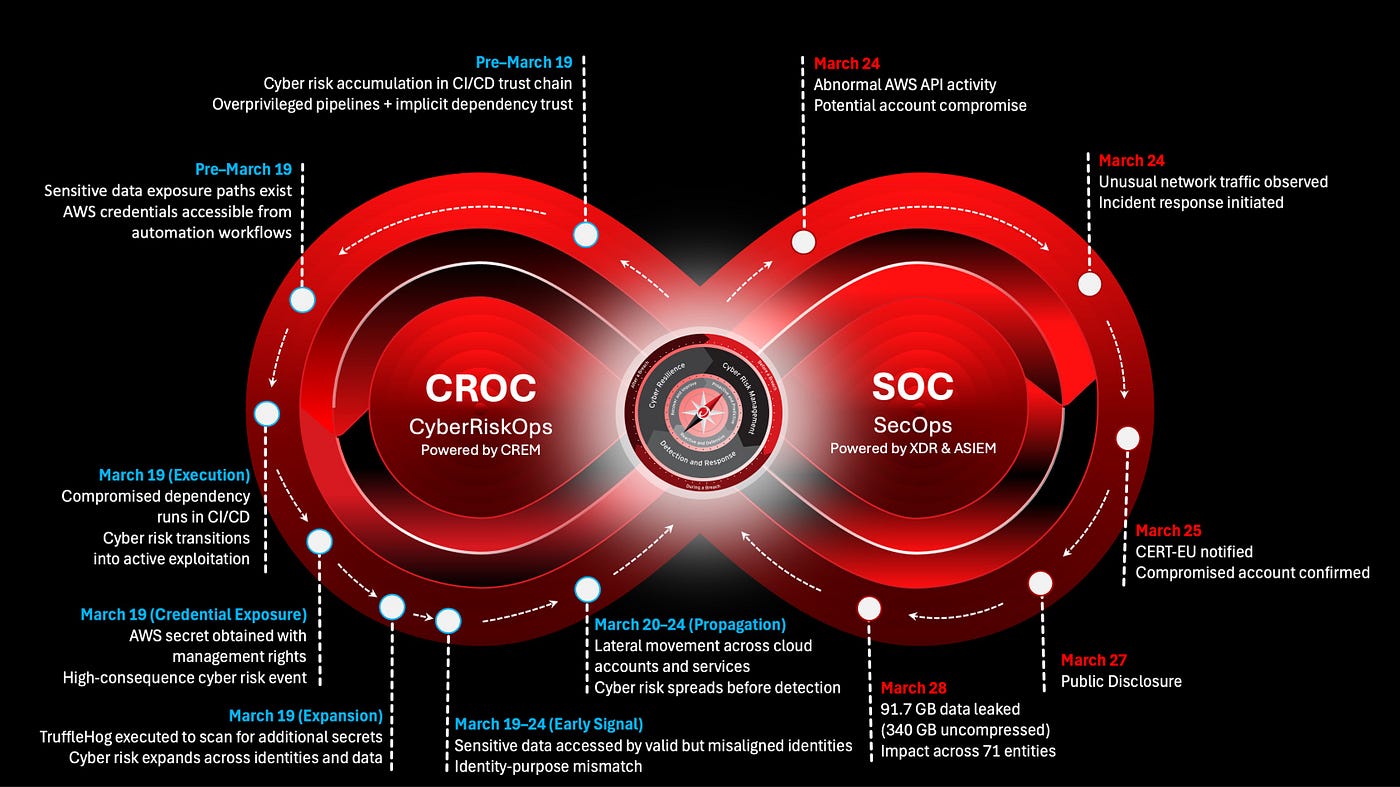
The CROC is not just a SOC with a new label — it’s a new function entirely. While the SOC is reactive (focused on threat detection and incident response), the CROC is proactive: focused on understanding, measuring, and reducing cyber risk in real-time, at scale, and in sync with business operations.
What Does Operationalization Mean?
- Cyber risk becomes an input into decisions across IT, security, and business units
- Risk scoring is automated and continuous, not periodic or manual
- Control validation happens in real time — not just audits or point-in-time checks
- Business units understand how their actions change cyber risk posture
- Cyber risk telemetry flows to dashboards used in real decision-making contexts (not buried in security reports)
What Makes a CROC Different?
A Cyber Risk Operations Center is where:
- Cyber risk data is collected and analyzed continuously
- Risk levels are updated as telemetry changes
- Cyber risks are tied to assets, processes, and business outcomes
- Actionable playbooks guide how to respond to emerging risk conditions
The CROC becomes the central nervous system of cyber risk operations — enabling dynamic, responsive, and data-backed decision-making across all levels of the enterprise.
The CROC unlocks a new level of agility and alignment. But there’s one more stage — the summit of CROM maturity.
Level 5 — Proactive: Predictive, Preemptive Posture

At Level 5, cyber risk is not only operationalized — it’s anticipated. Organizations are no longer content with seeing risk in real time; they now forecast it, simulate it, and act before risk materializes.
This level represents a true shift in mindset. Instead of responding to threats or managing risk from behind, organizations now lead with predictive models, threat intelligence, and risk simulations that guide strategy.
Characteristics of Level 5
- Cyber risk is integrated with business risk and financial forecasting
- Predictive analytics inform strategy, investment, and product development
- Threat modeling and simulation tools are used to test responses to hypothetical events
- Control adjustments are made before exposure changes
- Human and AI-driven decision-making work in concert to maintain cyber risk resilience
Thinking Ahead, Acting Ahead
Organizations at Level 5:
- Simulate threats before deploying new systems
- Forecast the risk impact of business decisions (e.g., mergers, launches, vendor changes)
- Use machine learning to detect early signals of control failure or emerging threats
- Build proactive playbooks that don’t wait for incidents to occur
At this point, cyber risk becomes a source of competitive advantage, not just a defensive concern. Risk data shapes innovation. Confidence in controls supports faster execution. Security and resilience are woven into the business DNA.
What It Takes to Stay Proactive
- A mature CROC that functions like a strategic control tower
- Advanced analytics and modeling capabilities
- Alignment between security, risk, finance, operations, and leadership
- A culture that prizes proactive resilience over reactive recovery
At Level 5, cyber risk isn’t a disruptor. It’s a driver of smarter, faster, and safer growth.
The Full CROM Journey
Here’s a reminder of how far we’ve come:
- Level 0 — Unaware: Cyber risk is invisible
- Level 1 — Aware: Risk lives in spreadsheets
- Level 2 — Basic: Heat maps give the illusion of control
- Level 3 — Monitored: CyberRiskOps introduces real-time data
- Level 4 — Operationalized: CROC becomes the hub of cyber risk operations
- Level 5 — Proactive: Cyber risk is forecasted and strategically managed
Each level builds on the last. Every step matters. And the future of cyber resilience belongs to those who are ready to leave static models behind and operate cyber risk like a real-time system.
Why CROM Matters Now
Organizations can no longer afford the gap between strategic frameworks and operational execution. The threat landscape is too fast, too intelligent, and too adaptive.
CROM is more than a maturity model — it’s a cyber risk transformation roadmap. It redefines what it means to be truly secure in a digital-first world.
Adopting CROM:
- Ends the illusion of continuous.
- Retires heatmaps as a central decision tool.
- Embeds cyber risk into every operational layer of the business.
Ultimately, the Cyber Risk Operational Model isn’t just about managing risk — it’s about proactively controlling your cyber strategy.
Castro, J. (2025). Cyber Risk Should Not Be Treated — It Should Be Operationalized. ResearchGate. https://www.researchgate.net/publication/389991463 DOI:10.13140/RG.2.2.12429.45289
Castro, J. (2025). Cyber RiskOps: Bridging Strategy and Operations in Cybersecurity. ResearchGate. https://www.researchgate.net/publication/388194428 DOI:10.13140/RG.2.2.36216.97282/1
Castro, J. (2025). The Illusion of “Continuous” in Cybersecurity: The Biggest Vulnerability in Frameworks and Regulations. ResearchGate. https://www.researchgate.net/publication/388682749 DOI:10.13140/RG.2.2.10471.15520/1
Castro, J. (2025). How to Turn Cyber Risk Assessments into Real Cyber Risk Reduction. ResearchGate. https://www.researchgate.net/publication/388564202 DOI:10.13140/RG.2.2.14029.76007/1
Castro, J. (2024). From Reactive to Proactive: The Critical Need for a Cyber Risk Operations Center (CROC). ResearchGate. https://www.researchgate.net/publication/388194441 DOI:10.13140/RG.2.2.27408.93445/1
Castro, J. (2025). Cyber Risk Operations Center (CROC) Process and Operational Guide. ResearchGate. https://www.researchgate.net/publication/389350613 DOI:10.13140/RG.2.2.19164.09600
Castro, J. (2024). Cyber Risk 101: Understanding and Managing Cyber Risk. ResearchGate. https://www.researchgate.net/publication/388493450 DOI:10.13140/RG.2.2.23453.83684/1
Castro, J. (2024). Not All Risks Are Created Equal: The Unique Challenges of Managing Cyber Risks. https://www.researchgate.net/publication/388194434 DOI:10.13140/RG.2.2.24053.49126/1
메타데이터
- post_id
- ac705d32070d
- slug
- cyber-risk-operational-model-crom-from-static-risk-mapping-to-proactive-cyber-risk-operations-ac705d32070d
- url
- https://medium.com/@cybersecuritycompass/cyber-risk-operational-model-crom-from-static-risk-mapping-to-proactive-cyber-risk-operations-ac705d32070d
- canonical_url
- https://medium.com/@cybersecuritycompass/cyber-risk-operational-model-crom-from-static-risk-mapping-to-proactive-cyber-risk-operations-ac705d32070d
- author_url
- https://medium.com/@cybersecuritycompass
- status
- ok
- fetched_at
- 2026-06-26 21:52:29