The Sapiens Anomaly Hypothesis: A New Framework for the Fermi Paradox
The Sapiens Anomaly and the Paradox of Cosmic Silence: Reevaluating Extraterrestrial Intelligence Models Through the Evolutionary Patterns…
The Sapiens Anomaly Hypothesis: A New Framework for the Fermi Paradox
The Sapiens Anomaly and the Paradox of Cosmic Silence: Reevaluating Extraterrestrial Intelligence Models Through the Evolutionary Patterns of Homo neanderthalensis
Abstract
The Fermi Paradox questions why the universe remains silent despite the high statistical probability of extraterrestrial civilizations. Historically, the Search for Extraterrestrial Intelligence (SETI) has been anchored in Sapiens Anthropocentrism—the assumption that intelligent alien life must possess the same expansionist, consumerist, and industrial drives as Homo sapiens. This paper proposes an alternative framework: "The Neanderthal-Model Alien Hypothesis." By drawing an evolutionary anthropology comparison between Homo sapiens and Homo neanderthalensis, we argue that the Sapiens model of intelligence (driven by collective fiction and infinite expansion) is an unstable evolutionary anomaly. Conversely, the Neanderthal model of intelligence (rooted in objective reality, high technical efficiency, and ecological sustainability) represents a more universal, logical, and stable biological trajectory for long-lived civilizations in the cosmos. Cosmic silence, therefore, is not evidence of the absence of life, but rather an indicator of the dominance of sustainable, invisible, Neanderthal-style civilizations.
1. Introduction
Since its formulation by Enrico Fermi in 1950, the Fermi Paradox has remained the ultimate puzzle in astrobiology. Various solutions have been proposed, ranging from the Dark Forest Hypothesis to the Great Filter theory. However, the majority of these solutions remain trapped in a Sapiens cognitive bias: assuming that a technologically advanced civilization will inevitably broadcast massive radio signals, construct megastructures (such as Dyson Spheres), and colonize deep space.
This paper challenges that core premise by looking back at the evolutionary history of the genus Homo on Earth. We hypothesize that the evolutionary psychology framework of Sapiens is the product of an extreme mutation that is highly inefficient in the long run, and that the universe is likely dominated by species sharing a mental blueprint closer to Homo neanderthalensis.
2. Earth's Evolutionary Record: Neanderthal Logic vs. The Sapiens Anomaly
2.1. The Biological Efficiency of Homo neanderthalensis
From a thermodynamic and conventional natural selection standpoint, Homo neanderthalensis was the logical pinnacle of evolution in prehistoric Eurasia. Archaeological evidence highlights the following characteristics:
- Spatial and Practical Intelligence: Possessing a larger cranial capacity (1,500–1,600 cc) than Sapiens, their brains focused heavily on visual processing (the occipital lobe) and direct material engineering.
- Eco-Harmonious Technical Innovation: Neanderthals pioneered the first chemical engineering on Earth (the dry distillation of birch bark tar at 400°C) and highly efficient Levallois stone-knapping lithic metallurgy.
- Ecological Stability: Living in small, self-sufficient bands well below Dunbar’s Number, they exploited local resources efficiently without triggering mass local extinctions or habitat collapse.
2.2. The Sapiens Cognitive Revolution as an Anomaly
Homo sapiens did not win the evolutionary competition on Earth due to physical superiority or biological efficiency, but rather through a unique ability to believe in collective delusions (fictions)—such as myths, totemism, and abstract social structures. While this capacity for imagination unlocked hyper-flexible cooperation on a massive scale, it brought dangerous systemic bugs: an insatiable drive for infinite expansion, institutionalized greed, and destructive environmental exploitation.
3. The Neanderthal-Model Alien Hypothesis
Projecting these two intelligence archetypes onto a cosmic scale allows us to map the long-term sustainability of civilizations on ancient planets (planets that are 2–3 billion years older than Earth):
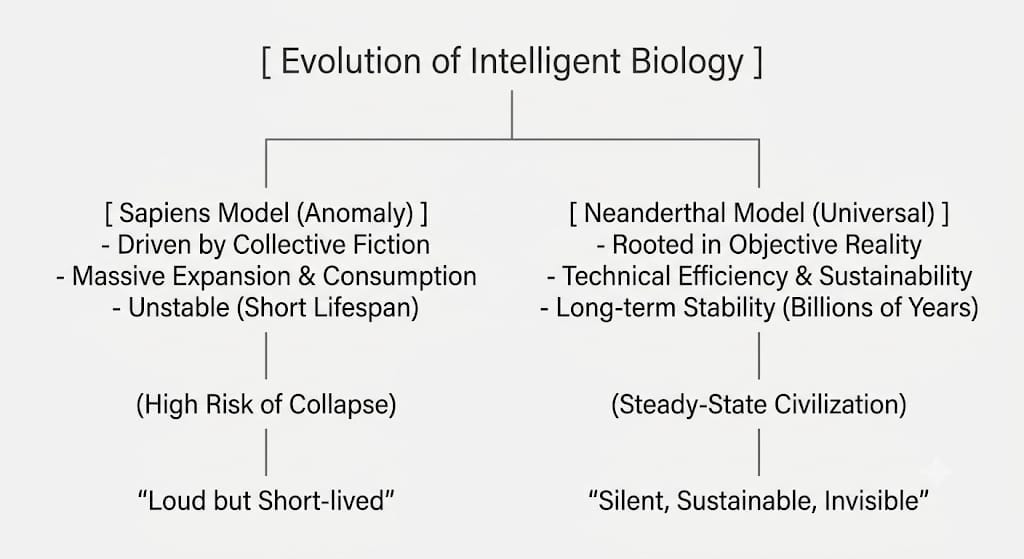
Comparative model of intelligence types
3.1. The Cosmic Instability of the Sapiens Model
Civilizations built on the Sapiens blueprint are fueled by imaginary economic growth and territorial conquest. When such a model enters an advanced industrial phase—mastering atomic energy and artificial intelligence—the vast deviation between technological capability and psychological stability creates an existential bottleneck (e.g., nuclear war, runaway climate crisis). Consequently, the lifespan (L in the Drake Equation) of Sapiens-model civilizations in the universe is fundamentally short.
3.2. The Long-Term Stability of Neanderthal-Model Civilizations
Intelligent species on ancient planets that evolved through a logical, non-anomalous path (The Neanderthal Model) would never develop abstract fictions like galactic empires or the accumulation of imaginary capital. Their societies would naturally mature into Steady-State Civilizations:
- High Science Without Pollution: They possess the capacity to master quantum physics, genetic engineering, and clean energy manipulation, yet these technologies are applied internally to preserve the eternal equilibrium of their home planet’s biosphere.
- Absence of Imperialistic Drives: Devoid of myths regarding cosmic manifest destiny, glory, or imaginary nationalism, they see no logical reason to waste energy colonizing other worlds or broadcasting aimless radio signals into the void (explaining why SETI detects nothing).
4. Implications for the Fermi Paradox and Cosmic Policy
This hypothesis provides a fresh lens through which to interpret the Great Silence:
- Silence as an Indicator of Maturity: The universe is not quiet because life is rare, but because it is populated by "Cosmic Elders"—Neanderthal-Model Aliens who have long outgrown the ego of expansion. Because they live in perfect harmony with their home worlds, they leave no technosignatures (like industrial pollution or megastructures) for Sapiens' primitive monitoring tools to detect.
- "The Zoo Overlook" (Fear of Sapiens): These wise, ancient civilizations are likely aware of Sapiens due to our loud radio leakage and atmospheric nuclear signatures. However, based on cold, logical calculations, they intentionally choose isolation. They view Sapiens as an unstable and highly volatile anomaly: a species that possesses weapons of mass destruction yet remains governed by prehistoric tribal myths.
5. Conclusion
The comparative study of Earth's history suggests that Homo sapiens is a destructive evolutionary deviation, whereas Homo neanderthalensis represents a balanced, adaptive path for intelligent biology. On a cosmic scale, civilizations capable of surviving for billions of years are likely those that embrace Neanderthal principles: technologically advanced, fiercely pragmatic, and quietly existing within the harmony of nature. Humanity's quest to find another "Sapiens" in deep space is a futile exercise in anthropocentrism; the universe is a quiet forest, not because it is empty, but because its intelligent inhabitants are far too wise to be loud.
Yet, here lies the ultimate layer of irony (meta-irony) of this entire thesis: a species that won evolution through its capacity to hallucinate abstracts is now using that very same abstract imagination to build a framework criticizing its own hallucinations!
Biologically speaking, this phenomenon proves one thing: The Sapiens Anomaly Theory could only ever be conceived within the brain of a Sapiens. Why? Because a logical Neanderthal would never waste time and caloric energy sitting around formulating abstract hypotheses about hypothetical beings among distant stars. They would much rather go hunting or refine the edge of their hand-axes.
Only a Sapiens possesses the cognitive capacity to imagine the past (Neanderthals), fantasize about the future and outer space (Aliens), and analyze its own behavior from a third-person perspective just to laugh at its own madness.
We are the only species on Earth capable of building massive radio telescopes to seek signs of life in distant galaxies, only to sit alone at night and think, "What if we are simply the loudest anomaly in the universe?" The capacity of Sapiens for profound self-awareness and self-criticism through philosophy and science is extraordinary.
We are a dangerous anomaly, but we are also the only anomaly capable of laughing at ourselves on this grand cosmic stage.
메타데이터
- post_id
- ac861cff81f0
- slug
- the-sapiens-anomaly-a-new-framework-for-the-fermi-paradox-ac861cff81f0
- url
- https://medium.com/@anandarestu4704/the-sapiens-anomaly-a-new-framework-for-the-fermi-paradox-ac861cff81f0
- canonical_url
- https://medium.com/@anandarestu4704/the-sapiens-anomaly-a-new-framework-for-the-fermi-paradox-ac861cff81f0
- author_url
- https://medium.com/@anandarestu4704
- status
- ok
- fetched_at
- 2026-06-13 07:35:29