Top Crypto Narratives for the Next Bull Run
Crypto bull runs are never driven by price alone.
Top Crypto Narratives for the Next Bull Run
Crypto bull runs are never driven by price alone.
Every major cycle has been powered by narratives.
In 2020 and 2021, DeFi introduced permissionless finance to a broader audience. NFTs brought digital ownership into culture and communities. Layer 1 ecosystems attracted developers, liquidity, and retail attention. In the latest cycle, Bitcoin ETFs, restaking, memecoins, RWA, and Solana ecosystem growth became major attention drivers.
The next bull run will likely follow the same pattern.
Capital will move toward the narratives that combine three things: real user demand, strong market imagination, and improving infrastructure.
So the key question is:
What crypto narratives could define the next bull run?
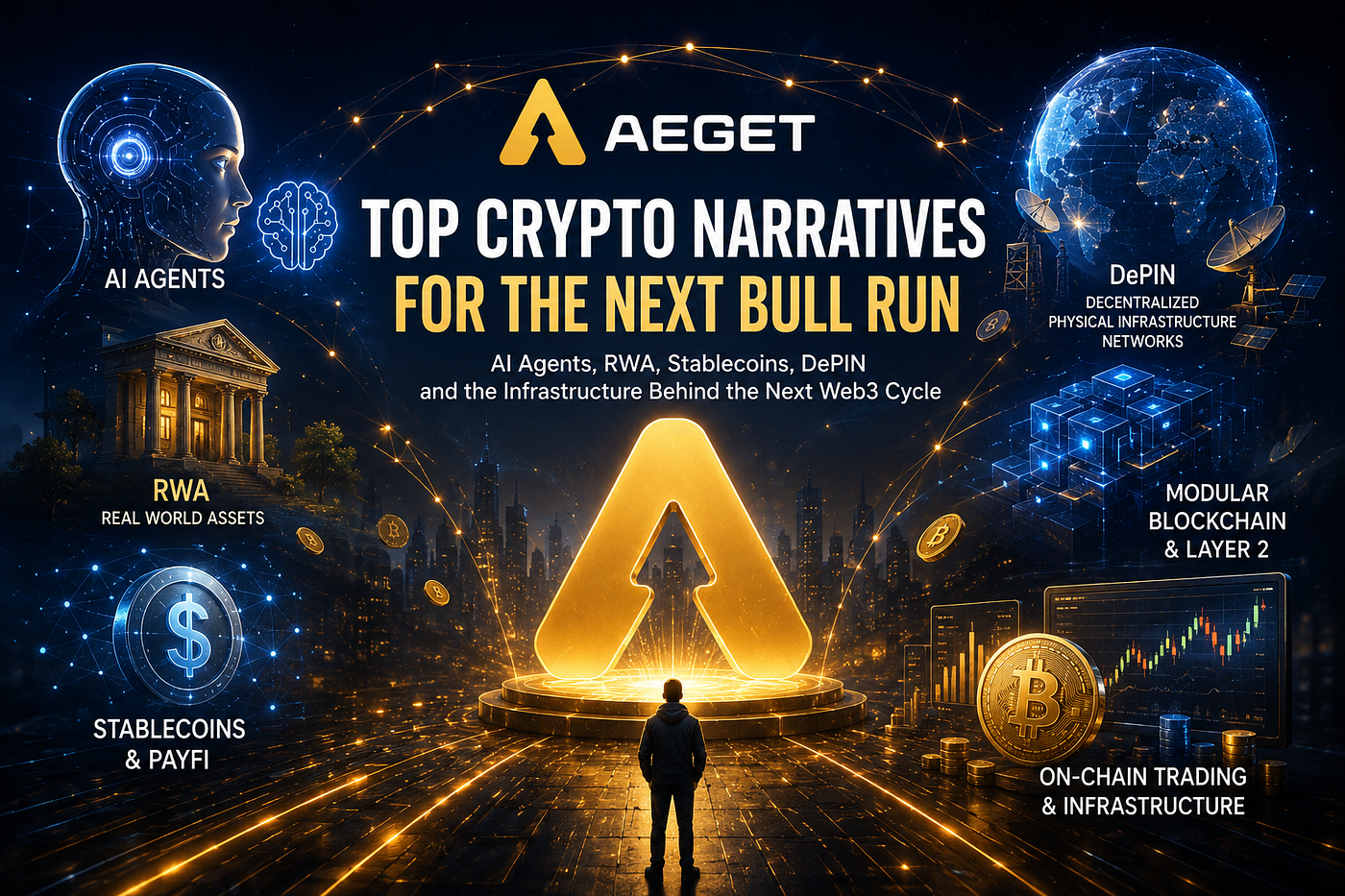
Based on current market signals, five narratives stand out: AI Agents, Real World Assets, Stablecoins and PayFi, DePIN, and crypto infrastructure.
Together, they point to one bigger trend: crypto is moving from speculation-only markets toward programmable, global, always-on digital finance.
AI Agents x Crypto: From Chatbots to Economic Actors
AI has quickly become one of the fastest-growing technology categories in the world. According to McKinsey’s 2024 global AI survey, AI adoption among organizations increased significantly, with generative AI moving from experimentation into real business use cases. At the same time, AI agents are becoming one of the most discussed directions in software.
But AI agents are not just smarter chatbots.
They are designed to take action.
An AI agent can search, compare, analyze, trade, pay, subscribe, book, monitor, and execute workflows on behalf of users. Once agents begin to take actions, they need financial infrastructure.
This is where crypto becomes relevant.
AI agents need:
- wallets
- payments
- identity
- market access
- asset ownership
- automated execution
- risk control
Traditional financial systems were built for humans, banks, and institutions. AI agents, however, operate digitally, globally, and continuously. They need financial rails that are programmable, open, and available 24/7.
Crypto already has many of these characteristics.
Stablecoins can support programmable payments. Wallets can support digital ownership. Exchanges can provide liquidity. Smart contracts can automate execution. On-chain data can support transparency.
This is why AI Agents x Crypto may become one of the strongest narratives of the next bull run.
The core idea is simple:
AI gives agents intelligence. Crypto gives agents economic power.
RWA: Bringing Real-World Value On-Chain
Real World Assets, or RWA, have become one of the strongest institutional crypto narratives.
Unlike purely speculative trends, RWA connects crypto with assets that already exist in traditional finance: treasury bills, private credit, real estate, commodities, funds, and other financial products.
The growth of tokenized U.S. treasuries is one of the clearest signals. According to RWA.xyz, the tokenized treasury market grew rapidly through 2023 and 2024, supported by higher interest rates and demand for on-chain yield products. Major financial institutions, including BlackRock and Franklin Templeton, have also entered the tokenized asset space.
The appeal of RWA is clear.
Traditional assets are large but often slow, fragmented, and difficult to access globally. Blockchain infrastructure can make them more transparent, programmable, and accessible.
RWA may become one of the most important bridges between traditional finance and Web3 because it brings real-world value into digital asset markets.
In the next bull run, RWA could attract three types of participants:
Retail users looking for more stable yield.
Institutions exploring tokenized financial products.
Crypto-native platforms building new on-chain asset markets.
This makes RWA more than a trend. It is part of the long-term financialization of blockchain infrastructure.
Stablecoins and PayFi: Crypto’s Most Proven Use Case
Stablecoins may be the most practical product crypto has created so far.
While many crypto narratives depend on future adoption, stablecoins already have real usage across trading, settlement, remittances, DeFi, treasury management, and cross-border payments.
According to DefiLlama and Visa Onchain Analytics, stablecoins have consistently represented one of the largest areas of on-chain activity, with supply returning to strong growth after the 2022 market downturn. They are widely used because they solve a simple problem: moving dollar-denominated value across digital networks.
This is why stablecoins are central to the PayFi narrative.
PayFi refers to payment-focused finance built on crypto rails. It includes cross-border payments, merchant settlement, payroll, creator payments, on-chain commerce, and eventually agent-to-agent payments.
Stablecoins are especially important for AI agents.
If autonomous agents need to pay for data, APIs, compute, subscriptions, digital services, or trading strategies, they need a payment layer that works at software speed.
Traditional payment systems are not designed for machine-driven microtransactions across global networks.
Stablecoins are much closer to that future.
In the next cycle, stablecoins may evolve from a trading tool into the payment layer of the digital economy.
DePIN: Turning Physical Infrastructure into Token Networks
DePIN, or Decentralized Physical Infrastructure Networks, is another narrative with strong long-term potential.
DePIN uses token incentives to coordinate real-world infrastructure, including wireless networks, storage, compute, mapping, energy, sensors, and data collection.
This narrative matters because it connects crypto with physical-world utility.
Instead of only building financial applications, DePIN projects attempt to create decentralized alternatives to traditional infrastructure networks.
The AI boom may further strengthen DePIN.
AI needs massive amounts of compute, data, bandwidth, and storage. Centralized cloud providers dominate these resources today, but decentralized networks may offer alternative ways to coordinate supply and demand.
Examples in the DePIN space include decentralized wireless networks, GPU compute markets, storage networks, and mapping/data networks.
The key idea is:
DePIN turns real-world resources into open, token-incentivized networks.
For the next bull run, DePIN has strong storytelling power because it combines crypto, AI, infrastructure, and real-world utility.
That makes it a narrative worth watching.
Crypto Infrastructure: The Gateway to the Next Cycle
Every bull run brings new users.
But new users do not only need narratives. They need infrastructure.
They need secure platforms.
They need liquidity.
They need market access.
They need risk control.
They need trading tools.
They need simple user experiences.
This is why crypto infrastructure may become one of the most important themes of the next cycle.
As markets become more complex, users will not only look for tokens to buy. They will look for reliable platforms that help them access opportunities safely and efficiently.
This includes spot trading, futures trading, staking, copy trading, risk management, asset protection, and global market access.
This is where AEGET’s positioning becomes relevant.
AEGET is a global cryptocurrency trading platform focused on building a secure, stable, and innovative digital financial service ecosystem. According to AEGET’s brand introduction, the platform provides services including spot trading, futures trading, staking, and copy trading, while emphasizing security infrastructure such as AI risk control, hot and cold wallet separation, multi-signature protection, multi-factor authentication, and high-performance matching.
In a market driven by fast-moving narratives, trusted infrastructure becomes even more important.
Users may be attracted by AI Agents, RWA, Stablecoins, DePIN, or other emerging trends. But to participate in these opportunities, they need a gateway that is secure, stable, and efficient.
AEGET’s brand philosophy reflects this direction:
A — Advanced & Alpha Driven by technology and innovation.
E — Exchange, Efficiency, Ecosystem Building high-performance infrastructure and an interconnected ecosystem.
GET — Gain, Empower, Thrive Helping users capture opportunities and grow with the digital economy.
This makes AEGET more than a trading venue. It positions the platform as a trusted gateway for users entering the next phase of digital assets.

What These Narratives Have in Common
AI Agents, RWA, Stablecoins, DePIN, and crypto infrastructure may look different on the surface.
But they share the same underlying direction.
They all move crypto closer to real economic activity.
AI Agents create autonomous digital participants.
RWA brings traditional assets on-chain.
Stablecoins enable global digital payments.
DePIN connects physical infrastructure with token networks.
Crypto platforms provide the access layer for users and institutions.
This suggests that the next bull run may not be defined by one single narrative.
It may be defined by the convergence of multiple narratives into a broader digital financial ecosystem.
The winners will likely be the platforms and projects that combine strong storytelling with real infrastructure, real users, and real utility.
The Risks Still Matter
A strong narrative does not remove risk.
AI agents can make mistakes.
RWA faces regulatory and custody challenges.
Stablecoins depend on trust, reserves, and compliance.
DePIN networks need sustainable supply and demand.
Crypto platforms must maintain security and reliability during high-volatility periods.
This is why users should not only chase narratives. They should also evaluate infrastructure, risk controls, transparency, liquidity, and long-term sustainability.
The next bull run may create major opportunities, but it will also reward users who understand the difference between hype and durable value.
Conclusion: The Next Bull Run Will Be Infrastructure-Driven
The next crypto bull run will likely be shaped by narratives that connect imagination with real utility.
AI Agents may unlock autonomous finance.
RWA may bring real-world value into Web3.
Stablecoins may become the payment layer of the digital economy.
DePIN may connect physical infrastructure with blockchain incentives.
Crypto infrastructure may become the gateway that allows users to access all of these opportunities.
For users, the challenge is not simply finding the next trend.
It is finding trusted ways to participate.
As AEGET continues to build around security, stability, and innovation, its role as a trusted gateway to the crypto world becomes increasingly aligned with where the industry is heading.
The next bull run will not only be about price.
It will be about infrastructure, access, and trust.
And in the next cycle, trust may become the most important narrative of all.
And in the next cycle, trust may become the most important narrative of all.
메타데이터
- post_id
- ac89ff329147
- slug
- top-crypto-narratives-for-the-next-bull-run-ac89ff329147
- url
- https://medium.com/@aegetglobal/top-crypto-narratives-for-the-next-bull-run-ac89ff329147
- canonical_url
- https://medium.com/@aegetglobal/top-crypto-narratives-for-the-next-bull-run-ac89ff329147
- author_url
- https://medium.com/@aegetglobal
- status
- ok
- fetched_at
- 2026-07-09 23:37:22