4 Major Lies Paul Told About Jesus
The main reason today’s Christians act so un-Christ-like can be summed up in a single word: Paul.
4 Major Lies Paul Told About Jesus

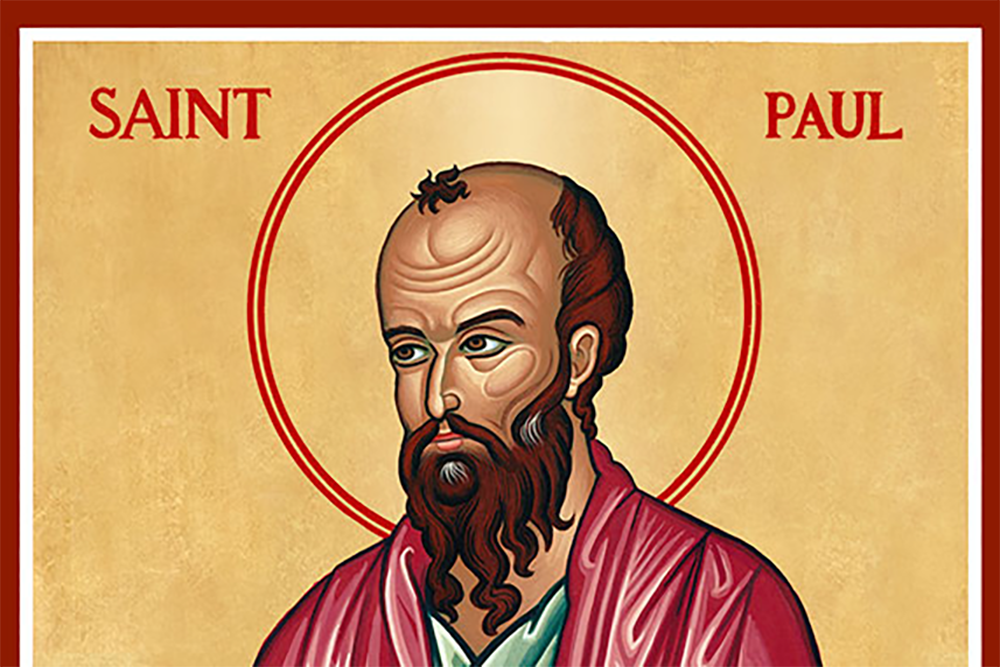
Our old friend Paul, the patron saint of the religion about Jesus.
The main reason today’s Christians act so un-Christ-like can be summed up in a single word: Paul.
Paul, who admits in his own letters that he never actually met Jesus, (1) did more than any other single person to transform the religion of Jesus into the religion about Jesus — shifting Jesus’s radical spiritual and political program for earthly justice into a checklist of beliefs about a dead man coming back from the grave.
His writings laid the groundwork for a movement, eventually embraced by the ruling class, that stripped Jesus of his most dangerous quality: his demand that the world be turned upside down, here, now, in this life.
By redirecting this revolution inward — away from material poverty, inequity, and colonial occupation, toward personal sin and eternal salvation — Paul handed the wealthy a tool to keep the working class enslaved for two thousand years.
To do it, he relied on four key lies — each one a sharp departure from what Jesus actually taught, and each one still being told from pulpits every Sunday morning.
Our Methodology
Before we begin, a word about methodology.
What we’re trying to do at The Jesus Movement is rediscover the actual Jesus — the historical Jesus, the Jewish preacher and healer who lived and taught in ancient Palestine two thousand years ago — and reconstruct, as honestly as we can, what his message actually was.
That requires reading the Bible not as an infallible, singular text handed down by God, but as a collection of documents written in the decades after his death. These documents were filtered — carefully and deliberately — by a ruling elite who decided which ideas got copied, circulated, and eventually canonized — and which ones disappeared.
To do that work, we rely on academic scholars: people who have spent their entire careers studying the texts, the languages, and the world that produced them, making claims with supporting evidence rather than theological authority.
These scholars range from the deeply devout (the seminal, five-volume historical Jesus series was written by John P. Meier, a Catholic priest and professor) to the agnostic convert (like New York Times bestselling author Bart Ehrman).
There is not, however, universal agreement on everything — and the authenticity of any given Jesus saying or story is less a true-or-false binary than a spectrum of probability. Honest scholars argue about where things fall on it, and accept that new evidence will emerge and that theories will evolve over time.
This is the lens we’re working with. If you reject this, the rest of my argument will make little sense.
1. The Core of the Gospel
If there is one thing almost all scholars of the New Testament agree on, it’s what was at the center of Jesus’s message. And — spoiler alert — it’s not what Paul claimed it to be.
To Jesus, it’s what he announces in his very first words in the very first Gospel. Mark, which scholars believe was the first one written, opens with Jesus proclaiming: “The time is fulfilled, and the kingdom of God has come near” (Mark 1:15). This pronouncement — that a new world is coming, a kingdom of God — is the core of the historical Jesus’s message. The phrase (or its counterpart, “kingdom of heaven,” in Matthew) appears some 126 times in the four canonical gospels. (2)
Jesus, standing in the long tradition of Jewish prophets who announce God’s reckoning, was issuing a warning. The one God of the world — the singular, all-powerful God whose own people were the Jews — was about to intervene in history. That intervention would bring about a new order on this earth, where the righteous were vindicated and the powerful were brought down.
Importantly, there was a political angle to this. Although we don’t read it that way today, saying “the kingdom of God” was like saying “the United States of God.” Jesus was furious at the treatment of the Jewish people of Galilee and Judea at the hands of their Roman colonial oppressors, and at the Jewish religious elite who colluded with them to maintain power. His message was both a reminder and a warning: you are not in control here. God is. And you’re about to pay dearly for your misdeeds.
Instead, it was Jesus who paid dearly. His overtly political message was too much for the Romans, who had little tolerance for rebellion among conquered peoples. The colonial governor Pontius Pilate had him executed in the most horrific way possible — as they did with other would-be revolutionaries — as a stark reminder of what happens to those who dare challenge the empire.
Needless to say, if you’ve ever read any of Paul’s writings in the New Testament — or, you know, have gone to church in your lifetime — you know that this is not the core of the Gospel message for Paul. In fact, in the writings all scholars agree are undeniably his, Paul only uses “kingdom of God” seven times. (3)
To be sure, Paul definitely thought God was about to intervene in history, and that the coming Kingdom would be here on earth (the idea that heaven is up in the clouds or someplace other would develop centuries later). (4)
But Paul flipped Jesus’s message on its head. To Paul, the messenger became the message. Jesus wasn’t a prophet announcing the kingdom — he was the way to the kingdom — which brings us to lie number two.
2. The Requirement for Salvation
Paul, like many others in the years after Jesus’s murder, claimed to have a mystical experience of a risen Christ. That experience of the resurrection became the fuel to his fire — and it produced a gospel that had almost nothing to do with what Jesus actually taught.
“If you confess with your mouth that Jesus is Lord (5) and believe in your heart that God raised him from the dead, you will be saved,” Paul wrote in Romans, the longest and most eloquent statement of his theology that survives.
To Paul, nothing else mattered — and it’s a refrain he returns to throughout his writing. Not feed the hungry, nor cancel the debts, nor love your enemies — but confess, believe, and be saved.
Needless to say, this was not the message of the historical Jesus. If you read the synoptic Gospels — Matthew, Mark, and Luke — closely and in isolation from Paul’s letters, you see a dramatically different requirement for entry into the coming kingdom.
This difference is most clearly articulated in Matthew’s passage (sometimes mistakenly called a parable) of the sheep and the goats, where Jesus says:
“When the Son of Man (6) comes in his glory… all the nations will be gathered before him, and he will separate people one from another as a shepherd separates the sheep from the goats, and he will put the sheep at his right hand and the goats at the left.
Then the king will say to those at his right hand, ‘Come, you who are blessed by my Father, inherit the kingdom prepared for you from the foundation of the world, for I was hungry and you gave me food, I was thirsty and you gave me something to drink, I was a stranger and you welcomed me, I was naked and you gave me clothing, I was sick and you took care of me, I was in prison and you visited me.’
Then the righteous will answer him, ‘Lord, when was it that we saw you hungry and gave you food or thirsty and gave you something to drink? And when was it that we saw you a stranger and welcomed you or naked and gave you clothing? And when was it that we saw you sick or in prison and visited you?’ And the king will answer them, ‘Truly I tell you, just as you did it to one of the least of these brothers and sisters of mine, you did it to me.’ (7)
To be fair, there’s considerable debate among scholars about the authenticity of this saying. But there’s consensus that it represents what the historical Jesus most likely believed and preached, that ethical action — feeding the hungry, showing mercy — was the requirement for entry into the kingdom.
The idea of a final judgment ran deep in the Jewish thought of Jesus’s time, and Jesus almost certainly believed it. (8) To think that Jesus would make the final judgment about metaphysical claims after his execution is absurd.
It’s likely why the core of Jesus’s ethical teaching is summed up repeatedly in the Greatest Commandment. In fact in Luke, when a lawyer asks Jesus directly — what must I do to inherit eternal life? — Jesus doesn’t mention resurrection. He doesn’t mention faith. He points to the Law: love God completely, and love your neighbor as yourself. Do this, Jesus says, and you will live. (9)
Scholars consider Jesus’s concept of the Greatest Commandment to be among the most historically reliable things we can say about him. No Jewish teacher before Jesus had ever pulled these two specific verses from the entire Torah, joined them together, and declared them the heart of everything. That synthesis is unique to Jesus, which is precisely why historians trust it. (10)
Taken together, the picture is consistent and clear: for the historical Jesus, entry into the coming Kingdom was an ethical question, not a theological one. It was about what you did — how you treated the hungry, the sick, the imprisoned, the stranger — not what you believed about what happened to someone’s body after they died.
Paul knew this tradition. He had access to it. He chose something else entirely.
3. Why We Love Our Enemies
Another of Jesus’s unique ethical directives came in the form of loving your enemies. Paul also commanded his followers to do the same — but for a very different reason.
Jesus’s teaching on this appears in both Matthew and Luke. In Matthew, Jesus commands: “Love your enemies and pray for those who persecute you, so that you may be children of your Father in heaven; for he makes his sun rise on the evil and on the good, and sends rain on the righteous and on the unrighteous.” (11)
The theological logic here is precise and radical. Love your enemies not because it will change them, not because God will reward you for it, and not because vengeance belongs to the Lord. Love your enemies because that’s what God does. God gives sun and rain to everyone — the wicked and the righteous alike, without distinction, without condition. Jesus is asking his followers to imitate a God who is not keeping score.
Paul says something that sounds almost identical — but isn’t. In Romans, Paul writes:
Bless those who persecute you; bless and do not curse them… Beloved, never avenge yourselves, but leave room for the wrath of God; for it is written, ‘Vengeance is mine, I will repay, says the Lord.’ No, ‘if your enemies are hungry, feed them; if they are thirsty, give them something to drink; for by doing this you will heap burning coals on their heads. (12)
Our old friend Paul is not asking his followers to imitate a loving God. He is asking them to stand aside so an angry God can do your dirty work. Don’t take revenge — not because revenge is wrong, but because God’s revenge is coming and it will be far worse than anything you could manage. Feed your enemy, Paul says, and you increase his guilt. You are, in effect, sharpening the blade.
The difference between these two Gods is not subtle. Jesus’s God is a universal provider who loves without condition. Paul’s God is a divine judge who is keeping a ledger and will settle it on the last day.
Historical Jesus scholar John Dominic Crossan puts it as cleanly as anyone has: “For Paul, you do not respond violently now, because God will respond violently later. For Jesus, you do not respond violently ever, because God acts nonviolently always.” (13)
Sadly, two thousand years of Christian history have been shaped far more by Paul’s God than by Jesus’s. (Not that the church has ever taken nonviolence seriously when it was in a position of power.)
4. The Body
But perhaps the most striking difference between Jesus and Paul isn’t about what the gospel is for — it’s about what the gospel is made of.
To understand this, you have to understand that Paul and Jesus were not just separated by time and geography — they were shaped by two fundamentally different intellectual worlds.
Jesus, a rural Galilean peasant, was steeped in traditional Palestinian Judaism — a tradition that did not separate the spirit from the flesh. In the Jewish worldview Jesus inhabited, a human being was an indivisible unity. You couldn’t split the spiritual from the physical any more than you could split theology from economics or religion from politics. The flesh wasn’t a problem to be overcome. It was the site where God’s will got enacted. (14)
Paul was something different. He was a diaspora Jew living in what is today southern Turkey — then part of the cosmopolitan, Greek-speaking world of the Roman Empire. His thinking deeply reflects that.
The Greco-Roman philosophical culture Paul moved through — shaped by Plato and his descendants — operated on a strict hierarchy: the spirit was superior, eternal, and divine; the flesh was inferior, perishable, and corrupt. The body was, at best, a temporary vessel — at worst, a prison. (15)
This is not an abstract theological distinction. It produced two completely incompatible visions of what the Kingdom of God actually is.
Paul states his position plainly in 1 Corinthians: “Flesh and blood cannot inherit the kingdom of God, nor does the perishable inherit the imperishable.” (16) For Paul, the physical body has to be left behind — transformed into a spiritual body, shed like a cocoon — before salvation is possible. The Kingdom belongs to the spirit, not the flesh.
Jesus pointed in the exact opposite direction. When asked for proof that God’s Kingdom was arriving, Jesus didn’t point to spiritual experiences or doctrinal clarity. He pointed to bodies: “The blind see and the lame walk, the lepers are cleansed and the deaf hear.” The Kingdom was arriving in flesh — in restored bodies, fed stomachs, healed skin.
In fact, the Lord’s Prayer, the only prayer Jesus ever taught his followers, puts it without ambiguity: “Your kingdom come, your will be done, on earth as it is in heaven.” (17) Not in heaven instead of earth — here, on earth, in this body — in this life.
Crossan calls this the fundamental “gulf in sensibility” between the two men — what he terms the difference between sarcophobia (fear of the flesh) and sarcophilia (love of the flesh). For Paul, flesh is the problem. For Jesus, flesh is the point. As Crossan summarizes: “For Jesus, anyone incarnating divine justice on earth was precisely ‘flesh and blood’ entering the kingdom of God.” (18)
Paul’s take was the theological groundwork for two thousand years of Christianity that have been so much more interested in where your soul goes after you die than in whether your body has food, shelter, and dignity while you’re alive. That’s not an accident — that’s Paul — and a ruling class that picked up and propagated his message because it did not threaten their power.
What Paul Built
Four lies. Four departures from what Jesus actually taught. And in each case, the direction of the departure is the same: away from the earth, away from the body, away from the poor, and toward the interior — toward belief, toward the soul, toward a salvation that costs the powerful nothing and demands nothing of them.
This is not a coincidence. To be fair, Paul didn’t set out to build an ideology of control — he was a genuine believer wrestling with a genuine theological crisis. He was trying to make sense of a resurrection he was convinced had happened and a kingdom he was convinced was coming.
He wasn’t cynical. He was wrong, and the people who came after him — the forgers who wrote letters in his name, the emperors who baptized his theology, the bishops who enforced it — were far more deliberate than he was.
But intent doesn’t determine consequence. What Paul built, whatever he meant by it, was a religion that could — and did — enslave us to oppressive systems. That’s the religion about Jesus.
But the religion of Jesus offers a different way. Jesus didn’t ask anyone to believe the right things about him. He asked them to feed the hungry, cancel debts, love their enemy, and build the kingdom here — in this body, on this earth, right now.
That program was dangerous enough to get him killed by the most powerful empire in the ancient world. It is still dangerous. It is still possible. And it has nothing to do with what Paul told you.
Sign up for my weekly e-mail
If you liked this story, considering signing up for my weekly newsletter that separates the Jesus from Christianity: https://bit.ly/jesusmovementemail
FOOTNOTES:
- Paul admits in 1 Corinthians 15:3–8 that he never met Jesus. He only claims to have had a mystical experience of Christ after the resurrection, which is NOT THE SAME as having known Jesus.
- This count is from E. P. Sanders, *The Historical Figure of Jesus. ( Also, Matthew, following a Jewish tradition of reverence still practiced by many observant Jews today, substitutes “heaven” for the divine name to avoid writing or speaking it directly. For a detailed explanation of this practice and its significance for reading Matthew’s gospel, see W. F. Albright and C. S. Mann, [Matthew*, The Anchor Yale Bible Commentaries](https://amzn.to/4vxoz9A) (New Haven: Yale University Press, 1995).
- This is from Meier’s A Marginal Jew Vol. 2: Mentor, Message, and Miracles.
- For more on how the idea of heaven came to be a place other than Earth, see Bart Ehrman’s excellent *Heaven and Hell: A History of the Afterlife.*
- It’s debated what exactly Paul meant by “Jesus is Lord.” Writing centuries before the Council of Nicaea and the writing of John’s Gospel, Paul almost certainly did not have a trinitarian same-substance theology of later Christians. He seemingly believed the resurrection elevated Jesus to God’s level and Jesus became God. It’s honestly a messy, high-wire mental gymnastics act that Paul went through to maintain that there was only one God. At no point did Paul give up his Judaism or his monotheism.
- In the synoptic Gospels, scholars believe Jesus does not equate himself with the “son of man,” a figure from the book of Daniel that will return for the final judgment. Later theology imprinted in our minds that Jesus was that figure, speaking about himself in the third person.
- Matthew 25:31–45.
- The concept of a final judgment was a prominent feature of Jewish apocalypticism, a worldview that developed about two centuries before Jesus was born. Driven by the theological problem of why the righteous suffer while the wicked prosper, many Jewish thinkers concluded that God would soon intervene to overthrow the cosmic forces of evil currently controlling the world. This intervention would culminate in a definitive Day of Judgment, where God would permanently destroy everything and everyone opposed to God. By the first century, this belief was widespread among Jewish groups such as the Pharisees, the Essenes, and prophetic circles like that of John the Baptist. For more, see Ehrman’s *Heaven and Hell.*
- Luke 10:25–28.
- The authenticity of the Greatest Commandment exchange is widely accepted among mainstream scholars, though with an important caveat about Luke’s version specifically. Luke’s framing — where a lawyer, rather than Jesus, recites the two commandments, and Jesus responds “do this and you will live” — is generally regarded as a literary creation by Luke’s author, who reworked the Marcan version (Mark 12:28–34) and repositioned it earlier in Jesus’s ministry to set up the Parable of the Good Samaritan. The core teaching itself, however — Jesus combining the commands to love God (Deuteronomy 6:5) and love neighbor (Leviticus 19:18) and ranking them above all other laws — is considered historically authentic by scholars including John P. Meier and John Dominic Crossan, on the grounds that no Jewish text prior to Jesus had ever made this precise synthesis. Bart Ehrman draws a direct line between this teaching and the Sheep and the Goats, arguing that Matthew 25 is essentially the practical illustration of what loving one’s neighbor actually requires.
- This is part of the Sermon on the Mount, Matthew 5:44–45, and also appears in Luke 6:27–36.
- Romans 12:14, 19–20.
- John Dominic Crossan, *Render Unto Caesar: The Struggle Over Christ and Culture in the New Testament* (New York: HarperCollins, 2022).
- John Dominic Crossan, *The Birth of Christianity: Discovering What Happened in the Years Immediately After the Execution of Jesus* (New York: HarperCollins, 1999).
- Ibid.
- 1 Corinthians 15:50.
- Matthew 6:10.
- Crossan, The Birth of Christianity.
메타데이터
- post_id
- ac9ae3cef525
- slug
- 4-major-lies-paul-told-about-jesus-ac9ae3cef525
- url
- https://medium.com/@andrewspringer/4-major-lies-paul-told-about-jesus-ac9ae3cef525
- canonical_url
- https://medium.com/@andrewspringer/4-major-lies-paul-told-about-jesus-ac9ae3cef525
- author_url
- https://medium.com/@andrewspringer
- status
- ok
- fetched_at
- 2026-06-10 08:17:25