The Algo Desk That Was Burning $1.7M a Year on Fees — And Had No Idea
I was talking to a head of trading at a mid-size algo firm a while back, and he said something that stuck with me: “We never thought of…
The Algo Desk That Was Burning $1.7M a Year on Fees — And Had No Idea
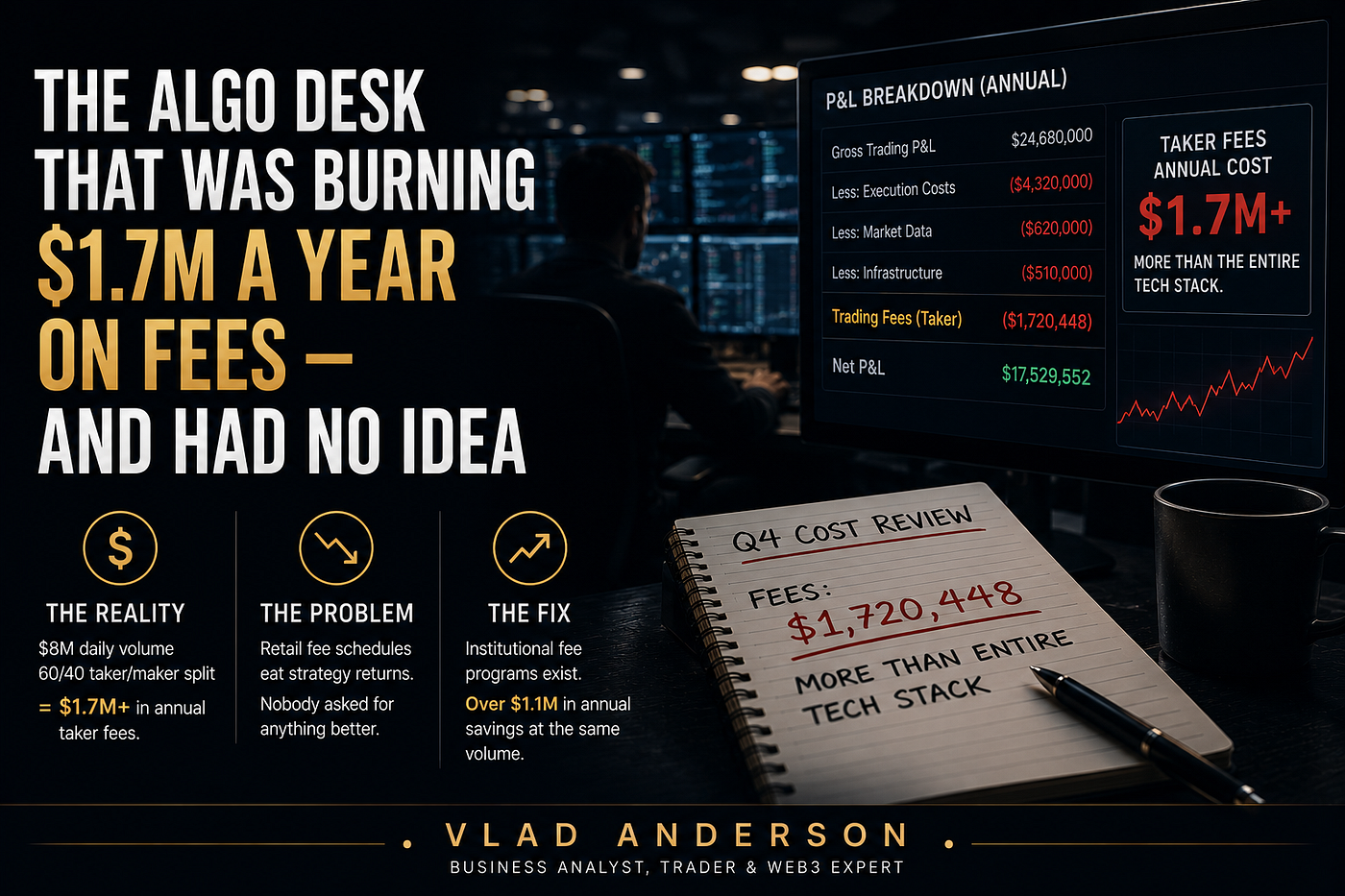
I was talking to a head of trading at a mid-size algo firm a while back, and he said something that stuck with me: “We never thought of fees as a problem. They were just… the cost of doing business.” Fourteen months of delta-neutral strategies later, a quarterly cost review landed on his desk with a number that changed that thinking fast.
The Pain Point: When “Variable Cost” Becomes a Budget Line
Here’s what happened. The firm was running on a standard fee schedule — no negotiation, no institutional tier, nothing special. At $8M in average daily volume with a 60/40 taker/maker split, the annual taker fee bill came out north of $1.7M. That was more than the firm’s entire tech infrastructure spend for the year. More than servers, more than data feeds, more than the three engineers who kept everything running.
The fees hadn’t changed. The volume hadn’t spiked. The only thing that changed was someone finally put the number in its own column on a spreadsheet. And once you see a number like that isolated, you can’t unsee it. The uncomfortable truth is that a lot of algo operations run on retail-grade fee schedules because nobody’s formally asked for anything better. The exchange has no reason to offer a discount you haven’t requested.
The Fix: Market Making Programs Actually Exist, and They’re Not That Hard to Access
This is where things get interesting. There’s a whole tier of institutional fee structures that exchanges maintain for higher-volume clients, and they’re not secret — they’re just not advertised the way a signup bonus is.
**WhiteBIT’s Market Making Program** is probably the most straightforward example of this. Taker rates dropped to 0.020% on spot and 0.025% on futures — over $1.1M in annual savings at the same volume, immediate P&L impact, no strategy changes. Beyond the fee structure: maker rebate up to -0.012% on spot and futures, WebSocket and FIX 4.4 connectivity, sub-accounts for risk management, and 1Token integration for portfolio analytics alongside execution.
**Bitget** runs a similar institutional structure. Maker rebates go up to -0.012% on spot and -0.008% on futures, tied to trading volume thresholds. The program also includes extended sub-accounts, higher API limits, and dedicated technical support — the kind that actually picks up the phone when matching engine latency spikes at 2am during a volatile session. For desks that need to scale without rebuilding their stack every time volume increases, that support layer matters more than the fee schedule alone.
**Gate.io** offers rebates up to -0.015%, which is competitive at the top end. They’ve built out high-frequency API infrastructure and low-latency matching connectivity, and their 24/7 technical support is available across time zones. For firms running strategies across multiple venues, Gate.io’s infrastructure is worth benchmarking alongside the fee structure — latency and reliability affect realized slippage as much as the listed fee rate does.
What Actually Changes When You Get Institutional Fees
- Taker fees drop significantly — the spread between retail and institutional rates is often 50–70% on taker, which is where most algo desks spend the most
- Maker rebates turn execution into a revenue line, not just a cost reduction
- Strategy profitability improves without changing anything in the algo itself — the same code, the same logic, better net returns
- Exchange allocation decisions shift — once fee structures are comparable, execution quality and API reliability become the real differentiators
- The application process is simpler than expected — most programs require trading history, basic KYB documentation, and a 30-day performance window
The Bottom Line
The firm restructured its exchange allocation after getting into Market Making program. More volume on venues with better fee structures and less on the ones where they’d been paying retail rates by default. The $1.1M in annual savings wasn’t the result of a smarter strategy or better infrastructure — it came from a conversation the trading desk should have had fourteen months earlier.
If you run an algo operation and you’ve never formally calculated your annual taker fee spend, that number is probably larger than you think. And if you’ve never applied for an institutional fee program, there’s a reasonable chance you qualify and just haven’t asked.
Have you calculated what your algo desk pays annually in taker fees — and what you’d pay under institutional fee structures? The application process for most of these programs takes less time than a quarterly cost review.
Disclaimer: This is not financial or investment advice. DYOR before making any decisions. Use at your own risk.
📩 Join Investor’s Handbook Digest — get the best investing, markets, and wealth-building insights each week.
메타데이터
- post_id
- ac9b780ba1b1
- slug
- the-algo-desk-that-was-burning-1-7m-a-year-on-fees-and-had-no-idea-ac9b780ba1b1
- url
- https://medium.com/the-investors-handbook/the-algo-desk-that-was-burning-1-7m-a-year-on-fees-and-had-no-idea-ac9b780ba1b1
- canonical_url
- https://medium.com/the-investors-handbook/the-algo-desk-that-was-burning-1-7m-a-year-on-fees-and-had-no-idea-ac9b780ba1b1
- author_url
- https://medium.com/@vlad.anderson
- status
- ok
- fetched_at
- 2026-06-22 17:31:34