Backrooms and Modernity
Backrooms (2026) is YouTuber-turned-filmmaker Kane Parsons’ directorial debut and the first major feature film that explores the…
Backrooms and Modernity
Backrooms (2026) is YouTuber-turned-filmmaker Kane Parsons’ directorial debut and the first major feature film that explores the decentralized internet mythology (called a creepypasta) that quickly spawned numerous short stories, YouTube films, video games and was even featured in American Horror Stories Season 3, episode 20. For those who aren’t aware, the backrooms originated in a 2019 post on 4chan’s /x/ (paranormal) board, with a picture of a Wisconsin furniture store being renovated and the caption:
“If you’re not careful and you noclip out of reality in the wrong areas, you’ll end up in the Backrooms, where it’s nothing but the stink of old moist carpet, the madness of mono-yellow, the endless background noise of fluorescent lights at maximum hum-buzz, and approximately six hundred million square miles of randomly segmented empty rooms to be trapped in
God save you if you hear something wandering around nearby, because it sure as hell has heard you”
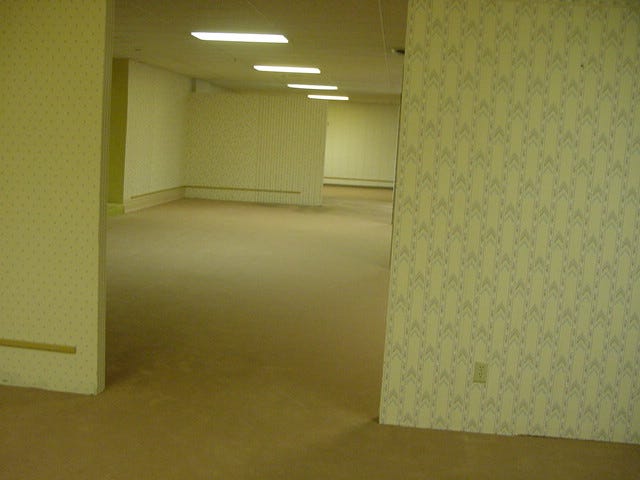
The idea behind this 4chan post is that an individual can “noclip”, referring to the cheat or developer tool of disabling collision in video games allowing the player to phase through solid objects. The logic is applied in the original backrooms post: you can somehow noclip through reality and end up in the parallel space known as the backrooms. The backrooms themselves are a liminal space, as exemplified by the photo that originated this idea: a space that appears strange or eerie because it’s usually filled with people, but currently empty. There’s a sense of familiarity and unfamiliarity at the same time. While the backrooms aren’t necessarily scary in the typical, horror trope sense, they do evoke feelings of existential dread or simply dread, even if there isn’t a malevolent entity present. The fact that photos of liminal space do produce such eeriness is noteworthy in itself.
The backrooms are typically portrayed as vast, nearly infinite labyrinths of mostly empty liminal space. It spawned another environment called the poolrooms, which are vast corridors of white tile and shallow pools mirroring the vaporwave aesthetic, which makes an appearance in the film. The eeriness of these liminal spaces comes from the fact that they’re familiar yet alien in the sense that they have a familiar form but lack the function that makes them recognizable. Office space ought to have people in it, but without them, it evokes a sense of discomfort precisely because there’s a sort of uncanny valley effect present within the space. In the film, Clark states that the backrooms are like a huge office building. But the backrooms don’t match any office in particular; they simply have that sense of officeness. They have the carpet, that particular style of ceiling, the fluorescent lights. That’s what makes it recognizable in a general sense without the referent. They’re pointing to something familiar (office space) but don’t have its function (production/work). It’s how Clark, then Mary describe the backrooms. Describing them is “like describing a dog to someone who’s never seen a dog and asking them to draw it.” In that statement, we have a precession of simulacra. First, there’s the specific dog itself. Then, you remember the dog. When you describe the dog to someone, you’re describing it from memory, which is a little fuzzy and isn’t the dog itself. The person you describe the dog to draws it and probably gets the general form of a dog, and if that drawing were shown to someone who knows what a dog is, they could probably guess it’s a dog. But the drawing isn’t that specific dog; it’s a general form of a dog. It has some dogness which makes it recognizable. That’s essentially the backrooms: space without a referent.
The discourse surrounding Backrooms is mostly on the psychological level. Most people identify that the film deals with trauma, mental illness, and avoidance. It follows Clark, a failed architect, who is living his nightmare as the owner of a failing furniture store and navigating a failed marriage. He’s very bitter and it comes through in his therapy sessions with Mary. We find out Mary, Clark’s therapist, was a child of a single mother, Nora, who became paranoid and was eventually committed. We get the sense her childhood led her down the path of becoming a therapist. Clearly, these characters have unresolved trauma and are struggling with their own mental issues. Clark, as we find out, doesn’t want to change. Mary tries to help her patients (Clark in this case) overcome their mental struggles. These readings aren’t wrong per se, but, these interpretations impose a narrative structure on something that resists it. The backrooms are inherently without purpose: they don’t have a telos. They’re a space that does what it does toward no end. The question is, what are they for? The answer is, nothing. At the beginning of the film, the electrician actually hints at the backrooms’ purposelessness. When asked by Clark if a set of mysterious red switches on the store’s circuit breaker are the source of his electrical problems, the electrician replies, “I don’t see how. It’s just… there.” In the final scene, when Phil, an Async scientist, interviews Mary, he states:
“ I- I mapped out areas to the best of my abilities…But I don’t understand it, I- I- I can’t even describe it…There are… doors… opening everywhere. We don’t know why or… what is connecting them, they just sort of keep happening…But I don’t understand it, I — I — I can’t even describe it…. It — ”
As Phil implies here, the backrooms are just there without reason. There is no “why” to the backrooms. He doesn’t understand them, nor does Async. Through mapping and investigation, he and Async hope to find out the why, the how, the what of the backrooms. What do they conceal? What do they reveal? Why do they exist? Async’s efforts are, ultimately, doomed because they are trying to discover a purpose in a space that has none. The backrooms aren’t concealing anything. They are the truth in that there is none.
Vendors of Simulation
Clark and Mary parallel one another in their careers. Both sell simulations of something lost or denied to them in their past. Clark sells signs of home: bedroom displays, curated domestic space. Mary sells the experience of self-transformation. In the commercial Clark attempts to shoot, the tagline at the end is, “Now, walk in today… kick your feet back…enjoy an empire of your own. For every sultan deserves a throne.” In a sense, he’s selling the experience of a pre-modern conception of the home. It was a sacred space. In ancient Rome it was believed that lares, household deities, acted within the home, in the Middle Ages, the house was the ecclesia domestica, an extension of the Church. Traditionally, the home was an ordered interior against a chaotic exterior. The same applies to kingdoms and empires. Within — Order, civilization, ethnos. Outside — Chaos, barbarity, xenos. Empires are built, not bought, but, for a price, even if you have no credit, now you too can buy an empire for yourself.
Mary, as seen through a commercial, sells her self-transformation program:
You can be the author of your own design, because we all deserve another chance to fulfill our dreams. The moment you believe change is possible, you’ve already begun. Order “The Window Within” and the companion three-part audio program, Guided Openings, by Dr. Mary Kline. Available now for $24.95 plus shipping. Go 1–800–555–0199.
Mary is selling the experience of self-transformation with the autonomous self-creating individual of liberal modernity as its core audience. Commercial Mary states, “The moment you believe change is possible, you’ve already begun.” which reveals that action is not needed, only belief. By purchasing her program, you have bought the belief you can change. The action of purchasing replaces the act of undergoing the process of self-transformation. It’s similar to the notion of narcotizing dysfunction where the individual is bombarded with so much information that simply knowing about issues acts as a substitute for action.
In many pre-modern religious traditions, initiatory rites and rituals were grounded in a metaphysical framework and sacred power that the individual was subjected to. Whether it was Eleusinian mysteries or Christian baptism, the idea is that undergoing these rituals led to genuine spiritual transformation. You went into these rites in one state and exited in another through participating in sacred time; in a ritual that was given to humanity by the Sacred. Mary’s self-help program is the complete opposite. Guided by a product, you are the author, you believe things can change, your dreams can come true. There is nothing outside your self, as the title The Window Within suggests, it opens to more you. It’s similar to a central theme in the movie Obsession (2026), where Bear desires the experience of being with Nikki, effectively Eros without alterity — initiation without the sacred, the experience without what makes it real.
Katabasis into Liminality and Simulacra
Clark’s journey into the backrooms isn’t so much that he moves from reality to a parallel reality, but it’s a gradual descent, similar to Dante’s in the Divine Comedy in that Clark descends through levels of simulacra. However, Clark’s journey isn’t so much that each stage he goes through gets progressively worse on, say, a moral level, meaning, it’s not the same as Dante’s descent where each respective circle and sin is more grievous than the last. Dante’s work is predicated on a metaphysical framework that was believed to be more real than the physical realm. Clark’s journey takes him farther away from the referent. The backrooms mythos has no greater foundation than modernity itself.
We find out at the beginning of the film that Clark was kicked out of his home, which is the referent. His home was real, with all its flaws and peculiarities. Now, he inhabits an image of the home; a curated vision of a bedroom that is faithful to the original but has been set up as a commodity. He sleeps in one of his bedroom set displays on the main floor whose function is to simulate domestic life. He’s essentially inhabiting an image. The main floor of his store is effectively a liminal space: it’s the form of something that points to retail, given the layout, the decor, and what it houses, but, because it’s a failing furniture store, its function is absent.
The basement of Clark’s store is a liminal image-space. The first time we see the basement, we find a random coffee table near the bottom of the stairs, sort of arbitrarily placed. There’s no organization based on theme; random pieces of furniture line the walls. At least on the main floor there’s some organization based on theme; bedroom sets, living rooms, outdoor sets, etc. In the basement, you have random furniture sets, shelves, outdoor furniture, and bedroom furniture. There are sets and images of the home but without anything coherent to tie them together. Meaning, there’s no overarching organizational theme that unifies these furniture sets; patio furniture is placed next to a living room set, bedroom furniture lines the walls alongside pieces that go who knows where.
The aesthetic of the basement is mono-color and windowless. It has drop ceilings and fluorescent lights. If you were to walk into the basement, you’d not immediately recognize it as a place of commerce. It has no signs that say “SALE” or “Everything must go!” as you see on the main floor. At most you have price tags on the furniture that point to retail, but it’s largely devoid of function aside from holding furniture. It’s pointing to an image of the home (which is what the main floor does) while itself being an image of the main floor.
When the lights flicker again, a frustrated Clark descends into his basement to eventually find a light shining through what should be a solid wall. When he falls through the wall, he finds the area he fell into is an image of the basement. He finds a pile of furniture, some of which is clipped into one another, in the middle of a large, empty (save for the furniture) room with barriers that are arbitrarily placed and don’t serve any function. Its aesthetic is more arbitrary, more liminal, more mundane, with a more noticeable absence of function, even further removed from referent.
Essentially, Clark’s journey parallels the precession of simulacra. He had the real at one point, his home, but is now forced to inhabit an image of the real: one of his bedroom sets. These bedroom sets are instantly recognizable as a curated reconstruction of a bedroom out there somewhere. These are contained within Cap’n Clark’s Ottoman Empire which, taken as a whole, points to homeness in general without being a specific home. The main floor’s retail structure is one that surrounds the bedroom set. The “SALE” signs, the pirate theme, the slogan, the curated staging all point to this. The bedroom is no longer reflecting the home; it’s selling a denatured version of it. The mess, the conflict, the wear, the particularities are filtered out. It isn’t a bedroom, it’s a commercial fantasy of a bedroom. The image of a home has overtaken and distorted the reality it once reflected. The real home still exists, but the image is actively masking what a home actually involves.
Clark’s store is, in a sense, a matryoshka doll of signs. It is itself a sign that contains signs: the staged furniture sets, the basement, and the portal to the backrooms. Every container has something within it, but when we get to the “backrooms doll”, it’s hollow precisely because it points to nothing but itself; it’s pure simulacrum. It’s similar to what happens in modernity. The backrooms don’t just happen to resemble Clark’s basement. They are what happens when Clark’s store has been stripped of every concrete function and referent. They represent modernity itself, stripped to its bare core. Just as Clark’s furniture store strips away the microcosm of order that is the home through commodification of an empire, just as a self-help program divorces self-transformation from a power outside the self and sells it as an experience, the backrooms strip away all purpose and referential grounding and are completely divorced from any concrete reality. They are their own reality.
Mary has already embarked on her journey into the underworld beginning with her childhood. Her childhood starts out seemingly normal, opening with the scene where she and her mother, Nora, leave handprints in fresh concrete outside their house. We later find out that her mother became a paranoid shut-in, keeping Mary inside her home warning her that “they’re all over the place.” Mary had experienced reality and a normal family life before Nora’s descent into madness. When Nora had a mental breakdown, young Mary experienced reality as filtered through her mother’s delusion. Eventually, we find out her mother was committed to a mental institution. After Nora was institutionalized, Mary was left to deal with her trauma on her own. She never quite comes out of her own underworld and moves through her life with this trauma acting as a guiding element. We see in one scene, at a party she hosts, Mary staring longingly at a mother and daughter, which is a faithful image of what we see in the beginning of the movie.
Mary’s physical descent into the underworld happens when she goes looking for Clark. It so happens that Clark finds her and knocks her out. The film cuts to a scene that shows an institutionalized Nora, then Mary as a kid alone in her childhood home. Then the film proceeds to show how the backrooms operate. It first shows her childhood home as it actually was. Then goes through iterations, or memories, of her home as the backrooms remember it, each more distorted than the last until her childhood home is reduced to an empty room with an archway in a corner. This is essentially the movie presenting its version of the precession of simulacra; you have the thing itself (Mary’s childhood home), a few recreations of it, each more distorted than the last, but still recognizable as her childhood home. From about the fourth or fifth iteration, it becomes less and less recognizable as a home and more just space. The final shot of the empty room with an archway, has no connection to Mary’s childhood home at all. It points to nothing else but itself.
Clark’s katabasis is never completed; there is no anabasis. Clark is consumed by an image of himself: a Still Life pirate Clark. The image of Clark makes it out of the backrooms, as we see briefly when Mary is being escorted through the Async facility. The real Clark is consumed. What exits the backrooms is an image of an image of Clark: the monster is a monstrous image of the pirate mascot which is a simulacrum of the real Clark. His commercial mythology reproduced as a monstrosity kills him. He entered as a vendor of simulated homes and came out as a simulated person. He became the product of the same process he’d been participating in. In contrast, the real Mary makes it out of the backrooms, but she is herself unchanged. Neither Clark nor Mary affected anything in the backrooms. There was nothing to save, nothing to transform or be transformed by.
Loops and Repetition
“We all have our loops, our habits… behaviors that keep us walking in circles. Reaching for the same solutions over and over again, thinking each time will take you somewhere new… But they don’t. And still, it’s the neural pathway of least resistance. The path YOU made. It’s the one that kept you safe when you were a child. You learned to push people away before they could hurt you. And now, as an adult, you’re still stuck right where you started… Alone.” — Mary’s monologue at the beginning of the film
Mary is essentially describing the backrooms, and ultimately modernity, without knowing it. The backrooms are essentially signs completely removed from the referent. They don’t point to anything in particular but the general sense of modern space. A sign is constrained by its referent because it is anchored to something particular. There’s one Hagia Sophia, one Mary’s childhood home, one Clark’s home. Once a sign is decoupled from the referent, it becomes its own unique reality and proliferates itself. This is essentially why the backrooms, in Kane Parsons’ rendition, are seemingly infinite. With regards to space, things contained within space are limited by the greater logic of the space itself. The bedroom sets, living room sets, etc. repeat but are constrained by the commercial logic of Clark’s furniture store. The backrooms are devoid of any such logic.
When Clark finds the backrooms, he descends into pure simulation. What he finds is endless repetitions of meaningless forms: an image of his basement showroom, an endless office hallway, rooms filled with random furniture, a cardboard cutout that repeats the same voice lines. Even when Clark initially runs from the monster, he’s seemingly not consciously running back to the room where he entered. He squeezes through a tiny door with three doorknobs (itself a product of the backrooms; there’s no point, no reason for three doorknobs, they’re just there) and ends up looping back to the area he entered from. He acts out what the backrooms do, what signs without referents do; endlessly loop because that’s all there is to do. The cardboard cutout that endlessly repeats voice lines is not inviting people into a retail store, nor advertising something. It’s not pointing to anything and thus has no function other than to repeat the same voice lines over and over again.
The Backrooms as Modernity
The usual trope of a protagonist’s arc is that the context or the world in which they act is changed in some way and/or the protagonist themselves are transformed by their journey. If we take the film The NeverEnding Story as an example, Bastian saves Fantasia and is himself transformed. He gains courage, no longer being that timid kid from the beginning, becoming the hero. The backrooms aren’t simply a parallel dimension; they’re a parallel modernity. Their mythology has no greater foundation than modernity itself. In Backrooms, neither Clark nor Mary changes anything about the backrooms, nor are they themselves transformed. The backrooms don’t need a hero any more than they need a villain. If Clark had lived and Mary had died or if the monster had died, it would have made no difference to the backrooms. Their only function, as we assume, is to generate images. Even that is speculative. The backrooms are inherently without purpose. No one knows why the backrooms exist, why doors to the backrooms appear, or how they function.
Neither Mary nor Clark are “chosen” in the same way that Bastian was chosen. Clark happens to discover the backrooms. Mary discovers them by trying to find Clark. These characters aren’t special. Quite the opposite in fact. They are merely vehicles to interact with the backrooms. These characters don’t influence the backrooms; the backrooms will do whatever they do with or without someone to witness it. The backrooms don’t transform in any meaningful sense, as Bastian does in The NeverEnding Story. They simply generate. They add distortions of real things, space, and people. Mary and Clark’s backstories are unnecessary for the backrooms. The backrooms would exist without them and without their interaction. Fantasia would exist without Bastian, but would have been destroyed by The Nothing if he hadn’t acted within that world. If Clark, Mary, or anyone else in the film hadn’t discovered the backrooms, the backrooms would have still continued to expand, generate images, and manifest doorways. They would just continue to exist.
Fantasia is similar in that it’s a manifestation of humanity’s hopes and dreams, but it’s qualitatively different from modernity. It has an essence, a substance; it’s ethereal at times, fantastical, and, in some sense, defies the logic of modernity. But the backrooms, as a manifestation of modernity, have no essence, no substance. Neither do the objects contained within them, as their telos has been stripped away. Once representation is no longer anchored to a particular reality, it can reproduce itself indefinitely. And once function is no longer oriented toward an end, reproduction becomes an end in itself. The backrooms generate images, but toward no end. They are not qualitatively different from modernity. The backrooms give rise to distortions of things in the real world, but those distortions have no function, no point, no purpose. They’re just there. There is thus nothing about the backrooms that could transform anyone who enters. Mary isn’t transformed because there is nothing within the backrooms for her to act upon, nor anything within them capable of acting upon her in a way that produces transformation. Instead the backrooms give her a more honest version of what her career is producing: the experience of something.
Here, I think, is the meta point of the film. Normally, the audience experiences a narrative arc through a protagonist, witnessing their transformation or the actions through which they transform the world around them. In Backrooms, we don’t see the transformation of the backrooms or actions that transform the world around them, we don’t see the transformation of the backrooms but the dissemination of meaningless space that Mary and Clark proceed through. Neither Clark nor Mary embarks on a conventional hero’s journey; only serving as instruments to reveal the backrooms. The genius of Parsons’ Backrooms, whether intended or not, is that no one matters to the backrooms in this film. Bastian mattered to Fantasia. We see the backrooms do what they do at the end of the film, without any intervention by Async or Mary or Clark. The monster is incidental. The backrooms proliferate the forms we see removed from their original referent. Clark’s kitchen no longer has any alimentary logic to it. Even the neighborhood Mary emerges into while fleeing Captain Clark has no communal purpose.
Mary’s monologue about loops is descriptive of the very architecture of the space she’ll eventually find. It refers to a psychological pathology that she applies to the individual patient. The solution is to choose another loop, to design your own path. But the loop isn’t within the patient. As gleaned from Mary and Clark’s therapy session, this isn’t the first time they’ve repeated the same therapeutic role-play. Mary can’t see that Clark’s repetition of resentment and anger, while rooted in some sort of trauma, is a result of the space he inhabits; commercial, modern, absent of purpose, which is itself a loop. The very framework Mary operates under is itself a product of the environment she inhabits; whether that be her Window Within or the structure of her therapy. It’s the experience of self-transformation, the commodification of belief, the endless repetition of the same. She can describe Clark’s loop because she’s an outside observer of Clark’s failed marriage. But she can’t describe the greater repetition, because that requires one to step outside of modernity. It would be like trying to get a fish to explain what water is.
Both protagonists’ arcs end in an unsatisfactory way, in that, nothing is resolved or revealed that gives any answers or makes any difference in the larger story. Not even Async has any answers. It’s because the backrooms resist answers. Answers require purpose. The backrooms have none. It’s not the case that if Phil had more time, more energy, more resources, he could map out the backrooms. The backrooms change. Once one space is mapped, another is generated, and so on and so forth, ad infinitum. It’s an inverted Borges fable of the map. Instead of the map outliving its usefulness, with the backrooms, the territory outruns the map. The backrooms are a space where representation no longer leads back to anything real; it only leads to further representation.
The horror of the backrooms isn’t that they’re some seemingly infinite space with a monster, a manifestation of your own nightmare, or the endless repetition of image-space. The real horror is that the architecture of the backrooms is not alien. When Clark discovers the threshold between “the real world” and the backrooms, we see that it doesn’t open to some fantastical world, but opens to more modernity. It’s modernity in its purest form. The logic of the backrooms is the very existential condition of modernity itself. Your morning commute, your consumer habits, your scrolling, your life. That’s the backrooms loop manifested in reality. And the “reality” we inhabit is one in which teleology and referentiality have collapsed. The backrooms are modernity taken to its logical conclusion. They’re terrifying not because they’re radically different, but because they’re too similar.
I‘m reminded of the Nine Inch Nails song Every Day is Exactly the Same:
I believe I can see the future ’Cause I repeat the same routine I think I used to have a purpose Then again, that might have been a dream
메타데이터
- post_id
- acc2f2c7fe97
- slug
- backrooms-and-modernity-acc2f2c7fe97
- url
- https://medium.com/@esoterror/backrooms-and-modernity-acc2f2c7fe97
- canonical_url
- https://medium.com/@esoterror/backrooms-and-modernity-acc2f2c7fe97
- author_url
- https://medium.com/@esoterror
- status
- ok
- fetched_at
- 2026-08-20 04:26:24




.jpg)