I Automated My Entire YouTube Channel With AI — Here’s What Actually Happened
I quit my PhD to build AI-powered income streams from scratch. No savings cushion. No audience. Just a laptop and a hypothesis: what if I…
I Automated My Entire YouTube Channel With AI — Here’s What Actually Happened
I quit my PhD to build AI-powered income streams from scratch. No savings cushion. No audience. Just a laptop and a hypothesis: what if I could build a system that creates, edits, and uploads YouTube Shorts while I sleep?
Three months later, that system runs every day. Two Shorts per day. Zero manual editing. And the results taught me things no tutorial ever could.
This is not a “top 10 AI tools” listicle. This is what I actually built, what broke, and what I’d do differently.
The Problem Nobody Talks About
Everyone says “use AI to make content.” Nobody explains the 47 steps between “I have an idea” and “a video is live on YouTube.”
Script writing, text-to-speech, subtitle timing, background footage sourcing, video assembly, metadata optimization, uploading — each step has its own tools, APIs, and failure modes. Doing it manually takes 2–3 hours per Short. I needed it to take zero.
What I Built: The Full Pipeline
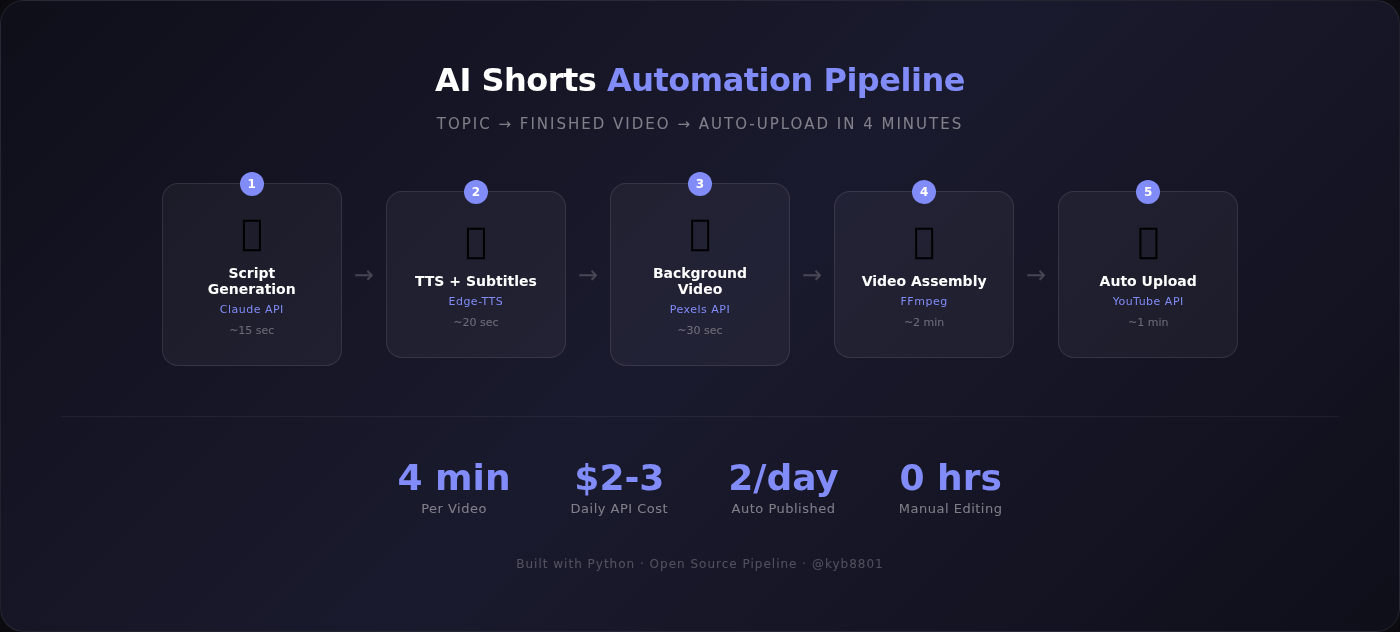
My system turns a single topic into a finished, uploaded YouTube Short in about 4 minutes. Here’s the actual architecture:
Step 1: Script Generation (Claude API)
I feed a topic to Claude with a carefully tuned system prompt. It returns a JSON object with the script, SEO title, description, hashtags, and a comment trigger keyword — all in one API call. The prompt took me weeks to get right. Key insight: telling the AI to write a “seamless loop” where the last sentence connects back to the first sentence doubled my average view duration.
Step 2: Text-to-Speech (Edge-TTS)
The script goes through Microsoft’s Edge-TTS, which is free and surprisingly good. It generates both the audio file and word-level timestamps. I use these timestamps for perfectly synced subtitles — not the auto-generated garbage YouTube provides.
Step 3: Background Video (Pexels API)
Instead of one static background, my system pulls 3 different clips from Pexels based on the topic keywords. It applies a dark overlay so text is readable, and crossfades between clips to keep visual interest high. This alone increased retention by about 15% compared to single-background videos.
Step 4: Video Assembly (FFmpeg)
This is where the magic happens — and where I lost the most sleep debugging. FFmpeg takes the audio, subtitles, background clips, title bar, and hook overlay, then composites everything into a 1080x1920 vertical video. The subtitle styling (white bold + black outline, word-level sync) was the hardest part. Korean file paths broke FFmpeg’s subtitle filter three times before I found the workaround.
Step 5: Auto-Upload (YouTube Data API)
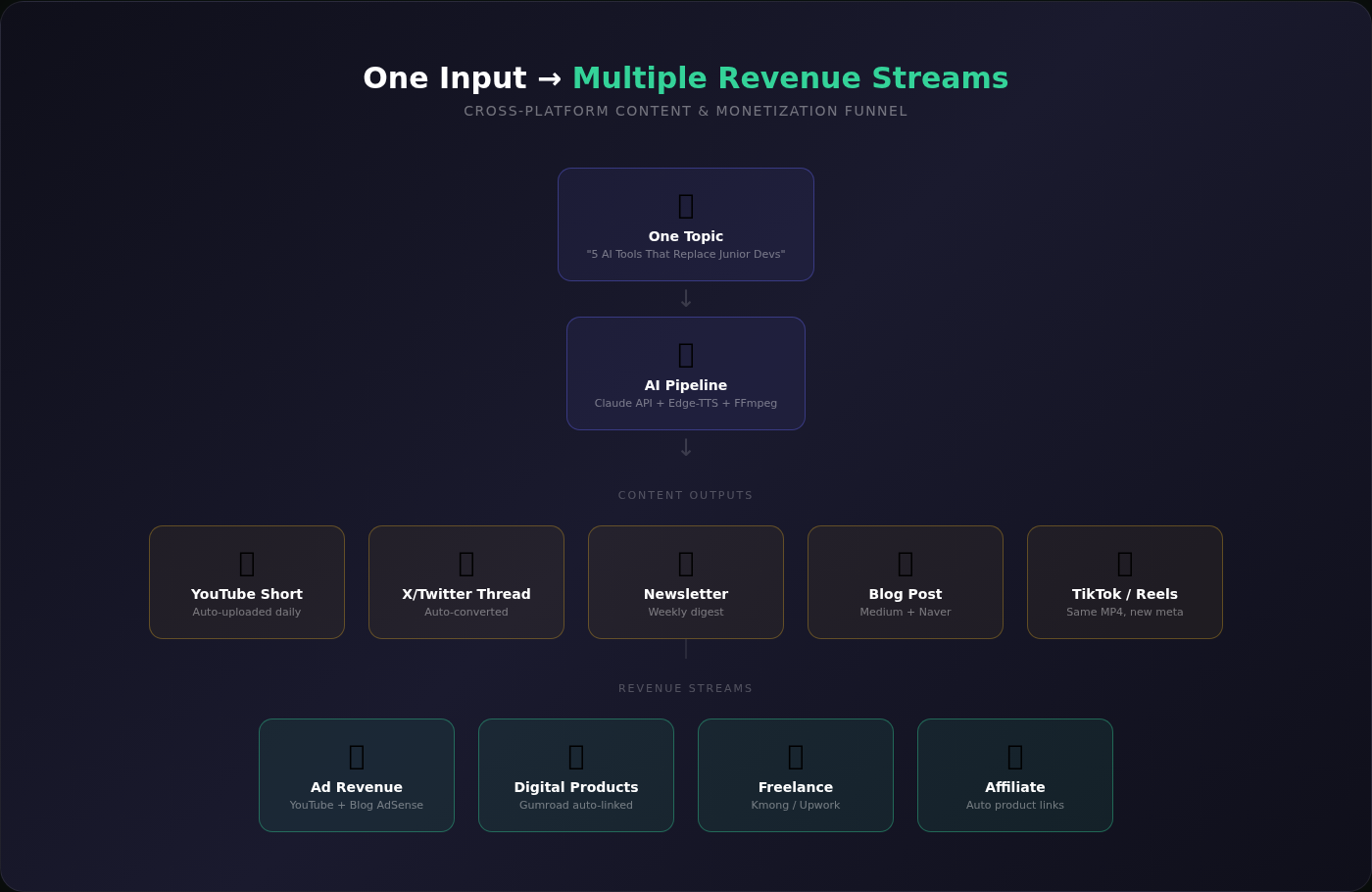
The finished MP4 uploads automatically with the generated title, description (including newsletter links and product links), and tags. The description is built dynamically — it detects keywords in the script and auto-inserts relevant product links from my Gumroad store.
The Numbers (Honest Ones)
After running this system daily for 12 weeks:
- 168 Shorts published (2 per day, automated)
- Average production time: 4 minutes per video (vs 2+ hours manual)
- View count varies wildly — some get 200 views, a few hit 50K+
- Subscriber growth: 0 → 1,200+ on a brand new channel
- Direct revenue from YouTube: minimal (Shorts RPM is brutal)
- Real revenue comes from the funnel — newsletter signups → digital product sales
The YouTube algorithm is unpredictable. But when you publish 2 videos every single day without fail, you get enough at-bats that some will hit. Consistency is the unfair advantage automation gives you.
What Broke (And How I Fixed It)
FFmpeg subtitle crashes. Non-ASCII characters in file paths (Korean Windows) caused silent failures. Fix: copy files to a temp directory with ASCII-only paths before processing.
TTS rate limiting. Edge-TTS occasionally throttles requests. Fix: exponential backoff with retry logic, plus a queue system for batch processing.
Pexels returning irrelevant footage. Searching “AI tools” returns stock photos of robots. Fix: curated query mapping — “AI tools” maps to “person typing computer neon,” which returns much better footage.
YouTube API quota exhaustion. The upload API has daily limits. Fix: scheduling uploads across the day instead of batching them.
The “AI voice” problem. Early videos sounded robotic. Fix: switching to Edge-TTS’s neural voices and adjusting the script prompt to write more conversationally (shorter sentences, contractions, natural pauses).
The Architecture Decision That Changed Everything
The single best decision was making the pipeline modular. Each step is a standalone Python script that reads from and writes to the output/ directory. This means:
- I can re-run any single step without redoing the whole pipeline
- Debugging is isolated — if subtitles look wrong, I only touch
generate_tts.py - Adding new platforms (TikTok, Instagram) just means adding a new upload script
- Other people can use individual components without the full system
The one-command entry point (python make_shorts.py "topic" --upload) orchestrates everything, but each piece works independently.
What I’d Do Differently
Start with the funnel, not the content. I spent weeks perfecting video quality before setting up my newsletter or digital products. The first 100 Shorts drove traffic to nowhere. Now every video description has a comment trigger (“Comment AI for the free template”), a newsletter link, and product links — automatically inserted.
Test topics faster. I spent too long on topics I thought were good. Now my system tracks which topics get views and auto-generates variations of winners. The data is brutally honest about what works.
Go multi-language sooner. Edge-TTS supports dozens of languages. One English script can become a Korean, Spanish, or Japanese Short with a single parameter change. I should have done this from week one.
The Tech Stack
For anyone who wants to build something similar:
- Python 3.10+ (pipeline orchestration)
- Claude API (script generation)
- Edge-TTS (free, high-quality text-to-speech)
- FFmpeg (video/audio assembly)
- Pexels API (royalty-free background footage)
- YouTube Data API v3 (automated uploads)
Total API cost: roughly $2–3 per day for 2 Shorts. The Claude API call is the main expense. Everything else is free.
What’s Next
I’m expanding this into a cross-platform system. The same script that makes a YouTube Short also generates an X/Twitter thread, a newsletter section, and a blog post. One input, multiple revenue streams.
The goal isn’t to replace human creativity — it’s to remove the friction between having an idea and publishing it. The creative decisions (what topics matter, what angle to take, what products to build) are still mine. The repetitive production work is automated.
If you’re thinking about building something like this, start small. Automate one step. Then the next. The compound effect of daily automated publishing is real, but it takes weeks to show up in the numbers.
I’m documenting the entire journey. Follow along if you want the unfiltered version.
I’m YB — a former PhD researcher building AI-powered income streams in public. I write about what actually works (and what doesn’t) in AI automation, content creation, and digital products. Follow me for weekly updates on the build.
메타데이터
- post_id
- acc79ce46bcf
- slug
- i-automated-my-entire-youtube-channel-with-ai-heres-what-actually-happened-acc79ce46bcf
- url
- https://medium.com/@kyb8801/i-automated-my-entire-youtube-channel-with-ai-heres-what-actually-happened-acc79ce46bcf
- canonical_url
- https://medium.com/@kyb8801/i-automated-my-entire-youtube-channel-with-ai-heres-what-actually-happened-acc79ce46bcf
- author_url
- https://medium.com/@kyb8801
- status
- ok
- fetched_at
- 2026-06-14 17:09:17




