The Body Was the First Embodied AI — It Has Been Running Code Since Before Language
Before any machine learned to perceive, adapt, and act in the physical world, the human body was already doing it — in four letters, 46…
The Body Was the First Embodied AI — It Has Been Running Code Since Before Language
Before any machine learned to perceive, adapt, and act in the physical world, the human body was already doing it — in four letters, 46 chromosomes, and a spiral that keeps arriving in every living system. Maria Sibylla Merian documented the interface in 1699. We are only now building the vocabulary to read what she drew.
Maria Sibylla Merian drew the metamorphosis before anyone had a word for it. The same structure she traced in the caterpillar appears in your DNA, in the mathematics of galaxies, and in the architecture.

Index


Maria Sibylla Merian, Amsterdam to Suriname, 1699. The caterpillar and the moth on one plate — the same animal, drawn in sequence. Vincere Press, Pg 001.
To understand what she was actually reading, begin where she began — with the plant. The plant is the layer you can see with the naked eye. It is also the layer that contains the first piece of the pattern this Codex will build, page by page, across every domain that matters
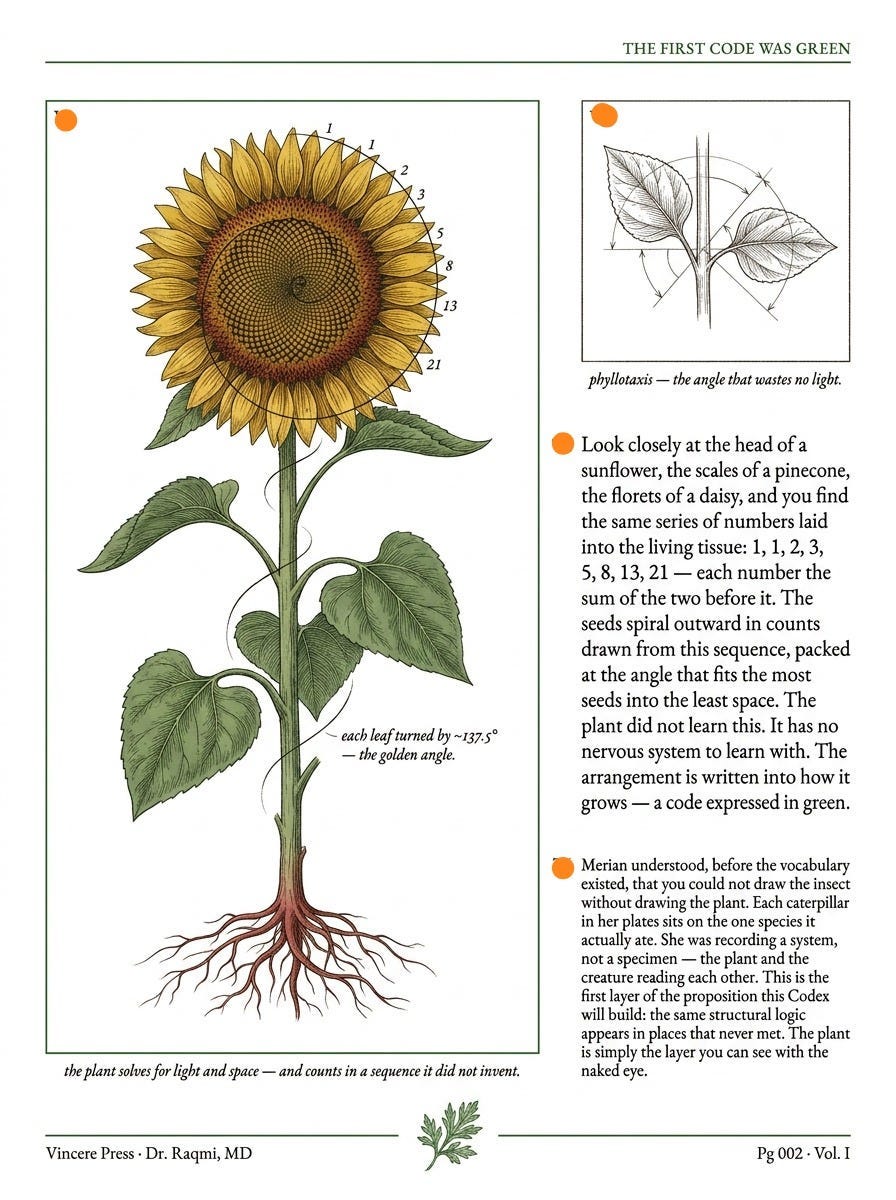
The seed head counts in Fibonacci numbers; the leaves climb by a constant angle. The plant solves for light and space — and encodes a sequence it did not learn. Vincere Press, Pg 002.
The next layer you cannot see at all. It is written inside the body of the caterpillar before the caterpillar changes. It precedes the form. It is the code that makes the becoming possible — and it is written in an alphabet of four letters that every living thing on this page, including you, shares completely.

The caterpillar carries the butterfly in its code before it pupates. The body’s alphabet has four letters; the human cell holds 23 pairs. The form precedes the becoming. Vincere Press, Pg 003.
Hold the number — 46. Hold the Fibonacci sequence. Both appear in living systems. But the same ratio that orders the sunflower turns up in a nautilus shell, in the arms of a spiral galaxy, in the unfurling of a fern. Those systems share no ancestor. A mollusc and a galaxy were never in contact. Yet the proportion recurs

The same spiral measures a shell, a galaxy, a seed head, and a fern. Four systems with no contact. One ratio. Vincere Press, Pg 004.
A pattern that recurs without contact has a name for the way it is preserved across time — and that name is the record. For the pattern to be studied, it must be documented. And documentation is fragile. Merian’s Suriname journals nearly did not survive. The knowledge the women in the trial records carried survived only because the inquisitor needed it on the page. What makes it to us is always the accident of survival.

The plate survived the voyage, the press, and three centuries of shelving. The record is the pattern’s fourth body. Vincere Press, Pg 005.
Four layers — plant, body, number, record. Before the argument builds further, this is the page that turns around. The pattern has been shown in four materials. The question now is whether you have seen it — not in the archive, but in your own life, in the places you have always known something without being given permission to name it

The glass is blank on purpose. This page is the one you complete. Vincere Press, Pg 006.
What you just did is the same act Merian performed over the caterpillar — sustained attention to a pattern, without rushing to name it, until it showed its shape. The next page names the shape. And it is careful about what it calls it, because the naming matters. A law and a principle are not the same thing. Only one of them can be argued
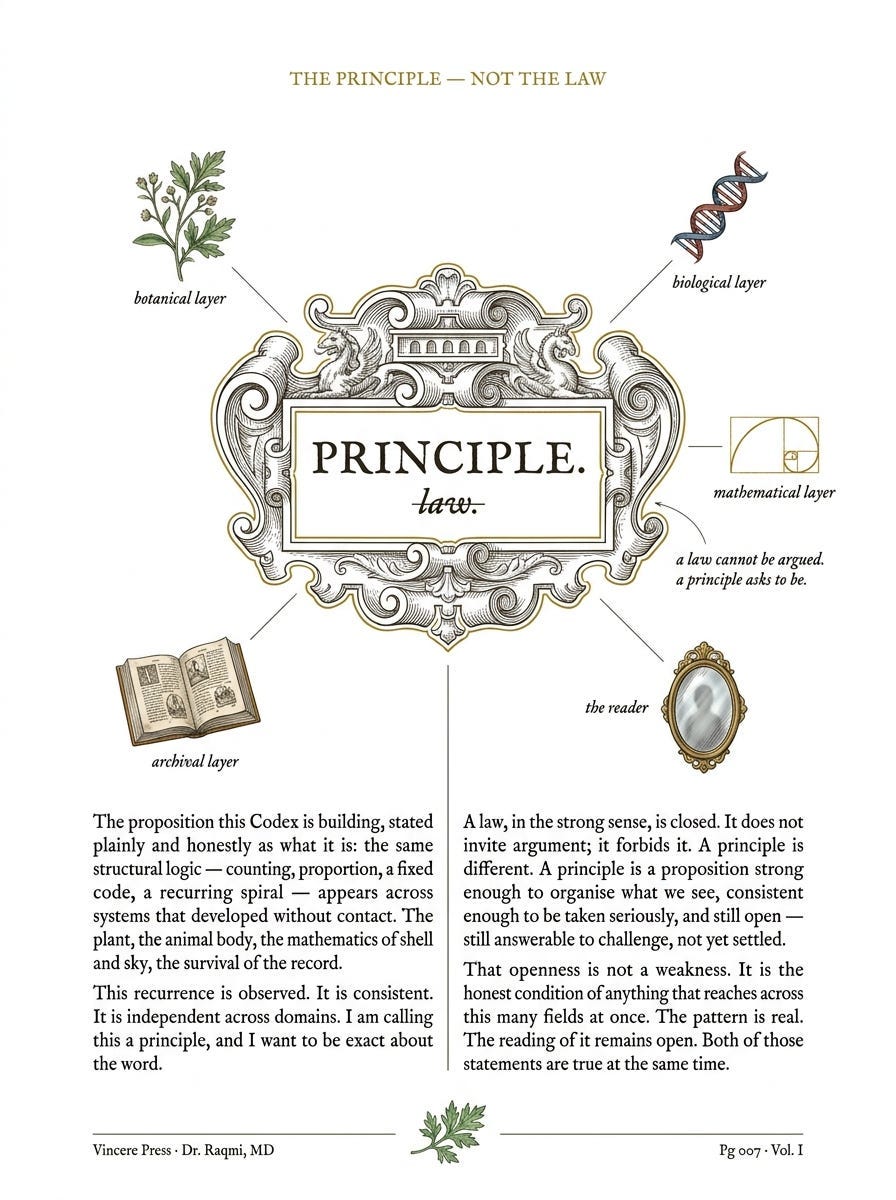
Not a law. A principle. A law forbids argument; a principle requires it. This page names the difference out loud. Vincere Press, Pg 007.
A principle this broad ought to show up even in the systems humans built themselves — starting with the one we built out of language. Not any one language. All of them. Because the same structural features appear in languages that never borrowed from one another — and that is exactly what the principle would predict.

The branches diverge; the root is shared. Human languages with no common ancestor still build from the same deep parts. Vincere Press, Pg 008
The newest thing we have built is a mind made of nodes. Not a human mind — a machine one. And the machine arrived at the same architecture as the forest floor and the nervous system and the mycorrhizal web, without being shown any of them. This is the most contemporary page in the Codex, and the most sober.

Fungal web, nerve cell, and machine model — different materials, the same architecture. Nodes and the links between them. Arrived at three times independently. Vincere Press, Pg 009.
The machine is the newest place the pattern surfaces. The next page is the oldest place humans have deliberately put it: the symbols we choose to stand for ourselves. The marks modern institutions reach for when they want to say who they are. The shapes go back much further than the companies that use them.

Old shapes, new doors. The generic marks modern institutions reach for all have ancient source-forms. Generic examples shown — the vocabulary is public, the pattern is in plain sight. Vincere Press, Pg 010.
You have now seen the pattern in seven materials. A principle is only worth anything if you can use it. The next page is the most practical in the Codex — how the reading-eye is actually built, not as mysticism but as the trainable discipline Merian practised every day of her working life.

Merian’s method, reduced to four moves you can practise: observe, record, compare, and withhold the verdict until the pattern shows itself. Vincere Press, Pg 011.
Building the eye raises a deeper question — why is the human mind able to do this at all? Pattern recognition is not an optional upgrade. It is the cognitive architecture you were born with. The next page examines the gift and its shadow, because the same faculty that reads true patterns can also manufacture ones that are not there.

The mind is built to complete patterns — and to manufacture them. The gift that finds real signal can also produce false ones. Wisdom is telling them apart. Vincere Press, Pg 012.
Read the pages back and you find they were never really separate. The plant’s spiral and the galaxy’s spiral are the same mathematics. The four-letter code in the cell and the deep grammar under every language are the same idea. The fungal web, the nerve, and the machine are the same architecture. One signal. Many materials. The final page makes this visible all at once
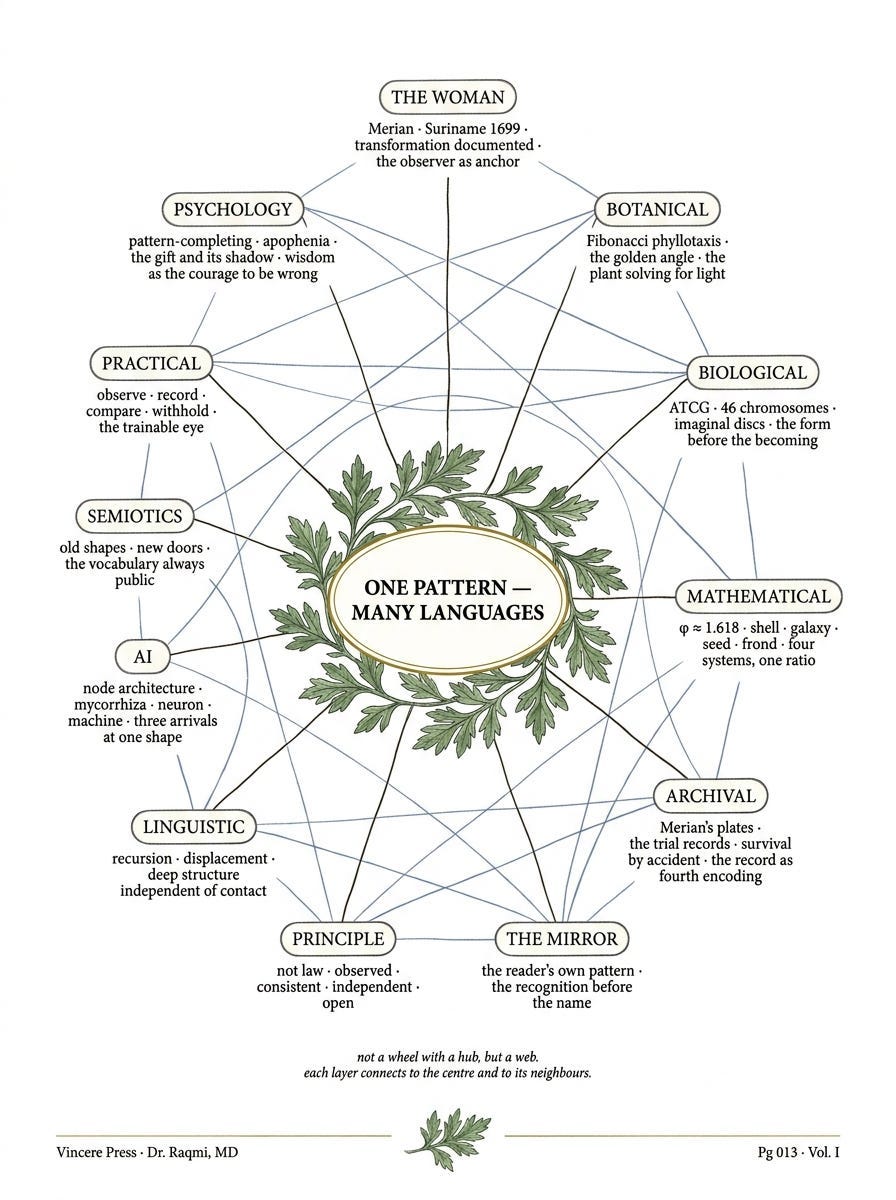
Not a wheel with a hub, but a web. Each layer connects to the centre and to its neighbours. This is the page where the separate pieces become one thing. Vincere Press, Pg 013.
Maria Sibylla Merian never claimed to invent the metamorphosis she drew. She claimed only to have watched it closely enough to record it truthfully — and that turned out to be the rarer and more lasting thing. This first volume of the Codex has done the same with a larger subject. The plate is left blank on purpose. The next observation is yours to make

.
메타데이터
- post_id
- accd60a5ccc0
- slug
- the-body-was-the-first-embodied-ai-it-has-been-running-code-since-before-language-accd60a5ccc0
- url
- https://medium.com/@vincerepress.substack.com/the-body-was-the-first-embodied-ai-it-has-been-running-code-since-before-language-accd60a5ccc0
- canonical_url
- https://medium.com/@vincerepress.substack.com/the-body-was-the-first-embodied-ai-it-has-been-running-code-since-before-language-accd60a5ccc0
- author_url
- https://medium.com/@vincerepress.substack.com
- status
- ok
- fetched_at
- 2026-06-09 15:37:30





