Differences between SELECT COUNT(*), SELECT COUNT(1), and SELECT COUNT(column) in MySQL — An…
*Differences between SELECT COUNT(), SELECT COUNT(1), and SELECT COUNT(column) in MySQL — An Analysis Based on InnoDB and MyISAM**
In MySQL databases, SELECT COUNT(*), SELECT COUNT(1), and SELECT COUNT(column) are commonly used statistical query statements for calculating the number of rows in a table or the number of records under specific conditions.
However, the performance and meaning of these three syntaxes differ slightly across storage engines (such as InnoDB and MyISAM).
This article delves into the differences between these three COUNT statements from the perspectives of InnoDB and MyISAM, and discusses their performance and applicable scenarios.
I. Basic Concepts
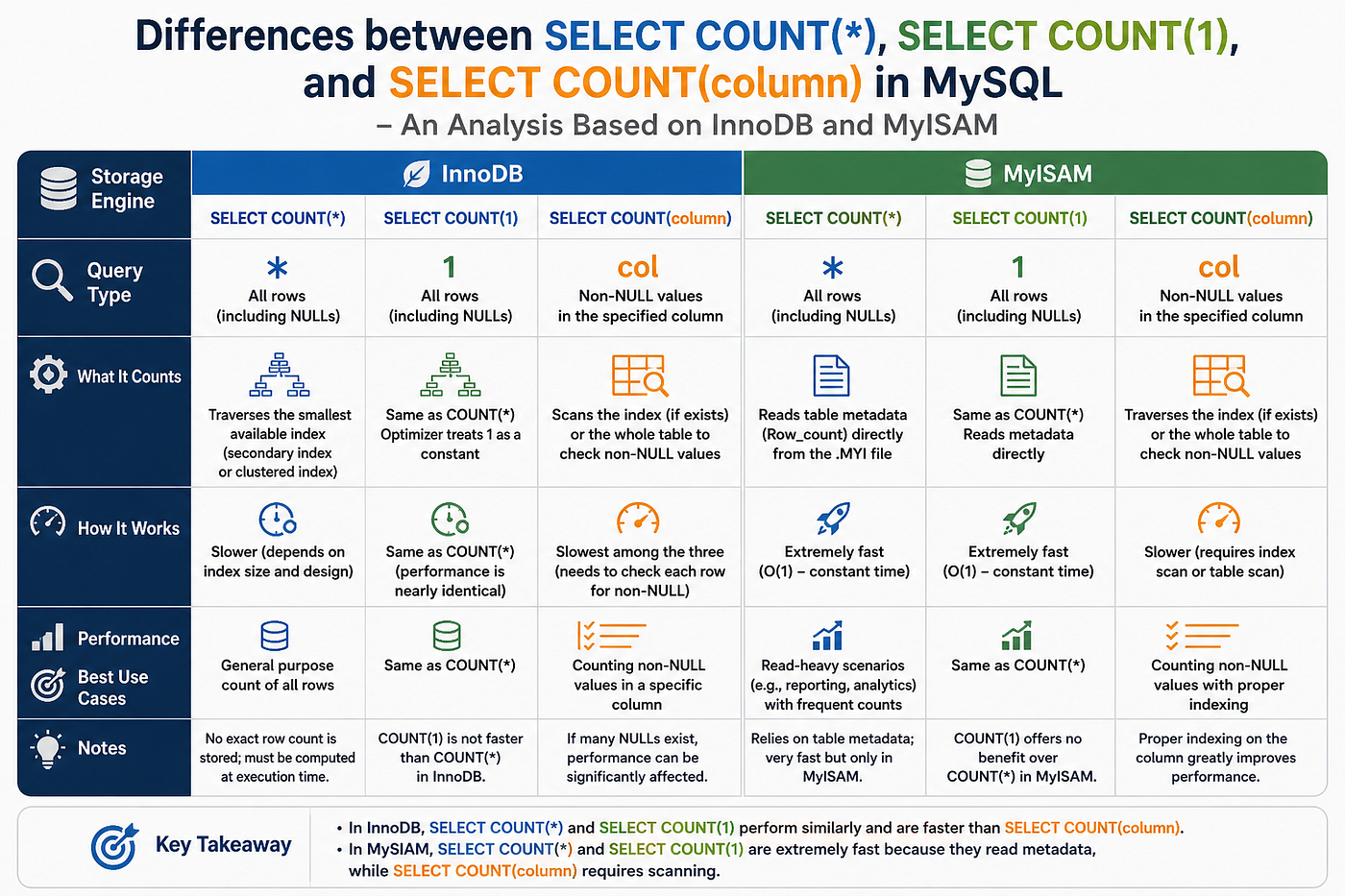
- *SELECT COUNT()** This function counts the total number of rows in a table, including rows where values may be NULL. It does not depend on any specific column and directly retrieves the total number of rows.
- SELECT COUNT(1) Similar to COUNT(), it counts the total number of all rows. The constant 1 has no special meaning; the effect is identical to COUNT().
- SELECT COUNT(column) This counts the number of rows where the specified column has a non-NULL value. Rows with NULL in that column are excluded from the count.
MySQL’s two primary storage engines — InnoDB and MyISAM — implement COUNT operations through different mechanisms, which directly affect query performance and behavior.
II. Performance in InnoDB
InnoDB is the default transactional storage engine for MySQL. It supports row-level locking and foreign keys while emphasizing data consistency. The characteristics of the three COUNT statements in InnoDB are as follows:
- *SELECT COUNT() and SELECT COUNT(1)**
- Similarities: In InnoDB, the execution efficiency of COUNT(*) and COUNT(1) is nearly identical. The MySQL optimizer translates both into the same execution plan, typically scanning the clustered index (primary key index) to count rows.
- How it works: InnoDB tables do not store metadata for the total row count. The index must be scanned to calculate it. MySQL generally chooses the smallest secondary index (if available) because it has lower I/O overhead. If no secondary index exists, the clustered index is scanned.
- Performance impact: On large tables without suitable secondary indexes, scanning the clustered index incurs high I/O costs. InnoDB’s transaction isolation mechanisms (such as MVCC) may require processing multiple data versions, further increasing overhead.
2. SELECT COUNT(column)
- How it works: InnoDB scans the index on the specified column (if it exists) or the clustered index, counting only rows with non-NULL values. Without an index, a full table scan occurs.
- Performance impact: This generally performs worse than COUNT(*) or COUNT(1), especially when the column contains many NULL values or lacks an index. Additional overhead may arise if the column is not part of the primary key, requiring access to the clustered index.
3. InnoDB Considerations
- COUNT query performance depends heavily on index design. Create indexes on frequently queried columns to avoid full table scans.
- In high-concurrency transactional environments, MVCC may cause slight variations in results depending on the transaction isolation level.
- For approximate row counts, consider using EXPLAIN or querying information_schema.tables instead of expensive COUNT operations.
III. Performance in MyISAM
MyISAM is a non-transactional storage engine that uses table-level locking and prioritizes query speed. Its COUNT implementation differs markedly from InnoDB.
- *SELECT COUNT() and SELECT COUNT(1)**
- Similarities: Both execute with identical efficiency.
- How it works: MyISAM maintains an accurate row count in the table metadata. SELECT COUNT(*) or COUNT(1) reads this counter directly, without scanning data or indexes.
- Performance impact: Extremely fast and unaffected by table size. Ideal for frequent total row count queries.
2. SELECT COUNT(column)
- How it works: Requires scanning the index or table data to check for non-NULL values. A full table scan occurs without an index.
- Performance impact: Significantly slower than COUNT(*) or COUNT(1) because it cannot use the metadata counter.
3. MyISAM Considerations
- COUNT(*) and COUNT(1) perform exceptionally well without a WHERE clause. With a WHERE clause, table or index scans are required.
- MyISAM does not support transactions, so results are always real-time.
- Frequent updates can create temporary bottlenecks due to table-level locking.
IV. Performance Comparison and Applicable Scenarios

V. Optimization Suggestions
- *Prefer COUNT() or COUNT(1)**: These are comparable in performance across both engines and more versatile. Use COUNT(column) only when non-NULL counting is explicitly required.
- Create appropriate secondary indexes for InnoDB: Smaller secondary indexes significantly improve COUNT(*) performance.
- Leverage MyISAM for fast statistics: Excellent for non-transactional reporting or statistical applications.
- Avoid frequent COUNT operations in high-concurrency scenarios: Cache results or use approximate values from information_schema.tables.
- Optimize WHERE conditions: Ensure indexes support any filtering clauses.
VI. Conclusion
In MySQL, SELECT COUNT(*) and SELECT COUNT(1) exhibit nearly identical performance within each storage engine. InnoDB requires index scans, while MyISAM benefits from direct metadata access. SELECT COUNT(column) typically performs worse as it must verify non-NULL values. Understanding storage engine characteristics and optimizing based on business needs — particularly through thoughtful index design — can substantially enhance database performance.
Mock Interviewer Questions and Expected Answers
Interviewer: You have explained the differences well. Now, let us explore deeper.
Question 1: How does InnoDB’s MVCC mechanism affect COUNT query results under different isolation levels?
Expected Answer: MVCC maintains multiple row versions for concurrency. Results vary by isolation level: Read Uncommitted may include uncommitted data; Read Committed reflects committed data per statement; Repeatable Read (default) uses a transaction-start snapshot; Serializable adds locks for consistency but incurs high overhead.
Question 2: When might MyISAM’s row count counter become inaccurate?
Expected Answer: Due to table corruption, high-concurrency writes with table locks, or external modifications. Mitigate with ANALYZE TABLE, CHECK TABLE, or REPAIR TABLE.
Question 3: For an InnoDB table with 100 million rows and only a primary key, how long might SELECT COUNT(*) take, and how can it be optimized?
Expected Answer: Potentially several minutes due to full clustered index scan. Optimize by adding small secondary indexes, caching results, using approximate values, or partitioning.
Question 4: Is SELECT COUNT(id) (where id is the primary key) faster than COUNT(*)?
Expected Answer: Performance is typically identical because both scan the clustered index. With smaller secondary indexes available, COUNT(*) may be slightly faster as the optimizer can choose the smallest index.
Question 5: How would you design a production system to avoid frequent expensive COUNT queries?
Expected Answer: Implement caching (Redis), maintain a dedicated counter table via triggers, use asynchronous statistics, approximate values, and optimized partitioning/indexes. For strict real-time needs, combine triggers with careful locking strategies.
Interviewer’s Summary: Strong foundation demonstrated. Continue deepening knowledge of execution plans, locking, and real-world high-concurrency scenarios.
This article provides a comprehensive reference for MySQL developers and database administrators preparing for technical interviews or optimizing production queries.
🔖 Thanks for reading.
- If you enjoyed this article, please consider giving it a clap.👏
- I would appreciate hearing your thoughts in the comments below! 💭
- Follow me for ongoing learning and connection!🔔
- For Interview preparation, please visit https://codestutorial.com. I hope that it will be helpful.
메타데이터
- post_id
- acdbf5b2aa1a
- slug
- differences-between-select-count-select-count-1-and-select-count-column-in-mysql-an-acdbf5b2aa1a
- url
- https://medium.com/codetutorials/differences-between-select-count-select-count-1-and-select-count-column-in-mysql-an-acdbf5b2aa1a
- canonical_url
- https://medium.com/codetutorials/differences-between-select-count-select-count-1-and-select-count-column-in-mysql-an-acdbf5b2aa1a
- author_url
- https://medium.com/@umeshcapg
- status
- ok
- fetched_at
- 2026-06-12 07:40:50