What Kind of Movies Do You Like? Speak Natural Korean Today!
Talk Movies with Your Korean Friends: “어떤 영화 좋아해요?”
What Kind of Movies Do You Like? Speak Natural Korean Today!
Talk Movies with Your Korean Friends: “어떤 영화 좋아해요?”
안녕하세요! (An-nyeong-ha-se-yo!) I’m your Daily Hangul editor and your personal Korean culture guide. Imagine this: You’re hanging out at a trendy cafe in Hongdae, Seoul. The ambient lights are warm, the smell of freshly brewed coffee is in the air, and your new Korean friend leans in and asks: “어떤 영화 좋아해요?” (Eotteon yeonghwa joahae-yo?) You know they are asking about movies, and your mind flashes to your favorite K-Dramas and films. You want to shout, “I love romantic comedies!” or “Action movies are my absolute favorite!” But instead, you freeze. You smile nervously, not knowing how to say it simply in Korean. Don’t worry! We have all been there. Talking about hobbies, especially movies and music, is the absolute best way to break the ice and build a deep connection (known as 정 — Jeong) with Koreans. Today, you are going to master this simple conversation so you can confidently talk about your favorite genres over some delicious tteokbokki or chicken!
Phase 2: Deep Dive into 3 Core Expressions
Let’s break down the essential phrases you need to talk about movies in Korean. These are beginner-friendly (A1) yet highly natural.
1. 어떤 영화 좋아해요? (Eotteon yeonghwa joahae-yo?)
• Pronunciation: eot-teon yeong-hwa jo-ah-hae-yo? / Sound-alike: “Ut-ton yung-wha jo-ah-heh-yo?” • Meaning: What kind of movies do you like? • K-Culture Moment: This is the ultimate conversational icebreaker in Korea. Whether you are on a friendly blind date (소개팅 — Sogaeting) or chatting with colleagues after work, this question always makes an appearance! • Editor’s Insight: Notice that there is no word for “you” in this sentence! In Korean, we naturally drop pronouns like “you” or “I” when the context is clear. “어떤” (eotteon) means “what kind of,” “영화” (yeonghwa) means “movie,” and “좋아해요” (joahae-yo) is the polite form of “to like.” • Situation Spectrum: • Friends/Casual: 어떤 영화 좋아해? (joahae?) — ✅ • Coworkers/Semi-formal: 어떤 영화 좋아해요? — ✅ • Boss/Formal: 어떤 영화를 좋아하십니까? — ⚠️ (A bit too formal for hobbies!) • 🤔 Think About It: Why do you think Korean culture prefers dropping pronouns like “you”? How does this reflect the community-focused mindset of Korean society?
2. 로맨틱 코미디 좋아해요. (Romaentik komidi joahae-yo.)
• Pronunciation: ro-maen-tik ko-mi-di jo-ah-hae-yo / Sound-alike: “Row-man-teek ko-mee-dee jo-ah-heh-yo” • Meaning: I like romantic comedies (rom-coms). • K-Culture Moment: Mentioning this genre is perfect when discussing hit romantic comedies like Business Proposal or Our Beloved Summer! • Editor’s Insight: Good news! Many movie genres in Korean are loanwords from English. “로맨틱 코미디” (Romaentik komidi) is romantic comedy. Koreans often shorten this to the super-cute slang “로코” (Roko)! • Situation Spectrum: • Friends/Casual: 로코 좋아해! (Roko joahae!) — ✅ • Coworkers/Semi-formal: 로맨틱 코미디 좋아해요. — ✅ • Boss/Formal: 로맨틱 코미디를 좋아합니다. — ✅ • 🤔 Think About It: Koreans love to shorten words (like “로코” for Rom-Com). Does your native language have similar cute abbreviations for movie genres?
3. 액션 영화는 별로 안 좋아해요. (Aeksyeon yeonghwa-neun byeollo an joahae-yo.)
• Pronunciation: aek-syeon yeong-hwa-neun byeol-lo an jo-ah-hae-yo / Sound-alike: “Ack-shun yung-wha-nun byul-lo an jo-ah-heh-yo” • Meaning: I don’t really like action movies. • K-Culture Moment: Use this when a friend suggests going to watch a loud, explosive blockbuster, but you prefer something quiet and cozy. • Editor’s Insight: Instead of saying “I hate action movies,” which can sound a bit too strong and harsh, Koreans use the magic word “별로” (byeollo), which means “not really” or “not particularly,” followed by “안” (an — not). It softens your rejection beautifully! • Situation Spectrum: • Friends/Casual: 액션은 별로 안 좋아해. — ✅ • Coworkers/Semi-formal: 액션 영화는 별로 안 좋아해요. — ✅ • Boss/Formal: 액션 영화는 별로 좋아하지 않습니다. — ✅ • 🤔 Think About It: How does using soft words like “별로 안…” help maintain harmony and politeness in a group conversation?
Phase 3: Textbook Korean vs. Real Korean Showcase
Let’s look at how actual native speakers talk compared to stiff textbook guides!
Scenario 1: Asking someone about their favorite movie
• 📖 Textbook: 당신은 어떤 장르의 영화를 선호합니까? (What genre of movies do you prefer?) — Sounds like a robotic survey! • 🗣️ Real Korean: 어떤 영화 좋아해요? (What kind of movies do you like?) or 무슨 영화 좋아해요? (What movies do you like?) • 💡 Why the difference?: Real-life Korean is casual and comfortable. We use the simple verb “좋아하다” (to like) instead of formal vocabulary like “선호하다” (to prefer).
Scenario 2: Saying “I can’t watch scary movies”
• 📖 Textbook: 저는 공포 영화를 싫어합니다. (I dislike horror movies.) — Sounds very cold and absolute. • 🗣️ Real Korean: 공포 영화는 무서워서 못 봐요. (I can’t watch horror movies because they are scary.) • 💡 Why the difference?: Sharing the reason why you don’t like something (like being scared) makes you sound friendly, cute, and approachable!
Phase 4: K-Culture Deep Dive & Body Language
4–1. Nunchi (눈치) & Body Language Tips
When talking about things you like or dislike in Korea, body language tells half the story!
- The Soft Nod: When someone shares their favorite movie, nod slowly (끄덕끄덕 — kkeodeok kkeodeok) and say “아, 진짜요?” (Ah, jin-jja-yo? / Oh, really?). It shows you are actively engaged.
- The Gentle Wave: If you want to say “No, I don’t like horror movies,” gently wave your hand left and right near your chest while smiling. It signals a soft, polite refusal without looking aggressive.
4–2. The Culture of “Binge-Watching” (정주행)
In Korea, media culture is fast and highly social. When a new drama drops on Netflix, Koreans love to do 정주행 (Jeong-ju-haeng), which literally means “driving straight ahead,” but is used for “binge-watching” a whole series in one weekend. Asking someone, “요즘 뭐 정주행해요?” (What are you binge-watching lately?) is the ultimate way to show you understand modern Korean lifestyle!
Phase 5: Play the Game — Pojangmacha Conversation!
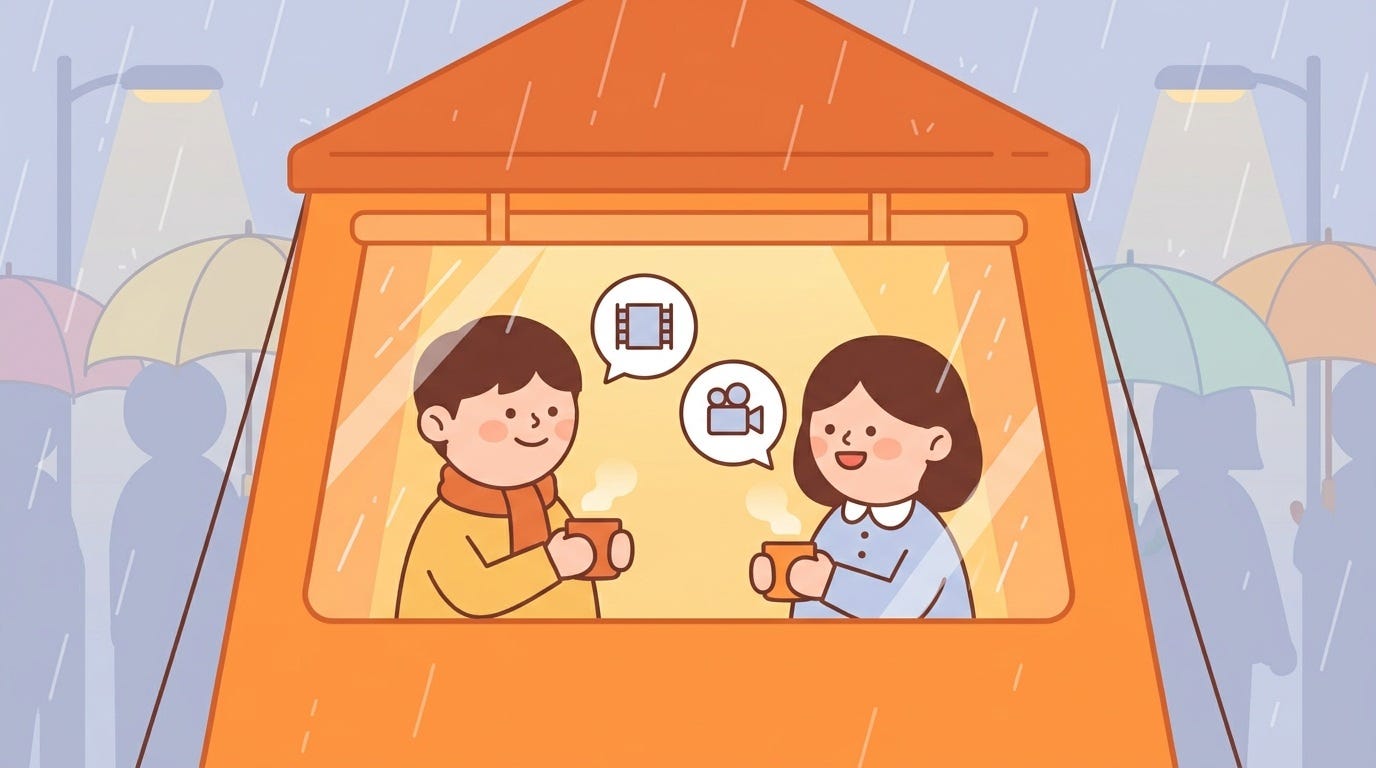
Let’s test your skills! You are sitting with Minjun, your friendly Korean colleague, at a cozy street food tent (포장마차 — Pojangmacha) in Seoul on a rainy Friday evening. • Cast: • You (A curious K-culture lover) • Minjun (A friendly local who loves films)
• Minjun: (🎭 smiling, raising a glass of cider) 오늘 진짜 수고 많았어요! (Oneul jin-jja su-go man-at-seo-yo! / You worked really hard today!) • You: (🎭 clinking glasses) 고마워요, 민준 씨! (Go-ma-wo-yo, Minjun-ssi! / Thank you, Minjun!) • Minjun: (🎭 looking outside at the rain) 비도 오는데, 이번 주말에 영화나 볼까요? (Bi-do o-neun-de, i-beon ju-mal-e yeong-hwa-na bol-kka-yo? / Since it’s raining, shall we watch a movie this weekend?) • You: (🎭 nodding eagerly) 좋아요! 영화 좋아해요. (Jo-ah-yo! Yeong-hwa jo-ah-hae-yo. / Sounds good! I like movies.) • Minjun: (🎭 leaning closer) 오, 그래요? 어떤 영화 좋아해요? (Oh, geu-rae-yo? Eotteon yeong-hwa jo-ah-hae-yo? / Oh, really? What kind of movies do you like?)
🔀 Decision Point! How will you respond?
• Option A: “로코 좋아해요!” (Ro-ko jo-ah-hae-yo! / I like rom-coms!) • Option B: “아니요, 싫어해요.” (An-ni-yo, sil-eoh-hae-yo. / No, I hate them.) • Option C: “공포 영화는 별로 안 좋아해요. 로코 어때요?” (Gong-po yeong-hwa-neun byeol-lo an jo-ah-hae-yo. Ro-ko eo-tteo-yo? / I don’t really like horror movies. How about a rom-com?)
💡 Choices Analysis:
• Best Choice: Option C! It politely expresses what you dislike using “별로 안”, suggests a cozy genre, and asks for Minjun’s opinion to keep the conversation lively. • Good Choice: Option A! Energetic, cute, and uses the natural abbreviation “로코.” • Risky Choice: Option B. This sounds very blunt and might make the poor Minjun think you are angry! Try to avoid direct rejections like “싫어해요” in casual chats.
Phase 6: 10-Second Emotion Shadowing Drill
Speak with feelings! Try matching the emotion tags below to sound like a native:
- [😊 Super Excited & Happy] • 진짜 / 재밌어요! • Jin-jja / jae-mit-seo-yo! • “It’s really fun!”
- [🥺 Shy & Cute] • 로코 / 좋아해요. • Ro-ko / jo-ah-hae-yo. • “I like rom-coms.”
- [😤 Scared but Playful] • 공포 영화는 / 무서워요! • Gong-po yeong-hwa-neun / mu-seo-wo-yo! • “Horror movies are scary!”
Phase 7: K-Culture Mini Dictionary
Word (Korean + Romanization) English Meaning Real-world Context 정주행 (Jeong-ju-haeng) Binge-watching Watching an entire series from start to finish. 인생 영화 (In-saeng yeong-hwa) Life Movie The absolute best movie of your entire life. 로코 (Ro-ko) Rom-Com Short for 로맨틱 코미디 (Romantic Comedy). 배우 (Bae-u) Actor / Actress Used when asking “Who is your favorite actor?”
Phase 8: Traveler’s Survival Kit
If you find yourself in front of a theater box office in Seoul, use these handy survival cards!
🎫 Survival Card 1
• Korean: 영화표 두 장 주세요. • Romanization: Yeong-hwa-pyo du jang ju-se-yo. • English: Two movie tickets, please.
🍿 Survival Card 2
• Korean: 팝콘이랑 콜라 주세요. • Romanization: Pap-kon-i-rang kol-la ju-se-yo. • English: Popcorn and cola, please.
💬 Survival Card 3
• Korean: 영어 자막 있어요? • Romanization: Yeong-eo ja-mak is-seo-yo? • English: Are there English subtitles?
📌 Editor’s Travel Note: To book movies or check showtimes in Korea, download the local theater apps such as the CGV Official App or Lotte Cinema Official App. To find the nearest theater quickly, use the Naver Map App, as Google Maps is not fully optimized in South Korea!
Phase 9: Think Deeper — “한 발 더 깊이” (A Step Deeper)
In Korean culture, talking about movies or music is not just a casual chat; it’s a way of sharing 공감 (Gong-gam — empathy). When Koreans love a movie, they often watch it multiple times and discuss the hidden meanings over dinner. Sharing your “인생 영화” (life movie) with someone shows that you are letting them into your inner world. It’s a beautiful way of building long-lasting friendship! 💬 Your Turn: What is your absolute “인생 영화” (Life Movie)? Tell us in the comments below using simple Korean if you can!
Phase 10: FAQ & Common Mistakes
Q: Can I use “무슨” (museun) instead of “어떤” (eotteon)?
A: Yes! Both are great. “어떤” asks “What kind of movie,” while “무슨” is closer to “What movie (specifically).” In daily life, they are interchangeable!
Q: How do I say “I don’t like horror movies” politely?
A: Use “별로 안 좋아해요” (byeol-lo an jo-ah-hae-yo) instead of “싫어해요” (sil-eoh-hae-yo). It sounds much gentler and keeps the conversation warm.
Q: Do I need to say “저는” (I) in every sentence?
A: No, please drop it! Saying “저는” too much sounds like a textbook. Just say “로코 좋아해요” directly!
🚨 Common Mistake Alert!
• Wrong: 당신은 어떤 영화 좋아해요? (Dang-sin-eun eotteon yeonghwa joahae-yo?) • Correct: 어떤 영화 좋아해요? (Eotteon yeonghwa joahae-yo?) • Reason: Calling your friend “당신” (Dangsin) sounds very unnatural, romantic, or even confrontational in modern Korean! Just omit “you” entirely.
Phase 11: Action Missions!
• 🥉 Bronze Mission: Record your voice saying: “로코 좋아해요!” and listen to make sure it sounds natural. • 🥈 Silver Mission: Write a post on your social media: “제 인생 영화는 [Movie Title]예요!” (My life movie is [Movie Title]!). • 🥇 Gold Mission: Find a Korean language partner and ask them: “어떤 영화 좋아해요?” and react to their answer!
Phase 12: Interactive Quiz Challenge!
1. Which of the following is the most polite way to say “I don’t really like action movies”?
• A) 액션 영화 싫어합니다. • B) 액션 영화는 별로 안 좋아해요. • C) 액션 영화 안 좋아해!
2. Fill in the blank: I like romantic comedies.
• “로맨틱 코미디 _____.”
3. True or False: You must always use the word “당신” (you) when asking a Korean friend a question.
• True / False
👀 Click here to see the answers! 1. Answer: B (“별로 안 좋아해요” is the perfect natural, polite formula!) 2. Answer: 좋아해요 (joahae-yo) 3. Answer: False (It is much more natural to drop “you” entirely!)
See you in the next lesson! 다음에 또 만나요! (Da-eum-e tto man-na-yo!)
Originally published at https://dailyhangul.com on June 6, 2026.
메타데이터
- post_id
- ace2b9f4f5e5
- slug
- what-kind-of-movies-do-you-like-speak-natural-korean-today-ace2b9f4f5e5
- url
- https://medium.com/@dailyhangul/what-kind-of-movies-do-you-like-speak-natural-korean-today-ace2b9f4f5e5
- canonical_url
- https://medium.com/@dailyhangul/what-kind-of-movies-do-you-like-speak-natural-korean-today-ace2b9f4f5e5
- author_url
- https://medium.com/@dailyhangul
- status
- ok
- fetched_at
- 2026-07-14 13:03:24





