The Spectrum of Non-Duality Is Still Duality
Why mapping reality may be the mind’s final illusion
The Spectrum of Non-Duality Is Still Duality
Why mapping reality may be the mind’s final illusion
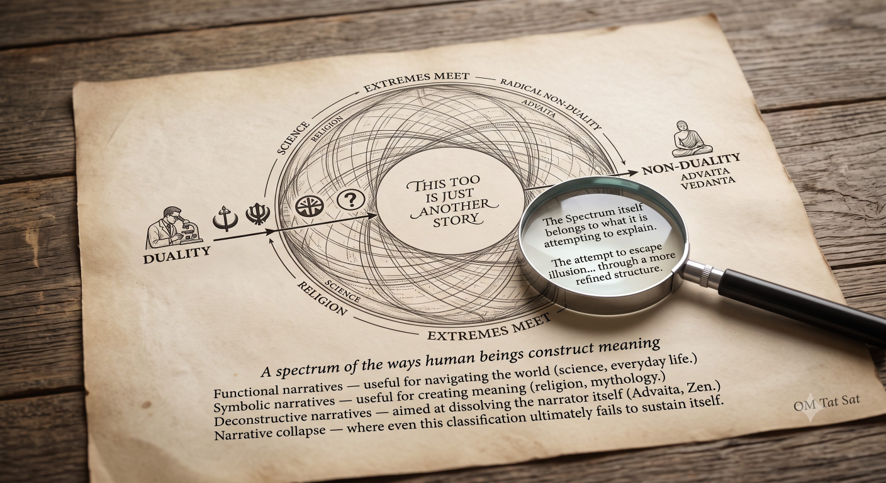
Artwork by Nano Banana Pro
Recently, I came across an article proposing a “spectrum of duality and non-duality.”
It is an elegant idea.
Different perspectives — science, religion, Advaita Vedanta, radical non-duality — are arranged along a single axis, as though they represented different degrees of proximity to reality.
Then comes an even more sophisticated refinement.
The spectrum is no longer linear.
It becomes circular.
The extremes meet.
The beginning and the end become neighbors.
It is an intellectually appealing construction.
Precisely for that reason, however, it quietly rests upon an almost invisible assumption:
That there is something waiting to be mapped.
The problem is not the content.
It is the structure.
The issue is not that different traditions are placed within the same diagram.
The issue is the assumption that they all belong to the same category of thing.
Perhaps they do not.
Science, as a practice, is first and foremost a method of inquiry.
Religion primarily communicates through symbols.
Advaita does not seek to offer another theory about the universe; it points toward what remains when every theory has fallen silent.
What is often called radical non-duality generally does not introduce another position, but questions the need for any position at all.
Placing all of these on the same axis does not necessarily reveal an underlying unity.
It may simply reveal something deeply human:
Our need to organize whatever still appears scattered.
A False Opposition
The spectrum begins with what seems like an obvious intuition.
Duality on one side.
Non-duality on the other.
Yet this is precisely where the first difficulty appears.
Within the Advaita Vedanta tradition, non-duality has never been presented as the opposite of duality.
It is not the other end of the same line.
It points to the absence of the division itself.
If there are not two poles,
what meaning does the axis between them still possess?
Perhaps the spectrum itself belongs to what it is attempting to explain.
When a New Category Is Still a Category
Some contemporary approaches associated with radical non-duality argue that only immediate experience exists, while everything else is mental construction.
At first glance, this appears to be a complete break from previous philosophy.
But a closer look suggests that much of the novelty lies less in the content than in the language used to describe it.
Throughout the history of philosophy, remarkably similar intuitions have appeared under different vocabularies.
The words change.
The emphasis changes.
Yet the underlying structure remains surprisingly familiar.
Perhaps the desire to present an entirely unprecedented vision is stronger than the novelty itself.
When the Map Begins to Disappear
Interestingly, the very article eventually acknowledges — almost in passing —
“In the end, this too is just another story.”
If that sentence is taken seriously,
something remarkable happens.
The entire spectrum loses its privileged status.
Because then:
The scientist tells a story.
The religious believer tells a story.
The philosopher tells a story.
The non-dualist tells a story.
And the one arranging all those stories into a single map…
does too.
No observer remains outside what is being observed.
Not even the critic.
What May Actually Be Organized
If we still wish to preserve some kind of model,
perhaps it describes something quite different.
Not a spectrum of reality.
But a spectrum of the ways human beings construct meaning.
Something like this:
- Functional narratives — useful for navigating the world (science, everyday life).
- Symbolic narratives — useful for creating meaning (religion, mythology).
- Deconstructive narratives — aimed at dissolving the narrator itself (Advaita, Zen).
- Narrative collapse — where even this classification ultimately fails to sustain itself.
And even this organization…
remains another narrative.
The Mind’s Final Movement
The mind rarely settles for creating explanations alone.
It also wants to organize them.
Compare them.
Arrange them.
Rank them.
Build systems.
Draw maps.
Perhaps this provides a sense of certainty.
Because even an imperfect map often feels more comforting than acknowledging that there may be no conceptual territory waiting to be organized.
Here we encounter the mind’s most subtle movement.
The attempt to escape illusion…
through a more refined structure.
In One Sentence
The spectrum is elegant.
The spectrum is sophisticated.
But it still assumes there is a territory waiting for a map.
And perhaps that is the final gesture of duality itself.
OM Tat Sat
메타데이터
- post_id
- ace670a9a02e
- slug
- the-spectrum-of-non-duality-is-still-duality-ace670a9a02e
- url
- https://medium.com/new-earth-consciousness/the-spectrum-of-non-duality-is-still-duality-ace670a9a02e
- canonical_url
- https://medium.com/new-earth-consciousness/the-spectrum-of-non-duality-is-still-duality-ace670a9a02e
- author_url
- https://medium.com/@wvs2002
- status
- ok
- fetched_at
- 2026-07-17 03:23:32