I’M A BETTER PERSON THAN GOD.
He doesn’t meet my moral standards. He condones slavery.
Holy Hormones Bible Study: If your book isn’t a buzz, it’s not the Bible.
I’M A BETTER PERSON THAN GOD.
He doesn’t meet my moral standards. He condones slavery.
SPOILER ALERT: The Saints who can hear the melody of the words of the Bible know the title of this post is an absurdity. Unfortunately, it is an opinion expressed far too often on this platform.
BUT NOW THAT I HAVE YOUR ATTENTION.. . .
If you are not a financial member of Medium, CLICK HERE for a free read.
This post is a companion to EYE FOR AN EYE — ARE YOU SURE YOU KNOW WHAT THAT MEANS?
If that rocked your boat, you had better have a cup of tea, an aspirin, and a good lie down before proceeding. You will never look at God’s Character in the same way again.
If you have already read a Holy Hormones article you know what to expect. If this is your first visit, it is advised that you read THIS before proceeding.
However, if you like what you read, there is more to be found in this LIBRARY.
Introduction
There have recently been several posts from a Medium contributor claiming that the Bible does not condone slavery. But these are swamped by those who claim the moral high ground because “it is obvious that it is instructed in the Scriptures.” There have been comments from a few who could see his point, some others have been condescending, showing how well-read the respondent is, but some were downright hostile.
This is one of the most misleading, dishonest interpretations I’ve ever seen of the slavery in the OT. The overwhelming majority of biblical scholars do not land anywhere near your interpretation, and what you are doing is wrong.
For want of a better name I’ll call this person Ginosko. You had better have something more than aspirin if you are in Ginosko’s stable — and keep the bottle beside you.
I contend that Scriptures show, unambiguously, that the God of Abraham, Isaac, and Jacob does not condone slavery– and never has.
Do I expect anyone to believe me?
I hope so but Epictetus wrote, “It’s impossible for persons to learn what they think they already know.” Perhaps you’ve noticed there is no shortage of experts waiting to pounce. Cogito Ergo Veritas, “I think it therefore it is true,” prevails. (It would be surprising if you aren’t saying, ‘Backatchya!”)
And I’m not encouraged by the American philosopher, Don Marquis, who wrote, “If you make people think they’re thinking, they’ll think they love you; but if you really make them think, they’ll know they hate you.” I wonder if I will have a hareem at the end of this?
The tenor of Ginosko’s hysterically hostile comment above implies that there is a lot of tidying up to do so it is not known how many posts this will take.
We have to start somewhere so it might as well be with the word, slave.
WHOEVER CONTROLS THE VOCABULARY CONTROLS THE CONVERSATION.
What is a slave?
Uh! Oh! Has Pandora’s Box been opened?!!!
Don’t be alarmed. That’s not where we are going. We are looking for a common sense definition — not a biological one.
There are numerous miles of column inches spent on defining what some words in the original Bible languages mean — specifically:-
H5650 — ‘eḇeḏ → Hebrew
G1401 — doulos → Greek
But everyone understands what a slave is — and it’s never a good thing, is it?
Perhaps the meaning is not so crisp.
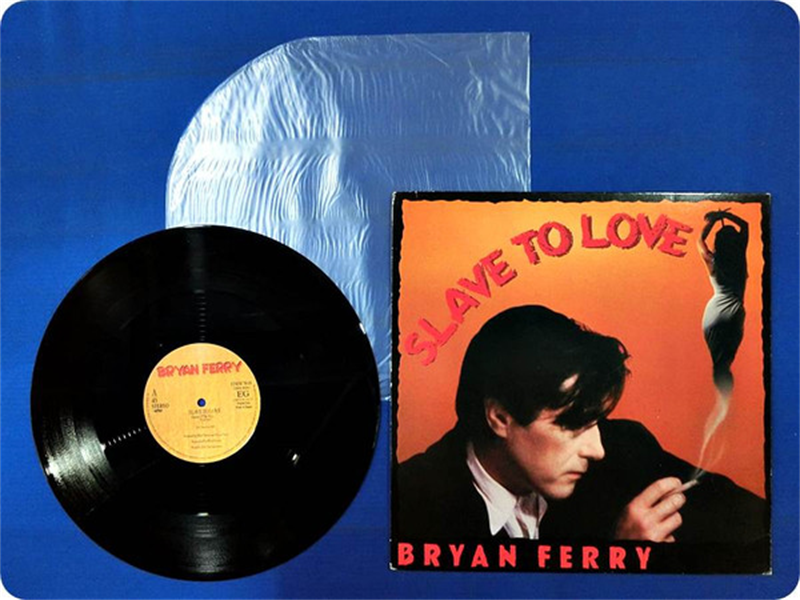
But we all know that love is what it’s all about these days so being a slave to it must be a good thing. I’m so confused.
Hold that thought. It will resurface fairly soon.
Does the Bible change its mind?
Contrary to popular belief, very little. If you like you can follow the arguments of the various conspiracy theories about how they (whoever they are) have kidnapped the Bible and done it violence over the centuries. But there are thousands of copies spread around the Mediterranean Sea, in a multitude of languages to be able to cross-check and confirm that we can have racing-certainty confidence in the original languages.
The problem is the constant movement of the English language. (I’m surprised that name didn’t go the same way as the Gulf of Mexico.) God, in His Infinite Wisdom, set His Word in Dead Languages, because He knew what would happen. Each new Bible Translation SHOULD go back to the original languages and start from scratch. (But we know they don’t.)
It is interesting to compare early and modern translations of the words H5650 — ‘eḇeḏ and G1401 — doulos. And it is not a difficult task.
The number of times the word slave occurs in the KJV OT is zero, 0, never, nix, zero with the rim rubbed out, zilch, not one.
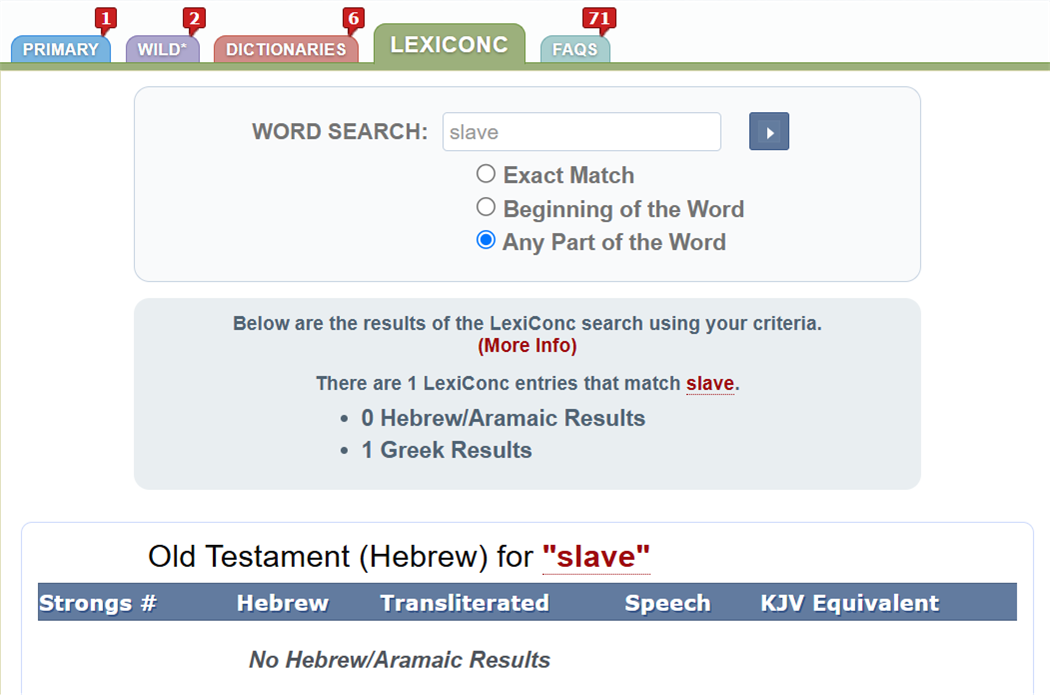
It occurs in Jeremiah 2:14 as italics, indicating it has been inserted by the Translators, “Is Israel a servant? is he a homeborn slave? why is he spoiled?”

KJV translates H5650 — ‘eḇeḏ as, servant (744 times), manservant (23x), bondman (21x), bondage (12x), bondservant (1x). Even the twelve times it is translated bondage, ten refer to, “The LORD thy God, which brought thee out of the land of Egypt, from the house of bondage,” and two to the Babylonian Exile.
Scrutinising the forms of the word slave in Genesis in the NASB(2020) shows 42 mentions of the word. Five of these are H5650, translated as servant or bondman in KJV, otherwise H8198, translated, handmaid (29x), maid (12x), maidservant (8x), bondwomen (3x), maiden (3x), women servants (3x), handmaidens (2x), bond maid (1x), servant (1x), wench [archaic form of young female virgin] (1x) in KJV.
There are two cases in NASB(2020), Genesis 17:12 & 13, which refer only to males where the translators inject the word slave.
The NIV is near-enough-as-good-as NASB(2020).
HOW CAN THERE BE SO MANY SLAVES IN THE MODERN TRANSLATIONS OF THE SAME HEBREW WORDS?
Perhaps the word slave post-dated the KJV?
No. The etymology website, Etymonline shows it to have been available for use in the KJV.
slave(n.): c. 1300, sclave, esclave, “person who is the chattel or property of another,” from Old French esclave (13c.) and directly from Medieval Latin Sclavus “slave” (source also of Italian schiavo, French esclave, Spanish esclavo)
Also, it is not unreasonable to deduce that the medieval translators knew about slavery.
DON’T FRET — I HAVE A THEORY.
But first, I’ve done some research on the research on this topic.
The biblical scholars mentioned in Ginosko’s response have certainly been busy. It is not claimed that my discoveries are statistically significant but there appears to me, of no Theological qualification, that there is a fatal flaw (discovered ALMOST universally across the literature).
There are reams of pages about, Roman practices, Greek practices, American practices, European practices, Mediterranean economics, and other high powered subjects that go far beyond the boundaries of the topic of Israelites as (sic)slaves or (sic)slave owners. The information is immaterial and, not only should but must, be rejected as inadmissible. To include it would show a bias toward the irrelevant, the classic red herring logical fallacy.
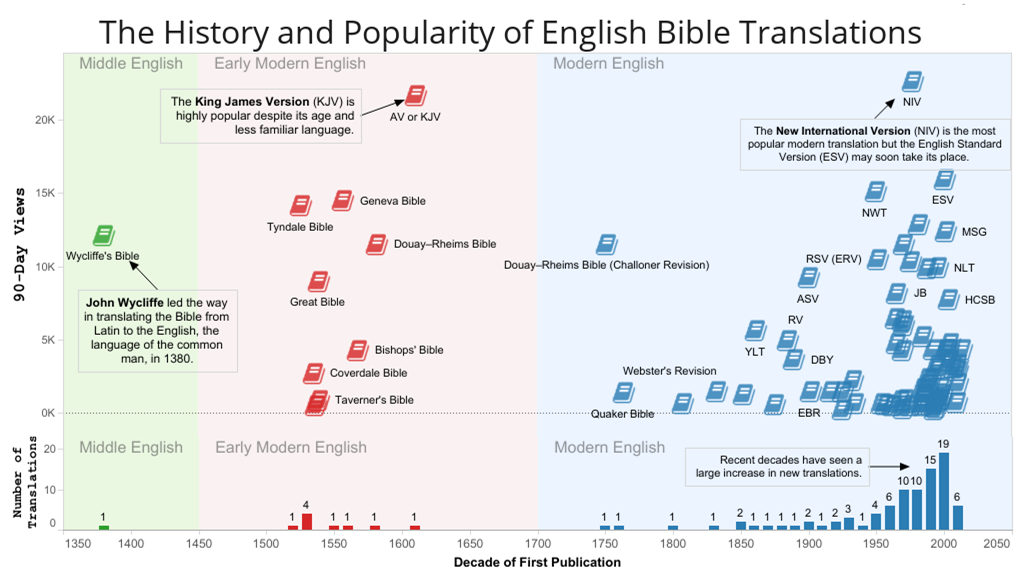
The old adage about a picture being worth a thousand words holds true here.
By the Grace of God, a skilled data → graph producer has been found on a site called (viz.)BIBLE, run by Robert Rouse who believes he has been called to be a Minister of Data and I’m not about to argue with him. His ability to present the patterns I see far exceed mine. His site is well worth a visit. It will give the background of this chart. However, the idea projected speaks for itself. The number of new Bible translations begins to take off in the first half of the 20th Century. History shows something else that took off was Hollywood movies.
Here’s another picture.
An analytical technique relatively new on the scene is the *Google Books Ngram Viewer*. It can give an indicative picture of the frequency of individual words in the database of 5.2 million books (500 billion words) stored somewhere in Google Land. The spectrum ranges from the years 1600 to 2020.
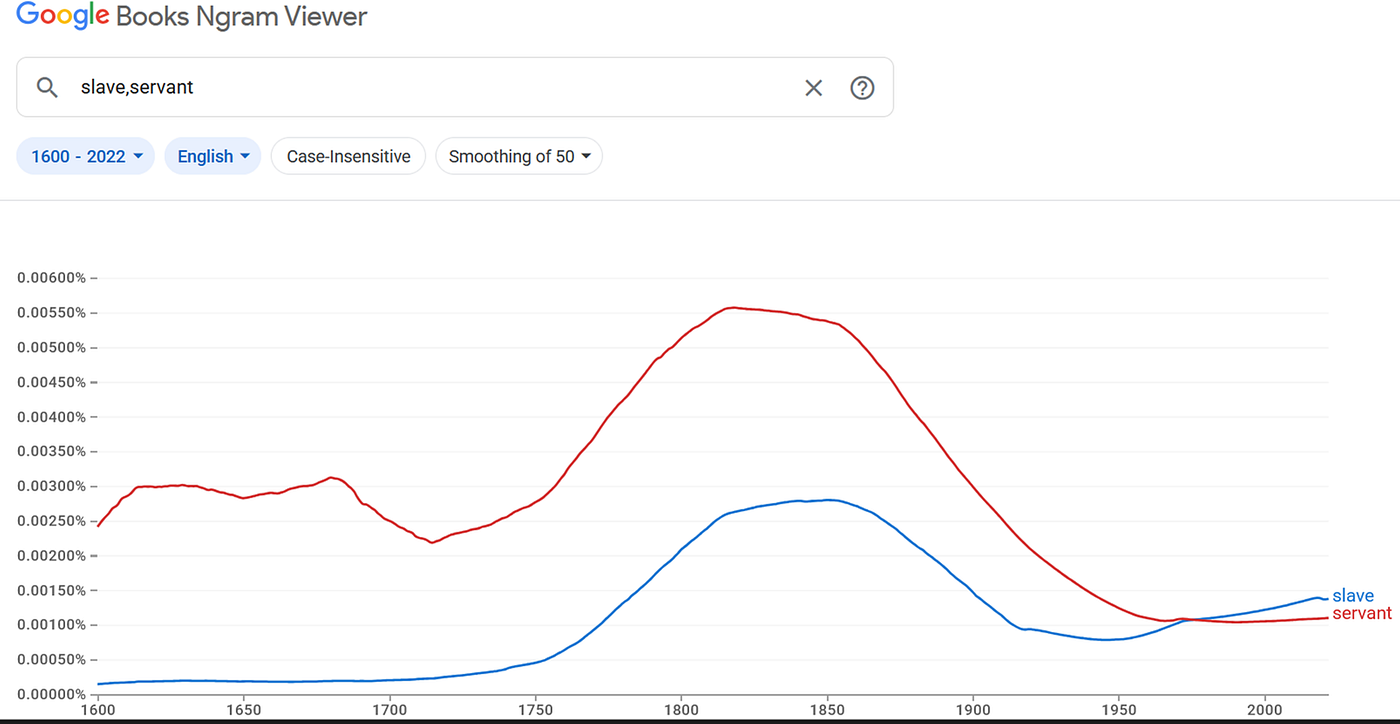
When comparing the words slave and servant it can be seen that servant was dominant, regardless of the circumstances, but slave started to blossom around the time of the dawn of Hollywood movies — and forged ahead during the exponential increase of modern translations.
W. Barnes Tatum, in his book, “Jesus at the Movies: A Guide to the First Hundred Years.” Claims the American film industry has been producing movies based on Bible stories, “swords and sandals,” since 1897. Also, Matthew Page points out that “more biblical films were released in the years from 1909 to 1911 than at any other time.” And the Biblical Blockbusters about slavery began to appear in about 1925 with Ben Hur and the Hollywood Slave was given birth — the problem is that it was about Roman Slavery — not Hebrew on Hebrew slavery.
Another slavery film, “Uncle Tom’s Cabin,” was released in 1903. But this was White on Black slavery in America — not Hebrew on Hebrew slavery in Israel.
This made for good drama.
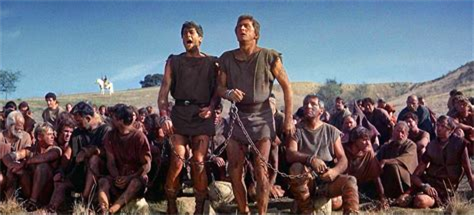
So in the Movie Studios all the different categories of slave were blended and intermingled with the obscenity that was in America, (Australia has nothing to be proud of) where the Hollywood Slave dominated. Most of the English Bible translations emanated from USA. Looking at the two figures above it is not unreasonable to deduce that the translators carried subliminal images of Kirk Douglas and Charlton Heston in their imagination. There is now a plethora of slaves. Hebrew slaves, Roman slaves, Greek slaves, and African slaves — all blended into the one-size-fits-all Hollywood slave.
It can be seen from the charts that the scholars and translators of the recent versions began to come of age after being subjected to the subliminal indoctrination by Hollywood through their formative years. Everyone has a bias. On what evidence does one establish that bias? Their conclusions cannot be considered safe because it is not known how much their bias was tainted by Saturday matinees.
So what?
One of the flaws in the arguments slandering Yehovah about slavery is the term Graeco-Roman. The Slave Laws of the Torah should not be compared to the pagan Laws.
THE SLAVE LAWS OF THE TORAH SHOULD NOT BE COMPARED TO THE PAGAN LAWS.
For instance, Aristotle in his work, Politics, argued that some people were “natural slaves,” destined to serve others due to their lack of rational capacity. This perspective justified slavery as a natural and necessary institution in ancient Greek society.
The antics in the Colosseum showed the esteem in which slaves were held by the Romans. After the Bar Kokhba Revolt, Judea was decimated and Jewish slaves flooded Rome. It is said that the price of a Jewish slave in the Roman slave markets fell below that of a horse.
THESE JEWS WERE SUBJECT TO THE SLAVE LAWS OF THE PAGANS. AS THIS PROJECT CONTINUES (IF WE BOTH LAST) IT WILL BECOME GLARINGLY OBVIOUS WHICH JURISDICTION THEY WOULD PREFER.
MY POSTULATION IS THAT MODERN SCHOLARSHIP ON THIS TOPIC IS NOT WORTH MUCH BECAUSE IT CARRIES TOO MUCH BAGGAGE FROM THE MOVIES WHERE, APPARENTLY, ONE SLAVE IS AS GOOD AS ANOTHER. THERE IS NO FINESSE.
(It is up to you to take it or leave it.)
As with Eye-for-Eye, the words ‘eḇeḏ & doulos in Exodus 21 have been entirely misinterpreted. If you stick with me you will be shown that The Laws of the Slaves is a misnomer. It should be The Laws of the Responsibilities.
CHATTEL SLAVERY, AS PER THE MODERN UNDERSTANDING, IS NOT IN GOD’S VOCABULARY.
That’s enough for you for now. The emphasis has been to knock the mistranslation, resulting in misinterpretation, on the head. The softer translations of the KJV are entirely valid.
That is just house keeping. It’s time to start to step up.
It seems that a lot of people consider God is too Heavenly Minded to be of any Earthly use but He is the God of Common Sense. A deeper investigation into His Torah of Exodus 21 will now begin.
Conclusions so far.
I’m open to correction but the emotive vibe of the word slave for ‘eḇeḏ & doulos is derived from Greek, Roman, and early American Industrial Relation practices and absolutely, definitely, unambiguously inapplicable to Exodus 21.
The word slave does not occur in the KJV and started to take off in coincidence with Hollywood Bible movies about Roman/Greek/Pagan slavery. The result adds a new category to the Roman, Greek, Pagan and Hebrew slaves — the Hollywood Slave which is a one-size-fits-all.
I’m sure there are many rigorous scholars out there but experience shows it is necessary to kiss a few frogs before you find your prince. However, it seems to me that the bulk of modern scholarship has investigated the incorrect situation. And every undergraduate has learned to their cost that a 100% correct answer to another question is 100% wrong.
The forgoing evidence has not been presented to convince any reader but to allow a personal decision to be made. There is much more to know about this subject. Perhaps you’ll pay another visit, sometime. If you have seen something you like, I encourage plagiarism. So, always check everything I say first, then please re-cycle, re-brand, re-structure, re-issue, re-label, or re-gurgitate in any manner you please. No need to acknowledge me because the Holy Spirit Who holds the Intellectual Rights.
All Glory to the God of Abraham, Isaac and Jacob.
(We all have a plank in our eye. It’s bigger than we think.)
ネ
메타데이터
- post_id
- ad1142e09aad
- slug
- im-a-better-person-than-god-ad1142e09aad
- url
- https://medium.com/the-dove/im-a-better-person-than-god-ad1142e09aad
- canonical_url
- https://medium.com/the-dove/im-a-better-person-than-god-ad1142e09aad
- author_url
- https://medium.com/@exithermal
- status
- ok
- fetched_at
- 2026-07-29 20:22:19