Pet food ERP is really about protecting every batch promise
Pet food ERP is really about protecting every batch promise
Pet food ERP is really about protecting every batch promise
Pet food ERP is really about protecting every batch promise
Pet food companies do not just manage inventory. They manage formulas, lots, expiration dates, labeling rules, recalls, margin pressure, and customer trust across every channel.
A bag of pet food looks simple when it reaches the shelf.
Inside the business, that same bag may carry a much longer story: ingredient lots, supplier documents, formula versions, batch records, production yields, quality checks, best-by dates, packaging labels, warehouse locations, ecommerce orders, distributor shipments, returns, and accounting entries.
If any part of that story is disconnected, the risk does not stay isolated.
A formula change can affect labeling. A supplier issue can affect production. A lot-tracking gap can slow a recall. A warehouse mistake can ship the wrong batch. A costing error can hide margin loss. A spreadsheet can look harmless until a regulator, retailer, distributor, or customer asks for proof.
That is why pet food ERP software should not be evaluated like generic inventory software.
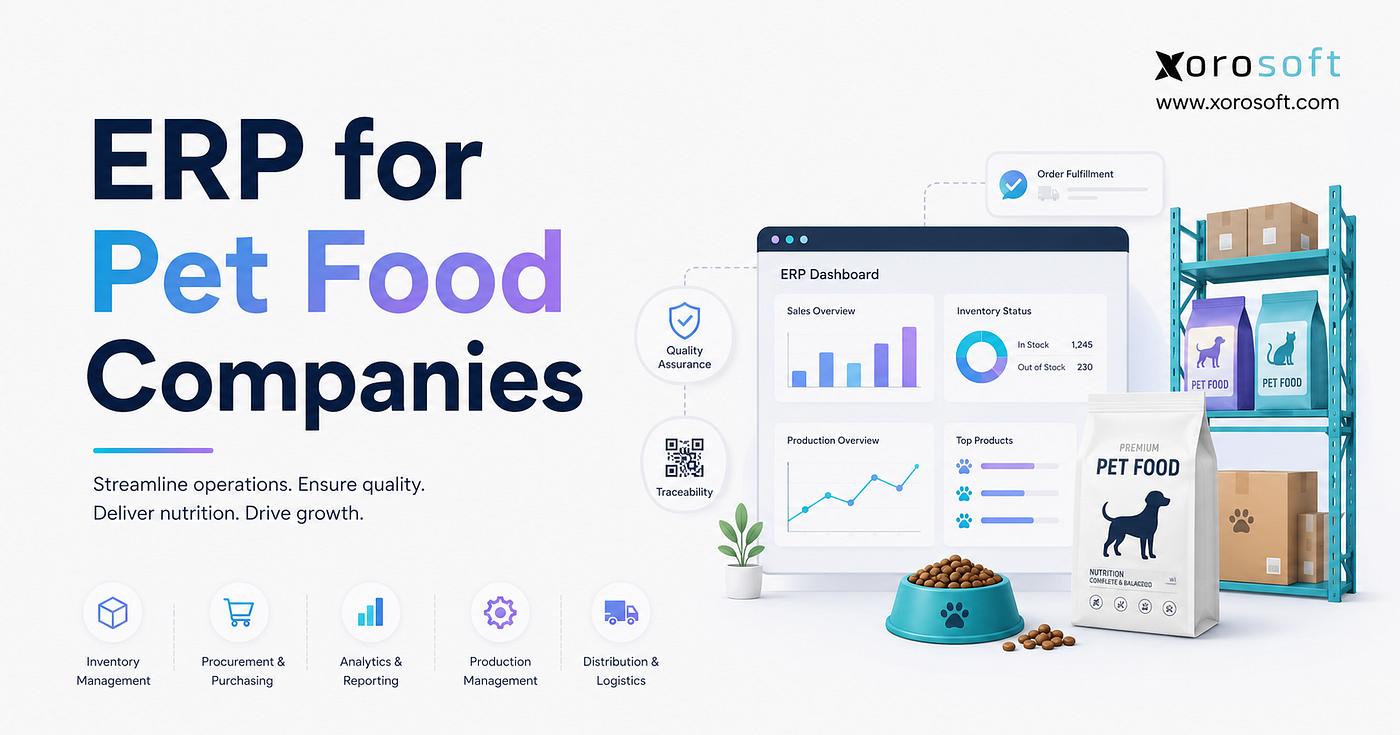
For pet food companies, ERP is the operating system that connects product safety, production control, inventory accuracy, traceability, compliance, fulfillment, and finance.
Pet food is closer to regulated production than simple CPG
Pet food companies operate in a category where trust matters deeply.
Customers are feeding animals they consider family. Retailers want reliable suppliers. Distributors want accurate shipments. Regulators expect safe production and truthful labeling. Internal teams need every formula, batch, ingredient, and finished good to be traceable.
The FDA’s pet food regulation guidance states that pet food must be safe to eat, produced under sanitary conditions, contain no harmful substances, and be truthfully labeled. It also explains that canned pet foods have additional low-acid canned food requirements, and that pet food labeling is regulated both federally and by state laws.
That makes pet food operations different from a simple ecommerce product business.
A pet food brand may still need fast fulfillment, Shopify integrations, Amazon inventory, wholesale orders, and clean accounting. But it also needs production and compliance discipline: ingredients must be controlled, formulas must be versioned, lots must be traceable, labels must match what is produced, and recall records must be accessible.
The ERP decision is not just about efficiency. It is about whether the company can prove what happened.
Growth increases operational pressure
The pet industry is large and still growing.
APPA’s pet industry statistics report $158 billion in U.S. pet industry expenditures in 2025 and project $165 billion in 2026, with pet food and treats projected at $69.7 billion. That growth creates opportunity, but it also raises the operating standard.
Pet food brands are not only selling more. They are often selling through more channels.
A company may start with one DTC website and a co-packer. Then it adds Amazon, independent pet retailers, wholesale distributors, subscription orders, national retail chains, a 3PL, multiple warehouses, private-label production, and promotional packs. Each new channel adds a new layer of inventory, fulfillment, labeling, forecasting, and reporting complexity.
Growth usually exposes the same weak points:
- Formula records live in spreadsheets.
- Lot numbers are tracked manually.
- Expiration dates are visible only in the warehouse.
- Customer service cannot see batch-level order history.
- Finance cannot connect production yield to margin.
- Retailer requirements are managed outside the system.
- Purchasing decisions rely on incomplete ingredient visibility.
- Recall readiness depends on one person knowing where the records are.
A growing pet food company needs more than order volume capacity. It needs operational control.
What pet food ERP should connect
Pet food ERP should connect the workflows that decide whether the company can produce, trace, ship, and account for every product accurately.
At minimum, that includes:
- Ingredient purchasing
- Supplier management
- Formula and recipe control
- Batch production
- Lot tracking
- Expiration and best-by dates
- Quality holds and releases
- Inventory by warehouse and location
- Ecommerce and wholesale orders
- Picking, packing, and shipping
- Returns and replacements
- Recall readiness
- Costing and margin reporting
- Accounting and month-end close
A system like XoroERP is relevant when these workflows need to live in one connected platform instead of across accounting software, spreadsheets, warehouse tools, production files, ecommerce apps, and manual reports.
The goal is not to make every team use one screen for everything. The goal is to make every operational event update the same source of truth.
When production consumes ingredients, inventory should update. When a batch is completed, finished goods should carry the right lot and cost information. When an order ships, the system should know which lot left the warehouse. When a return arrives, the product should not become sellable until its status is clear. When finance closes the month, inventory value should match operational reality.
Formula control is not just an R&D issue
Formulas are the foundation of pet food production.
A formula determines which ingredients go into a product, how much of each ingredient is required, what process is followed, what output is expected, and how cost rolls into finished goods. If formula control is weak, production, purchasing, costing, labeling, and compliance all become harder.
Pet food companies often deal with formulation complexity that grows over time:
- Multiple life-stage products
- Dog, cat, and specialty pet formulas
- Grain-free, limited ingredient, high-protein, fresh, frozen, wet, dry, or treat lines
- Ingredient substitutions
- Nutrient targets
- Packaging variants
- Private-label versions
- Regional or retailer-specific requirements
Formula changes should not happen casually. The system should preserve version history, effective dates, ingredient changes, approval status, and production usage.
If a formula changes but purchasing, labeling, costing, and production do not update together, the business creates risk.
Formula control is not only about making the product correctly. It is about proving which version was made, when it was made, which ingredients were used, and which customers received it.
Lot traceability is the core operating requirement
Lot traceability is one of the most important ERP capabilities for pet food companies.
The business should be able to trace backward from finished goods to ingredient lots and forward from ingredient lots to finished goods, orders, customers, distributors, and warehouse locations.
That matters because pet food issues can move quickly.
A supplier may notify the company about an ingredient concern. A lab result may identify a contamination risk. A retailer may report product complaints. A customer may file a pet food complaint. A batch may need investigation because of odor, packaging defects, foreign material, nutrient issues, or spoilage.
The FDA’s recalls and withdrawals for animal products explain that recalls can be initiated by a firm, requested by FDA, or ordered under statutory authority. When that happens, the company’s ability to identify affected lots quickly becomes critical.
Lot traceability should answer:
- Which ingredient lots were used?
- Which finished goods batches were produced?
- Which warehouse locations stored them?
- Which orders shipped them?
- Which distributors or retailers received them?
- Which units remain on hand?
- Which units were returned, held, destroyed, or corrected?
A company that cannot answer those questions quickly is not ready for recall pressure.
Compliance requires records, not memory
Compliance is not a binder on a shelf. It is a set of operating records created as work happens.
The FSMA Preventive Controls for Animal Food rule requires covered animal-food facilities to follow current good manufacturing practices and establish a food safety system that includes hazard analysis and risk-based preventive controls when needed. The rule also discusses monitoring, corrective actions, verification, recall planning, and supply-chain programs where applicable.
For pet food companies, that means ERP should support the records behind the process.
A system cannot replace food safety expertise. It can, however, make the records easier to create, connect, retrieve, and review.
Useful ERP-supported records may include:
- Supplier approvals
- Ingredient receipts
- Certificates of analysis
- Formula versions
- Batch tickets
- Production yields
- Quality checks
- Cleaning or sanitation records
- Lot genealogy
- Hold and release activity
- Corrective actions
- Recall simulation results
- Shipment history
- Return disposition
When records live in disconnected files, compliance work becomes reactive. When they are created inside the operating workflow, audit readiness becomes much more practical.
Label control is an operational workflow
Pet food labeling is not just a marketing task.
FDA’s animal food labeling and pet food claims guidance explains that federal animal-food labels must include items such as proper product identification, net quantity, manufacturer or distributor information, and ingredient listing. FDA also notes that ingredients must be listed by common or usual name in descending order of predominance by weight.
AAFCO’s pet food labeling requirements further explain that states have legal authority over feed and pet food label review, and that pet food labels include required items such as product name, intended species, quantity statement, ingredient statement, guaranteed analysis, nutritional adequacy statement where applicable, feeding directions, and manufacturer or distributor information.
For operators, the ERP implication is straightforward: formulas, ingredients, labels, packaging, and production must stay aligned.
If a formula changes, does the label need review? If an ingredient source changes, does the ingredient statement remain correct? If a product is reformulated for a life stage, does the nutritional adequacy statement still match? If a private-label product uses a different package, is the right label tied to the right batch?
Label control becomes much easier when ERP connects formula versions, item masters, packaging SKUs, production batches, and approval workflows.
Expiration dates change inventory logic
Pet food inventory is not just counted. It ages.
Expiration dates, best-by dates, freshness windows, and shelf-life rules affect what can be produced, sold, transferred, picked, or discounted. A warehouse may have enough units in total but still lack sellable stock if the available inventory is too close to expiration for a retailer, distributor, or ecommerce promise.
This is especially important for fresh, frozen, refrigerated, raw, wet, specialty, or premium pet food products.
ERP and WMS workflows should support:
- Lot-level expiration dates
- First-expired, first-out picking
- Shelf-life rules by customer or channel
- Inventory holds for aging stock
- Alerts for soon-to-expire inventory
- Transfer recommendations between warehouses
- Discount or liquidation decisions
- Waste and spoilage tracking
A generic inventory system may show that the SKU is available. A pet food ERP should show whether it is available for the right customer, channel, and freshness requirement.
Warehouse execution protects lot and expiry accuracy
Warehouse processes decide whether traceability survives daily operations.
If receiving does not capture the correct lot, the error follows the ingredient into production. If putaway ignores expiration dates, pickers may ship the wrong batch. If returns are restocked without inspection, unavailable product may become sellable. If cycle counts update quantities without lot detail, inventory accuracy becomes superficial.
A connected XoroWMS becomes relevant when pet food brands need warehouse execution tied to lot control, expiration dates, barcode scanning, receiving, putaway, picking, packing, transfers, returns, and cycle counting.
For pet food companies, WMS is not only about shipping faster. It is about preserving product identity as inventory moves.
A strong warehouse process should know:
- Which lot is in which bin
- Which product is closest to expiration
- Which lots are on quality hold
- Which units are reserved for specific customers
- Which product was shipped on each order
- Which returned units are sellable, damaged, expired, or quarantined
Warehouse speed matters. Lot accuracy matters more when trust is at stake.
Costing and margin visibility are harder than they look
Pet food margins can be difficult to manage.
Ingredient costs fluctuate. Packaging costs change. Freight costs rise. Yield loss varies by batch. Co-packer fees may differ by product. Waste, rework, and spoilage may not be captured consistently. Promotions, subscriptions, wholesale pricing, marketplace fees, and distributor discounts can make channel margin difficult to see.
If production and accounting are disconnected, finance often receives the impact late.
A pet food ERP should help connect ingredient cost, production yield, labor, overhead, packaging, freight, finished-goods value, channel pricing, and COGS.
That does not mean every company needs an overly complex cost model on day one. It means the system should create a reliable path from production reality to financial reporting.
Leaders should be able to ask:
- Which SKUs are profitable by channel?
- Which batches had unusual yield loss?
- Which ingredients are driving cost changes?
- Which products create excess waste?
- Which customers or channels consume the most margin?
- Which inventory is at risk of write-off because of expiry?
A good pet food ERP does not just help the company make product. It helps the company understand whether making that product is financially healthy.
Ecommerce and wholesale create different fulfillment pressures
Pet food brands often sell through several models at once.
DTC ecommerce may require small orders, subscription cycles, fast fulfillment, and high customer-service visibility. Wholesale may require case quantities, pallet shipments, distributor rules, EDI, customer-specific pricing, and retailer compliance. Amazon or marketplace demand may require separate inventory logic. Retail chains may demand strict labeling, shelf-life, and shipment documentation.
A system like XoroONE fits the conversation because pet food brands often need omnichannel connectivity, inventory controls, accounting, warehouse management, production, reporting, ecommerce, and EDI in one environment.
The difficulty is not one channel. It is the combination.
A DTC customer may need one case shipped today. A distributor may need a pallet next week. A retailer may require a minimum shelf life on delivery. A subscription customer may expect the same product every month. A wholesale buyer may reserve inventory before production is complete.
ERP should help decide what can be promised, where it should ship from, which lot should be used, and how the transaction affects inventory and accounting.
Pet food ERP varies by business model
Not every pet food company needs the same ERP depth.
A startup selling a small number of shelf-stable treats may need basic inventory, lot tracking, ecommerce integration, and accounting. A frozen raw pet food company may need cold-chain visibility, expiration control, strict warehouse workflows, and recall readiness. A co-manufacturer may need formula versioning, customer-owned formulas, batch scheduling, production costing, quality records, and private-label packaging control.
A wholesale-heavy brand may need EDI, distributor pricing, retailer chargeback tracking, pallet-level shipping, and inventory allocation. A DTC subscription brand may care more about forecast accuracy, subscription cycles, fulfillment speed, and customer-level visibility.
That is why ERP solutions by industry should be evaluated through the specific operating model.
The right ERP is not the one with the longest checklist. It is the one that can handle the company’s highest-risk workflows without forcing teams back into spreadsheets.
Common mistakes pet food companies make
The first mistake is treating lot tracking as optional until a recall happens. By then, the company needs records immediately.
The second mistake is separating formula management from production and labeling. If those workflows drift apart, the product story becomes harder to prove.
The third mistake is relying on spreadsheets for expiration dates. Aging inventory must be visible to purchasing, warehouse, sales, and customer service.
The fourth mistake is choosing ecommerce tools that cannot support batch-level operations. Selling online is only one part of the workflow.
The fifth mistake is ignoring costing until margins feel wrong. Batch yields, waste, ingredient costs, packaging, freight, and channel fees should be visible before finance discovers the problem at month-end.
The sixth mistake is expecting ERP to fix weak processes automatically. Software can support traceability, compliance, and control, but only when the business defines ownership, data standards, approvals, and exception rules.
Frequently asked questions
What is pet food ERP software?
Pet food ERP software is an integrated system for managing formulas, ingredients, batch production, lot tracking, expiration dates, inventory, warehouse operations, ecommerce, wholesale, compliance records, costing, accounting, and reporting. It helps pet food companies connect product safety, production, fulfillment, and finance in one operating system.
Why do pet food companies need ERP?
Pet food companies need ERP when spreadsheets and disconnected tools can no longer support traceability, formula control, expiration management, recalls, warehouse accuracy, production costing, ecommerce orders, wholesale requirements, and accounting. ERP becomes especially important as SKUs, channels, suppliers, warehouses, and regulatory requirements grow.
What ERP features matter most for pet food brands?
The most important features are lot traceability, batch production, formula versioning, ingredient tracking, expiration-date control, quality holds, recall reporting, warehouse management, purchasing, production costing, ecommerce integration, wholesale order management, accounting, and reporting.
How does ERP help with pet food recalls?
ERP helps with recalls by connecting ingredient lots to finished goods, warehouse locations, shipments, customers, distributors, returns, and remaining inventory. This allows the company to identify affected products faster, isolate inventory, support customer communication, and produce recall records more reliably.
Does pet food ERP support FDA and AAFCO requirements?
ERP does not replace regulatory expertise, but it can support the records and workflows needed for compliance. Pet food companies still need to understand FDA, state, and AAFCO-related requirements. ERP can help maintain formula, label, lot, production, supplier, quality, and shipment records.
When should a pet food company upgrade from spreadsheets?
A pet food company should evaluate ERP when lot tracking, formula changes, expiration dates, recalls, production costing, warehouse movements, ecommerce orders, wholesale requirements, or accounting reconciliations become difficult to manage manually. The trigger is usually operational risk, not just revenue size.
Build the batch record before the brand gets bigger
Pet food growth rewards brands that can move quickly.
But it punishes companies that scale without control.
Every new SKU, formula, supplier, channel, warehouse, distributor, and retailer adds another place where the product story can break. The stronger the operating system, the easier it becomes to answer the questions that matter: what was made, what went into it, where it went, what it cost, what label it carried, and whether it can be trusted.
For pet food companies, ERP is not just software for the back office. It is the system that protects the batch promise from ingredient receipt to customer delivery.
For pet food, treat, and animal-food companies that need batch traceability, production control, warehouse execution, ecommerce, wholesale, accounting, and reporting connected, Xorosoft may be relevant as a modern ERP option for inventory-driven businesses. Xorosoft’s food and beverage ERP for batch-driven brands is especially relevant where lot traceability, expiry alerts, production management, costing, compliance reporting, and multi-channel fulfillment need to work together.
If your team wants to review how pet food ERP should support your formulas, lots, expiration dates, warehouse workflows, sales channels, compliance records, and accounting, you can book a personalized Xorosoft demo.
Read the full blog
For the complete original guide, additional examples, and supporting details, read the full article on the Xorosoft blog.
메타데이터
- post_id
- ad1d47a79bdc
- slug
- pet-food-erp-is-really-about-protecting-every-batch-promise-ad1d47a79bdc
- url
- https://medium.com/@Xorosoft_Technologies/pet-food-erp-is-really-about-protecting-every-batch-promise-ad1d47a79bdc
- canonical_url
- https://medium.com/@Xorosoft_Technologies/pet-food-erp-is-really-about-protecting-every-batch-promise-ad1d47a79bdc
- author_url
- https://medium.com/@Xorosoft_Technologies
- status
- ok
- fetched_at
- 2026-08-01 02:16:27