Bridge to Empiria
Bridge to Empiria

Apply the PAL-8 template and anticipate the system — access here: ∞ → PAL-8 Basic Template ← ∞ Identify Region, Resources, Routes, and Networks in seconds
✍️ Apolítik0. Creator of the Palindromic Geopolitical Theory (PGT)
∞ → ← ∞
From Structural Formulation to Systematic Observation
Abstract
With the architectural stabilization of the Palindromic Geopolitical Theory (PGT) and the explicit articulation of its conditions of falsifiability, the phase of conceptual formulation is considered complete. This article does not expand the theoretical framework nor introduce new analytical categories; rather, it declares the methodological transition toward systematic empirical application. From this point onward, the PGT ceases to refine itself structurally and begins to be evaluated through comparative observation of real configurations of global power. The bridge to empiria does not imply automatic verification or anticipatory validation, but deliberate exposure of the model to concrete scenarios under explicit criteria of contrast. The theory does not expand; it submits itself.
∞ → ← ∞
Introduction
The Shift in Intellectual Regime
Every theoretical architecture reaches a decisive moment: the point at which it ceases to consolidate itself internally and begins to confront systematically the reality it seeks to interpret. Following the formulation of its structural axes, the systemic integration of strategic blocs, the formalization of configurational variation through ΔP and δP, and the explicit articulation of its conditions of falsifiability, the Palindromic Geopolitical Theory has reached its conceptual closure.
This point does not mark a dogmatic culmination. It marks a transition.
In its initial phase, the theory required ontological precision and internal coherence. That stage has been completed. The challenge now is not to redefine categories, but to observe how those categories operate when applied to concrete historical scenarios.
The move toward empiria does not imply abandoning structural abstraction. It implies a shift of focus: from conceptual construction to configurational observation. The architecture remains stable; the object of observation varies.
In human terms, this is the moment when a theory ceases to speak primarily about itself and begins to speak in the presence of reality.
∞ → ← ∞
1. Scope of the Empirical Phase
Configurational Observation and Methodological Delimitation
The transition toward the empirical phase does not imply transforming the PGT into a deterministic predictive model or a rigid quantitative scheme. Its objective is not to anticipate specific events, but to observe concrete structural configurations in light of the previously stabilized architecture.
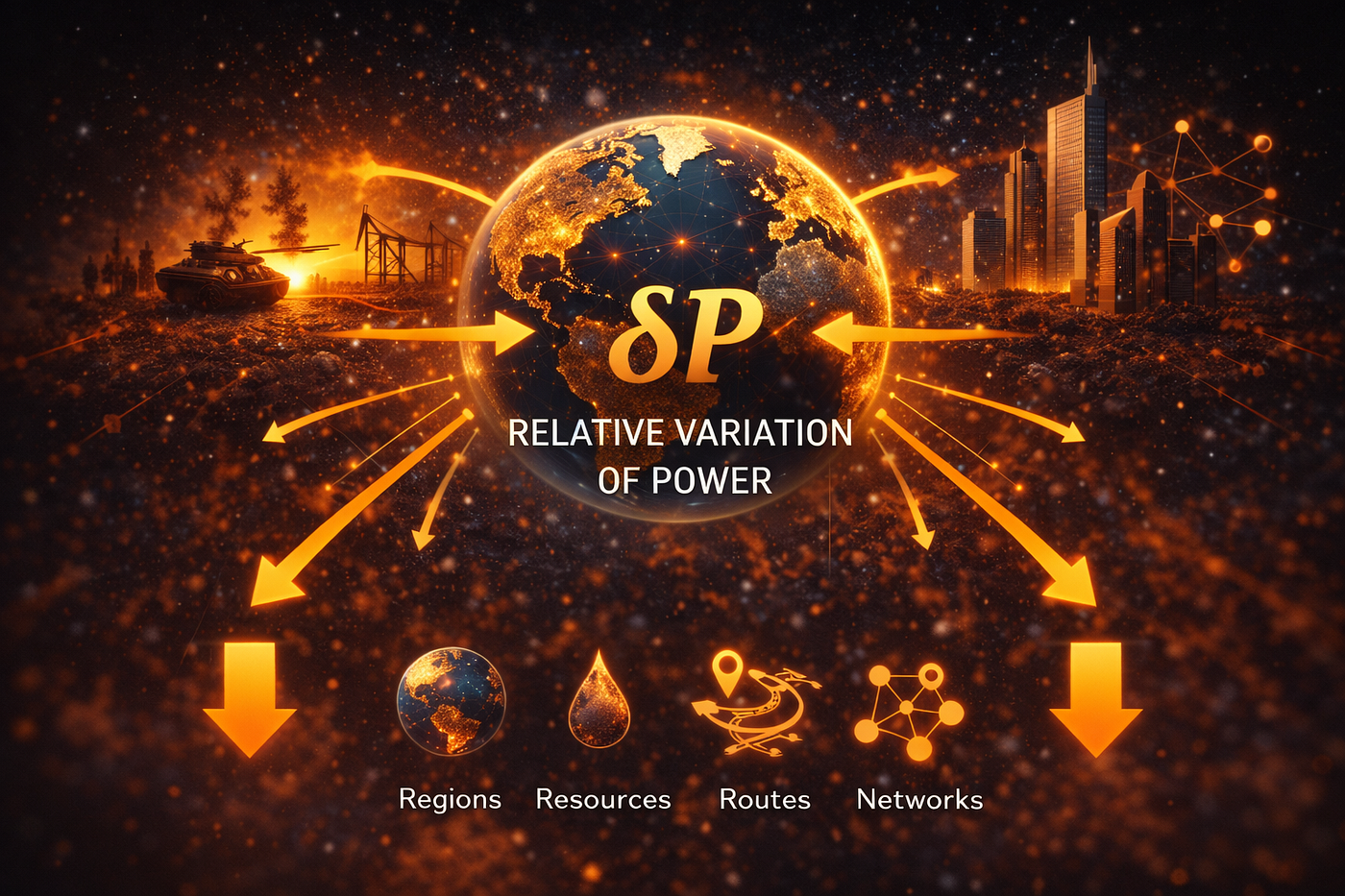
The empirical phase will focus on identifying how, in specific historical contexts, the Global Power Axes — Region, Resources, Routes, and Networks — interact, and how configurational variations (ΔP and δP) manifest in terms of defense, appropriation, saturation, rupture, and reconfiguration. The emphasis will not rest on isolated events, but on discernible structural patterns.
In this sense, empirical observation is oriented toward addressing questions such as:
- Is structural interdependence among the axes verifiable in concrete cases?
- Do configurational variations generate discernible effects on systemic equilibrium?
- Is there evidence of functional reversibility, or conversely, of persistent structural rigidity?
These questions do not seek to confirm the theory automatically. They seek to contrast it under real conditions, recognizing that the outcome may strengthen, refine, or eventually weaken it.
It is important to underscore that the empirical phase does not reopen the conceptual architecture. No new axes or ontological categories will be added to accommodate particular cases. The coherence of the model will depend on its capacity to operate within the limits already established.
The scope of this stage is therefore evaluative and comparative. The PGT does not abandon its structural level of analysis; it applies it. Empiria does not redefine the theory; it tests it.
∞ → ← ∞
2. Criteria of Application and Operational Limits
Coherence Without Expansion
The empirical application of the PGT will not consist in adapting the model to each observed case, but in examining whether cases conform — or do not conform — to the previously stabilized architecture. The theory will not expand to absorb anomalies; its coherence will depend on its capacity to operate within the limits already declared.
Empirical observation will be guided by three fundamental operational criteria:
- Structural consistency: The analysis must explicitly identify interaction among the ERE axes. If a case does not involve significant articulation among Region, Resources, Routes, and Networks, application of the model will be considered inappropriate.
- Scale delimitation: The PGT will be applied exclusively to configurations of regional, interregional, or global scope. Strictly domestic phenomena or sectoral micro-dynamics will fall outside its operational perimeter.
- Distinction between intensity and direction: Empirical interpretation must clearly differentiate between the orientation of displacement (ΔP) and its configurational magnitude (δP), avoiding the reduction of relational variation to mere quantitative measurement or simple positional transition.
These criteria do not constitute new theoretical rules, but methodological safeguards. Their function is to prevent the empirical phase from diluting the structural clarity achieved during conceptual formulation.
Likewise, empirical application does not imply automatic validation. A case that does not fit the model will not be forced within its logic; it may indicate limits of applicability or, in repeated scenarios, call structural premises into question. Coherence requires accepting both outcomes as possible.
The operational phase does not transform the PGT into a closed predictive tool or a normative device. It remains a configurational analytical framework whose strength will depend on its performance in relation to real-world scenarios observed under explicit parameters.
∞ → ← ∞
3. Declaration of Methodological Transition
Conceptual Stability and Observational Openness
With the explicit articulation of its structural limits and conditions of falsifiability, the Palindromic Geopolitical Theory enters a new phase of development. The conceptual architecture remains stabilized; what changes is the regime of observation.
From this point onward, the PGT will not expand through the incorporation of new axes nor through ontological adjustments designed to accommodate particular cases. The consistency of the model will depend on its capacity to operate within the perimeter already defined. Empirical application will not entail conceptual reformulation, but systematic contrast.
At this stage, the configurational dimension of analysis — expressed through the interaction among the ERE axes and the distinction between direction (ΔP) and relational intensity (δP) — will remain the structural criterion of interpretation, without requiring formal exposition of its notational framework in every case. Empirical evaluation will privilege observable relational coherence over advanced technical modeling.
The theory thus ceases to refine itself at the conceptual level and begins to expose itself consistently to the examination of historical reality. Its legitimacy will not depend on the formal complexity of its formulation, but on its capacity to illuminate concrete configurations of global power without altering its architecture.
This bridge does not foreclose the future evolution of the framework; it delimits its present regime. The phase that now begins is empirical and evaluative. The theory no longer expands; it applies.
In palindromic terms, the structure remains. What shifts now is the focus.
∞ → ← ∞
∞ → Based on the Palindromic Geopolitical Theory (PGT), created by Apolítik0. All rights reserved.
✍️ Apolítik0
📖 Discover the full vision in the book: Amazon — Palindromic Geopolitical Theory (PGT) ← ∞
∞ → The Balance decide ← ∞
∞ → ← ∞
**This article is also available in Spanish on my Substack**
∞⟷∞
Official Prompt PAL-8 | PGT
Apply the PAL-8 Protocol of the Palindromic Geopolitical Theory (PGT) to the following case: -CASE-
Develop the analysis according to the following sequence:
- Identification of the strategic node
- Power axes involved (Region, Resources, Routes, and Networks — ERE)
- Actors and capabilities
- Systemic pressure
- Friction or emerging disequilibrium
- Dynamics of control or dispute
- Risk of rupture or escalation
- Prospective scenario of reversibility or stabilization
Maintain a structural, strategic, and replicable approach.
Avoid descriptive or journalistic analysis.
Prioritize systemic logic, power relations, and patterns of strategic reversibility.
메타데이터
- post_id
- ad3bc93592c8
- slug
- bridge-to-empiria-ad3bc93592c8
- url
- https://medium.com/palindromic-geopolitical-theory/bridge-to-empiria-ad3bc93592c8
- canonical_url
- https://medium.com/palindromic-geopolitical-theory/bridge-to-empiria-ad3bc93592c8
- author_url
- https://medium.com/@apolitik0
- status
- ok
- fetched_at
- 2026-06-15 20:49:13