Takes Away The Sin!
Chapter 8: AdlerianPsychology
Takes Away The Sin!
Chapter 8: AdlerianPsychology
“Surely the darkness shall cover me, and the light around me becomes night; the darkness and light are both alike to You.” ~Psalm 139:11–12~
If not a Medium member, click **here** for a free link to the story!
In Section 7: Sin5: “Individual Sin with Communal Sanctification,” I shared a quote from Matthew:
“If your brother or sister sins, go and point out their fault, just between the two of you.” ~Matthew 18:15–20~
What was not spelled out, is what this intervention might look like. So, I invite into the discussion some modern psychological perspectives.
Adlerian Psychology and Erikson’s Psychosocial Stages
The next two sections (10 and 11) apply modern psychology to the issue at hand. This first section is an introduction to Adlerian psychology. Alfred Adler was a student of Sigmund Freud, but broke away from Freud to establish his own concept called Individual Psychology, a holistic approach.
Adler brings a unique perspective to his work as he was raised in a Jewish home but converted to Christianity as an attempt to hide from the Nazis while living in Geneva. That plan didn’t work, so he immigrated to the United States.
Similarly, Erik Erikson was raised in a Jewish home but then married a Christian and converted. Erikson was educated by Freud’s daughter, Anna Freud, who specialized in childhood development. So, both men experienced the Judeo/Christian coin from both sides and perhaps represent the best of both worlds. Let’s see how their perspectives help us understand, a little better, the concept of sin.
Erik Erikson also brings a rather unique perspective. As a light-skinned, blue-eyed Jew (his family of origin, is Danish), he was picked on by Jewish children as being too Nordic, and picked on by Gentile children for being Jewish. So, very much accustomed to oppressive behaviors.
Even though the two gentlemen did not know each other, and with Erik Erikson the younger by about three decades, still, their work overlaps as they share:
- The role of social systems and structures in human development and,
- The importance of the development of a healthy but unique self-esteem, and overcoming feelings of inferiority.
Section 9: Adlerian Psychology(33)(34)
Adlerian Psychology describes four related concepts that kind of explain “everything.”
-
A prime motivator is what he calls Fictional Lifestyles. Fictional Lifestyles are defined explicitly and/or tacitly by social institutions. This comes out of tribal structures, often defining lifestyles that distinguish one tribe from another. A broadly defined lifestyle is inclusive and a narrowly defined one becomes exclusive. The more narrow a lifestyle is, the more outsiders (disenfranchised or sinners) there are. And remember that Jesus, after reading Isaiah 61 ~Luke 4:16–30~ argued that setting “…at liberty those who are oppressed…” applied universally, his audience was “filled with wrath” and tried to “throw him down the cliff.”
-
A second primary motivator is an inborn need to strive for “superiority” which he later called “perfection,” however, both terms are fraught with possible misinterpretation. The best interpretation, in my opinion, is the development of a unique ideal self with a full sense of competence. This involves a sequence:
- To be seen and accepted without judgment,
- To belong and be fully incorporated into a supportive social group,
- To develop a unique set of skills making up a competence,
- Which is used to contribute to the welfare of the social group (love your neighbor)
- And finally, to feel appreciated.
“…the most fundamental and undeniable principle of mental health — [is] that each individual must develop an interest in the welfare of others. ‘There is a law,’ he [Adler] remarked, ‘that man should love his neighbor.’” “…to Adler, neuroses resulted from an unhealthy focus on perceived inferiorities [low self esteem] and mistaken ideas of superiority [fragile self esteem].”
- These “perceived inferiorities” are the result of experiencing trauma, especially in childhood, resulting in three neurotic Personality Types:
- Ruling Type (The bully)
- Leaning Type (Dependent on the bully)
- Avoiding Type (Disengaging from life)
And a fourth personality type representing the ideal and healthy person, where such traumas are avoided or overcome, possibly through therapy.
- Socially Useful Type (Competent enough to stand up to the bully)
- Socratic-style therapy.
The counseling technique is Socratic-style questioning which teases out the patient’s belief system (affected by fictional lifestyles) and how these beliefs may or may not support the inner drive to be socially useful — love of neighbor.
Enough with the overview, let’s dig a little deeper.
Fictional Lifestyles
The source of motivation, in Adler’s view, is a vision of a “fictional lifestyle,” meaning a particular world view — one classic American fictional lifestyle, that many people seem to long for, shaped in the 1950s, was:
- Getting married,
- Having two children (one boy and one girl, in that order, of course),
- Living in a house with a white picket fence, a dog and a cat,
- The wife staying at home, as the homemaker, (ostensibly to free up jobs for returning soldiers) and
- The husband venturing off to the workplace as the provider —
This dream was heavily fictionalized during the 1950s with government supported films shown in schools — and generally symbolized by the TV series “Father Knows Best.” What was driving this lifestyle was to “normalize” the country following World War II, but to also differentiate the United States from the rest of the world, especially the Godless communists.

Christian Flag and USA Flag
Of course, this dream, this fictional lifestyle, really didn’t happen, mainly because life just isn’t all that simple. But one of the things it did do was that it made going to church a patriotic thing, and American flags started, with some controversy, showing up in church sanctuaries.
Currently the fictional lifestyle that is most prominently being promoted is the various expressions of Christian Nationalism, the most concerning being the Seven Mountain Mandate, which has the ear of our president through Paula White-Cain currently his Senior Advisor and Faith Director.
Christian Nationalism is characterized by(35):
- Freedom for…straight, white, “Christian” men.
- Order for everyone else: women, people of color and queer people.
- Righteous violence for anyone who steps out of line (law and order when possible, vigilante violence if not).
So, when society forces upon us unrealistic fictional lifestyles, that only fits (or barely fits) a narrow slice of society, we are actually creating “sinners,” out of those who do not fit in. Thus an increase in Adler’s dysfunctional personality types: Ruling, Leaning, and Avoiding and the persecution of the Socially Useful, demonized as socialists, communists and so on.
“For when we were in the realm of the flesh, the sinful passions aroused by the law were at work in us, so that we bore fruit for death. But now, by dying to what once bound us, we have been released from the law [the law’s narrow expectations] so that we serve in the new way of the Spirit, and not in the old way of the written code.” ~Romans 7:5–6~
Personality types
Adler defines four personality types which are identified based on different levels of energy. The first three are thought to be genetic predispositions affected by abusive, neglectful, pampered, or overburdened (illness, lack of education, poverty, and so forth) childhoods — resulting in low self esteem. The fourth being an ideal healthy personality. These are similar to four personality types proposed by the ancient Greeks — Choleric (bad tempered), phlegmatic (unemotional), melancholy (sad), and Sanguine (optimistic), with their four bodily fluids called humors — hot, cold, wet and dry.
- Ruling type: (Choleric-hot and dry)
- This is the most energetic. Within this category, the more energetic are the bullies, always angry, hurting others.
- The lesser energetic within this category, are sadists, hurting others by hurting themselves — including suicide.
2. Leaning type or dependent type: (Phlegmatic-cold and wet)
- This type has middle energy and becomes dependent on others, perhaps dependent on the ruling types.
- Can develop “…neurotic symptoms: phobias, obsessions and compulsions, general anxiety, hysteria, amnesias, and so on, depending on individual details of their lifestyle.”
3. Avoiding type: (Melancholy-cold and dry)
- Low energy.
- Survive by avoiding responsibility (especially other people).
- Can “…become psychotic, retreating finally into their own personal worlds.”
4. Socially Useful type: (Sanguine-warm and moist)
- High energy.
- However, the energy is focused on social interest — love of neighbors.
- Psychologically healthy.
As you will see, these personality types emerge during the fourth stage in Erikson’s eight Psychosocial Stages, Inferiority vs. Industry, ages six to 11 where the virtue of Competence is developed — the striving for “superiority.”
Striving for “superiority”
To Adler, the singular human motivator is the striving for “superiority,” later preferring to use the term “perfection,” which is the desire to achieve full potential, to come closer and closer to a unique ideal self, a full sense of competence, in order to contribute to social good and feel appreciated.
“The only individuals who can really meet and master the problems of life…are those who show in their striving a tendency to enrich everyone else.” ~Alfred Adler, “What Life Could Mean to You”~
“Be perfect, therefore, as your heavenly Father is perfect.” ~Matthew 5:48~
This striving for an ideal sense of competence, implies working against resistance, where too much or too little resistance inhibits growth. A seed planted too deep, cannot overcome the resistance of the soil, whereas a seed planted too shallow, suffers from the drying heat of the hot sun. ~Matthew 13:3–9~
As children and adults we need to learn how to navigate resistance imposed upon us, and to also know when we need to “up the game,” ourselves.
But the development of competence cannot happen in isolation, it needs to happen within a community, where mutual respect is essential. ~Matthew 7:12~ ~Luke 6:31~
One of the controversies that I’ve already mentioned is the words “superiority” and “perfection” as these concepts are tied in with “perfectionism” which is a psychological dysfunction. Personally, I would use the term “assertiveness” as discussed in Yetzer Harah, our assertive inclinations; and Yetzer Hatov, our altruistic inclinations:
Assertive <**Abundant Life> Altruistic**
Assertiveness in the striving for Perfection tempered by the altruistic goal of contributing to social good — love of neighbor. This combination could also be called having (psychological) Agency — the ability to initiate and control our actions.
Converting the above combination using Adlerian language it would look like this:
Perfection <Abundant Life> Social Good
To put things into perspective, my wife and I have the privilege of getting to know a woman, who is both physically and mentally challenged. She cannot drive, and needs the assistance of a walker, so is dependent on public transit and getting rides from people she knows and trusts, like us. What we have learned about her is that she is totally focused on contributing to her larger community — including the town she lives in. She has total agency in arranging how to get to her destinations on time, how to manage her eating schedule, and so on. When asked, she has events scheduled at least a month in advance. Including, we just learned, volunteering in support of a community bicycle race.
Five goals of striving
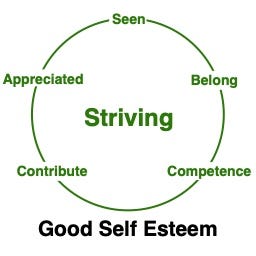
Five goals of striving. Graphic by Gary L. Engstrom
According to Adlerian Psychology, regardless of personality type described above (the first three distorted by experiencing abuse) deep within is a striving to achieve the following five basic life goals(35):
- To be seen and connect with others, without judgment.
- To belong, within a supportive community.
- To contribute positively to society’s welfare — “love your neighbor” — with a need for empathy, within healthy boundaries.
- All this in order to feel appreciated, essential for the development of self esteem.
And, in order to contribute the individual needs to strive toward:
- A sense of competence, that is to overcome perceived feelings of inferiority and to achieve personal growth and mastery — again developing self esteem.
And, remember, a good self esteem (a healthy ego) is essential for one to become humble, the precursor for developing a healthy sense of empathy.
Adlerian Therapy
What Adlerian therapy does is, through Socratic-style questioning, the counselor teases out the individual’s subliminal fictional lifestyle and then asks how that lifestyle contributes, or not, to the individual’s striving to achieve these five goals — being seen, belonging, contributing, feeling appreciated, and achieving a sense of good self esteem. Gradually the lifestyle starts to merge with the five goals, and healing begins.
So, the question is, “How can we, as individuals or a community, walk along with others, enabling them to achieve their own particular unique lifestyle that will help them reach the goal of contributing positively to the welfare of society?” — “loving neighbor.”
While we may not be professional councilors, we can learn to have intentional conversations by developing active listening skills(36).
In the Preface of this treaties I made reference to a young man returning to his home town from prison, opening a shoe repair shop. What if, instead of isolating and banishing him, the community had “intentional conversations with him, and showed appreciation for his contribution to the community? I often think about him and what his life journey turned out to be.
Competence and Erikson’s Psychosocial Stages

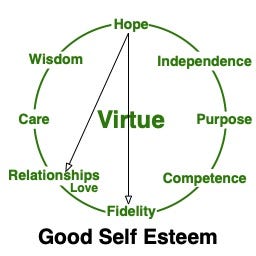
Interconnections of Virtue. Graphic by Gary L. Engstrom
Professional counseling is certainly important, however, prevention is much more effective than treatment. The key, according to Adler, is the development of Competence, Erik Erikson’s fourth stage (age 6–11), and the ability to contribute positively to the community in significant ways during our most productive years (Care), ages 40–65, Erikson’s seventh stage of development. These stages are discussed next in Section 11, “Erikson’s Eight Psychosocial Stages.”
✢ ✢ ✢
The next day John saw Jesus coming toward him and said, “Look, the Lamb of God, who takes away the sin of the world! ~John 1:29~
Gary L. Engstrom, a science guy, and author of “Living the Beatitudes: The Way to a Most Excellent Life.”
“Takes Away the Sin!: What if Sin Is Really A Blessing” Series:
(1) Sin as a Redemptive Blessing (2–3) Original Sin or Situational Sin (4) Demons/Fallen Angels (5–6) Blood Sacrifice or Communal Sanctification (7) Unity of Opposites (Plus) (8) Adlerian Psychology (9) Erikson’s Eight Psychosocial Stages (10) Unity of Thinking (11) “Ideal” Personal Food Laws (12) Epilogue
Book suggestions:
- “The Courage to Be Disliked” by Ichiro Kishimi and Fumitake Koga: Presented as a dialogue between a philosopher and a young man, this international bestseller breaks down complex Adlerian ideas into a clear, engaging conversation.
- “The Courage to Be Happy” by Ichiro Kishimi and Fumitake Koga: A sequel to The Courage to Be Disliked, this book continues the dialogue to help readers apply Adler’s teachings in their daily lives to find true happiness.
- “A Primer of Adlerian Psychology” by Harold Mosak and Michael Maniacci: This book is a straightforward and comprehensive overview of Adlerian psychology. It combines theoretical grounding with practical applications.
Part 6 Citations:
(33) Vision article, “A Psychology of Change,” (2011) by Gina Stepp. (34) Web Space article, “Alfred Adler,” by C. George Boeree. (35) UC Berkley Social Science Matrix article, “The Flag and the Cross: White Christian Nationalism and the Threat to Democracy,” (2023) by Phil Gorski. (36) Very Well Mind article: “7 Active Listening Techniques For Better Communication,” (2024) by Arlin Cuncic.
Refer also to:
Reasoned cases for Christ article, “The 7 Mountain Mandate: A Critical Examination in Light of God’s Holy Word,” (2024) by Bruce Cooper. The Conversation article, “What is the ‘Seven Mountains Mandate’ and how is it linked to political extremism in the US?,” (2025) by Art Jipson.
메타데이터
- post_id
- ad40ca55fdb9
- slug
- takes-away-the-sin-ad40ca55fdb9
- url
- https://medium.com/@garyengstrom_72732/takes-away-the-sin-ad40ca55fdb9
- canonical_url
- https://medium.com/@garyengstrom_72732/takes-away-the-sin-ad40ca55fdb9
- author_url
- https://medium.com/@garyengstrom_72732
- status
- ok
- fetched_at
- 2026-07-31 23:37:08