Return to the Soil’s Memory: Why the Farms of the Future Are Built on Our Grandfathers’ Diaries
I belong to a generation of kids exiled to their grandparents’ villages for the summer, double-serving as a way for parents to buy a few…
Return to the Soil’s Memory: Why the Farms of the Future Are Built on Our Grandfathers’ Diaries
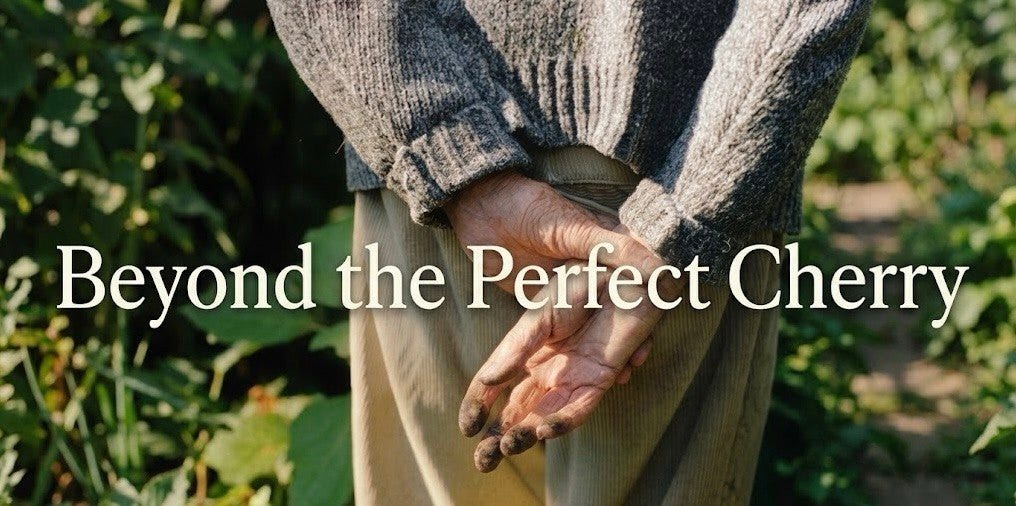
I belong to a generation of kids exiled to their grandparents’ villages for the summer, double-serving as a way for parents to buy a few months of peace and a crash course in the fundamental laws of reality. A lesson that cherries don’t just materialize inside plastic clamshells, and that a crisp, perfect french fry is a product that has traveled an enormous, exhausting road before landing on your tray.
If in childhood it seemed that village holidays, feeding the livestock, weeding the beds, watering the dry earth, were some elaborate form of punishment by labor, today the understanding arrives with full clarity: this was how we received basic, fundamental knowledge of the land. Knowledge that now, under the noise of social feeds, is all but lost. It has been washed away by the digital current, and it will hardly be easy to find again.
But can we renounce technology in the twenty-first century? Of course not. That kind of radicalism today would be equal to shooting yourself in the foot in the middle of the Sahara, one meter from a saving oasis. Yet we have just as little right to renounce the old knowledge nature has accumulated about itself — that deep feeling for the land and the ability to touch reality with your own hands.
As a myth-loving species, we have fed for too long on the industrial-age fantasy of linear progress. Today, we are fractured into two camps: those who blindly reject innovation in a desperate cling to a pastoral past, and those recklessly drunk on the triumph of automation. Yet both sides are trapped in an optical illusion. The truth requires far more than passive observation. The real challenge of our era is to reclaim what was lost, to build a bridge between ancient wisdom and the technological edge of the new century.
The Narrative Architecture of the Field, and the Lessons of Jacob van den Borne
These were exactly the questions I was turning over as I stood on the field of one of the most advanced modern farms in the Netherlands. The charismatic Dutch farmer-visionary Jacob van den Borne shows, plainly and visibly, the dead end that blind faith in the industrial template leads to. Humanity has treated the land for far too long as a mute substrate, something to be mindlessly flooded with universal chemistry for the sake of squeezing out a profit margin, or, no less sadly, buried under tons of bureaucratic reports and office regulations. Isn’t this precisely where we fell into a colossal knowledge gap — a mental chasm where we unlearned how to listen?
If the drive to Jacob’s farm feels like a stretch for now, you can always tune into his talk, “How to create the farms of the future | Jacob van den Borne | TEDxEindhoven”. He breaks down his own breakthroughs from the moment he first rigged his potato harvesters with yield sensors and digital mapping. And since people have an appetite for facts, here is a bit of raw data: across different spots of the exact same field, yields swung from 30 to 80 tons per hectare. The earth delivered this insane spread because every meter of soil has a personality — its own hidden topography scars, water table, and the storage capacity of what Jacob terms the subsoil ‘battery.’
Nitrogen sensors, biomass scanners, and satellite maps are all woven into the fabric of a deep narrative architecture. They act as translators, turning the century-old, faint whisper of exhausted soil into a language of data a modern mind can understand, giving the earth back its right to be heard.
The ultimate paradox is this: we needed space satellites and terabytes of data just to recover the depth of context that Jacob’s grandfather, my grandfather, or yours held intuitively. For them, a paper journal was plenty — handwriting the story of their fields every single night. None of this implies that automation is a failure. It absolutely works. Investing in GPS navigation slashes field overlap from 12% to a mere 1% and pays for itself within three months. But these technologies only begin to bear real fruit when they are backed by a deeper rooted wisdom.
Sovereignty as the Protection of Old Knowledge
Back in 1924, the Austrian thinker Rudolf Steiner, noticing the first signs of European soil degradation from synthetic fertilizers, formulated a manifesto: a farm is not a factory — it is a closed living organism. Today, the defense of this organism has outgrown the realm of pure ecology and risen to the level of national security.
In this century, true national sovereignty runs deeper than military hardware, geopolitical posturing, or digital independence. It is the uncompromising guardianship of the ancient, core knowledge of your land, seamlessly mapped onto the sharpest technological edge of the age.
Where people have unlearned how to feed themselves, where they dismantle their own agrarian microbiome and forget how to handle the soil, they automatically forfeit their future. The contemporary American farmer and essayist Chris Newman rightly points out that the traditional societies of the past were never passive observers; they managed their landscapes assertively, at scale, and systematically, relying on an intimate, deep-rooted knowledge of their ecosystems.
Sovereignty today is the capacity to take this time-tested wisdom, shield it from being flattened into anonymity by global agribusiness, and carefully weave it into the algorithms of autonomous systems. This is precisely what van der Borne did. When state regulations and bureaucracy drove drone operations into a dead end, he didn’t waste time fighting the system. Instead, he found an elegant loophole within the rules and opened the country’s first official, private drone airport — right on the grounds of his own farm.
Against the “Blissful Reality”: A Battle for Sanity
But how do you protect this knowledge if there is no one to pass it to? Here we run into the main existential threat, and it doesn’t even lie in the plane of climate change. The real trouble is elsewhere: the coming generation is growing up inside a total, sterile illusion.
The blissful reality of the feeds, where perfect products soundlessly materialize out of couriers’ thermal bags, has thoroughly fooled an enormous number of people. We have reached the point where people are sincerely convinced that milk comes from the supermarket fridge, and that farming is either a filthy medieval relic or a romantic picnic against a backdrop of lavender fields. This mental infantilism has nothing to do with reality.
The actual reality, the one glossy blogs are ashamed to show — is built hard. It is heavy, highly intellectual work, where you are required to be, all at once, the farmer scattering poop across the field, a microbiologist, an engineer, an IT specialist and a visionary in a single bottle. Between this reality and the generation of swipes, a deaf wall of sleek plastic has grown up. If we don’t embed modern technology into education in a way that restores to zoomers and Gen Alpha a basic respect for physical labor and for the soil — the next generation will find itself utterly helpless at the first serious storm. They will simply stand paralyzed by hunger in front of empty delivery lockers when the servers behind them go down.
This is why something has to change fundamentally, and now. And yes, this is why leading farmers are opening their own Academies, and top television hosts are abandoning stuffy metropolitan studios, moving out to the countryside, setting up farms, and gathering millions of people in front of their screens. This is not downshifting or sentimental drivel about ecology — it is an appeal to sanity, a chance to preserve that very sovereignty which begins not in government offices, but in people’s heads.
Which is precisely why I feel compelled to write about this relentlessly, hitting as hard as possible, before the digital debris suffocates us for good.
메타데이터
- post_id
- ad4d5cb6b9c7
- slug
- return-to-the-soils-memory-why-the-farms-of-the-future-are-built-on-our-grandfathers-diaries-ad4d5cb6b9c7
- url
- https://medium.com/@teterina.bgs/return-to-the-soils-memory-why-the-farms-of-the-future-are-built-on-our-grandfathers-diaries-ad4d5cb6b9c7
- canonical_url
- https://medium.com/@teterina.bgs/return-to-the-soils-memory-why-the-farms-of-the-future-are-built-on-our-grandfathers-diaries-ad4d5cb6b9c7
- author_url
- https://medium.com/@teterina.bgs
- status
- ok
- fetched_at
- 2026-07-08 20:12:56




