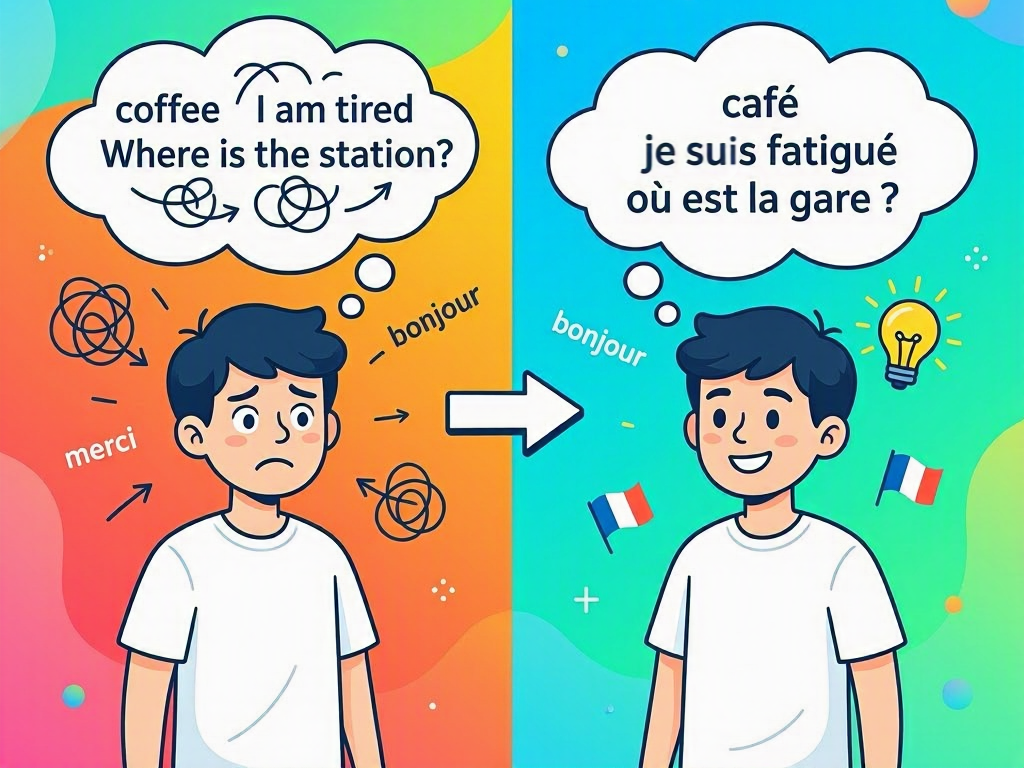
🧠 How to Build Simple French Sentences (Without Translating in Your Head)
You know French words.
🧠 How to Build Simple French Sentences (Without Translating in Your Head)

You know French words.
You know some verbs.
Maybe even a few adjectives.
But when you try to speak… your brain freezes.
Why?
Because you’re trying to translate from English.
In this guide, you’ll learn how to build simple French sentences naturally — step by step.
🔹 The Biggest Mistake Beginners Make
Most learners think like this:
“How do I say this in French?”
So they translate:
I am eating a red apple → Je suis manger une pomme rouge ❌
That’s wrong.
Instead, you need to think:
Subject → Verb → Object
🔹 Step 1: The Core Formula
Every simple French sentence follows this:
Subject + Verb + Object
Examples:
- Je mange une pomme.
- Tu regardes un film.
- Il aime le café.
That’s it. That’s your foundation.
🔹 Step 2: Add Adjectives (Now Your French Comes Alive)
You already learned adjectives — now use them.
👉 In French, adjectives usually come after the noun.
Examples:
- Je mange une pomme rouge.
- Elle a une maison grande.
- Il boit un café chaud.
Now your sentences sound more natural.
🔹 Step 3: Add Time (When?)
Add simple time expressions at the beginning or end.
Examples:
- Aujourd’hui, je travaille.
- Je mange à 8h.
- Demain, nous partons.
🔹 Step 4: Add Place (Where?)
Add location using à, dans, chez.
Examples:
- Je mange à la maison.
- Elle travaille dans un bureau.
- Je vais chez un ami.
🔹 Step 5: Combine Everything
Now stack your sentence:
Subject + Verb + Object + Place + Time
Example:
Je mange une pomme rouge à la maison aujourd’hui.
Another:
Elle regarde un film intéressant chez elle ce soir.
🔹 Step 6: Stop Translating (Important)
Instead of thinking:
“How do I say this in French?”
Think:
“What is the simplest sentence I can build?”
Example:
Instead of:
I am going to quickly eat a delicious meal at my friend’s house tonight
Start with:
Je mange chez mon ami ce soir.
Keep it simple. Build gradually.
🔹 10 Simple Sentence Patterns You Can Use Today
Use these daily:
- Je mange __
- Je bois __
- Je vais à __
- J’aime __
- Je regarde __
- Je fais __
- Je veux __
- Je suis __
- J’ai __
- Je travaille à __
Example:
Je bois un café chaud. J’ai une petite maison. Je suis fatigué.
🔹 Mini Practice (Try This)
Turn these into French:
- I eat a good meal
- I watch an interesting movie
- I am tired today
- I have a small house
- I drink cold water
(Answers)
- Je mange un bon repas
- Je regarde un film intéressant
- Je suis fatigué aujourd’hui
- J’ai une petite maison
- Je bois de l’eau froide
🔹 Final Advice
Fluency doesn’t come from knowing more words.
It comes from building more sentences.
Start with:
- Short sentences
- Simple structures
- Real daily situations
And most importantly:
👉 Don’t translate. Build.
메타데이터
- post_id
- ad5bba840c8f
- slug
- how-to-build-simple-french-sentences-without-translating-in-your-head-ad5bba840c8f
- url
- https://medium.com/@bhannusna/how-to-build-simple-french-sentences-without-translating-in-your-head-ad5bba840c8f
- canonical_url
- https://medium.com/@bhannusna/how-to-build-simple-french-sentences-without-translating-in-your-head-ad5bba840c8f
- author_url
- https://medium.com/@bhannusna
- status
- ok
- fetched_at
- 2026-08-03 00:32:08