I Used 8 AI Tools during my DEVCON Internship, and Still Believe Humans Win
Allyza’s DEVCON Jumpstart Internship Experience — Part 3 of 3
I Used 8 AI Tools during my DEVCON Internship, and Still Believe Humans Win
Allyza’s DEVCON Jumpstart Internship Experience — Part 3 of 3

By now, you know the stats. Allyza. BS IT from FEU Tech. Project Management track. The person who chose PM because it felt like a safe “home base,” then spent 520 hours getting dragged — sometimes kicking and screaming — into the deep end of technical innovation.
I walked into DEVCON as a project manager. I’m walking out as a hybrid: part developer, part roboticist, and full-time adaptive leader. The PM instincts didn’t die; they just got a massive hardware upgrade.
But let’s talk about the elephant in the server room. The question everyone asks when they see an intern shipping production-grade AI agents: “Will AI take your job?”
After building with eight different AI tools across every facet of this internship, I have a real answer. No. But the person who refuses to use them will.
The “Cyborg” Toolkit: What I Actually Shipped
“It is not the strongest who survive, but those most responsive to change.” — Charles Darwin
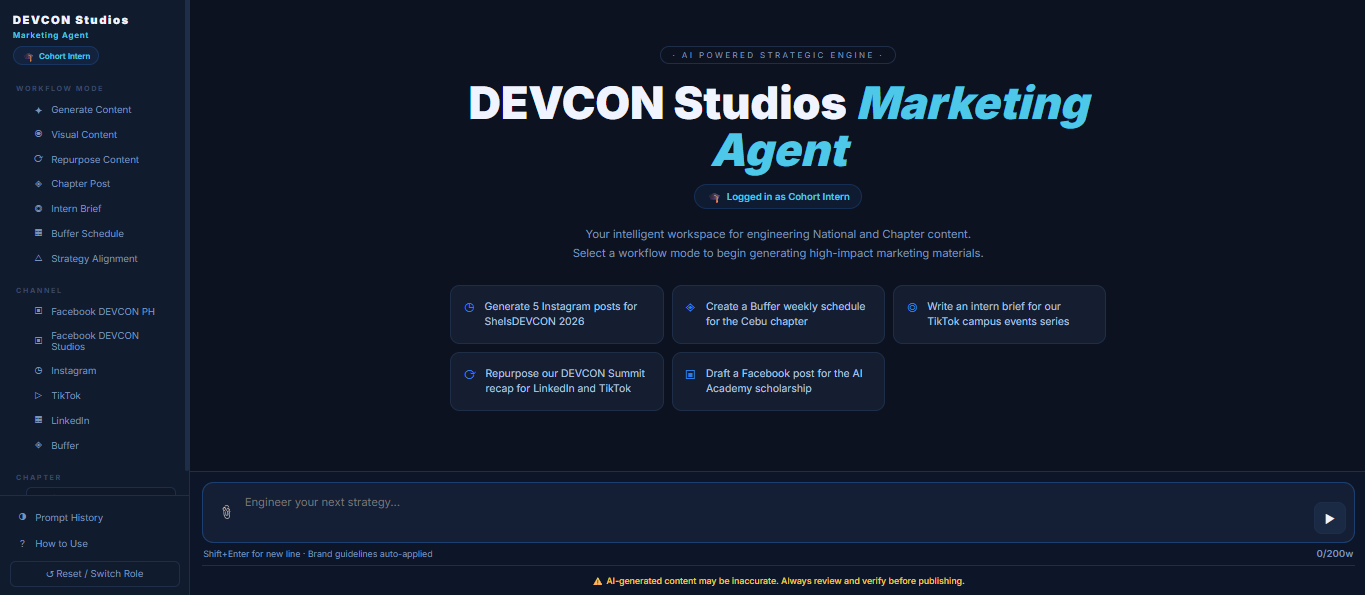
These weren’t toys. These were my primary development partners. Over 520 hours, I integrated a stack that allowed me to do the work of a five-person team:
Claude Code Snippet: How it Works thru VSCode
Claude/Claude Code:
- What it is: A sophisticated Large Language Model (LLM) designed for deep reasoning and complex coding tasks. Unlike basic chatbots, Claude Code integrates directly into your terminal or VS Code to act as a real-time engineer.
- How I used it: This was my primary pairing partner for developing the Marketing AI Agent. Instead of just asking for “snippets,” I used it to debate logic gates and security injection detectors. We spent late nights refining the agent’s architecture, ensuring that it wasn’t just functional, but production-grade and secure.

Using HeyGen for Women’s Month Cybersecurity Videos
HeyGen
- What it is: An AI video generation platform that specializes in “talking head” avatars and seamless video translation. It can take a text script and turn it into a high-quality video of a person speaking naturally. How I used it: I utilized HeyGen for our Women’s Month Cybersecurity series. It allowed us to create professional, localized video content at a speed that traditional filming couldn’t touch. We were able to reach DEVCON’s global chapters instantly by generating video assets in a fraction of the time it would take to edit them manually.

A snapshot of my first attempt of using Higgsfield
Higgsfield
- What it is: A cutting-edge AI video model built for social creators that specializes in realistic motion and high-fidelity “text-to-video” generation.
- How I used it: This was my go-to for dynamic AI video production. I used it to turn static concepts into social-ready content. It allowed me to experiment with cinematic scenes and motion that would have traditionally required a massive production budget or a professional film crew, giving our event promos a high-end feel.

My own NotebookLM for SHEisDEVCON Planning 2026
NotebookLM
- What it is: A personalized AI research assistant by Google that uses your own uploaded documents to create a “source-grounded” intelligence. It doesn’t hallucinate because it only answers based on the PDFs and links you give it.
- How I used it: This was my R&D brain. I fed it mountains of technical documentation for all major tasks in DEVCON. It synthesized thousands of words of documentation into actionable insights and study guides, allowing me to easily generate reports, data insights, videos, infographics, mind maps, and more to aid my entire DEVCON journey.

My 1st Caffeine AI Project
Caffeine AI
- What it is: An AI-powered design and workflow tool specifically built for rapid prototyping and bridging the gap between design and development.
- How I used it: This was central to our rapid design workflows for the Caffeine AI Hackathon. It helped me translate my “Project Manager vision” into an “Engineer’s execution.” It allowed us to move from a brainstormed idea to a visual asset in minutes, which was crucial when managing a high-stakes event for 300+ people.

How I Used Google Stitch to Improve my Personal Project
Google Stitch
- What it is: An AI-powered tool for generating and refining UI/UX designs by “stitching” together components, layouts, and interaction flows into cohesive interfaces.
- How I used it: I used Stitch to rapidly prototype and iterate on user interfaces for my internship projects. Instead of building screens from scratch, I leveraged AI-assisted layout generation and component stitching to create consistent, user-friendly designs. This helped me focus more on user flow and functionality, while still producing polished, high-fidelity mockups that clearly communicated my ideas to mentors.

Using ChatGPT to generate and separate assets
ChatGPT
- What it is: The world’s most versatile “Swiss Army Knife” AI, capable of everything from data analysis to creative writing and asset organization. How I used it: I used ChatGPT for the operational heavy lifting. This included everything from generating and separating assets for our design team to drafting crystal-clear, empathetic communication for 300+ attendees. When the room was bursting at the seams, ChatGPT helped me draft real-time updates for participants within seconds.
Eight tools. But here’s the kicker: in every single instance, I was the bottleneck. Not the AI. The tools were ready to go at 100 mph, but they required a human to define the goal, vet the ethics, and make the final “Merge to Main” call.
Why the Human Wins (An Anecdote from the Front Lines)
“The human capacity for empathy, creativity, and ethical judgment cannot be automated.” — Yuval Noah Harari


The moment I truly realized AI’s limits wasn’t behind a screen; it was at the Caffeine AI Hackathon. We planned for 150 people. Over 300 showed up.
There is no prompt you can write to manage a room that is literally bursting at the seams. No model can “read the room” when the food is running low and attendees are constantly asking you time-sensitive questions. That was me. That was human judgment under high-stakes pressure. I had to improvise, empathize with frustrated participants, and pivot our logistics in real-time.
As an ENTP-T, my “Turbulent” side is usually my biggest critic, but in that chaos, it became my greatest asset. That second-guessing and self-doubt? That’s actually Quality Control. AI doesn’t worry if an event is “good enough” or if a participant feels heard. I do. And in the future economy, caring is a competitive advantage.
The Mirror and the Stage: Breaking the Imposter Cycle

That’s me, the girl wearing pink amongst a Google AI Event with 70% men attending!
“Vulnerability is not weakness. It is our greatest measure of courage.” — Brené Brown

Featured by Ms. Shumate Royo during the DIWA Cohort Awarding
For a long time, I viewed “Authority” as a wall. When I sat across from leaders like Ms. Shumate Royo (former ED of DEVCON PH), I didn’t just feel small , I felt like I was trespassing in a world where I didn’t belong. I saw successful women in the industry as finished products, forgetting that they once stood exactly where I am standing: in the middle of the mess, wondering if they’d ever find their footing.
But Ms. Shumate changed my entire perspective on what a mentor is. She didn’t just give me advice; she gave me a mirror. She showed me that the uncertainty I was feeling wasn’t a sign of weakness, but a growing pain. She taught me that I shouldn’t be afraid of authority; instead, I should look at leaders and realize that I am looking at a future version of myself. That shift was tectonic. It turned my fear into a roadmap, and now, when I’m in a room full of experts, I don’t think, “What am I doing here?” I think, “I’m taking notes for when it’s my turn to lead.”

The 8 girls in ICT picked for the LIWANAG Cohort 1
Being part of the LIWANAG Cohort has been the most humbling “receipt” of my career so far. Being handpicked from a nationwide pool of applicants wasn’t just a win for my resume; it was a loud validation of my potential. Through the DIWA program, I’ve been given a seat at the table in high-level mentorship talks and major tech events — spaces that can often feel isolating for a woman in a male-dominated field. This cohort taught me that we aren’t just individual success stories; we are an ecosystem of women lifting each other up. I realize now that the investment my mentors make in me today is a seed. One day, I won’t be the one seeking guidance; I’ll be the one sitting on the other side of the table, looking at a student just like I was and saying, “Yes, you can do this.”
None of this would have been possible without the platform to test these lessons, and for that, I am eternally grateful that DEVCON gave me this stage. Before this internship, I was a student with a lot of “what-ifs” and a perfectionism that kept me from taking risks. I had the grit, but I didn’t have the arena. I am no longer just a student trying to keep up. I am a woman in tech, building my receipts, and realizing that the “fire” of leadership is already burning in me.
The #1 Skill: Adaptive Leadership

Picture with the volunteers as a SHEisDEVCON Lead
“You don’t learn to walk by following rules. You learn by doing and falling over.” — Richard Branson
If I could put one skill on a billboard for Cohort 4, it wouldn’t be “Python” or “Sui Move.” It would be Adaptive Leadership.
At DEVCON, the rhythm was: Learn the tech in the morning, ship the application by the afternoon. That cycle builds a specific kind of “battle-tested” confidence. You learn that you can handle things you’ve never seen before. Once you realize you can learn anything on the fly, you stop being afraid of the “New.”
Notes for the Next-Gen DEVCON Interns:
- Hunt the Ambiguity: If a task is unclear, say yes. Navigating the “gray area” is where the most growth happens. Don’t be afraid to ask the right questions and shout for help. Our DEVCON Leads are more than happy to accommodate and help us thrive and grow.
- Force Multiply, Don’t Replace: Use AI to handle the grunt work so your brain can handle the strategy. During DEVCON, I’d say 60% of our tasks included the use of AI, which helped us a lot during crucial, time-crunch events and tasks. As long as you still have your human autonomy, AI is a best friend, not a foe.
- Document the “Small” Wins: Not for your CV, but for your sanity. When the doubt gets loud, look at your what you’ve done over the months.
Looking Back at the Girl Who Stopped Waiting
“What you get by achieving your goals is not as important as what you become.” — Thoreau

I came into this internship looking for a challenge, but I didn’t expect to find a new version of myself. DEVCON didn’t “fix” my self-doubt , it just gave me a body of work so undeniable that the doubt had nowhere left to stand.
For the version of me that walked in uncertain, wondering if she was “tech” enough or “leader” enough: You were. You just needed the stage to prove it.
This was that stage. Sprint finished. System update complete.
메타데이터
- post_id
- ad78fa950d1a
- slug
- i-used-8-ai-tools-and-still-believe-humans-win-ad78fa950d1a
- url
- https://medium.com/@allyza.goyon/i-used-8-ai-tools-and-still-believe-humans-win-ad78fa950d1a
- canonical_url
- https://medium.com/@allyza.goyon/i-used-8-ai-tools-and-still-believe-humans-win-ad78fa950d1a
- author_url
- https://medium.com/@allyza.goyon
- status
- ok
- fetched_at
- 2026-07-13 08:49:10