The Knowledge Graph Trilogy-What Every PM Needs to Know About Ontology, Knowledge Graphs , Graph RAG
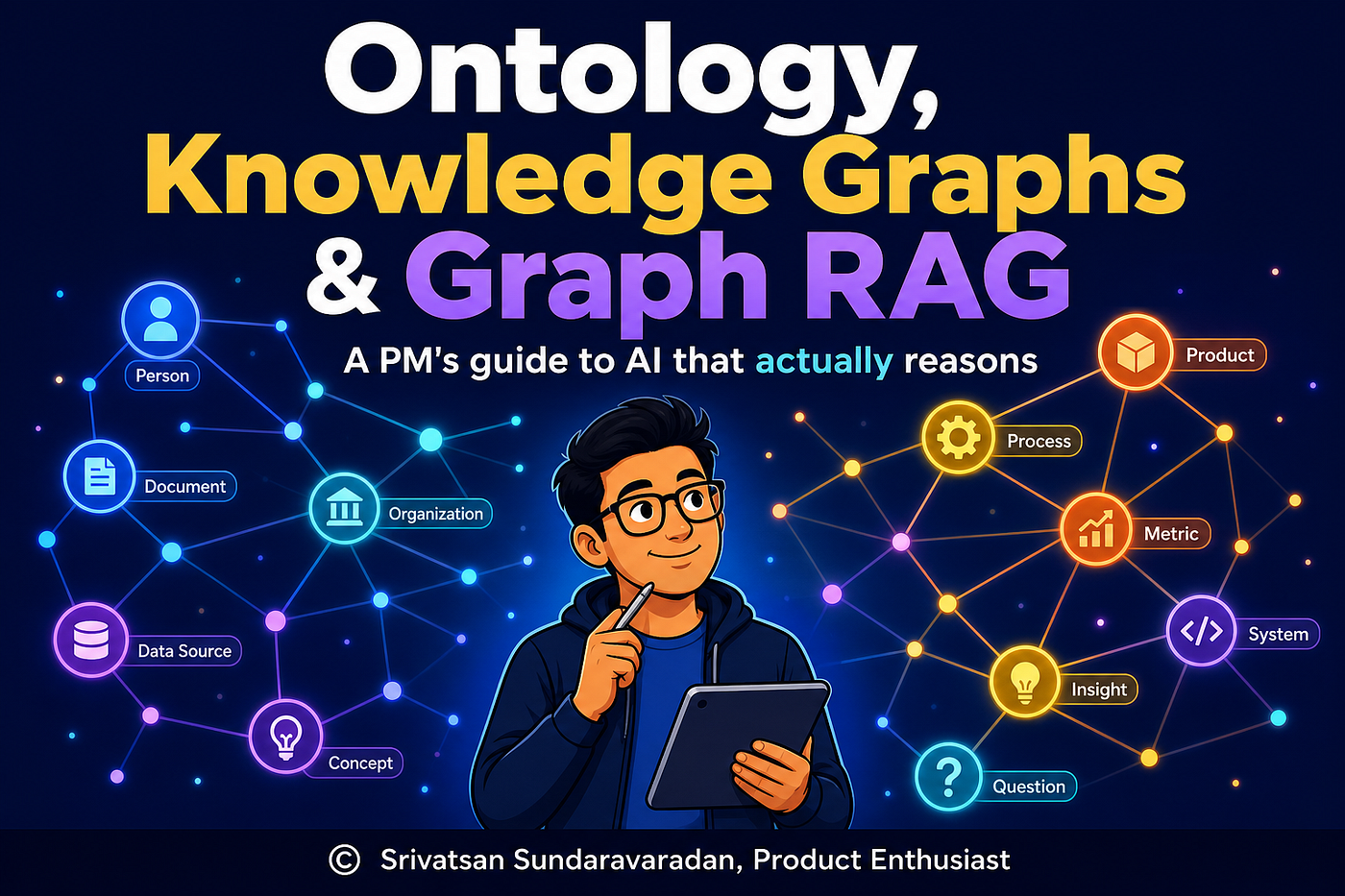
The Knowledge Graph Trilogy: What Every PM Needs to Know About Ontology, Knowledge Graphs & Graph RAG
The three concepts quietly powering the AI products you already love — and the ones you’re about to build.
— Written for product managers navigating the AI-first product landscape.
The Problem with How AI Usually “Knows” Things
Imagine hiring a brilliant new employee. They’ve read every Wikipedia article, every research paper, every news story ever written. They have a photographic memory. But here’s the catch — they have no idea how anything relates to anything else.
Ask them “Who is the CEO of the company that acquired Instagram?” and they’ll stare blankly. They know who Mark Zuckerberg is. They know what Meta is. They know Instagram was acquired. But they can’t connect the dots fast enough to give you a useful answer.
This is the core problem that Ontology, Knowledge Graphs, and Graph RAG solve — and why they matter enormously to PMs building AI-powered products.

Chapter 1: Ontology — The Rulebook of Reality
The Analogy
Think of an ontology as the rulebook that a librarian uses to organize an entire library.
It answers questions like:
- “A book is a type of publication.”
- “A publication has an author.”
- “An author is a type of person.”
- “A person can be an employee of an organization.”
An ontology doesn’t contain actual books. It defines what kinds of things exist and what kinds of relationships are possible between them. It’s the schema of the real world.
A Bit More Precisely
In computer science, an ontology is a formal specification of:
- Entities (what kinds of things exist — Person, Product, Company, Event)
- Properties (what attributes those things have — name, founded_date, revenue)
- Relationships (how things relate — “works_at”, “acquired_by”, “competes_with”)
- Rules (logical constraints — “a person can only have one birthdate”)

Why PMs Should Care
When you’re building an AI product, your ontology is your product’s world model. It’s the silent architecture that determines:
- What questions your AI can even understand
- What answers are logically possible
- How your product scales its knowledge without hallucinating
Real example: When Spotify built their music knowledge system, they had to define an ontology: Artists have genres. Genres have sub-genres. Albums have tracks. Tracks have moods. Moods relate to activities. This ontology enabled features like “Focus” playlists and contextual recommendations.
Without a well-designed ontology, you get a product that answers “Play something like Radiohead” with a Taylor Swift album because the AI found a loose keyword match.
Chapter 2: Knowledge Graphs — The Living Map of Everything
The Analogy
If an ontology is the rulebook, then a Knowledge Graph is the actual city built using those rules.
Imagine a city where:
- Every building is an entity (a person, a product, a company, an event)
- Every road between buildings is a relationship (“works at”, “founded by”, “similar to”)
- The traffic on those roads shows how strongly things are connected
Now imagine you can navigate that city to find answers. To know which products a customer has bought, follow the roads from “Customer” → “Purchased” → “Product”. To find who influenced a startup’s founding, navigate: “Founder” → “Mentored by” → “Person” → “Formerly at” → “Company”.
That’s a Knowledge Graph.

Technically Speaking
A Knowledge Graph stores information as triples: (Subject) → [Relationship] → (Object)
Examples:
(Elon Musk) → [founded] → (SpaceX)(SpaceX) → [competes_with] → (Blue Origin)(Blue Origin) → [founded_by] → (Jeff Bezos)(Jeff Bezos) → [formerly_led] → (Amazon)
This structure lets you traverse from Elon Musk to Amazon in 4 hops — something no keyword search could do.
Real-World Product Examples
Google Knowledge Panel When you Google “Taylor Swift”, that box on the right showing her discography, relationships, birthplace, and upcoming tours? That’s Google’s Knowledge Graph (literally — they named it that). It contains 500 billion facts and 5 billion entities.
LinkedIn’s Economic Graph LinkedIn’s entire talent intelligence system is a Knowledge Graph. Members → Skills → Companies → Industries → Jobs → Locations. This powers “People Also Viewed”, “Jobs you might like”, and LinkedIn’s B2B ad targeting. It’s why LinkedIn knows a backend engineer in Bangalore who uses Kubernetes is likely interested in a Senior DevOps role in Hyderabad.
Amazon’s Product Graph When Amazon says “Frequently bought together” or “Customers who bought this also bought…”, that’s traversal on a product-purchase-customer graph. The graph knows that people who buy a DSLR camera also buy memory cards, camera bags, and lens cleaning kits — not because they read about it, but because millions of edges in the graph told the story.
Netflix’s Content Graph Netflix doesn’t just tag movies by genre. Their content graph connects: Director → Style → Cast → Character type → Mood → Audience segment → Viewing time. That’s why “Dark” (German) and “Mindhunter” (American) end up in the same recommendation cluster for the same user.

Chapter 3: Graph RAG — The AI Detective
First, What Is RAG?
RAG stands for Retrieval-Augmented Generation. It’s how modern AI products stop hallucinating and start being useful.
The standard approach: when a user asks a question, the AI:
- Retrieves relevant documents from a database
- Reads those documents
- Generates an answer based on what it just read (not just what it memorized in training)
Think of it as the AI being a consultant who doesn’t pretend to know everything — instead, they look it up in a trusted database before answering.
Now Add “Graph” to RAG
Standard RAG has a problem: it retrieves documents based on similarity. It finds text chunks that look like your question. It’s good at matching surface-level patterns.
But real-world questions are relational, not just similar.
“Which of our customers who bought Product A in Q1, also work in the healthcare industry, and haven’t yet been contacted by sales?”
A document similarity search can’t answer this. A Graph RAG can — because it traverses relationships rather than matching text.
The Detective Analogy
Think of Graph RAG as an AI detective working a case.
Standard RAG is like a detective who:
- Reads witness statements
- Finds the most relevant ones to the crime
- Gives you a summary
Graph RAG is like a detective who:
- Maps out every person, location, event, and relationship on a board
- Follows the threads: “This person was at Location A → Location A is connected to Company B → Company B employed Suspect C”
- Traverses the whole web to surface the hidden connection
- Then explains the full chain of reasoning
The answer isn’t just found — it’s navigated to.
Why This Is a Massive Deal for AI Products
Graph RAG enables:
- Multi-hop reasoning — Answering questions that require connecting 3, 4, 5 facts across different entities
- Explainability — The AI can show you why it reached an answer (“I found this because Customer → Purchased → Product → Tagged as → Healthcare”)
- Precision — Less hallucination, because answers are grounded in graph paths, not pattern matching
- Context-awareness — The AI understands who is asking and what world they live in (their graph context)
Real Product Example: Enterprise AI Assistants
Imagine you’re building an AI assistant for a B2B SaaS company’s sales team. A rep asks:
“Which accounts are at risk of churning this quarter?”
Standard LLM answer: “Customers churn when they have low engagement, unresolved tickets, and competitor contact…” (generic, useless)
Standard RAG answer: “Based on these 5 support articles about churn signals…” (better, still generic)
Graph RAG answer: “Accounts Acme Corp, TechFlow, and DataBridge are at churn risk. Here’s why: Acme Corp has had 3 open P1 tickets for 14 days (→ Low Health Score), their primary champion left the company last week (→ Contact Graph change), and a competitor was mentioned in their last 2 support chats (→ Competitive Signal). I recommend escalating to your VP today.”
That’s the difference. Graph RAG made it personal, specific, and actionable — because it could traverse the graph of customers, contacts, tickets, health scores, and competitive signals in one reasoning pass.

Chapter 4: The PM Lens — Why You Should Care
It Changes What “Possible” Means for Your Product
Most AI products today are built on vector search + LLMs. They’re powerful but fundamentally limited to “find me things that look like this.” When you layer in a Knowledge Graph with Graph RAG, you unlock an entirely different product surface:

The Three PM Questions to Ask
1. What are the entities in my domain? Every product has a world. For an HR tool, it’s: Employees, Skills, Teams, Projects, Goals. For an e-commerce tool: Products, Categories, Customers, Orders, Suppliers. Defining these is ontology work.
2. What relationships matter most? Not all connections are equal. The most valuable relationships are the ones that enable your product’s core “aha moment.” For LinkedIn, it’s “Person → works_at → Company.” For Spotify, it’s “Track → has_mood → Context.” Your graph’s edges are your competitive moat.
3. What questions do your users need to answer across multiple hops? If your users ever ask “Why…?” or “Who else…?” or “What leads to…?” — those are multi-hop questions that Graph RAG is built to answer. These are your highest-value AI features.
The Product Moat Argument
Here’s the strategic insight most PMs miss:
Your Knowledge Graph becomes harder to replicate than your model.
OpenAI can release a better model tomorrow. Your competitor can access the same APIs. But your graph — built from your users’ interactions, your domain ontology, your unique relationship data — that’s yours. It compounds over time. Every user action enriches the graph. Every new entity added makes the whole graph smarter.
LinkedIn didn’t win because they had a better algorithm than Monster.com. They won because they built a graph that Monster could never catch up to.
Putting It All Together
Let’s do one final analogy to tie everything together.
Imagine you’re building a city (your product):
Ontology = The zoning laws and city plan — what types of buildings can exist, what roads are legal, what connects to what
Knowledge Graph = The actual city — millions of buildings (entities) connected by roads (relationships), built according to the zoning laws
Graph RAG = The AI-powered GPS + detective — given your destination (user question), it navigates the city in real time, explains the route, and finds the fastest path through known connections
Without good zoning laws (ontology), your city is chaos — buildings in wrong places, roads to nowhere.
Without the actual city (knowledge graph), your GPS has no map to navigate.
Without the AI navigator (Graph RAG), your city is a static map — beautiful but not useful.
All three together? You have a living, intelligent city that gets smarter every time someone walks its streets.
TL;DR for the Time-Pressed PM
- Ontology = The rules of what exists and how it can relate (your world model schema)
- Knowledge Graph = The actual structured map of entities and relationships in your domain
- Graph RAG = AI that navigates the graph to answer complex, multi-hop questions with explainability
Why it matters: It shifts your AI product from pattern-matching to reasoning. That’s the difference between an AI that looks smart and one that is smart about your specific domain.
The moat: Your graph is proprietary. Your model isn’t. Invest in your graph early.
If this resonated, I’d love to hear which products you think are closest to cracking this in your industry. Drop a comment below.
메타데이터
- post_id
- ad7d2b65bdc8
- slug
- the-knowledge-graph-trilogy-what-every-pm-needs-to-know-about-ontology-knowledge-graphs-graph-rag-ad7d2b65bdc8
- url
- https://medium.com/@srivatsan_innov/the-knowledge-graph-trilogy-what-every-pm-needs-to-know-about-ontology-knowledge-graphs-graph-rag-ad7d2b65bdc8
- canonical_url
- https://medium.com/@srivatsan_innov/the-knowledge-graph-trilogy-what-every-pm-needs-to-know-about-ontology-knowledge-graphs-graph-rag-ad7d2b65bdc8
- author_url
- https://medium.com/@srivatsan_innov
- status
- ok
- fetched_at
- 2026-07-15 00:37:03