The Soul Is Never in the Machine — And That’s Exactly the Point
What four AI artists taught me about creativity, curation, and why the best images start with a feeling, not a prompt.
The Soul Is Never in the Machine — And That’s Exactly the Point
What four AI artists taught me about creativity, curation, and why the best images start with a feeling, not a prompt.
There’s a strange moment that happens when you find the right image.
You’re scrolling through a library — or a folder of AI generations, or your third stock site of the morning — and then, suddenly, it stops you. Not because it’s technically impressive. Because it feels like something. It carries an emotional weight that makes you pause and think: yes, that’s it.
That moment is rare. And it’s getting rarer.
We’re living through a paradox right now. We have more images available to us than at any point in human history. AI tools can generate thousands of visuals in minutes. Stock libraries contain hundreds of millions of photos. And yet, creative professionals , bloggers, course creators, solopreneurs, small business owners are drowning in mediocre visuals while struggling to find ones that actually feel right for their brand.
This is the problem that Typedreams was built to solve. Not with more volume, but with the one thing that volume can’t manufacture: taste.
Why most AI images feel like nothing
Before we get to the good stuff, let’s be honest about something.
Most AI-generated images are forgettable. Not because AI tools are bad — they’re extraordinary — but because most people using them are chasing impressive output rather than meaningful output.
They type in a prompt. They pick the most technically polished result. They move on.
What gets lost in that process is the thing that makes art worth looking at: intention.
This is something I’ve been thinking about a lot since reading Typedreams’ series of interviews with the AI artists whose work appears in the library. These aren’t interviews with tech evangelists or tool reviewers. They’re conversations with working artists who have spent years learning how to use AI as a creative medium, not just a shortcut.
“Don’t chase impressive-looking results”
Finnish artist Jari Anttonen works at the intersection of mythology and machine learning. His images — layered with symbolic depth, built from ancient archetypes — are nothing like the glossy, hyperrealistic AI output that floods social media. They feel strange. Atmospheric. Slightly uncomfortable.
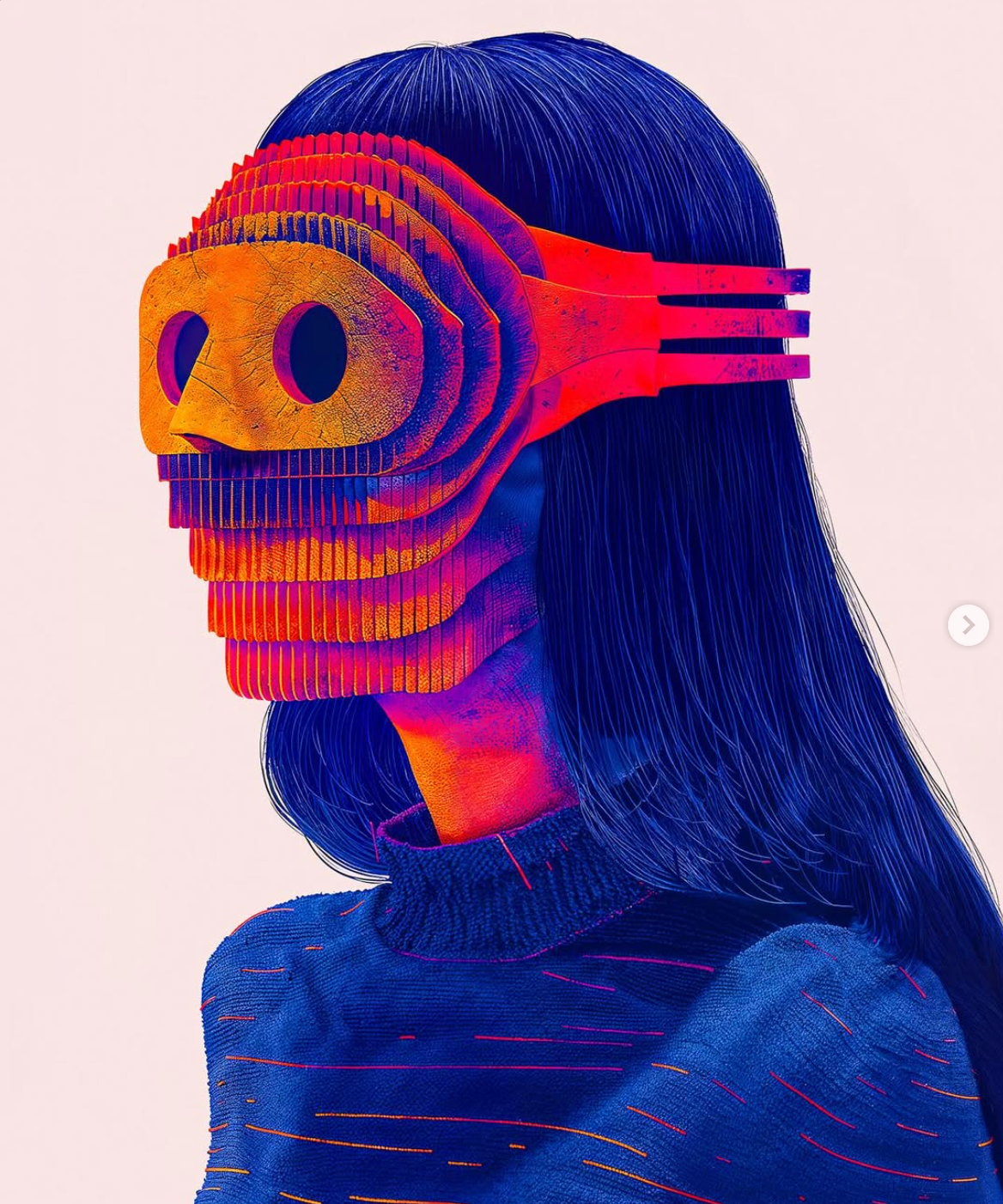
Jari Anttonen
That’s not an accident.
“Don’t chase impressive-looking results or whatever happens to be popular,” he told Typedreams. “Pay attention to what feels meaningful to you, even if it looks rough or strange.”
This is a radical piece of advice in a landscape where everyone is racing to generate the most technically polished visuals. Anttonen is saying something different: develop a point of view before you ever write a prompt. Let meaning guide the output, not the other way around.
For anyone building a brand, this is arguably the most important creative principle you can absorb. Your visuals should say something specific. They should feel like you. Generic beauty doesn’t build recognition — specificity does.
The 5-stage process that changes how you think about AI art
Romanian artist Cristina Ardelean describes her creative process in a way that should reshape how anyone thinks about using AI imagery in their work.

Cristina Ardelean
She doesn’t open a tool and start typing. She starts with mood-building — gathering references, sitting with a feeling, letting an emotional direction emerge. From there, she moves into world-building, then generation, then the critical stage most people skip entirely: curation. Finally, she refines.
Five stages. And only one of them involves pressing a button.
“AI doesn’t replace human emotion, it reveals it,” she told Typedreams. “The tool is powerful, but the intention behind it matters more.”
This is why Typedreams works. The 5,000+ images in the library aren’t the output of mass generation sessions. They’re the result of artists following a process like Ardelena’s — where emotional intention precedes every decision. When you download a collection, you’re not getting raw AI output. You’re getting the curated end result of that process.
For content creators who don’t have hours to spend on their own AI art workflow, that matters enormously.
“The idea matters more than the tool”
Digital artist Artem Pozdniakov has a philosophy that sounds almost provocative in an era obsessed with AI tools: the idea comes first, execution comes second.
His work lives in the territory of digital surrealism — unexpected juxtapositions, images that make you look twice. Not because they’re technically complex, but because the concept behind them is surprising.
“The idea matters more than the tool,” he told Typedreams. “Behind every creative work, first and foremost, stands your own idea and vision.”

Artem Pozdniakov
What this means practically: if you’re using a curated image library, you’re not outsourcing your creativity. You’re outsourcing the execution. The vision — what you’re communicating, what emotion you want to evoke, what story you want to tell — that still lives entirely with you. The right image just gives that vision somewhere to land.
Themed collections like Botanical & Natural Easter, Pastel Minimalism, or the Retro and Carnival series exist precisely because having a conceptual starting point — a vibe, a season, a feeling — makes it dramatically easier to find visuals that serve your specific creative intention.
“True AI art is not created in minutes”
This one is worth sitting with.
DDKing, an artist who works at the intersection of emotion and artificial intelligence, pushes back on the narrative that AI art is effortless content creation. His work — which explores grief, longing, and the complexity of lived experience — is described as “a process of cutting, reshaping, and refining until it carries meaning.”
“The soul is never in the machine — it is always in the human behind it,” he told Typedreams. “AI is a tool, and without human input it creates nothing.”

ddking_art
This transparency — this honest acknowledgment that the human is still doing the most important work — is part of what makes the Typedreams library different.
In a market where platforms are rushing to quietly replace human-made imagery with AI output while hoping users don’t notice, Typedreams does the opposite. It names its artists. It interviews them. It celebrates the human creative process behind every collection. And it does so at a moment when 90% of consumers say they want to know whether an image was made by AI.
Transparency, it turns out, isn’t a liability in the age of AI imagery. It’s a competitive advantage.
What this means for your creative work
If you’re a blogger, a course creator, a solopreneur, or anyone who needs cohesive, high-quality visuals on a regular basis — you’re dealing with a problem that has no satisfying solution right now.
Stock sites are expensive, overcrowded, and full of imagery that looks exactly like everyone else’s. AI generators are powerful, but they require time, skill, and a surprisingly steep learning curve. Free AI libraries exist, but they’re unorganised, aesthetically inconsistent, and built for quantity rather than quality.
Typedreams.site sits in a different category entirely. It’s a curated AI image library — small by stock site standards, but intentionally so. Every collection is thematically coherent.
The library is available on a one-time payment model — no subscription, no recurring fees, lifetime access. Individual collections start from €4.99. The **full Digital Bundle**, which includes 5,000+ images at €720.

Typedreams.site
But honestly? The most interesting thing about Typedreams isn’t the pricing.
It’s that it’s built on a belief that most of the stock image industry has quietly abandoned: that the images you use to represent your brand should feel like something.
Typedreams is a curated AI image library based in Ireland, featuring 5,000+ images organised into themed collections. Explore the library and the AI artist interview series at typedreams.site.
메타데이터
- post_id
- ad7edd8945aa
- slug
- the-soul-is-never-in-the-machine-and-thats-exactly-the-point-ad7edd8945aa
- url
- https://medium.com/@melissa_60215/the-soul-is-never-in-the-machine-and-thats-exactly-the-point-ad7edd8945aa
- canonical_url
- https://medium.com/@melissa_60215/the-soul-is-never-in-the-machine-and-thats-exactly-the-point-ad7edd8945aa
- author_url
- https://medium.com/@melissa_60215
- status
- ok
- fetched_at
- 2026-07-09 23:43:16