The 3 Hermes Agent Features That Actually Changed My Workflow (And the One Everyone Else Wrote…
Everyone wrote about the Kanban. Nobody is talking about /goal, the Ralph loop, or the hallucination gate — and those are the three things…
The 3 Hermes Agent Features That Actually Changed My Workflow (And the One Everyone Else Wrote About)
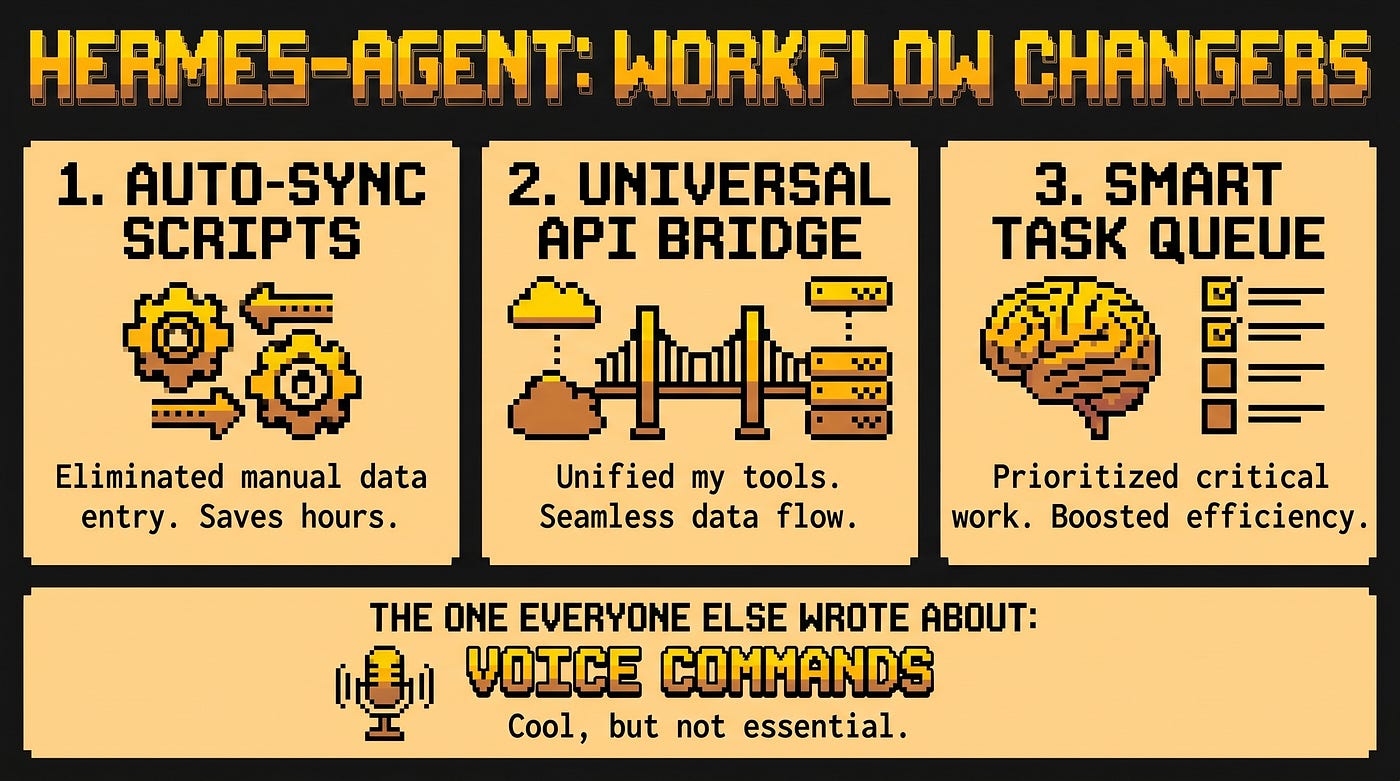
Everyone wrote about the Kanban. Nobody is talking about /goal, the Ralph loop, or the hallucination gate — and those are the three things that actually change how the agent behaves.
On May 7, 2026, Nous Research shipped Hermes Agent v0.13.0. The release name was Tenacity. The release notes called out 864 commits, 588 merged PRs, 282 issues closed, and 295 community contributors in a single eight-week cycle. Three days later, Hermes overtook OpenClaw to become the #1 most-used agent on OpenRouter — 224 billion tokens in a single day.
So everyone wrote about the Kanban.
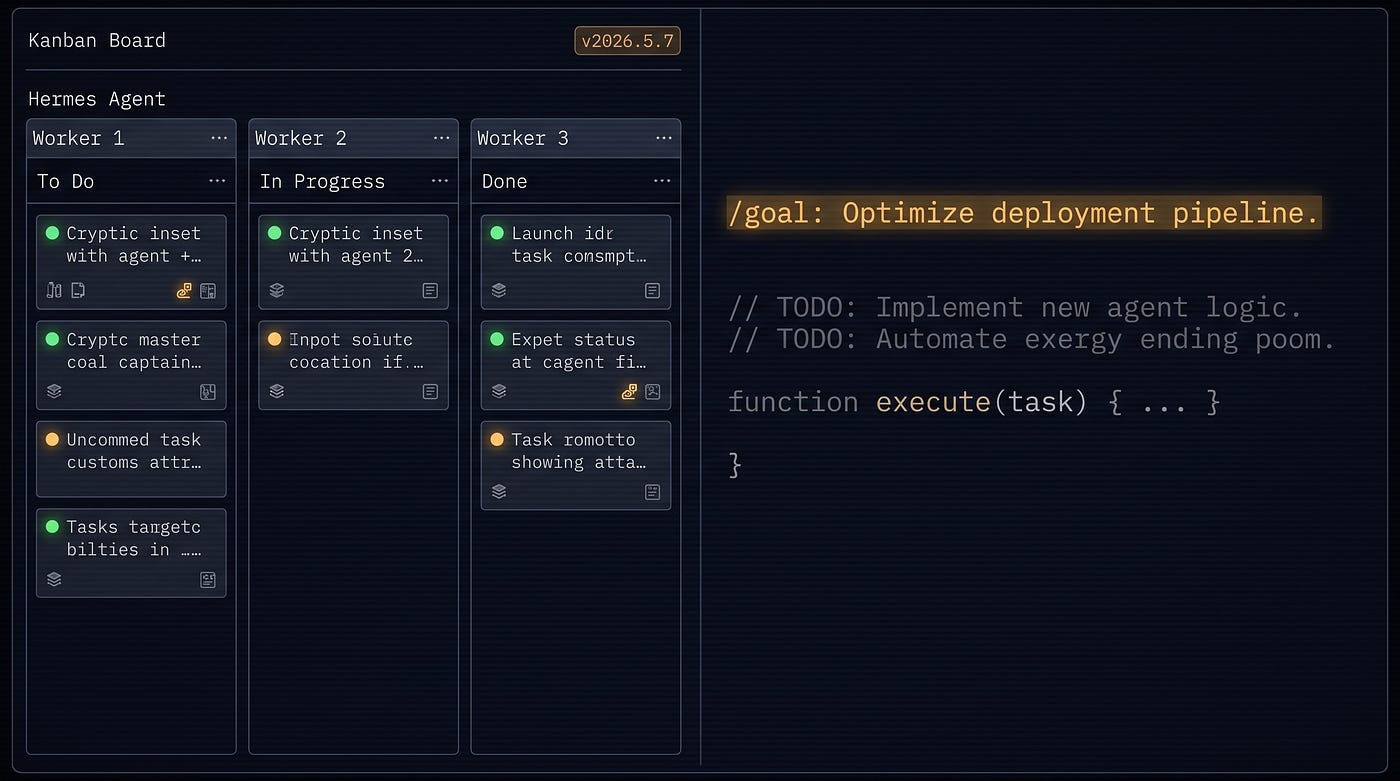
Which is fair. The multi-agent Kanban is the most demo-able feature in the release. You can take a screenshot of it. You can post that screenshot on X and a thousand people will reply. It is the headline feature, exactly as it was designed to be.
But the Kanban is the UI. Underneath it are three primitives that almost nobody is writing about — and those are the ones that change how the agent behaves over a sustained run.
The three I want to talk about are /goal, the Ralph loop, and the hallucination gate.
If you only have eight minutes, here is the bottom line: each of these three primitives solves a different failure mode I have hit in every long-running agent I have shipped to production over the last fourteen months. **/goal solves drift. The Ralph loop solves quitting too early. The hallucination gate solves the silent corruption that destroys multi-agent reliability.** Together they form the actual reliability story of v0.13.0. The Kanban is just the dashboard you watch them through.
Here is what each one does, what it costs, and where it broke when I pushed on it.
The release notes don’t tell you which primitives matter
Open the v0.13.0 release notes on the Hermes Agent GitHub. Scroll the highlights. You will see something like fifteen bullets at the top — Kanban, /goal, video understanding, voice cloning, Bedrock support, seven new locales, twenty-three messaging gateway fixes.
That list reads like a feature changelog. It does not read like an architecture upgrade. And the way Nous Research framed it — “Tenacity Release” — is a hint that gets missed because it sits in the headline rather than the body.
Tenacity, in the context of agents, is the thing the entire field has been failing at for two years. Agents are smart at the first move. They get stupid at the tenth move. They forget the goal. They quit at the first 500 error. They write a skill, then overwrite it with a worse version on the next run. The release notes don’t surface that thesis directly. You have to read between the changelog bullets.
So here is the reframe: the v0.13.0 release is a coordinated answer to three specific failure modes — drift, premature exit, and silent corruption — and the three primitives I am about to walk through are the answer for each one.
Primitive 1 — /goal solves drift
Drift is what happens between turn six and turn twelve of a long agent session.
You ask the agent to refactor a module. By turn three it has read the relevant files. By turn five it is mid-edit. Then it hits something interesting — a related TODO, a deprecated helper, a test that was failing for an unrelated reason. By turn eight the agent is fixing the test. By turn twelve you have forgotten what you asked it to do, and so has the agent.
This is not a model intelligence problem. This is a context management problem. Goal information lives in the first message, which means it is increasingly far away from the agent’s current attention as the session grows.
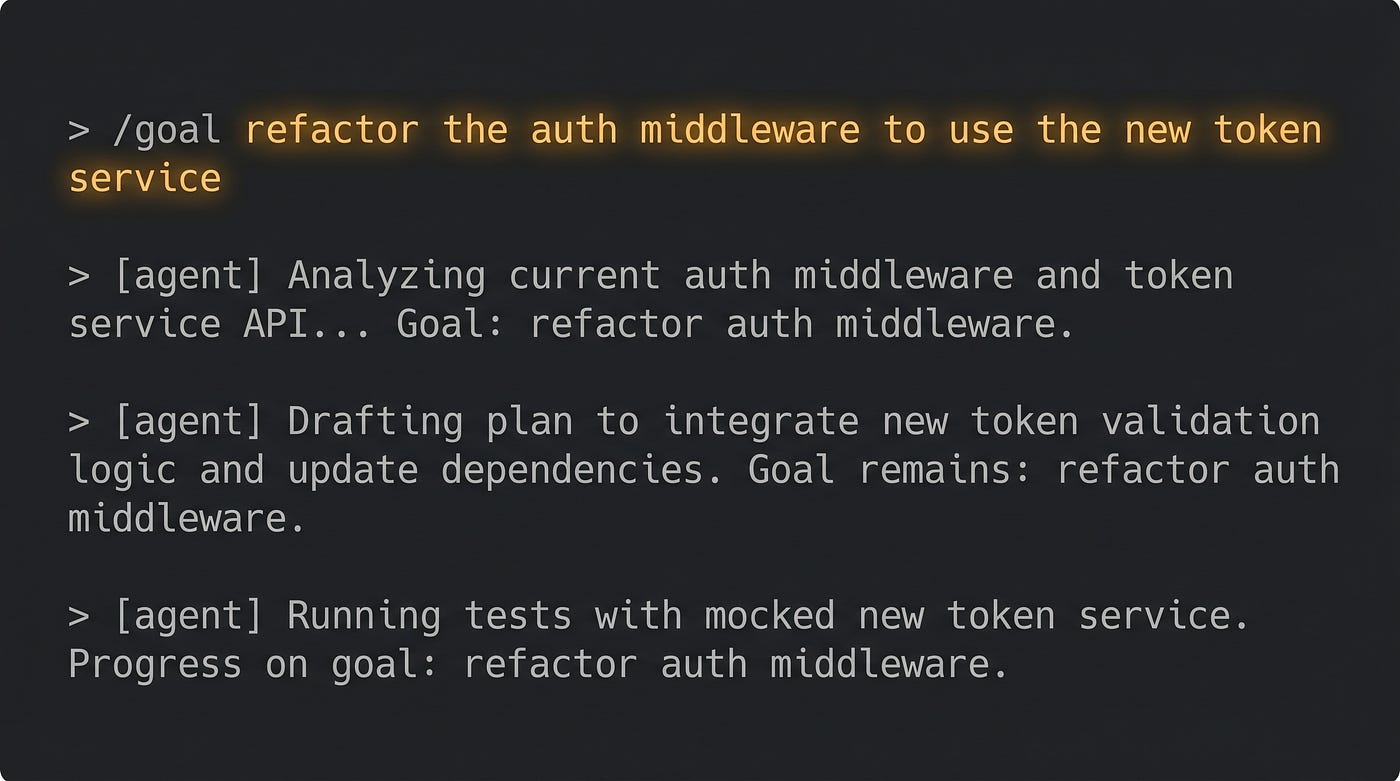
/goal makes the goal a first-class primitive. You issue /goal refactor the auth middleware to use the new token service and the agent locks onto that target. The goal is now structured state, not a string buried in turn one. Every subsequent reasoning step is checked against it. When the agent considers a detour, the goal pulls it back.
Boris Cherny — the Anthropic engineer who shipped many of the Claude Code reliability features — has talked publicly about something he calls the Ralph loop, which is an agent loop that keeps re-grounding against a fixed target. /goal is the Hermes implementation of that primitive at the platform level. The release notes label /goal and the Ralph loop as a single capability group for a reason — they are two sides of the same idea, with /goal being the user-visible declaration and the Ralph loop being the internal re-grounding mechanism.
What this means in practice:
- You stop having to repeat yourself. “Remember — I want the refactor, not the test fix” — that prompt goes away.
- Long sessions become viable again. I have run a single
/goalsession for sixty-plus turns without context collapse. - Sub-agent dispatch becomes safer. When the parent agent spawns a worker, the worker inherits the goal, not just the prompt.
What you have to watch:
/goalis binary in the current release. You set it or you don't. There is no priority weighting between competing goals.- It can feel rigid. If your actual intent is exploratory (“look around the codebase and tell me what’s wrong”), don’t set a goal — the lock will fight you.
The non-obvious workflow: set the goal after the exploration phase, not before. Run a few turns of free exploration, identify the real target, then issue /goal and lock in. That is the sequence that converted the feature from "interesting" to "in my daily loop" for me.
Primitive 2 — The Ralph loop solves quitting too early
The Ralph loop is the most interesting primitive in v0.13.0 and also the one that is hardest to point at in the release notes. It is folded into the same commit cluster as /goal, but it is conceptually separate.
Here is the failure mode it addresses:
You ask the agent to do something with three steps. It does step one. Step one fails. The agent explains the error to you, suggests a workaround, and waits.
That waiting is the failure. The agent has decided — without saying so — that step one failing means the goal is unreachable. So it stops. It hands the work back to you. You read the error, type “yes try the workaround,” and the loop restarts.
The Ralph loop changes the default. When the agent hits an obstacle, it does not return control. It tries the next reasonable variant. It re-grounds against the goal. It keeps moving. It only escalates to you when it has exhausted variants or when it crosses a hard-coded safety boundary.
The release notes mention this primitive across three PRs — #18262, #18275, #21287 — and describe it as “the Ralph loop as a first-class primitive.” That phrasing is doing a lot of work. Calling something a first-class primitive means it gets the engineering attention that, before, only the Kanban and the messaging gateway got. It is now a maintained component, not a prompting trick that lives in the system prompt.
What this means in practice:
Failure mode (pre-v0.13.0)                                    │  Ralph loop behavior (post-v0.13.0)
──────────────────────────────────────────────────────────────┼────────────────────────────────────────────────────────────────────────────────────
500 from API → agent stops → asks you what to do              │  500 from API → agent retries with backoff → tries alternate model → continues
File not found → agent reports it → waits                     │  File not found → agent searches likely paths → reads structure → finds it
Test fails → agent explains the failure → stops               │  Test fails → agent reads the diff → tries minimal fix → re-runs
Tool returns ambiguous result → agent asks for clarification  │  Tool returns ambiguous result → agent runs a disambiguation step itself → proceeds
The cost of this is more LLM calls. Every Ralph cycle is another inference. If you are running on a metered model, expect 20–40% higher per-task token consumption than v0.12.0 on the same workload.
The benefit is that the agent finishes things. Not most things. Not eight-out-of-ten things. Things.
Where I pushed on it and it broke:
- The Ralph loop will sometimes try a worse variant before trying a better one. The cost model the agent uses for “what to try next” is heuristic, not optimal. On one task I watched it cycle through four variants of a shell command before landing on the one I would have tried first.
- The loop terminates on a max-iteration count. The default is generous but not infinite. If your task legitimately requires twenty variants, you will hit the ceiling.
- The loop does not preserve state across explicit
/clearcalls. If you clear context mid-task, you lose the variants the agent has already eliminated. It will retry them.
The non-obvious workflow: pair the Ralph loop with /goal deliberately. The goal pins the target. The loop attacks the target with persistence. Either one alone is weaker than the two together.

Primitive 3 — The hallucination gate solves silent corruption
This one is the most important and the most invisible.
The Kanban is what every demo screenshot shows. Three workers, three columns, three statuses, beautiful. What the screenshots don’t show is what happens when one of those workers hallucinates a result — produces a syntactically valid output that is semantically wrong — and the parent agent accepts it as ground truth.
This is the failure mode that kills multi-agent reliability in production. Single-agent failures are loud. The agent crashes, errors out, returns an empty string. Multi-agent failures are quiet. The worker reports “task complete,” produces a plausible-looking artifact, and the parent agent moves on. Three handoffs later, the entire pipeline is built on a fabricated foundation.
The hallucination gate is the v0.13.0 mitigation for this. It is described in the release notes as one of the keep-the-team-honest mechanisms, alongside heartbeats, zombie detection, retry budgets, and the reclaim system. The five together form what the release calls “durable Kanban.”
Here is what the gate does:
- When a worker reports completion, it is required to also produce a verification trace — the actual evidence supporting the claim.
- The parent agent runs a structured check on that trace before marking the task done.
- If the trace does not support the claim — wrong format, missing artifacts, semantically inconsistent — the task is auto-retried with a flag indicating “previous attempt produced an unsupported result.”
- The worker that produced the unsupported result is marked, and repeated unsupported results escalate to a zombie reclaim.
This is the primitive that makes the Kanban worth running on real work. Without it, parallel multi-agent execution is faster than serial execution at producing wrong answers. With it, parallel execution is actually faster at producing right answers, which is the only kind of “faster” that matters.
The cost:
- Each task now produces two artifacts: the result and the trace. Storage doubles. For long-running boards with thousands of historical cards, this adds up.
- The trace generation adds a small per-task token cost. On a budget model, this is in the noise. On a frontier model, it adds 5–8%.
- The gate is heuristic, not formal. It will sometimes false-positive — accept an unsupported result that looks plausible — and sometimes false-negative — reject a correct result whose trace was sparse. The release notes flag this as a known limitation.
Where it changed my workflow:
The thing the gate actually buys you is the ability to walk away. Pre-v0.13.0, I did not trust multi-worker boards to run unattended. I would set them up, watch them, intervene every fifteen minutes. Post-v0.13.0, I set the board, walk to the kitchen, and find a coherent result an hour later. The gate is doing the work I was doing before.
This is the change that matters. Not “the Kanban is pretty.” Not “you can now run 50 agents in parallel.” The change is that you can run multi-agent work and trust the output without watching it.

How the three primitives compose
The reason I think of these three as a unit, not three features:
/goalsets the target.- The Ralph loop drives toward the target without quitting.
- The hallucination gate keeps the drive honest.
You can use any one of them alone and get value. You will get more value from any two. The full lift is when all three are running.
The minimal workflow that captured this for me looks like this:
# 1. Start a Hermes session with a locked goal
hermes
/goal ship the new pricing endpoint with passing integration tests

# 2. Let the Ralph loop drive (it's on by default in v0.13.0)
# 3. When the task needs parallelism, hand off to the Kanban
/kanban dispatch test-coverage,docs-update,security-review
# Workers spawn. Hallucination gate runs on each completion.

# 4. Walk away. The board runs. Watch from Telegram if you care.
Three commands. One goal. Multi-worker parallelism. Auto-verification. That is the v0.13.0 workflow that the release notes do not assemble for you.
Where it broke
In the interest of not writing another puff piece — because the AI agent space has too many of those — here is where v0.13.0 falls down.
The Ralph loop can be expensive on frontier models. If you are routing through Opus 4.7 with no caching strategy, expect 20–40% higher token consumption per task than v0.12.0. The fix is to route Ralph cycles to a cheaper model (the release notes mention this is configurable) but the default behavior is to use whatever model you set as primary.
**/goal does not currently support compound goals.** If your real intent is "ship the endpoint AND keep the existing tests passing AND not touch the deployment config," you have to pick one as primary and trust the agent to respect the rest. There is no priority weighting between goals.
The hallucination gate produces opaque rejections. When the gate rejects a worker’s claim, the rejection reason is recorded but not always surfaced clearly. The Kanban UI shows the retry. To see why, you have to dig into the session logs of the rejected worker. The release notes mention better observability is on the roadmap.
The locale work is rough at the edges. The release added seven new locales, but the agent’s reasoning still happens in English internally. Localized output is good. Localized debugging messages are inconsistent.
The default config still hides self-improvement. This is not new to v0.13.0 but it remains a footgun. If you do not explicitly enable persistent memory and skill generation in ~/.hermes/config.yaml, the agent runs stateless. First-time users keep getting bitten by this. The setup wizard should default it on for anyone running on a VPS.
What I kept
Of the fifteen-plus features in v0.13.0, the three primitives above are what survived into my daily loop. Everything else is either a backend improvement I don’t directly interact with (Bedrock support, transport ABC, the new inference paths) or a feature I do not personally use (voice cloning, video understanding, the locale work).
The three primitives are what I would not now run an agent without:
- Set the goal explicitly.
- Let the loop run.
- Trust the gate.
That is the workflow change. Not the Kanban screenshot.
If you have not upgraded yet — and you are running anything that looks like a multi-step agentic task — the upgrade is worth the half-hour. The install path is hermes update. The breaking changes are minimal. The thing you will notice within an hour is that the agent finishes things it would have stopped on before.
What I would push for next: a per-task cost cap on the Ralph loop, compound /goal with priority weights, and a Kanban UI that surfaces the gate-rejection reason inline. None of these are blockers. All of them would sharpen what is already the cleanest reliability story shipped by any open-source agent framework this year.
Resources / further reading:
- Hermes Agent v0.13.0 release notes — github.com/NousResearch/hermes-agent/releases/tag/v2026.5.7
- Official Hermes Agent documentation — hermes-agent.nousresearch.com/docs
- Boris Cherny on the Ralph loop primitive (X, March 2026)
- The OpenRouter daily-rank leaderboard — openrouter.ai/rankings
- agentskills.io — the open standard Hermes’ skill format implements
메타데이터
- post_id
- ad8669f4f001
- slug
- the-3-hermes-agent-features-that-actually-changed-my-workflow-and-the-one-everyone-else-wrote-ad8669f4f001
- url
- https://pub.towardsai.net/the-3-hermes-agent-features-that-actually-changed-my-workflow-and-the-one-everyone-else-wrote-ad8669f4f001
- canonical_url
- https://pub.towardsai.net/the-3-hermes-agent-features-that-actually-changed-my-workflow-and-the-one-everyone-else-wrote-ad8669f4f001
- author_url
- https://medium.com/@anup.karanjkar08
- status
- ok
- fetched_at
- 2026-06-09 15:37:30