Pakistan’s Role in Reducing Urban Carbon Emissions: The Case of Karachi’s Electric Buses
Climate change is one of the biggest challenges facing the world today, and a major contributor to this problem is carbon dioxide (CO₂)…
Pakistan’s Role in Reducing Urban Carbon Emissions: The Case of Karachi’s Electric Buses
Climate change is one of the biggest challenges facing the world today, and a major contributor to this problem is carbon dioxide (CO₂) emissions from transport. According to recent international media reports, the transport sector accounts for a significant share of global emissions, especially in large cities where traffic congestion and fuel consumption are high (Reuters, 2026; BBC News, 2026). As countries look for solutions, electric vehicles (EVs) and electric buses are emerging as key tools for reducing emissions and improving air quality.
In March 2026, several leading news organizations highlighted that electric vehicles can significantly reduce carbon emissions compared to traditional petrol and diesel vehicles. Reuters reported that EVs can lower emissions by up to 50–70% over their lifecycle, depending on the energy source used for electricity (Reuters, 2026). However, the same report also pointed out that global transport emissions are still rising because of increasing demand for mobility and freight services. This shows that switching to electric cars alone is not enough.
Experts now emphasize that a broader approach is needed. According to BBC News (2026), governments around the world are increasingly focusing on clean transport policies, including the electrification of public transport systems. Electric buses, in particular, are considered one of the most effective ways to reduce emissions in urban areas. Unlike private cars, buses carry a large number of passengers, which means they can reduce emissions per person more efficiently.
The Guardian (2026) also supports this view, noting that electric buses offer higher emission reduction benefits compared to individual electric cars. Many cities are now investing in electric bus fleets, along with other sustainable mobility strategies such as cycling infrastructure and low-emission zones. These combined efforts are helping to create cleaner, more sustainable urban environments.
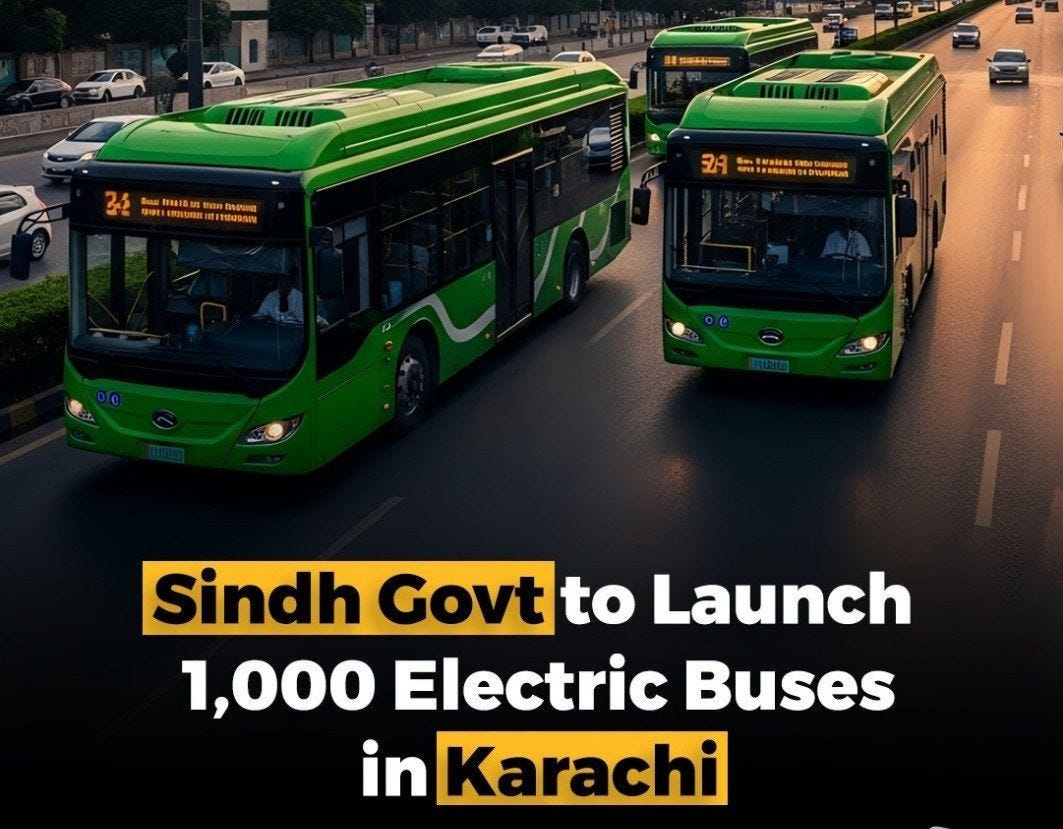
In this global context, Pakistan is also taking important steps toward reducing carbon emissions, especially in its largest city, Karachi. Karachi is a major metropolitan city with millions of residents and a high number of vehicles on the road. Traffic congestion, air pollution, and fuel consumption have long been serious problems in the city. Recognizing these challenges, the Government of Sindh has introduced electric buses as part of its urban transport system.
The introduction of electric buses in Karachi under the People’s Bus Service marks a significant shift toward sustainable mobility. These buses are designed to reduce reliance on diesel-powered vehicles, which are a major source of CO₂ emissions and air pollutants such as nitrogen dioxide (NO₂) and particulate matter (PM₂.₅). By replacing conventional buses with electric ones, Karachi is aligning itself with global efforts to reduce transport-related emissions.
Electric buses in Karachi also offer several additional benefits. They produce zero tailpipe emissions, which helps improve air quality and reduce health risks for urban populations. This is particularly important in cities like Karachi, where air pollution has been linked to respiratory diseases. Furthermore, electric buses are quieter than traditional buses, contributing to reduced noise pollution.
However, as highlighted in recent international reports, the transition to electric transport is not without challenges. BBC News (2026) and Financial Times (2026) both emphasize that infrastructure development, especially charging stations, is critical for the success of EV systems. In Pakistan, the expansion of charging infrastructure is still in its early stages, and further investment is needed to support large-scale adoption.
Another important issue is energy supply. For electric vehicles to truly reduce carbon emissions, the electricity used must come from clean or renewable sources. If electricity is generated from fossil fuels, the overall environmental benefit may be limited. Therefore, Pakistan must also focus on increasing its renewable energy capacity alongside promoting electric mobility.
Despite these challenges, the progress made so far is encouraging. Karachi’s electric bus initiative shows that developing countries can take meaningful steps toward sustainable transport. It also reflects a growing understanding that public transport electrification is more effective in reducing emissions than focusing only on private vehicles.
Recent news reports clearly indicate that the future of clean transport lies in integrated strategies. This includes not only electric cars but also electric buses, improved public transport systems, and better urban planning (Reuters, 2026; The Guardian, 2026). Cities that adopt such comprehensive approaches are more likely to achieve significant reductions in CO₂ emissions.
In conclusion, while electric vehicles play an important role in reducing carbon emissions, they are only part of the solution. Electric buses and sustainable public transport systems offer greater benefits, especially in densely populated cities. Pakistan, through initiatives like Karachi’s electric buses, is moving in the right direction. With continued investment, policy support, and infrastructure development, the country can make a strong contribution to global efforts to combat climate change and create cleaner, healthier cities for future generations.
메타데이터
- post_id
- adb59f83e292
- slug
- pakistans-role-in-reducing-urban-carbon-emissions-the-case-of-karachi-s-electric-buses-adb59f83e292
- url
- https://medium.com/@engr.yab/pakistans-role-in-reducing-urban-carbon-emissions-the-case-of-karachi-s-electric-buses-adb59f83e292
- canonical_url
- https://medium.com/@engr.yab/pakistans-role-in-reducing-urban-carbon-emissions-the-case-of-karachi-s-electric-buses-adb59f83e292
- author_url
- https://medium.com/@engr.yab
- status
- ok
- fetched_at
- 2026-06-20 20:29:01