DCSync attack — how it works, why it’s dangerous, and how to stop it
Imagine an attacker who never needs to touch a Domain Controller’s disk, never needs to “dump” NTDS.dit, and yet walks away with password…
DCSync attack — how it works, why it’s dangerous, and how to stop it
Imagine an attacker who never needs to touch a Domain Controller’s disk, never needs to “dump” NTDS.dit, and yet walks away with password hashes for any account in your domain — including the
krbtgtaccount used to forge Kerberos tickets. That’s exactly what a DCSync attack lets them do.
What is DCSync?
DCSync is a post‑exploitation technique that abuses Active Directory’s legitimate replication APIs (the Directory Replication Service / DRS Remote Protocol) to request credential material (password hashes, Kerberos keys, and other sensitive attributes) from a Domain Controller as if the attacker were another DC. It was popularized in tools like Mimikatz and is tracked by MITRE as sub‑technique T1003.006 (DCSync). attack.mitre.org+1
How it works — the technical nutshell
- Active Directory DCs use DRS to replicate account attributes between controllers. The protocol expects requests from trusted replication partners.
- An attacker who controls an account with replication rights (for example:
Replicating Directory Changes,Replicating Directory Changes All, or a high‑privilege account such as a Domain Admin) can call DRS APIs remotely and demand attribute values for users — includingunicodePwd,ntHash, and Kerberos key material. - Tools (Mimikatz, Impacket scripts, custom code) can simulate a DC and perform these calls remotely; the target DC responds and hands over the secrets without needing local file access.
Why it’s so dangerous
- Complete credential exposure: Attackers can extract NTLM hashes and Kerberos keys for any account, including service accounts and high‑privilege users.
- Golden Ticket enablement: Stealing the
krbtgtaccount keys lets attackers create forged Kerberos Ticket Granting Tickets (Golden Tickets), granting virtually persistent, undetectable domain access. - No on‑disk artifacts required: Since the attack uses legitimate replication APIs, it can evade some controls that look for file‑based credential dumps. Detection must therefore focus on anomalous replication behaviour.
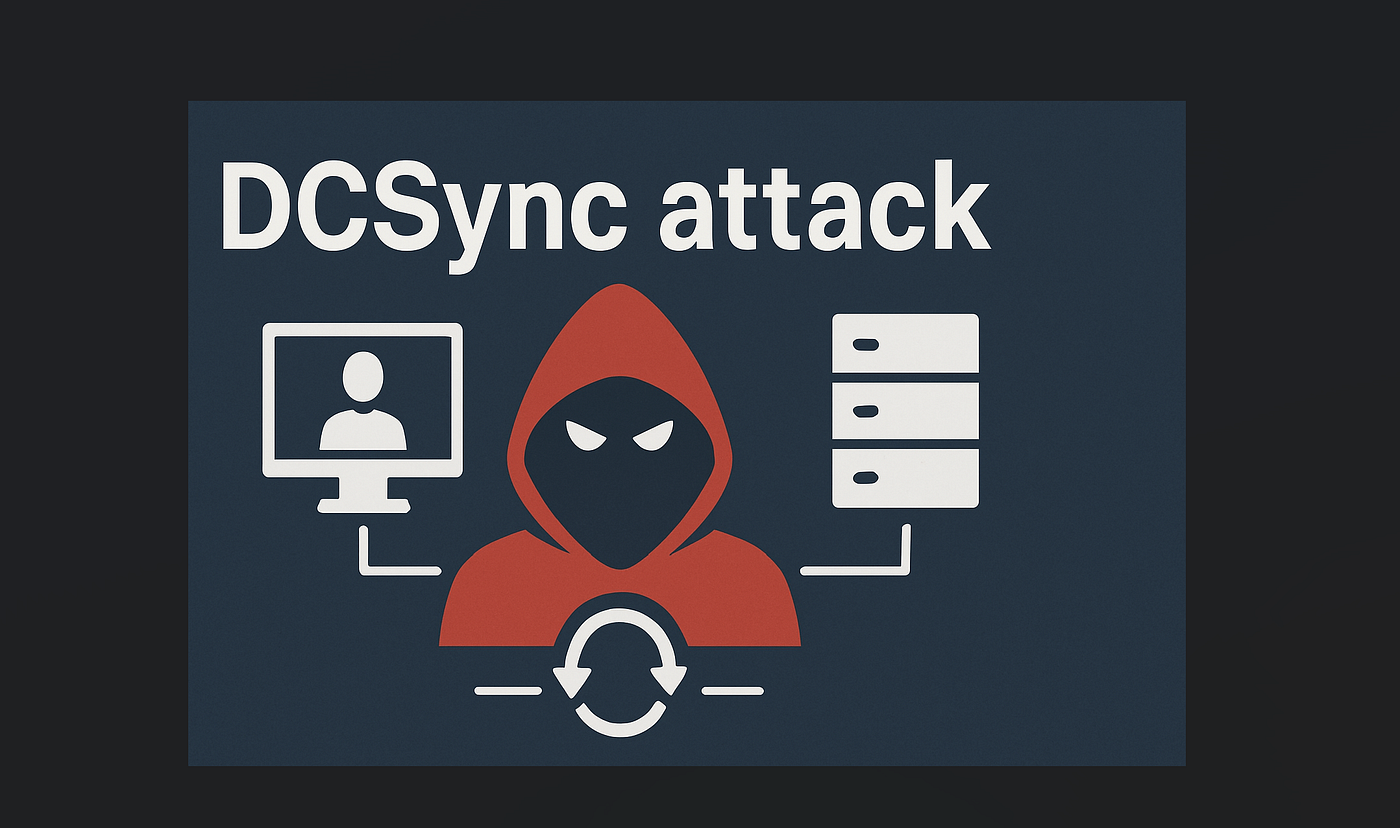
Typical attack chain (example)
- Initial foothold on a workstation or server.
- Credential or privilege escalation to an account that has replication rights or Domain Admin.
- Run DCSync (via Mimikatz/Impacket or custom code) targeting a DC and request sensitive attributes.
- Use stolen hashes/keys for lateral movement, persistence (Pass‑the‑Hash, Golden Ticket), or domain takeover.
Detection — what defenders should look for
Because DCSync leverages normal replication APIs, detection relies on logging, correlation, and baselining:
- Windows event correlation: On the targeted DC, correlate Security Event 4624 (Logon) with 4662 (Directory Service Access) or 5136/5137 (object modifications) using the LogonId — DCSync often appears as a network logon (Logon Type 3) followed by directory object access events. Finding a non‑DC host performing replication‑style access is highly suspicious.
- Monitor replication rights & unusual principals: Alerts when non‑DC machines or low‑privilege accounts suddenly perform replication actions or when an account that never acted as a replication source begins doing so. Elastic/other SIEMs provide prebuilt rules for this.
- Audit DACL changes and privileged group changes: Attackers sometimes add privileges or modify ACLs to grant replication rights — monitor for these changes.
(Important note: Events like 4662 may be noisy or disabled by default — you must enable advanced AD auditing to capture meaningful data.)
Prevention & hardening — practical steps
- Least privilege for replication: Only domain controllers and very few dedicated service accounts should have
Replicating Directory Changes/Replicating Directory Changes Allrights. Remove replication privileges from user/service accounts wherever possible. - Tiered admin model: Separate accounts and workstations for high‑privilege administration (PAM/Red/Blue tiers) so compromises of user workstations don’t lead to domain‑privilege escalation.
- Strong monitoring & alerting: Implement SIEM rules that flag first‑time replication activity, correlation of 4624+4662 with non‑DC source IPs, and unexpected access to
krbtgtor other sensitive objects. Use vendor/OSS detection content (Elastic, SentinelOne, vendor playbooks). - Protect and rotate
krbtgtwhen necessary: If compromise is suspected (or as part of recovery), reset thekrbtgtaccount password twice (waiting the recommended interval between resets) so old Kerberos keys are removed from history — this invalidates forged TGTs. Microsoft documents and community guidance explain doing two resets with the appropriate wait (default >10 hours) to ensure replication/KS lifetimes are handled. Plan this carefully — it impacts authentication infrastructure. - Limit admin tools & monitor for Mimikatz/Impacket usage: Block or alert on known offensive tool behaviour and suspicious use of RPC/DRS APIs from endpoints.
- Harden service accounts and rotate secrets: Use Managed Service Accounts, reduce reuse of credentials, and rotate high‑value secrets frequently. Consider LAPS for admin workstations and strong PAM tooling.
Incident response checklist (if you detect DCSync)
- Isolate the source (host/account) of the replication request — use correlated 4624/4662 logs to find source IP / LogonId.
- Contain compromised accounts/hosts: Disable or reset credentials of the suspected account(s); isolate affected workstations/servers from the network.
- Assess scope: Determine which accounts were requested/replicated — did attacker target only a subset, service accounts, or
krbtgt? - If
krbtgtwas exposed, plan a krbtgt rotation: Follow Microsoft guidance — resetkrbtgttwice with the recommended wait period, and test authentication across AD‑integrated services (this can cause service disruptions if not planned). - Full investigation & remediation: Hunt for initial access vectors, lateral movement artifacts, and persistence; rebuild or thoroughly clean compromised systems as required.
- Post‑incident hardening & lessons learned: Close permission gaps, improve logging and detection, and run red/blue exercises to validate improvements.
Final takeaways
- DCSync is especially insidious because it abuses legitimate AD functionality and can yield domain‑wide credential compromise without an on‑disk credential dump.
- Defend with a combination of least privilege, tiered admin models, strong auditing/alerting, and careful incident planning (including krbtgt rotations when necessary).
메타데이터
- post_id
- adc4e73cd281
- slug
- dcsync-attack-how-it-works-why-its-dangerous-and-how-to-stop-it-adc4e73cd281
- url
- https://medium.com/@paritoshblogs/dcsync-attack-how-it-works-why-its-dangerous-and-how-to-stop-it-adc4e73cd281
- canonical_url
- https://medium.com/@paritoshblogs/dcsync-attack-how-it-works-why-its-dangerous-and-how-to-stop-it-adc4e73cd281
- author_url
- https://medium.com/@paritoshblogs
- status
- ok
- fetched_at
- 2026-07-17 06:16:19