23 Minutes: The Real Cost of Checking Your Phone While AI Thinks
The seconds you spend scrolling while a prompt loads aren’t free — you pay for them in focus you don’t get back
ATTENTION ECONOMY
23 Minutes: The Real Cost of Checking Your Phone While AI Thinks
The seconds you spend scrolling while a prompt loads aren’t free — you pay for them in focus you don’t get back
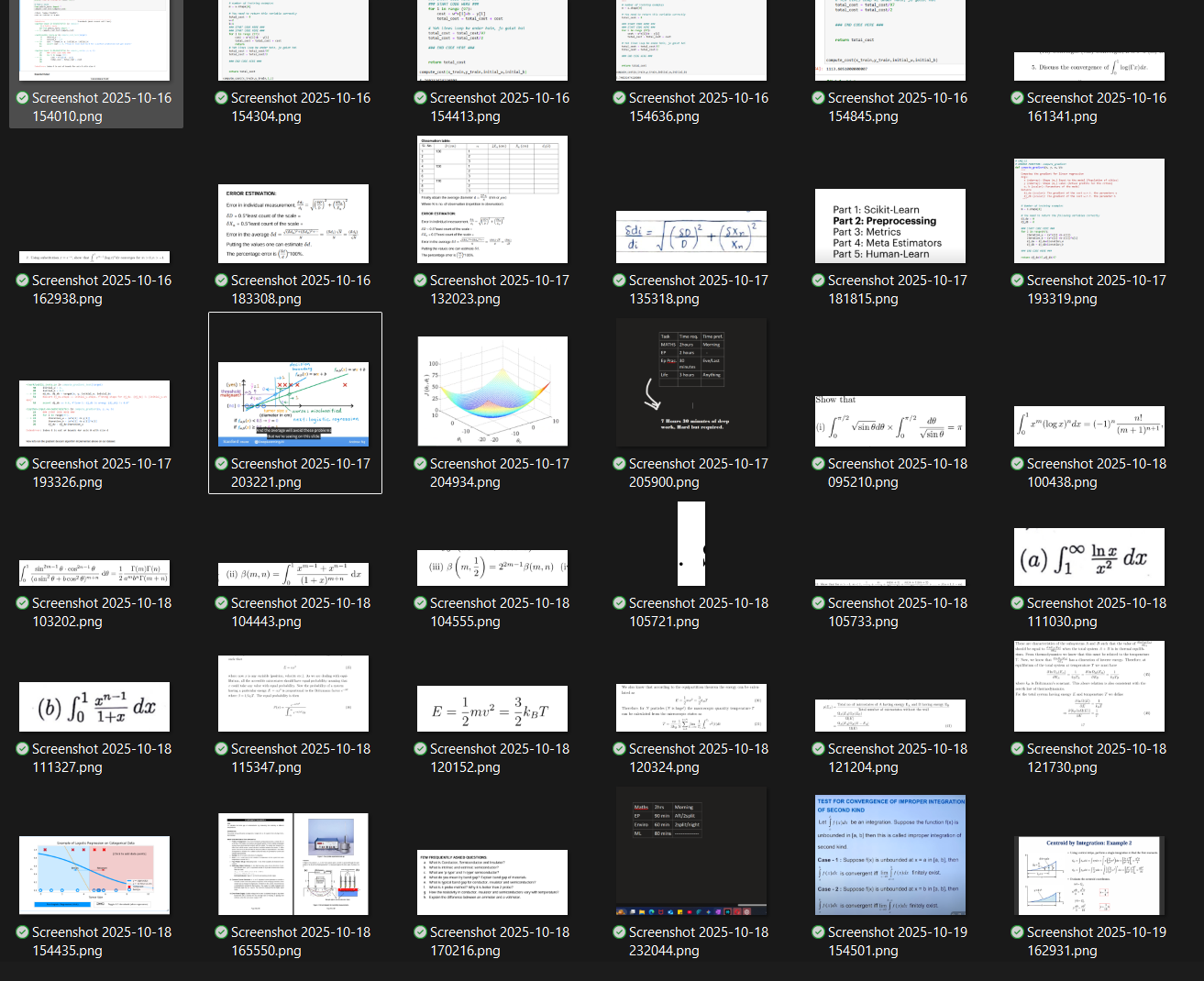
Why this scares me now?(Read to know) — Screenshot of My Screenshots Folder
You asked Gemini a question. It’s thinking. You’re now three reels deep into something you don’t remember opening.
I use AI throughout my day — for research, for doubts, for explaining things I should probably sit with longer than I do. Somewhere in the last few months, I noticed two things quietly wrecking my study sessions, in a way that’s almost invisible until you look for it.
Here’s the thing nobody tells you about using AI “efficiently” — it isn’t actually free. You pay for it. Not in money, and not even really in time. You pay for it in attention you don’t get back.
Problem 1: The 1-Minute Void
![Inability to focus — [AI Generated]](https://miro.medium.com/v2/resize:fit:1400/1*0vuHqKwDUevoGyovUyuMJQ.png)
Inability to focus — [AI Generated]
I prompt Gemini Pro to explain the proof of Lagrange multipliers. It thinks for a minute. In that one minute, I’m on my browser, so I check YouTube. Or Gmail. Or anything.
That one minute cost me way more than one minute.
There’s a number from attention research that changed how I think about this. Gloria Mark of UC Irvine and Sophie Leroy of the University of Washington studied what happens when you switch tasks, even briefly.
It takes an average of 23 minutes to fully re-engage with what you were originally doing. Not 23 seconds. Twenty-three minutes.
So when I think I’m “multitasking” during the AI’s thinking time, I’m potentially borrowing 23 minutes against the rest of my session — my brain doesn’t make a clean cut between tasks. Part of it stays stuck on whatever I looked at.
Here’s what makes it worse — this isn’t really about willpower. Getting distracted is always a choice, sure. But the setup — a chat box in the same browser as YouTube, one tab away from anything you want — makes the choice cheap. Too cheap. There’s no friction between “I am thinking about Lagrange multipliers” and “I am watching a video about something else entirely.”
This kind of friction used to exist. It doesn’t anymore. Your brain, like anyone’s, will take the path with less resistance unless you put the resistance back yourself.
Problem 2 — The Skimming Paralysis
The second thing is quieter, and honestly scarier — it’s changing how I read, not merely how I use AI.
ChatGPT has a habit of giving long, padded answers. Much of it is redundant. So you skim. You learn to skim. And here’s the cost — the habit doesn’t stay contained. You start skimming academic texts too, where every line matters.
This isn’t only my theory. MIT Media Lab ran a study in 2025, putting students on EEG headsets and having them write essays under three conditions — no tools, a search engine, or ChatGPT.
The brain connectivity results were almost a straight line. The no-tools group showed the strongest, most widespread brain activity.
Search engine users, moderate.
ChatGPT users, the weakest.
When the ChatGPT group was later asked to rewrite their own essay without the tool, they barely remembered what they’d written. Two English teachers who reviewed the essays — without knowing which group wrote what — independently called the AI-assisted ones “soulless.”
Worth being honest here — this is a preprint. The sample size is small, 54 people, 18 in the final stage, and other researchers have pushed back on the EEG methodology. I’m not saying AI makes you dumber, confirmed by science. I’m saying the early signal is uncomfortable enough to match exactly what I’m describing about my own reading.
There’s older research that says something similar, less dramatically. Betsy Sparrow’s 2011 study on the “Google effect” found that when people know information is searchable, they stop trying to remember the information itself. They remember where to find it instead.
A Genuine Request
I want to say this directly, not as an AI-criticism take, but as someone who actually lives it.
If you’re a student who self-studies, stop using AI for the small things. I do this myself — I take a screenshot of a paragraph from a textbook or a lecture slide and go straight to Gemini instead of sitting with it for two more minutes. My screenshot folder is the evidence. It’s full of these.
AI is quietly working against critical thinking when used like this. Not because AI is evil — because convenience, used carelessly, always trades short-term ease for long-term skill.
![Comparison — [AI Generated]](https://miro.medium.com/v2/resize:fit:1400/1*y6hAf32Qa8rTvEJCBY4eoA.png)
Comparison — [AI Generated]
What Actually Works — And Why Willpower Isn’t Enough
I already had some fixes for myself. The research explains why some of them work and others don’t.
Here’s what helps with the 1-minute void.
- Don’t default to the most powerful model for small things. The smaller and faster the task, the less reason to give your brain a 60-second exit door.
- Block tabs sitting one click away, using LeechBlock, xTab, or anything similar. The point isn’t discipline — it’s removing the option so discipline doesn’t have to fight a battle it usually loses.
- Keep your own attempt running in parallel. Don’t sit and wait — actively keep working the problem while the AI “thinks.”
- Park your doubts. Write them down, batch them, and take them to AI in a single session instead of breaking your flow every time a question comes up.
Here’s what helps with the skimming paralysis.
- Most AI tools let you set a custom instruction or preference. Tell it to give short, dense answers by default.
- Treat AI skimming and book reading as two distinct modes on purpose. Skimming itself isn’t the danger — even strong readers skim parts of a text. The danger is skimming becoming your only mode, even for material where every line earns its place.
- This connects to what cognitive psychologists call “desirable difficulty,” going back to Robert Bjork’s research at UCLA — information you struggle to retrieve sticks far better than information handed to you smoothly.
- Easy learning feels productive in the moment and is often the weakest in the long term. If reading a dense paragraph feels harder than asking AI to summarise it, the difficulty isn’t a bug. It’s the part of building your memory.
But Why Every Fix Failed for Me
Every system I’ve tried to boost my productivity — setting timers, marking session topics, time distribution, remembering to do certain things — fails for the same reason. It’s an extra step.
It’s something you have to remember to do, on top of the thing you’re already doing. Under any kind of cognitive load — exactly when you need it most — the extra step is always the first thing dropped. This isn’t a discipline failure. It’s a design failure in the system itself.
The fix isn’t a better reminder. It’s removing the need to remember anything at all.
So instead of “remember to not get distracted while AI thinks,” make the wait itself the trigger for a fixed, pre-decided physical action — something so automatic it doesn’t require a decision in the moment. The second you hit send on a prompt, your hand already knows where it’s going — to a pen, to write down your own attempt at the answer, not to your phone.
Not because you decided to be disciplined right then. Because there was never a decision to make.
This is the one fix I’d actually bet on. Not because it’s clever — because it doesn’t ask anything of your willpower at exactly the moment your willpower is weakest.
I sent this draft to Gemini once to check if it sounded too harsh. It took about a minute to respond. I know exactly what I did with it.
Support writers. All our nonprofit’s offerings here.
Click for Wordsmith, Mystery Writing, Write Like Stephen King, more

By the EIC Susan Brearley with Ideogram
메타데이터
- post_id
- adcd05651eaa
- slug
- i-have-417-screenshots-of-me-giving-up-on-thinking-adcd05651eaa
- url
- https://medium.com/it-chronicles/i-have-417-screenshots-of-me-giving-up-on-thinking-adcd05651eaa
- canonical_url
- https://medium.com/it-chronicles/i-have-417-screenshots-of-me-giving-up-on-thinking-adcd05651eaa
- author_url
- https://medium.com/@shreshthhh99
- status
- ok
- fetched_at
- 2026-07-18 08:45:11