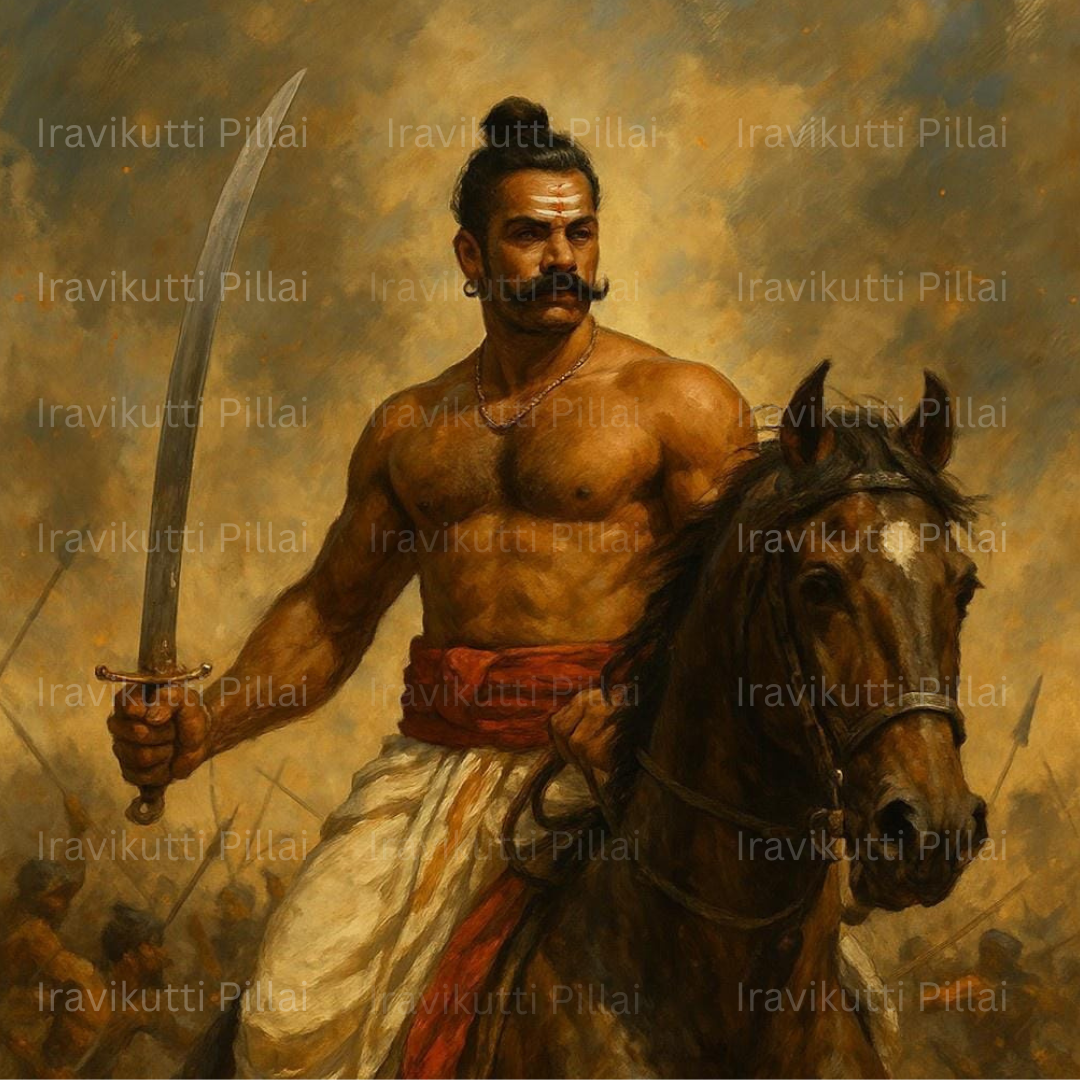
IRAVIKUTTI PILLAI: The Unsung Hero of Travancore’s Nair Legacy”
The Second Battle of Kaniyamkulam was a pivotal event in the history of Kerala, emerging from the embers of vengeance and military defeat…
IRAVIKUTTI PILLAI: The Unsung Hero of Travancore’s Nair Legacy”
The Second Battle of Kaniyamkulam was a pivotal event in the history of Kerala, emerging from the embers of vengeance and military defeat. This conflict was ignited by the beheading of General Vellayan, a distinguished commander of Thirumalai Nayakar’s army, and the previous failure of the Nayakar forces against the formidable Nair warriors of Travancore. When news of this setback reached the court of Thirumalai Nayakar, sovereign ruler of Madurai, it was met with fury and resolve. The king, deeply affronted by the disgrace of his army’s retreat, convened an emergency war council within the grandeur of his royal court. His voice, resolute and commanding, echoed through the chamber as he issued a singular and unwavering decree — retaliation was inevitable. His proclamation set into motion a war effort that would shake the region to its core. Across the Nayakar dominion, war drums resounded, their thunderous beats signaling the mobilization of a formidable force. The elite war elephants, their ivory tusks gleaming in the sunlight, were prepared for battle, while the cavalry — renowned for its speed and precision — was summoned to march upon Travancore. The king’s call to arms reverberated across the land, met with an unwavering response from his loyal vassals — the Palayakarars, whose allegiance and military prowess had long served the Madurai kingdom.
The Nayakar army was bolstered by a diverse and formidable array of warriors drawn from military tribes such as Maravar and Nayakar soldiers. The peasents from the communities such as Chettis, Vellalars, and Pattani warriors, all pledging their swords to their sovereign. Alongside them, the Rawoothars, Kuravanmar, Vadakanmar, Konkanadesakars, and Pattinimars took up arms. At the helm of this vast and disciplined army stood Ramappaiyan, Thirumalai Nayakar’s most trusted minister and an astute military strategist. With the weight of duty upon his shoulders, he meticulously orchestrated the campaign, leading the forces toward the battlefield with precision and determination. Their march, unwavering and relentless, took them through the rugged landscapes of South India, reaching Eethakanadu near Nagercoil in the Kanyakumari district, where they established their war camp in preparation for the decisive confrontation. The army advanced strategically, maneuvering through various key locations. Moving through Thirupathisaram and Vadaseery, they ultimately converged at Kanniyakulam — the site destined to witness one of the most significant battles in the history of the region. As the forces of Madurai prepared for war, the stage was set for a clash that would determine the fate of kingdoms and warriors alike.
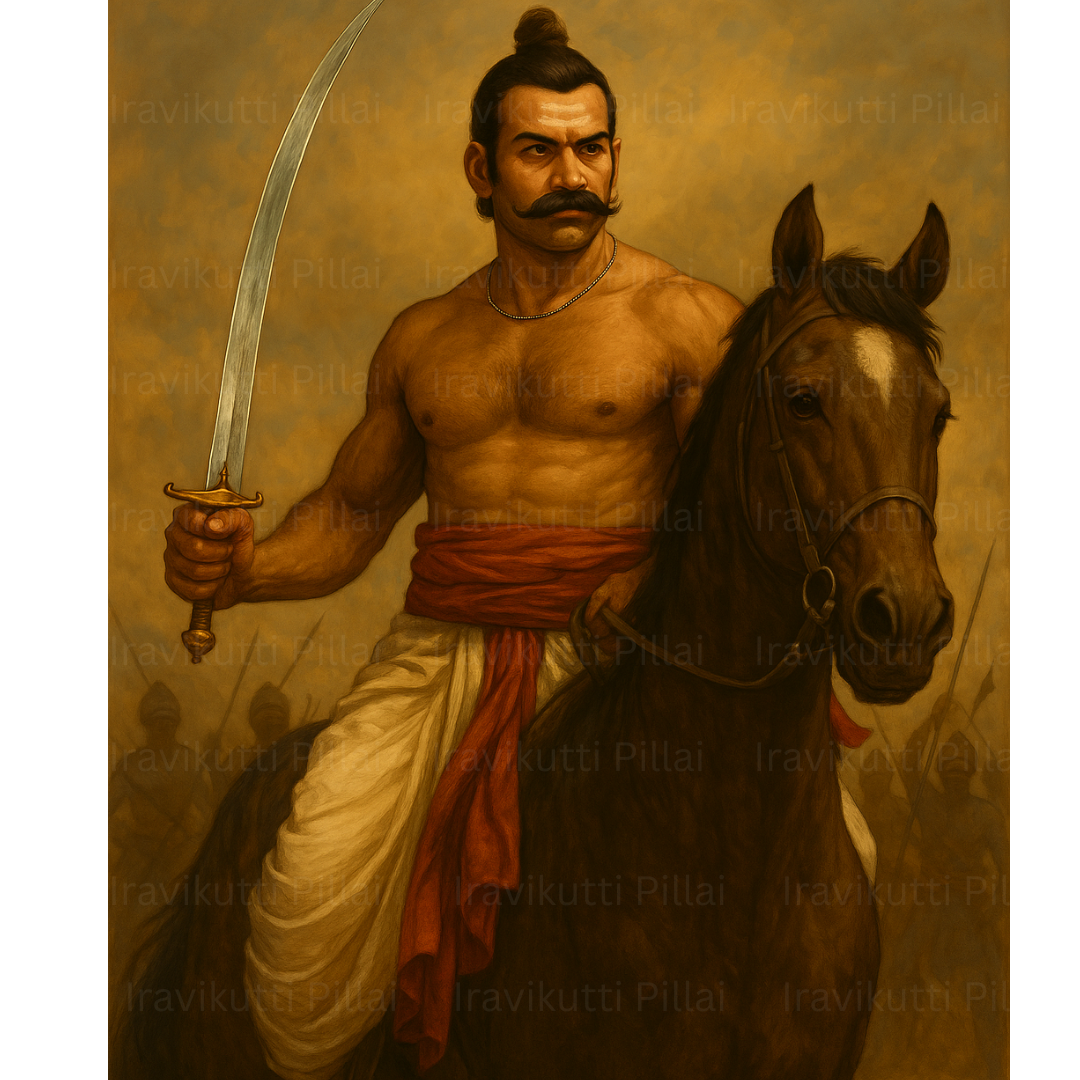
It was the reign of Vanchi Marthanda Varma, the sovereign of Thirpapoor Swaroopam , intelligence of an impending attack reached the royal court. In response, the king swiftly mobilized his forces, summoning the Kurups of Travancore, the Desavazhis (governors), and the elite Nair warriors, including the distinguished Munilakar. Additional reinforcements included the elephant-mounted warriors (Aannakar), the Yogakar, and the highly trained Illankam-Nair Kalari units.
Recognizing the gravity of the situation, Unni Kerala Varma convened a war council, assembling his most trusted ministers: Idatharathevan (or Idatharapotty), Kothamurukan, Kalayapaperumal, Kulathoor Raman, Shankakumaran, Veeran Keshawan, Ishwaran Devan, and Iravikuttypillai. At this crucial assembly, the king posed a decisive question — who among them would lead the army? A moment of silence followed until Iravikuttypillai, demonstrating unwavering resolve, volunteered to assume command from the front. The remaining ministers assured their support from the flanks, marking the beginning of a strategic and fateful campaign.
Iravikuttipillai, a figure of remarkable intellect and martial prowess, had assumed ministerial responsibilities in Travancore at the young age of sixteen. He was the son of Anizham thirunaal Vanchi Marthanda Varma and Ummaamma Pilla Thangachi of Keralapuram, and his upbringing was marked by rigorous training in both governance and combat. His family was mentioned as a house located near padmanabapuram, from where several nairs shed blood for the country.

Under the guidance of Papuvilakam Kochu Narayana Pillai, he became a master of martial arts, excelling in the use of weaponry and battlefield tactics. Beyond his military skills, Iravikuttypillai possessed exceptional linguistic abilities, being well-versed in Sanskrit, Malayalam, Tamil, and Manipravalam. His administrative acumen distinguished him within the royal court, earning him widespread recognition. However, his competence also bred resentment among the ministers of Ettara Yogam, who viewed his growing influence with envy. For years, they sought an opportunity to diminish his stature, and the impending war provided them with the perfect pretext.
Conspiracy Against a Leader
As the kingdom prepared for battle, a clandestine scheme unfolded within the court. Led by Veeran Keshawan, a faction of ministers orchestrated a plot to eliminate Iravikuttypillai. They dispatched a covert messenger to the enemy camp, revealing their intent to betray the young commander. The message reached Ramapayyan, a key strategist in the opposing ranks. Initially taken aback by such an act of treachery, he soon recognized the strategic advantage it offered. By facilitating Iravikuttypillai’s downfall, Ramapayyan saw an opportunity to strengthen his standing with Thirumalai Naicker, the ruler he served. Consequently, he chose to cooperate with the conspirators, ensuring that the betrayal would be executed on the battlefield. As the war loomed, the stage was set not only for a decisive confrontation but also for an act of internal treason that would test the resilience and legacy of Iravikuttypillai.
Dark Omens at Keralapuram
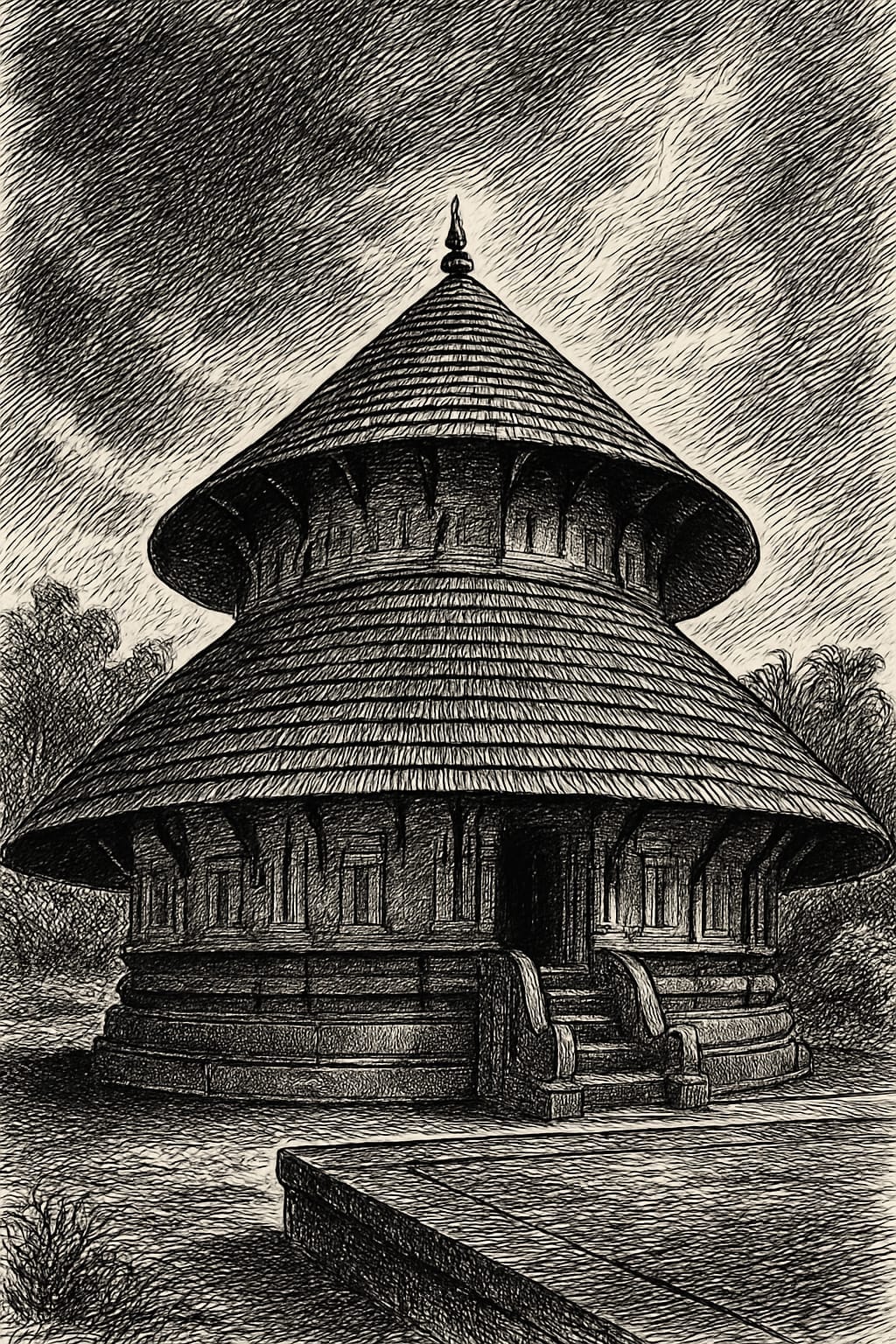
While war preparations were underway, the atmosphere at Iravikuttipillai’s ancestral home in Keralapuram was heavy with sorrow. His mother, Ummaya Pillai, observed a series of ominous signs, which deeply unsettled her. In their time, omens were considered significant warnings from the divine, shaping decisions and actions in daily life. Disturbed by these ill omens, Ummaya Pillai confided in her daughter-in-law. Iravikuttypillai’s wife Devaki Pilla Thankachi, gripped by fear, begged him not to go to war. She pleaded with him, citing the signs she had witnessed — her mangalasutra (sacred marital thread) had broken, a giant Vadavriksha tree had been uprooted, and Maravas (warriors from the rival faction) had captured her husband’s sword in a vision. Even more alarming, the chariot of the Kalkulam Neelakanda Swamy Temple, which had been in perfect condition, had suddenly broken down and collapsed to the ground — an ill omen of grave misfortune. Despite these dire warnings, Iravikuttypillai, the fearless warrior, refused to heed their pleas. His spirit remained unshaken, his mind set on battle. With unwavering resolve, he reassured his wife and mother, dismissing their fears as mere superstition. His destiny, he believed, lay on the battlefield.
Hearing his wife’s tearful pleas, Iravikuttypillai remained calm and resolute. With patience, he recounted the ancient tale of King Parikshit and Takshaka, the serpent king, to console her. He reminded her that fate is inevitable — just as Parikshit could not escape his destined end despite all precautions, neither could he. Looking into her anxious eyes, he reassured her with unwavering determination. “I have sworn before the court to lead the soldiers of Travancore against the Nayak army. How can I, a warrior, retreat from my word? It would be a shame for someone of my standing to turn back now.”
He continued, “I do not fear death, nor can I escape my fate. Even if I were locked inside a coffin, death would still find its way to me. No man can outrun his destiny.” With a firm voice, he declared, “If my time has come, so be it. I belong to a community where we train our bodies from a young age to face adversity. As a Nair, bound by duty and honor, should I not fight for dharma? Should I not defend my land and uphold the fame of my tharavad?” His words carried the weight of conviction, silencing all further protests. Though his wife and mother remained sorrowful, they could not break his resolve. The path of a warrior was one he had chosen, and he would walk it with pride — no matter the cost.
The Final Departure
Realizing that she could not stop her husband, Iravikuttypillai’s wife resigned herself to fate. His mother, too, made a final attempt to dissuade him, citing astrological warnings of impending doom. However, Pillai remained steadfast. Without hesitation, he began his preparations for war. He bathed, dressed in his battle attire, and armed himself with his sword, bow, arrows, and other weapons. As he made his final preparations, his wife wept silently in a corner, unable to contain her sorrow. Seeing this, Pillai gently consoled her. “Can a brave wife, one born with Kshatraveerya, cry like this?” he asked with a reassuring smile.
He then placed a few gold coins in her hand as a symbolic offering before battle, bowed at his mother’s feet, and sought her blessings. From there, he proceeded to his Illankam — the renowned Kalari training center of Southern Kerala — where he prostrated before his Kula Devata (family deity), seeking divine strength. When Pillai stepped out of his house, a sea of Nair soldiers awaited him. They erupted in praise as he mounted his favorite horse. However, the steed showed signs of hesitation and fear — another ill omen. Yet, Pillai remained undeterred. Ignoring all these warnings, he urged the horse forward, riding with unwavering resolve toward Udayagiri Fort, where the king was camped. Upon his arrival, his father, King Unni Kerala Varma, embraced him with pride but also concern. “Be careful, my son,” the king advised. “If ever you sense danger, send a messenger immediately.” With a solemn blessing, the king added, “Padmanabha will protect you.”Pillai, ever fearless, responded, “Even if defeat looms, I shall fight till my last breath.” Before proceeding to war, he visited a temple — likely the one near Udayagiri Fort — offering prayers for victory. From there, he rode through the towns of Thiruvidaicode, Paruthivila, Chunkankada, and beyond, reaching the battlefield where the decisive encounter awaited him.
The Battle of Valor: Iravikuttipillai’s Last Stand
The battlefield was a storm of fury and steel. Under Iravikuttypillai’s command, the forces of Travancore stood as an unyielding wall against the advancing enemy. From Neyyattinkara, Nemom, Eraniel, Pakode, and Kazhakootam, seasoned Nair warlords and warriors had assembled, their bows strung, their swords sharpened, their spirits aflame with the duty to defend their motherland. The air trembled with war cries as the two armies clashed, the echoes of steel meeting steel resonating through the vast fields of battle.
At the vanguard, Iravikuttypillai fought with the skill of a warrior born for war. His arrows struck their marks with lethal precision, felling enemy warriors before they could advance. The ground trembled beneath the pounding of hooves, the charge of war elephants, and the relentless push of his soldiers. But even as he led his men with unwavering resolve, treachery lurked within his own ranks. The conspirators — those who had long envied him — had woven their scheme into the chaos of battle, waiting for the moment to strike.
The enemy forces, a fierce assembly of Maravars, Vadukars, Rawuthars, and Pattani warriors, surged forward with deadly force. Muskets cracked through the battlefield, smoke and fire mingling with the scent of blood and sweat. Yet, Travancore’s warriors, trained in the ancient art of war, stood their ground. In a moment of triumph, Iravikuttypillai’s forces captured the Nayak banner — an act that sent waves of victory cries through the Travancore ranks. It was a symbol of dominance, a signal that the enemy was faltering.
But the battle was not yet won. Ramapayyan, sensing defeat, called for reinforcements. More horsemen stormed into the fray, the battle raging anew with an intensity that shook even the most hardened of warriors. The enemy ranks wavered, and key figures among them — Trisanku Kodi Veeran, Edatahara Potty, and Ilampayil Pandaram — began to retreat, vanishing into the dense forests in fear of their inevitable demise. Some of Iravikuttypillai’s loyal commanders urged him to retreat as well. The number of his warriors had dwindled, the battle stretching into a brutal confrontation of attrition. Yet, retreat was never an option for him. He stood defiant, his resolve unbroken, his duty to his land unwavering. With fire in his eyes and steel in his grasp, he chose to fight on.
The Fall of a Hero
As the battle reached its most merciless stage, Iravikuttypillai’s forces suffered devastating losses. Yet, even in the face of such overwhelming odds, he remained a titan on the battlefield. His sword cleaved through enemies as though guided by the gods themselves. Bloodied but unbowed, he fought with a fury that sent shivers down the spines of his foes. But fate, cruel and relentless, had conspired against him. Struck down by the enemy’s blade, his body bore the wounds of countless clashes. His strength waned, yet his spirit remained unyielding. Refusing to surrender, he wielded two swords in a final, desperate stand — a testament to his indomitable will.
For seven days, legend says, Iravikuttipillai held his ground. Seven days of unrelenting combat, of steel flashing through the air, of defiance against the tide of betrayal and bloodshed. But even the greatest warriors are bound by mortal limits. On the seventh day, exhausted and grievously wounded, he fell — not in surrender, but as a lion brought down by a thousand blades.
His severed head was carried by Ramapayyan and presented to Thirumalai Nayakar as a trophy of war. Yet, it was not the enemy who claimed victory that day. The legend of Iravikuttypillai would endure beyond death, beyond treachery, beyond time itself. He had not merely fought a battle — he had carved his name into history, a name that would forever be spoken with reverence, a symbol of unyielding courage and unshakable honor. The camp celebrated the victory, but the Nayakar himself was both astonished and sorrowful upon seeing the warrior’s head. “Who is this man?” Nayakar asked. Ramapaiyan replied, “He was one of the most efficient ministers of Travancore, a foremost leader and an exceptional warrior.”. Observing the dignified aura of the severed head, Thirumala Nayakar was moved. He gazed at the warrior’s noble features, adorned with fine kundalas (ear ornaments) and the sacred kasthuri tilaka. With a deep sigh, he lamented, “How could such a valiant warrior be beheaded? Why did you not capture him alive? Ramapaiyan, you have slain him through deceit — this is an injustice.” Overcome with remorse, Nayakar commanded, “Return his head to his homeland, ensuring it is treated with the respect it deserves.”
When the news of Iravikutty’s death reached Travancore through the Charans (messengers), the entire kingdom was plunged into sorrow. The royal family, ministers, and citizens mourned the loss of their valiant warrior. The ministers convened to discuss how to deliver this heartbreaking news to his mother. However, there was still a grave challenge ahead — the Vaduka Pada (Nayakar’s forces) were stationed at Aralvaimozhi, blocking the way to retrieve Iravikutty’s severed head. The ministers deliberated on who would undertake the perilous mission. The king and his council were deeply troubled, as the soldiers hesitated to approach the battlefield, fearing the enemy forces.
At that time, a warrior named Kaali Nair, a devoted disciple of Iravikutty, was visiting the Anantha Padmanabhaswamy Temple. Upon hearing the tragic news, he was struck with grief. Overwhelmed, he murmured, “I am his student, trained in the eighteen disciplines of Kalari. He raised me from childhood, teaching me the arts of combat — Kadaka, Vijayam, Viswamohanam, Shatrunjayam, Padalam, Shilakhandam, Satha Sastram, and many more. Yet, in the moment of his greatest need, I was absent. What kind of disciple am I, unable to stand by my master?”. Cursing his helplessness, Kaali Nair vowed, “I will retrieve my master’s head,” and sought permission from the king to embark on this dangerous mission. With unwavering courage, Kaali Nair entered the enemies camp, where the enemy forces were stationed. Displaying extraordinary skill and fearlessness, he left the Marava soldiers in awe. They rushed to inform Ramapaiyan of his presence.
When Kaali Nair was presented before Ramapaiyan, the latter mocked him, saying, “If you wish to find your master’s head, search among the many severed heads before you.” Unshaken, Kaali Nair responded, “If I fail to find his head, I will slay every one of you, and another war will begin here.” Recognizing the unwavering devotion and fury in Kaali Nair’s eyes, Ramapaiyan was moved by his loyalty. Acknowledging his master’s greatness, he decided to return the head. Kaali Nair swiftly identified Iravikutty’s severed head and, upon seeing it, broke down in sorrow. He cursed himself for failing to protect his master and rolled on the ground in anguish. Moved by his grief, even the Marava soldiers approached him and consoled him. Witnessing Kaali Nair’s unwavering loyalty, the soldiers in the opposing camp marveled, saying, “Are there disciples with such pure hearts? We have never seen such devotion and integrity in our land.” Watching Kaali Nair’s unwavering devotion and fearless demeanor, Ramapaiyan was intrigued. He approached the soldier and asked, “Who are you, and where do you come from?” Kaali Nair replied with pride, “I am Kaali Nair from Keezhkulam, near Thenkapatanam.” Impressed by his bravery, Ramapaiyan extended an offer. “Join my army. I will reward you with wealth and gold.” Without hesitation, Kaali Nair firmly refused. “I will not serve under an army that does not belong to me. I do not fight for wealth but for honor.”

Recognizing his loyalty, Ramapaiyan handed him Iravikutty Pillai’s severed head. With great reverence, Kaali Nair carried it back to Travancore. Upon his return, the ministers and citizens of Travancore were astonished by his courage. The entire kingdom mourned once more as Pillai’s family and people were engulfed in sorrow. At Keralapuram, the king and stationed soldiers honored Iravikutty Pillai with grand death rituals. Eighteen ceremonial sounds echoed through the air, and final rites were performed at his ancestral house. As a mark of gratitude, the Travancore kingdom granted Kaali Nair’s family vast lands at Kunchakodu. These lands remained in possession of his descendants for generations. Despite the honor bestowed upon him, Kaali Nair remained in deep grief. One day, he visited Pillai’s mother, seeking solace. Still burdened with sorrow, he proceeded to the Ayudhashala (weapon training hall). There, he equipped himself with various weapons, bowed before Elankam (a sacred place), and performed an intense sequence of Kalari steps as a final tribute to his master.
In a final act of devotion and despair, he took his own life by leaping onto a spear. Thus, two great warriors — master and disciple — met tragic ends, yet their legacy of patriotism, unwavering loyalty, and friendship remained immortal. Iravikutty Pillai was martyred at the young age of 32, fighting with relentless courage until the very end.
Conclusion:
The tale of Iravikutti Pillai and Kaali Nair is one of extraordinary courage, loyalty, and sacrifice. Iravikutty fought valiantly for his land and people, never retreating even in the face of certain death. His unwavering determination in battle made him a legend, a warrior whose bravery echoed through history. Kaali Nair, his devoted disciple, demonstrated unparalleled loyalty and gratitude. His journey to reclaim his master’s severed head, his refusal to serve a foreign army, and his ultimate sacrifice stand as testaments to the depth of his devotion. Their bond transcended the battlefield, embodying the ideals of patriotism, guru-bhakti (devotion to one’s teacher), and honor. Even in death, both warriors became immortal, leaving behind a legacy that continues to inspire generations. Their story remains etched in the annals of Travancore’s history as a shining example of true heroism and unwavering loyalty.
메타데이터
- post_id
- add6c81a4c0a
- slug
- iravikutty-pillai-the-unsung-hero-of-travancores-nair-legacy-add6c81a4c0a
- url
- https://medium.com/@nairsofkerala/iravikutty-pillai-the-unsung-hero-of-travancores-nair-legacy-add6c81a4c0a
- canonical_url
- https://medium.com/@nairsofkerala/iravikutty-pillai-the-unsung-hero-of-travancores-nair-legacy-add6c81a4c0a
- author_url
- https://medium.com/@nairsofkerala
- status
- ok
- fetched_at
- 2026-06-11 10:13:20