Vandal Hearts: Wayback Wednesday Vol. 15, Part 2
Vandal Hearts was released early in the PlayStation’s life cycle, and while it was impressive for its time, it hasn’t aged perfectly in…
Vandal Hearts: Wayback Wednesday Vol. 15, Part 2
Vandal Hearts was released early in the PlayStation’s life cycle, and while it was impressive for its time, it hasn’t aged perfectly in every respect. With that said, there’s still a lot to like, and despite its rough edges, it remains a worthwhile experience to this day.
Almost immediately, you’ll notice the story is very engaging, filled with war, resistance groups, terrorism, and double-crossing. The overall environment and plot are serious, though you will find an occasional humorous point here and there to lighten the mood just a little; those are temporary and fleeting against the overall grim tone of the plot. On the other hand, if you don’t want a heavy dose of politics (and related topics) mixed in with your video gaming, this might be a game you’d be better off avoiding.
Another thing that will become very apparent within minutes of starting a new game is that Vandal Hearts earns its “M” rating with its very bloody death animations. Every time you kill an enemy, they erupt in a fountain of blood. If you struggle with the sight of blood or consider yourself a pacifist, I would pass on this title. The mature subject matter and topics covered in the game are a secondary reason for the label of “M”. You probably want to be familiar with at least the basic topics covered in your typical civics 101 class, as well as have some working knowledge of world war 2, as this game draws some parallels with that war.
The gameplay is very simple, at its core, and plays out on large isometric fields with all sorts of natural and man-made barriers that can either hinder and annoy you a great deal, or serve as a way to help you improve your strategy and lead your troops to victory. For example, many characters have a limited range when going up hills compared with simply traveling over flat land, flying characters can hover over water and other obstacles that prevent everyone else from moving, and boulders can be pushed to take off significant damage from enemy troops.
While much of the game is easy, there are some very difficult missions sprinkled in. One of the first difficult missions you will come across starts when your characters enter a village and notice all of the villagers are turned into zombies or some other weird creatures. They decide it is better not to kill them, and you spend several frustrating turns desperately trying to run from them, as killing all of them leads to game over. Killing some means a lot less money, which is difficult because money is incredibly important for upgrading character equipment and not always easy to come by, especially early. But it is not just running from these zombie creatures; they actively and aggressively pursue you and will attack you, and have a decent range that trumps the range of some of your characters. This is where you start to realize, if you have not already, that using obstacles found in your environment is paramount to your eventual success.
Another tough mission has you chasing down dogs with very large ranges, and yet another tough mission dictates that you stop a large enemy group from exiting the screen, for if even one escapes the battle map, it is game over. In battles like the one just mentioned, impeccable timing and perfect use of every single turn are of the utmost importance, for even misusing one turn from one character in a battle that lasts 5 or more turns could lead to a loss.
Another battle has 3 characters surrounded, 360 degrees, with enemies who have a height advantage and you have to outlast them for many turns. Very hard. That is where this game loses points for me, the poor balance between the majority of very easy battles, with the occasional unforgiving battle where even one wrong move out of the 50+ you likely make in that battle could spell doom. This is especially highlighted in the 2nd battle of the 4th chapter. If you get past that, you will beat the game, so just show patience and perseverance until that point!
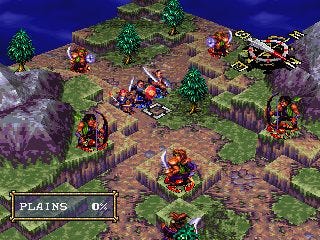
With all of that said, it is refreshing to see a strategy game, especially one from so long ago, that goes beyond the “bash their brains in, go to the next map, rinse and repeat” but actually requires you to do different things depending on the map and actually utilize a well-thought-out strategy. In the end, is this game hard? Yes, there are 4 or 5 brutal battles, but otherwise, the difficulty is very manageable throughout the six chapters. Each chapter has between 4 and 7 battles.
Again, the gameplay, at its core, is simple, but the strategies you will deploy can be quite complex, and the game gives you quite a bit of room to test out your ability to plan in several battles.
Where battles fall flat is the limited customization of each character. Everyone has limited weapons and armor, and although there are two class changes, at levels 10 and 20, you are limited to those 2 changes (and for some characters, just one change). Each class has a limited number of skills and/or magic as well, and you will find yourself using the same 2 or 3 moves for each character.
Keep in mind that this game also operates on a rock-paper-scissors philosophy for attacks, where arrows beat flying, magic beats heavy armor, swords beat archers, and so on.
The game does an incredible job of creating a solid atmosphere and a unique game world, one helped by the music, which feels grand but at the same time, urgent. Some of the town's music is mysterious, while others offer a well-needed, peaceful respite.
While the graphics and character sprites are clearly a product of their time, these issues take a back seat and are ultimately overshadowed by the excellent storytelling and plot progression. Don’t play this game to be wowed by its colours and animation, but for the intrigue.
Overall, this game should take around 12 to 18 hours. There is only one side quest and very little replayability unless you want to test out some other classes you didn’t pick on a first playthrough. Many hidden items are very hard to find, unless you have a walkthrough, and honestly, not worth the effort in finding if you are intent on playing this game blind, unless you are a completionist. Play this game with the understanding that it is mid-90s PlayStation in every way possible, but with the expectation of a well-told, interesting story with a few twists and battles that are thought-provoking.
Wayback Wednesday Volume 1, Part 1: Chrono Trigger and Part 2: Final Fantasy 7.
Wayback Wednesday Volume 2, Part 1: Super Metroid and Part 2: Castlevania: Symphony of the Night.
Wayback Wednesday Volume 3, Part 1: The Legend of Zelda: A Link to the Past and Part 2: Lunar Silver Star Story Complete.
Wayback Wednesday Volume 4, Part 1: Secret of Mana and Part 2: Wild Arms.
Wayback Wednesday Volume 5, Part 1: Illusion of Gaia and Part 2: Grandia.
Wayback Wednesday Volume 6, Part 1: Breath of Fire 3 and Part 2: X-Men Legends.
Wayback Wednesday Volume 7, Part 1: Star Ocean: The Second Story and Part 1: Super Mario RPG
Wayback Wednesday Volume 8, Part 1: Dragon Quest VI and Part 2: Demon’s Crest
Wayback Wednesday Volume 9, Part 1: Suikoden I and Part 2: Jeanne d’Arc
Wayback Wednesday Volume 10: Ranking the first 6 Final Fantasy games
Wayback Wednesday Volume 11, Part 1: Earthbound and Part 2: Valkyrie Profile
Wayback Wednesday Volume 12 Part 1: Legend of Legaia and Part 2: Secret of Evermore
Wayback Wednesday Volume 13 Part 1: Threads of Fate and Part 2: Soulblazer
Wayback Wednesday Volume 14 Part 1: Radiata Stories and Part 2: Robotrek
메타데이터
- post_id
- ade4e4b0896a
- slug
- vandal-hearts-wayback-wednesday-vol-15-part-2-ade4e4b0896a
- url
- https://medium.com/@carld18/vandal-hearts-wayback-wednesday-vol-15-part-2-ade4e4b0896a
- canonical_url
- https://medium.com/@carld18/vandal-hearts-wayback-wednesday-vol-15-part-2-ade4e4b0896a
- author_url
- https://medium.com/@carld18
- status
- ok
- fetched_at
- 2026-07-10 23:26:47