The state of Flutter as of August 2024
Flutter, the beloved cross-platform framework from Google, has been a favourite among developers for its ability to deliver beautiful…
The state of Flutter as of August 2024
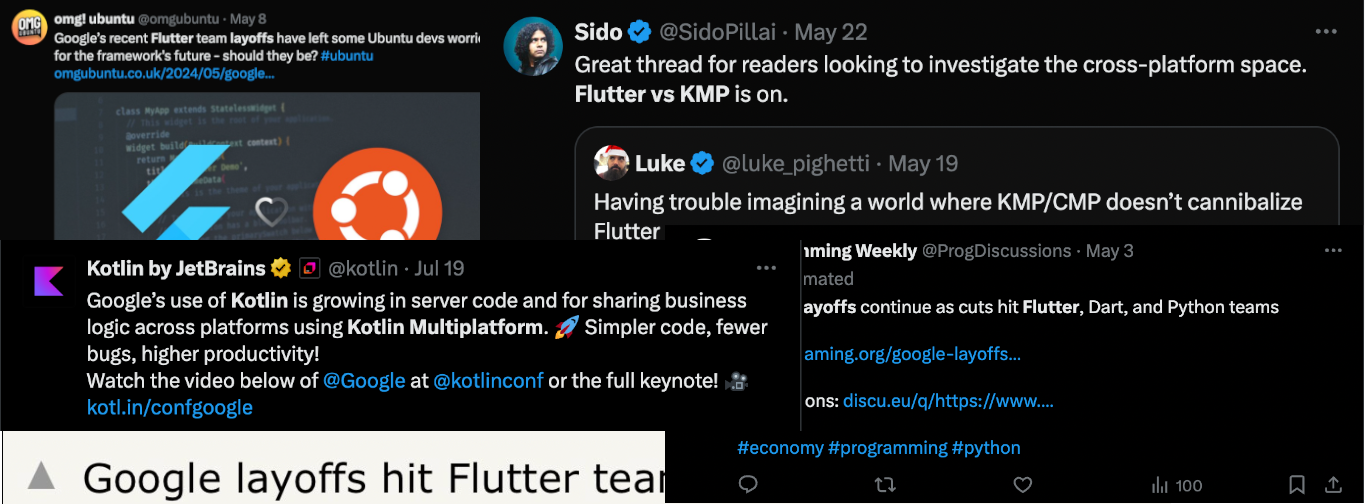
Tweets can sometimes be ominous! What if they are hash-tagged #Flutter?
Flutter, the beloved cross-platform framework from Google, has been a favourite among developers for its ability to deliver beautiful, high-performance apps across Android, iOS, and more. But recent events and emerging technologies are causing some developers to question whether Flutter’s dominance might be under threat. One contender that has been gaining significant attention is Kotlin Multiplatform (KMP), a technology that promises to unify Android and iOS development under a single Kotlin codebase. As a Flutter developer, you might be wondering if it’s time to jump ship — or if Flutter is still the safest bet.
Let’s dive into the details.
A Brief Overview: Flutter and KMP
Flutter has become a go-to framework for cross-platform development, largely because of its powerful rendering engine, Impeller, and its use of the Dart programming language. Flutter apps are known for their consistent performance across platforms, with a single codebase that can be compiled to native code for iOS, Android, and even web and desktop applications.
Kotlin Multiplatform, on the other hand, allows developers to write code once in Kotlin and share it across multiple platforms, including Android, iOS, desktop, and web. Unlike Flutter, which uses Dart and relies on its own rendering engine, KMP uses Kotlin, a language native to Android development, and integrates directly with platform-specific codebases. This allows developers to use native UI components and access platform APIs more seamlessly.
The Fear: Google’s Commitment to Flutter
There is a growing concern among Flutter developers about the future of Flutter, especially given Google’s track record of abandoning projects. Remember Google+, Google Reader, or even Google Hangouts? These were all services that, despite their popularity, were eventually discontinued as Google’s focus shifted. The fear is that Flutter could suffer the same fate, especially with the recent layoffs at Google that impacted some members of the Flutter team. The concern is that if Google decides to reduce its investment in Flutter, developers who have committed to the framework might be left scrambling.
The Allure of Kotlin Multiplatform
Kotlin Multiplatform has been gaining traction, particularly after Google announced its official support for the technology during Google I/O 2024. This is a significant endorsement, especially since KMP is developed by JetBrains, not Google. The fact that Google is supporting a technology it doesn’t own is telling — it suggests that Google sees a bright future for KMP, perhaps even brighter than Flutter’s.
One of the key advantages of KMP is that it allows developers to write truly native code. For Android, KMP compiles to JVM bytecode, and for iOS, it compiles to native binaries. This means that KMP apps can achieve native performance without the overhead of a bridge layer, which is necessary in Flutter to translate Dart code into platform-specific calls. This direct interaction with platform APIs can result in better performance and more seamless integration with platform-specific features.
The Technical Showdown: Performance, UI Rendering, and API Access
When it comes to performance, both Flutter and KMP can compile to native code, but the way they do it differs. Flutter compiles Dart code to machine code, bypassing the JVM on Android, which is efficient but involves an extra step compared to KMP’s direct compilation to platform-native code. This difference in compilation processes can lead to KMP having an edge in performance, especially in scenarios that require deep integration with native APIs.
In terms of UI rendering, Flutter’s approach involves drawing every pixel on the screen using its own engine, which ensures consistent design across platforms. However, this can sometimes lead to a less native feel, particularly on iOS. KMP, with its ability to use native UI components directly, offers more flexibility. Developers can choose to draw custom UIs using Compose Multiplatform (similar to Flutter’s approach) or leverage native components where necessary, providing a more authentic native experience.
Access to native APIs is another area where KMP shines. KMP allows developers to write platform-specific code in the same project, making it easier to access platform features without needing a bridge like Flutter’s platform channels. This not only simplifies development but also improves performance by eliminating the overhead associated with bridging Dart and native code.
The Maturity Factor: Stability and Production Readiness
Flutter is a mature framework with a large and active community, widespread adoption, and strong backing from Google. It’s stable, well-documented, and used in production by companies like Alibaba, BMW, and Google itself. On the other hand, while KMP is officially supported by Google and is making strides, parts of it, like Compose Multiplatform, are still in beta or even alpha stages. This makes Flutter a more reliable choice for production apps at this point, though KMP’s rapid development and growing support suggest it won’t be long before it reaches similar levels of maturity.
The Future: Where Is Google Heading?
The future of cross-platform development is hard to predict, but recent developments suggest that Google is hedging its bets. The official support for KMP indicates that Google is preparing for a future where Kotlin, not Dart, might be the dominant language for cross-platform development. This is a concerning sign for Flutter developers, as it could mean that Google’s focus might shift away from Flutter in favour of KMP. While Flutter remains a strong and capable framework, it’s clear that KMP is on the rise, and Google’s backing only strengthens its position.
Conclusion: Should You Be Worried?
As a Flutter developer, it’s natural to be concerned about these developments. Google’s history of abandoning projects, coupled with its recent endorsement of KMP, raises valid questions about the long-term viability of Flutter. However, it’s important to remember that Flutter is still a powerful, mature, and widely-used framework. For now, it’s safe to continue using Flutter, especially for projects that require a stable and well-supported platform.
That said, keeping an eye on KMP and even experimenting with it might be wise. The cross-platform development landscape is evolving, and being prepared for potential shifts in the industry could be beneficial. Whether Flutter continues to dominate or KMP rises to the top, being adaptable and knowledgeable in both technologies will ensure you stay ahead in the ever-changing world of app development.
메타데이터
- post_id
- ae20d81f5ccd
- slug
- the-state-of-flutter-as-of-august-2024-ae20d81f5ccd
- url
- https://medium.com/@sjsam/the-state-of-flutter-as-of-august-2024-ae20d81f5ccd
- canonical_url
- https://medium.com/@sjsam/the-state-of-flutter-as-of-august-2024-ae20d81f5ccd
- author_url
- https://medium.com/@sjsam
- status
- ok
- fetched_at
- 2026-06-26 21:52:29