Imagery through Haiku in Masaoka Shiki’s poem
Haiku is a style of poetry that uses a 5–7–5 syllable form. However, people have stepped away from this traditional form, and Haiku has…
Imagery through Haiku in Masaoka Shiki’s poem
Haiku is a style of poetry that uses a 5–7–5 syllable form. However, people have stepped away from this traditional form, and Haiku has become a loosely formatted style (Ali 218). Although many poets have shifted away from tradition, many are still able to capture the spirit of Haiku.
Words are broken down in Haiku into simple syllables. Together, these words and lines in the poems generate intense imagery. Most Haikus have seasonal/naturistic references that help ground the poem in time and place (Ali 217).
Japanese poet Masaoka Shiki wrote one poem that caught my attention. Harold G. Henderson translates the poem to:
“A lightening flash:
between the forest trees
I have seen water” (Henderson 222).
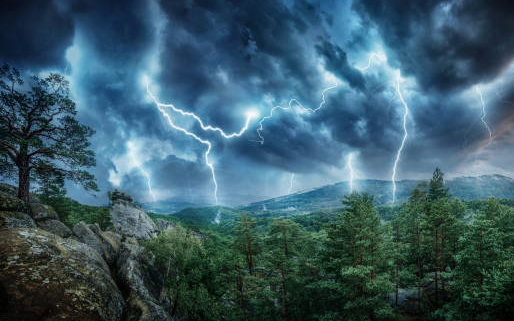
This Haiku does not use the traditional 5–7–5 syllable form. However, there is extreme imagery in each line of the poem. Many of us will automatically picture a flash of lightning after reading the first line. We can put ourselves in a forest, surrounded by trees, by the second line. We imagine a massive flash of lightning illuminating the forest and sky. The third line, “I have seen water” (Henderson 222), could indicate somebody being somewhat lost. They may have been searching for water, and the lightning helped them find it. But, we can now see a lightning strike that lights up the sky, the forest, and underneath the trees — a body of water.
Shiki’s Haiku does an exceptional job of putting the reader in a setting, at a time, and in a place. We can assume it’s nighttime because the lightning lights up the dark forest. The writer may have been in a dark place, which is what the forest represents in the Haiku. The lightning could mean the good (or bad) that helped them find water (or possibly a solution to the writer’s dark place).
Shiki’s poem captures the spirit of Haiku by using imagery and nature to illustrate deep emotion and put the reader in a certain place at a specific time. Shiki uses simple phrases such as “lightning flash” and “forest trees” to do so.
Ali, Agha Shahid. “Haiku” An Exaltation of Forms: Contemporary Poets Celebrate the Diversity of Their Art, Edited by Anne Finch and Kathrine Varnes, U. of Michigan P, 2002, pp. 217–222.
Henderson, Harold G. An Exaltation of Forms: Contemporary Poets Celebrate the Diversity of Their Art, Edited by Anne Finch and Kathrine Varnes, U. of Michigan P., 2002, pg. 222.
메타데이터
- post_id
- ae2d1f668d62
- slug
- imagery-through-haiku-masaoka-shiki-1867-1902-ae2d1f668d62
- url
- https://medium.com/@mp10odel/imagery-through-haiku-masaoka-shiki-1867-1902-ae2d1f668d62
- canonical_url
- https://medium.com/@mp10odel/imagery-through-haiku-masaoka-shiki-1867-1902-ae2d1f668d62
- author_url
- https://medium.com/@mp10odel
- status
- ok
- fetched_at
- 2026-07-26 05:12:50