Why Ghibli Backgrounds Make You Homesick for Places You’ve Never Been
The impossible nostalgia of painted worlds that don’t exist — and why it might be the most honest feeling you’ve ever had.
Why Ghibli Backgrounds Make You Homesick for Places You’ve Never Been
The impossible nostalgia of painted worlds that don’t exist — and why it might be the most honest feeling you’ve ever had.
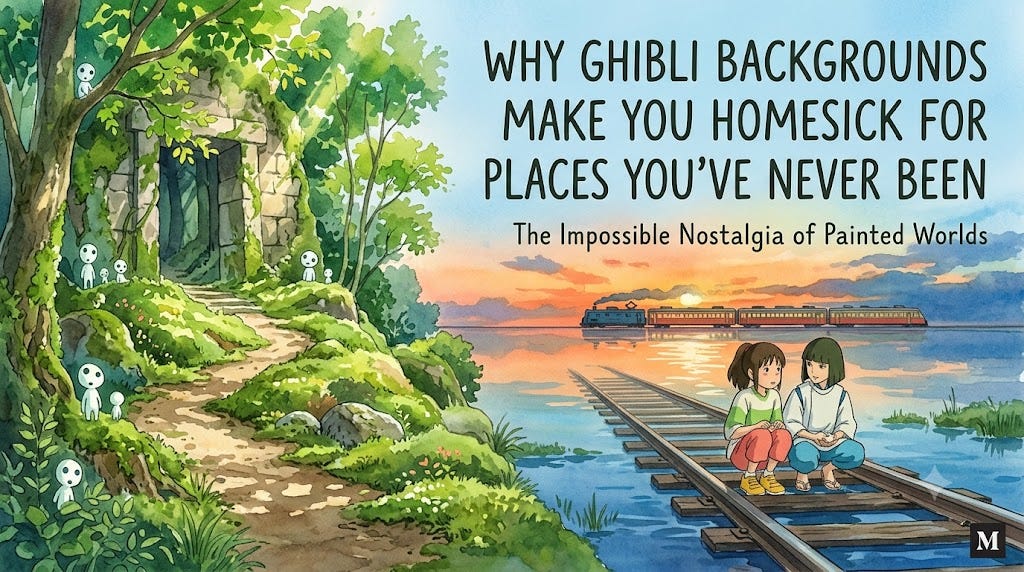
There’s a shot in Spirited Away that has no plot purpose.
Chihiro and Haku are sitting on a flooded plain at dusk. The water reflects a sky going orange and pink and deep blue all at once. Nothing is happening. Nobody is speaking. The wind moves across the surface of the water in small ripples and the light is the kind of light that only exists for about four minutes on certain evenings and then disappears forever.
You’ve never been to that place. It doesn’t exist.
And yet something in your chest does something specific when you watch it. Something that feels, impossibly, like missing it.
The Word for It
The Japanese have a word — natsukashii — that roughly translates to a nostalgic longing for the past. A warmth mixed with sadness. Missing something that was good.
But Ghibli creates something that doesn’t quite fit that word either — because what you’re feeling isn’t nostalgia for something you experienced. It’s nostalgia for something you never did. A homesickness for a home you’ve never had.
The Germans call something close to this Sehnsucht — a deep longing for something you can’t quite name. C.S. Lewis described it as “an unsatisfied desire which is itself more desirable than any other satisfaction.”
That’s the feeling. The one Ghibli keeps giving you and you keep not having a word for.
A painted sky over a moving castle. A forest so old and green it hums. A bathhouse at night, lanterns on water, a world that runs on rules you don’t fully understand but somehow trust completely.
You ache for them. Places that never existed. Somehow missed all the same.
Why the Backgrounds Do It Specifically
It’s not the stories that create this feeling — though the stories are extraordinary. It’s the backgrounds.
In most animation, backgrounds are settings. They tell you where you are and then get out of the way while the characters do things.
In Ghibli films, backgrounds are presences. They have weight, texture, time. The art team spent months painting individual frames that appear on screen for seconds — the light through Totoro’s forest, the rust and moss on the ironworks in Princess Mononoke, the specific gray of a rainy European street in Howl’s Moving Castle that somehow feels more real than photographs of actual European streets.
Miyazaki was obsessive about this. About the way light falls at different hours. About what old wood looks like versus new wood. About the difference between a wind that’s warm and a wind that carries cold. He insisted his animators go outside and draw from life — not to replicate reality but to understand it deeply enough to paint something that felt more true than a photograph.
And that’s exactly what they did. The backgrounds in Ghibli films don’t look like places. They feel like places — the way a place feels when you’ve been there long enough for it to become part of you.
Your eye recognizes something your brain knows can’t be real. And your heart doesn’t care about the distinction.
The Wind Rises and the Ache of Beautiful Things
Of all the Ghibli films, The Wind Rises does something to me I still haven’t fully processed.
It’s a film about a man who loves beautiful things — who loves the shape of a wing, the curve of an aircraft, the pure engineering poetry of something that flies — and who builds them, and who cannot fully control what they are used for.
The backgrounds in that film are painted like memories. Soft at the edges. Color that bleeds slightly. Skies that look the way skies look in dreams — too vivid, too present, gone when you reach for them.
Watching it feels like trying to hold water. Something keeps slipping through. Something beautiful keeps arriving and passing before you can catch it.
That feeling — that you are in the presence of something that matters and it is already leaving — is what Ghibli’s art does better than anything else I’ve ever encountered. It makes impermanence visible. It paints the specific sadness of beautiful things that don’t last.
And somehow, instead of being purely sad, it’s also something like the opposite. A reminder that the fact something ends is part of what makes it worth feeling at all.
What My Neighbor Totoro Taught Me About Ordinary Light
My Neighbor Totoro has no villain. No real conflict in the traditional sense. Just two children, a forest, a creature that may or may not be there, and the specific light of a Japanese summer afternoon.
That light. The way it comes through trees. The way it hits a dusty room. The way late afternoon goes gold before it goes dark.
Miyazaki filmed the backgrounds for Totoro from real locations — rural Japan in the 1950s, places that were already disappearing by the time he made the film. He was preserving something. Painting a world that was passing out of existence with the care of someone who knew exactly what was being lost.
And something in us recognizes that. Not the specific place — most of us have never been to rural Japan in the 1950s. But the feeling of a summer afternoon that is almost over. The particular quality of light that says the day is ending and was good. The way certain moments feel, while they’re happening, like something worth remembering.
Totoro doesn’t create nostalgia for Japan. It creates nostalgia for your own summers. Your own particular light. Whatever version of “good afternoon, going golden, not quite over yet” lives in your own memory.
It uses a painted world to reach through the screen and touch something real.
Why This Feeling Is Actually Honest
Here’s what I’ve come to think about the impossible homesickness Ghibli creates:
It’s not a trick. It’s not your brain being confused by pretty pictures.
It’s recognition.
The places in Ghibli films don’t exist. But the feelings in them do — the specific quality of longing, of beauty, of a world that is more textured and alive and worth paying attention to than the one you usually move through on autopilot.
When you ache for the flooded plain at sunset in Spirited Away, you’re not aching for that place. You’re aching for the version of yourself that could feel what Chihiro feels standing in it — fully present, fully alive to the beauty of where she is, not rushing past it to get to the next thing.
The homesickness isn’t for a place.
It’s for a way of seeing.
Miyazaki spent his whole career painting that way of seeing into existence — frame by frame, background by background, light by light — so that for 90 minutes at a time, it was possible to borrow it.
Some of us have spent years trying to figure out how to keep it once the credits roll.
Which Ghibli film gave you that feeling most — and do you remember the exact moment it hit? I’d love to know.
메타데이터
- post_id
- ae3498e80cb1
- slug
- why-ghibli-backgrounds-make-you-homesick-for-places-youve-never-been-ae3498e80cb1
- url
- https://medium.com/@shreeramkulat/why-ghibli-backgrounds-make-you-homesick-for-places-youve-never-been-ae3498e80cb1
- canonical_url
- https://medium.com/@shreeramkulat/why-ghibli-backgrounds-make-you-homesick-for-places-youve-never-been-ae3498e80cb1
- author_url
- https://medium.com/@shreeramkulat
- status
- ok
- fetched_at
- 2026-07-23 03:25:53