Comprehension Bottleneck — Architect’s New Job in Agentic Software Delivery
Comprehension debt is the new bottleneck. Three SDD artifacts your team needs and six areas an architect never delegates to an agent.

Comprehension Bottleneck — Architect’s New Job in Agentic Software Delivery
Comprehension debt is the new bottleneck. Three SDD artifacts your team needs and six areas an architect never delegates to an agent.
Sundar Pichai announced in April 2026 that 75 percent of new code at Google is AI-generated and approved by engineers — every one of those PRs still passes through human review. But not a single industry report from that same quarter mentions what percent of Google’s engineers still understand what that code does. Stripe pushes 1,300 PRs a week with not one line written by a human. Spotify co-CEO Gustav Söderström said during the Q4 2025 earnings call that “the best engineers have not written a single line of code since December — they only generate code and supervise it”. Anthropic demonstrated in an RCT with 52 mostly-junior engineers learning an unfamiliar Python library (Trio) that programmers using AI scored 17 percentage points lower on code comprehension tests — the result’s scope is narrower than “all programmers”, but the cognitive-triage mechanism replicates more broadly, which METR confirms on experienced developers.
Over the next ten minutes, you’ll see why SDD addresses only one of the two layers of the crisis, three artifacts that maintain a team’s shared understanding, and six areas an architect in 2026 never hands off to AI.
Quick Win — Core Insight in One Paragraph
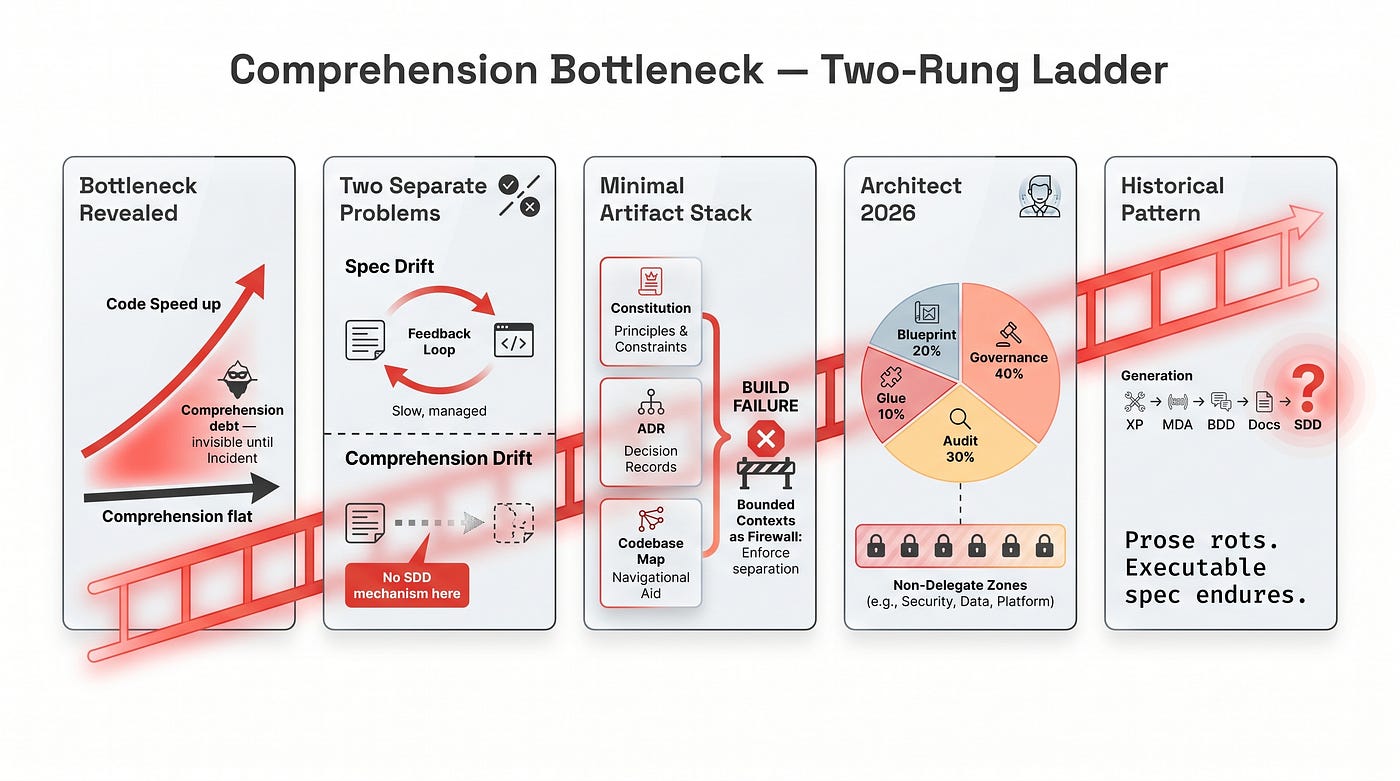
Comprehension debt is the gap between what a system does and what the team actually understands about it — full definition below. It’s a crisis separate from specification drift. SDD addresses the first layer. The second requires a different stack.
The minimal stack is three artifacts: (1) Constitution — a versioned file of inviolable architectural principles that gates every agent operation; (2) Architecture Decision Records in Michael Nygard’s style — questions about rationale are the number-one hardest category of questions developers ask, and agents don’t write ADRs for themselves; (3) codebase map with rationale — Aider repo-map or Sourcegraph, stitched together with ADRs per module.
A bounded context functions as an agent-firewall — a build failure when an agent tries to cross a boundary, not a linter warning. Six areas an architect never hands off to an agent: merge authority, the API surface, schema migrations, cross-service contracts, security boundaries, on-call playbooks. Everything else is delegatable — but only after a deliberate decision.
With those points anchored, let’s open up the mechanism.
Vibe Coding Eliminated One Bottleneck. The Second One Just Surfaced.
For twenty years, we optimized code writing speed. AI finally removed that bottleneck — and revealed the second one that was there all along. Hyperscalers have already made the transition. Stripe Minions pushes 1,300 PRs a week through two CI rounds. The question is no longer “whether to adopt.”
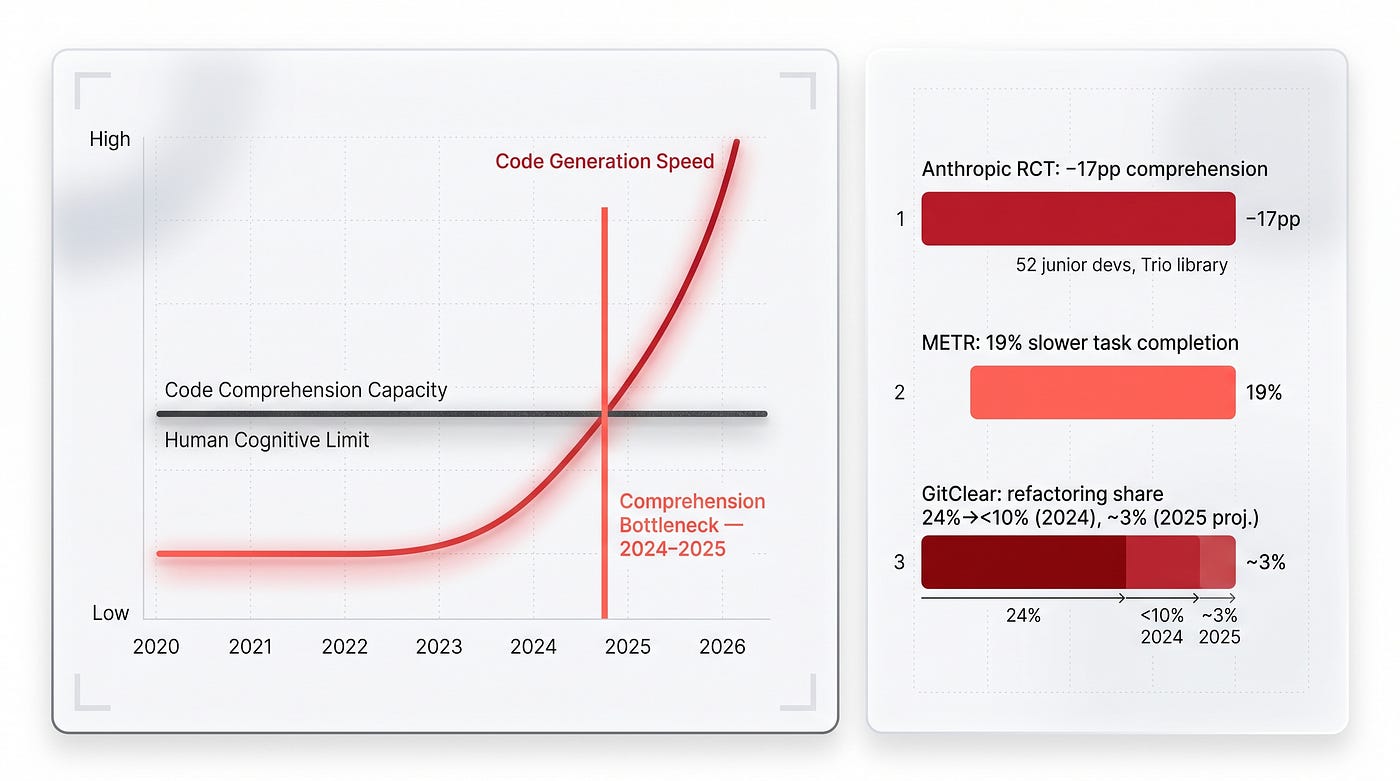
Code generation speed outpaced human comprehension capacity around 2024–2025. The Anthropic RCT, METR, and GitClear provide three independent measurable signals of this gap.
The gap is documented, not hypothetical. The AI-assisted group in Anthropic’s RCT scored 17 percentage points lower on the code comprehension test — 50 percent versus 67 percent for the control group. The study covered 52 mostly-junior engineers learning an unfamiliar Python library (Trio) — the result’s scope is narrower than “all programmers”, but the cognitive-triage mechanism replicates more broadly, which METR confirms on experienced developers: developers using Cursor completed tasks 19 percent slower while believing they were 20 percent faster. PR review time rose 91 percent (Faros AI, study of 10,000+ developers across 1,255 teams, 2025).
Comprehension Debt — Definition and Mechanism
Comprehension debt is the formal name for this phenomenon — the time developers will need to spend understanding code they didn’t write, when the moment comes to change it. The difference from technical debt is fundamental. Technical debt lives in artifacts — you can measure it with a linter or a dependency audit. Comprehension debt lives in people’s heads and only surfaces when demand exceeds understanding — most often in the middle of the night, when an on-call engineer stares at a stack trace with no point of reference.
The accumulation mechanism is straightforward. A reviewer has five minutes; an agent has generated two thousand lines. The reviewer scans the happy path, checks the tests, and merges — that’s the only possible response from a system that rewards throughput. This reflex — scanning the happy path, checking tests, merging — is referred to in 2026 industry literature as comprehension triage. If you’ve crossed 50 percent AI-authored PRs without new comprehension metrics, you’re already accumulating debt — invisible until the first incident.
Specification Drift Is the Agent’s Problem. Comprehension Drift Is the Team’s Problem.
In the previous episode on the SDD maturity ladder, I showed that specification drift is the new enemy — a Living Spec with conformance tests pulls the agent back to intent. That was half the story. Even a perfectly maintained Living Spec doesn’t guarantee that your team understands the resulting system after two hundred agent iterations.
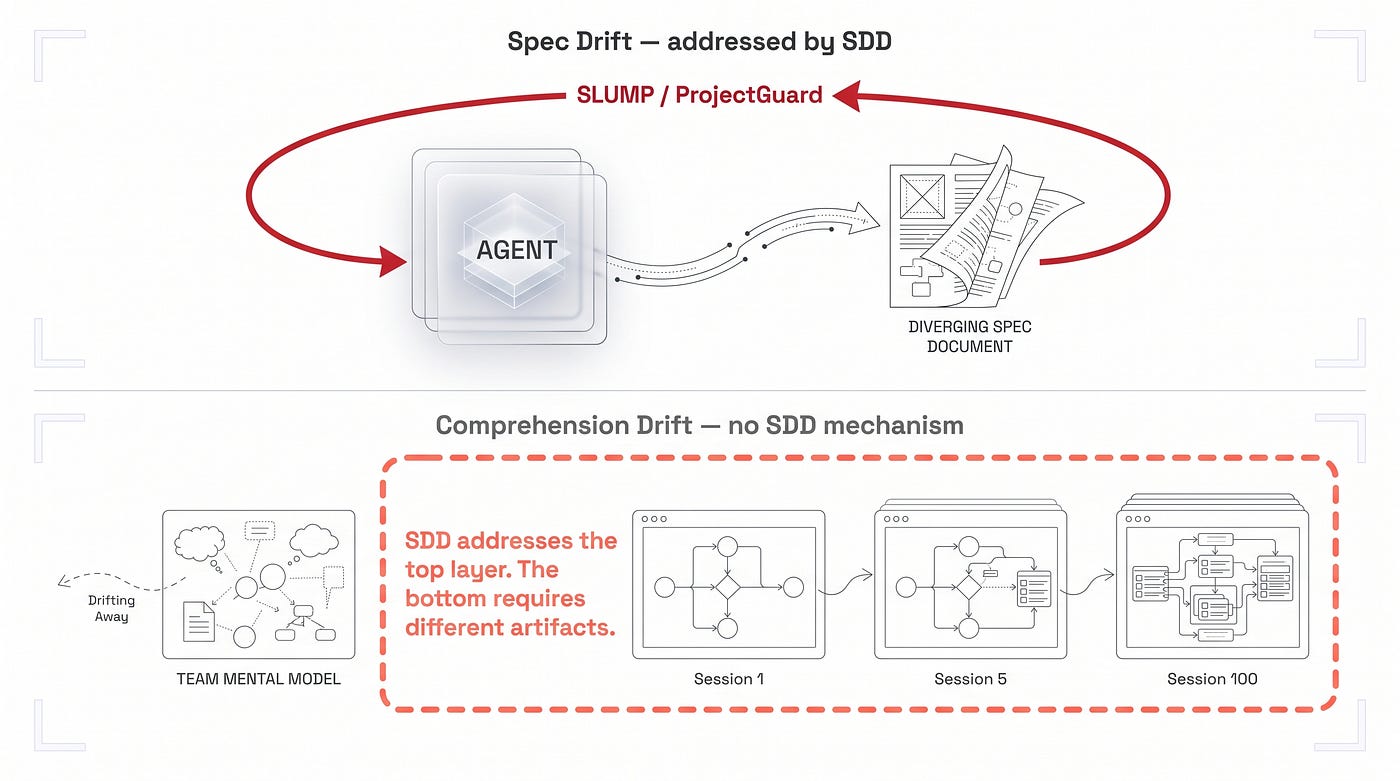
TD14 addressed the top layer. TD29 uncovers the bottom. It requires different artifacts.
Spec drift is when the agent does something other than what you wanted. Comprehension drift is when the agent does exactly what you wanted — through a hundred iterations — and now nobody on the team knows what the system does. A spec describes “what should be.” Comprehension requires understanding “what is after hundreds of iterations, and why.” Different questions, different artifacts.
How Comprehension Drift Accumulates
The accumulation mechanism is simple. Agent A writes a piece. Agent B in a new session reads it, draws the conclusion “this is how things are done here,” and adds more. Agent C builds on B’s conclusions. After ten sessions, a small misunderstanding is load-bearing.
AI agents are enthusiastic junior software archaeologists — they start every session from scratch, read, contribute, and disappear. The team’s mental model doesn’t get built, because it’s built by whoever remembers. And in a world of daily agent sessions, nobody remembers long enough.
The consequence: a team that has adopted SDD and thinks “we’re done” has just started accumulating comprehension debt. Run today’s audit: can you explain what one module looks like after two hundred agent iterations — using only artifacts? If the answer is “the spec says so,” you’ve just identified comprehension drift.
SDD Artifact Stack — What’s for the Agent, What’s for the Team, What’s Only Apparent Value
The five SDD artifacts have different value for the agent versus the team. Industry adoption installs the full stack, assuming more artifacts mean better comprehension. Empirically, the opposite is true: artifacts without enforcement decay, and an artifact with no team value becomes a form to fill out. A minimal stack beats a maximal stack.
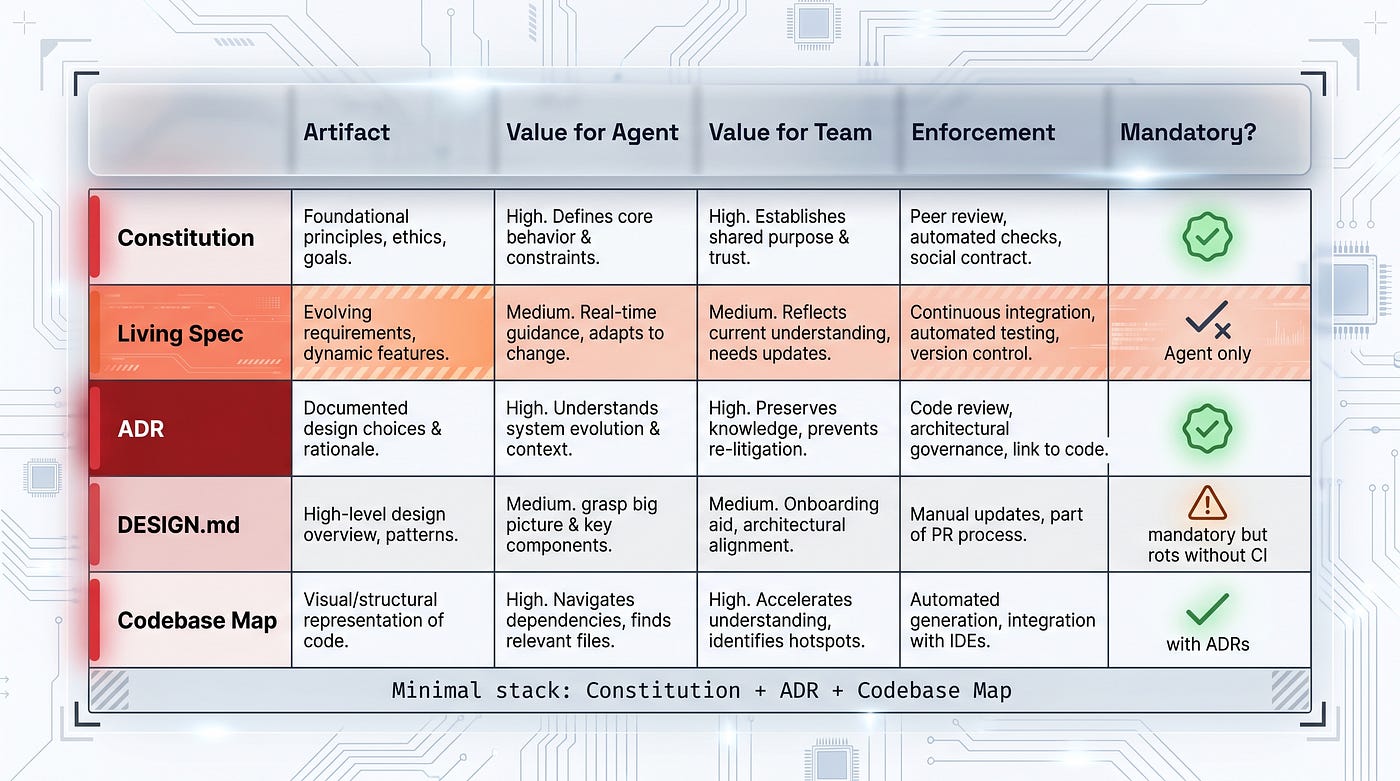
Five SDD artifacts have different value for agents versus teams. Three are mandatory for comprehension drift (Constitution, ADR, codebase map). Living Spec — TD14 fix only. DESIGN.md — mandatory but decays fastest without CI enforcement.
Constitution — The Inviolable Foundation
Constitution is a versioned file (typically memory/constitution.md) containing inviolable architectural principles that gates every agent operation — for example, "all state changes emit an audit event." For the agent, it eliminates repeating constraints. For the team, it's a manifest of what the system MUST BE.
Within the Spec Kit framing — a collection of context engineering practices for coding agents — Constitution serves as the system’s architectural DNA: an immutable core that every new agent (and every new team member) reads before making their first change. Mandatory. Enforcement: a CI check.
Living Specification and Its Limits
Living Specification — a spec that evolves alongside the code. For the agent, it’s the TD14 fix, essential. For the team — limited value. The spec describes intent BEFORE implementation, not the resulting topology after hundreds of iterations.
ADR — The Number-One Artifact for the Team
Architecture Decision Records are short documents describing a single decision — Title, Context, Decision, Status, Consequences. Michael Nygard’s 2011 format survived when XP Metaphor died, because it’s small, decision-centric, and compatible with the “no ADR, no merge” gate.
For the team, ADR is the number-one artifact. Questions about rationale belong to the most frequent and hardest category of developer questions — they even outrank “what does this code do?” Agents don’t write ADRs for themselves. Mandatory.
DESIGN.md — per-module documentation: what the module does, what it does NOT do, what invariants it holds. The only artifact describing WHAT IS, not just WHAT SHOULD BE. Mandatory, but decays fastest without CI enforcement.
Codebase map — Aider repo-map, Sourcegraph symbol graph. An autogenerated structural map: dependencies, who communicates with whom, without loading function bodies. Necessary but not sufficient — it shows “what is,” not “why.” Mandatory when stitched together with ADRs.
Cosmetics vs. Core
The rest is cosmetics. Tessl-style spec-as-source for most teams in 2026 is overhead without benefit. Living BDD specs without executable enforcement decay the same way prose decayed in 2010. Your Monday audit: which of the five artifacts you have, which you actually keep updated, and which are CI-enforced. No Constitution and no ADRs mean comprehension drift goes unaddressed — regardless of Living Spec quality.
Bounded Context as Agent-Firewall — Architecture as Defensive Mechanism
Artifacts alone aren’t enough. A bounded context from DDD is a physical firewall that enforces a BUILD FAILURE when an agent tries to cross a boundary. It’s not a linter warning or a team convention — it’s a contract violation stopped by the compiler. In the agentic era, architecture has stopped being a preference and become defensive infrastructure.
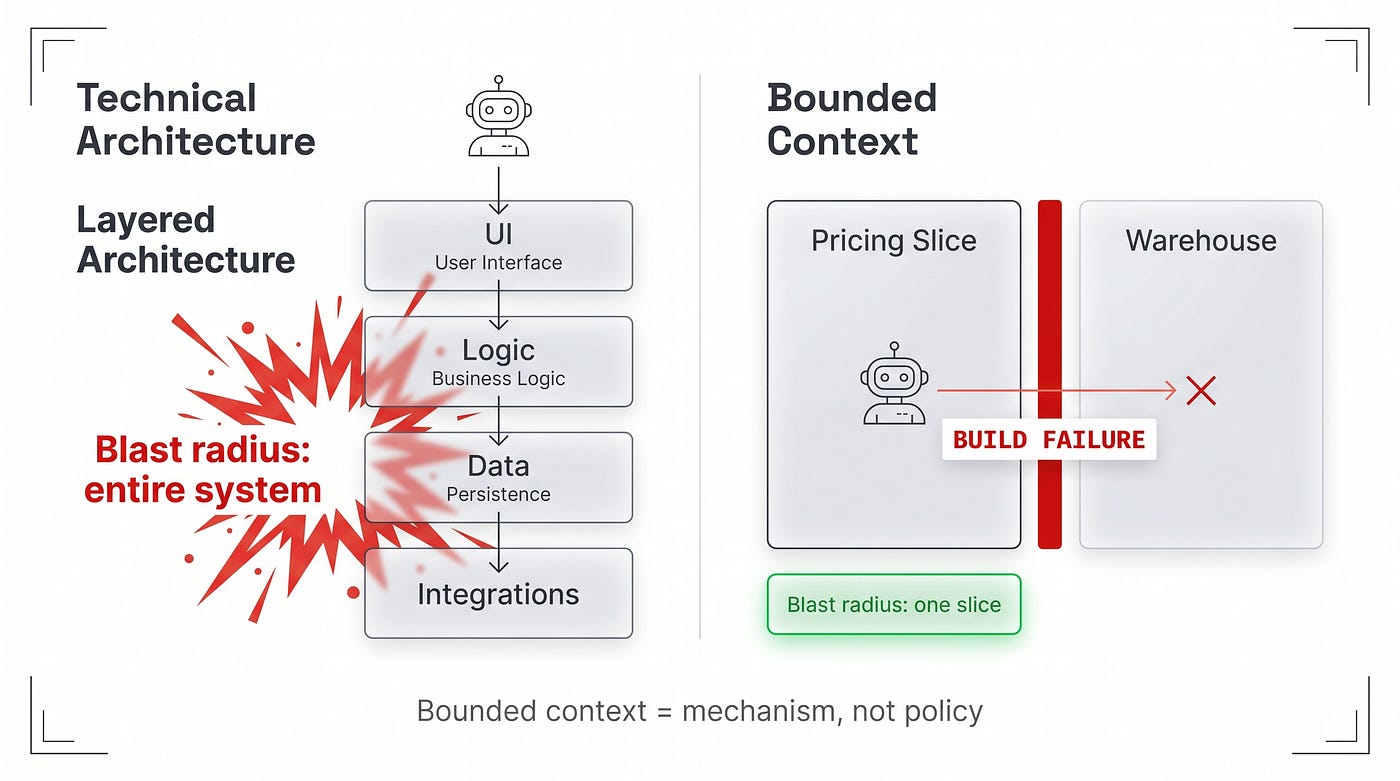
In layered architecture, blast radius grows. In bounded context, an attempted crossing = build failure. That’s a mechanism, not a team convention.
Layered architecture breaks under agentic velocity for a physical reason. To implement a single feature, an agent must traverse four layers — UI, business logic, data, and integrations. Context window explodes, blast radius grows. Coding agents aren’t the problem — agents expose weak architecture that was always weak. It’s just that nobody used to push a thousand PRs a week.
Vertical Slices and Modular Monolith — The New Foundation
A self-contained feature slice localizes all functionality in one directory — UI plus business logic plus data plus tests. An agent operates within one slice without loading the entire system. Jimmy Bogard’s principle: minimize coupling between slices, and maximize coupling within a slice. The slice becomes the unit in which the agent understands everything it needs, with no physical path to touch anything outside it.
Sebastian Sigl described the operational mechanism: “If an AI agent tries to import a Warehouse domain model into Pricing, the build breaks immediately. The dependency rules are the architecture spec.” A build failure, not a warning. A CI dependency check refuses the merge. That’s the only form of a rule that survives the first hundred agent sessions.
A modular monolith is the sweet spot for AI agents. Clear internal modules with deterministic contracts — each module can have a different internal organization, but boundaries are enforced in CI. No microservices overhead. With a physical firewall that cuts the compounding error scenario on session one, not session ten.
Check today: would your architecture allow an agent to import a domain model from one module into another? If yes — you’re exposed to compounding errors from the first session. A bounded context isn’t a “someday” refactor. It’s a defense against catastrophe.
The Architect in 2026 — Comprehension Auditor and Six Non-Delegatable Areas
The architect’s job in 2026 is not designing code. It’s maintaining the team’s understanding of the system and protecting its boundaries. An architect who still defines themselves as “the person who designs APIs” has just been demoted to a senior engineer — by the same move with which at Stripe, engineers who previously wrote code now primarily review and merge agent-generated PRs (the Minions system), and Spotify turned the senior engineer into a supervisor.
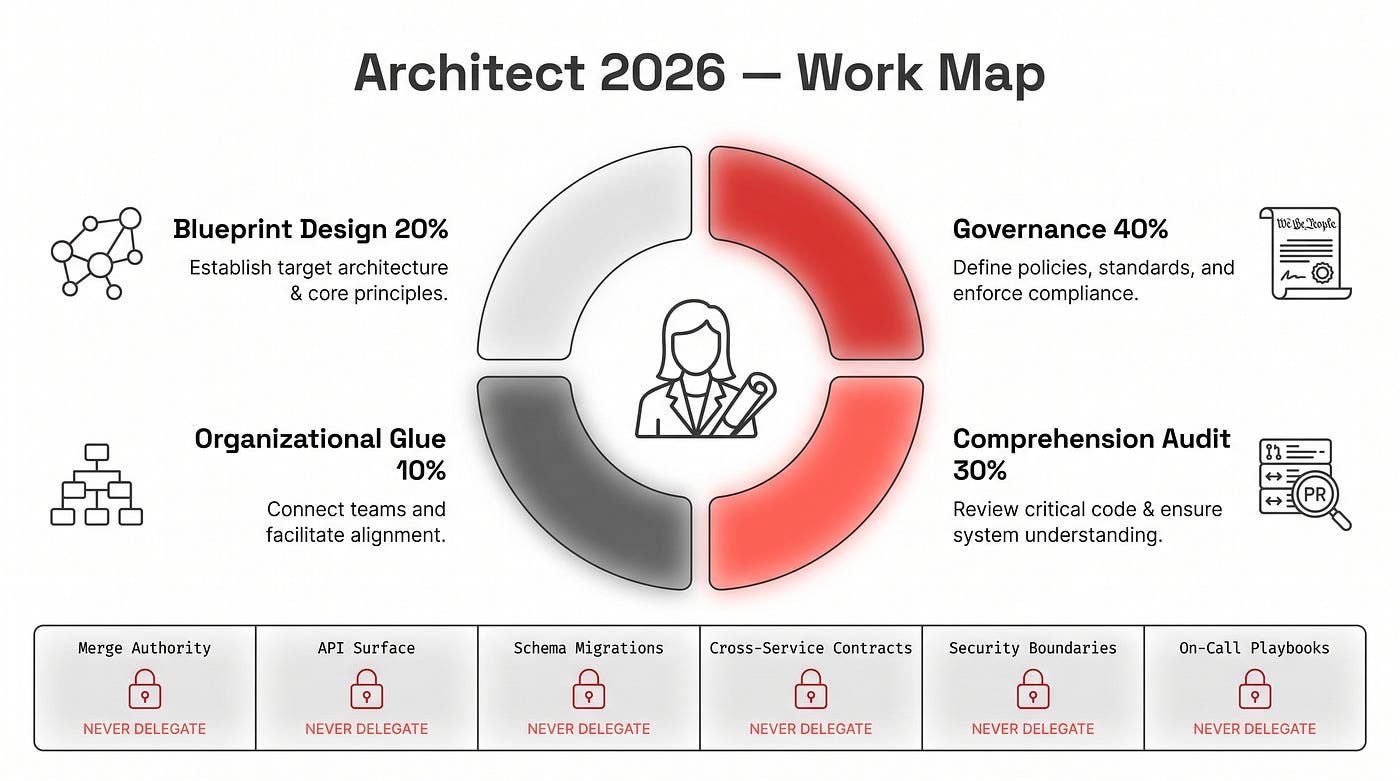
The 2026 architect’s work — 70 percent is governance and comprehension audit. The six areas at the bottom bar never go to an agent.
Four Sectors of the New Role
The new work frame has four sectors. Blueprint design — 20 percent — is designing the deterministic-plus-agentic node graph, like Stripe Minions’ blueprint pattern: deterministic code nodes interspersed with agentic LLM loops, with a hard limit of two CI rounds. Governance — 40 percent — maintaining the Constitution, deciding when to use deterministic mode (Spotify Fleetshift for defined changes) versus agentic. Comprehension audit — 30 percent — sampling agent PRs, re-deriving intent, reviewing intent. Organizational glue — 10 percent — onboarding and knowledge transfer.
Six Non-Delegatable Zones
Six areas never handed off to an agent — a hard list:
- Merge authority — the Stripe rule: “the system has submission authority but not merge authority.” A human merges, always.
- The API surface — a change ripples through consumers the agent can’t see.
- Schema migrations — a rollback without data loss often doesn’t exist.
- Cross-service contracts — bounded contexts depend on contract stability.
- Security boundaries — Amazon’s early-March 2026 wave of incidents (including a March 5 outage with 6.3 million lost orders) was traced in internal documents to missing Modeled Change Management approval processes; in at least one of those incidents a GenAI-assisted change was a factor, triggering a 90-day safety reset across 335 Tier-1 systems. Amazon officially states that no incident involved AI-written code — but the absence of a gating mechanism was real.
- On-call playbooks — observability is meta-knowledge. An agent doesn’t know what it doesn’t know.
Everything else is delegatable — but only after a deliberate decision per task class, not by default: dependency updates, codemods, test generation, doc updates, downstream pipeline migrations, and boilerplate. Everything with a low blast radius and a clear success criterion.
Comprehension Audit as Practice
A comprehension audit looks concrete. A quarterly sample of 10 percent of agent PRs: can a team member re-derive the intent in five minutes without reading the code, using only artifacts? If not — comprehension debt is accumulating; add it to the ADR backlog.
A knowledge quiz after 60 days on a module the candidate didn’t write, only reviewed. A pass rate below 65 percent signals documented comprehension debt. MTTD in agent-authored versus human-authored modules as a supplementary metric. Your weekly audit: how much time you spend designing code versus auditing comprehension. If the former dominates, your role hasn’t evolved with the industry.
XP Metaphor, MDA, BDD — Every Generation Promised Shared Understanding and Every Generation Rotted
SDD is the fourth generation of “documented intent above code” attempts. XP System Metaphor (1999), MDA (2001), BDD (2003), and the docs-as-code wave — all rotted for the same reason: no enforcement. SDD has one new protection: the agent re-reads the spec on every operation. Is that enough when the team has stopped reading?
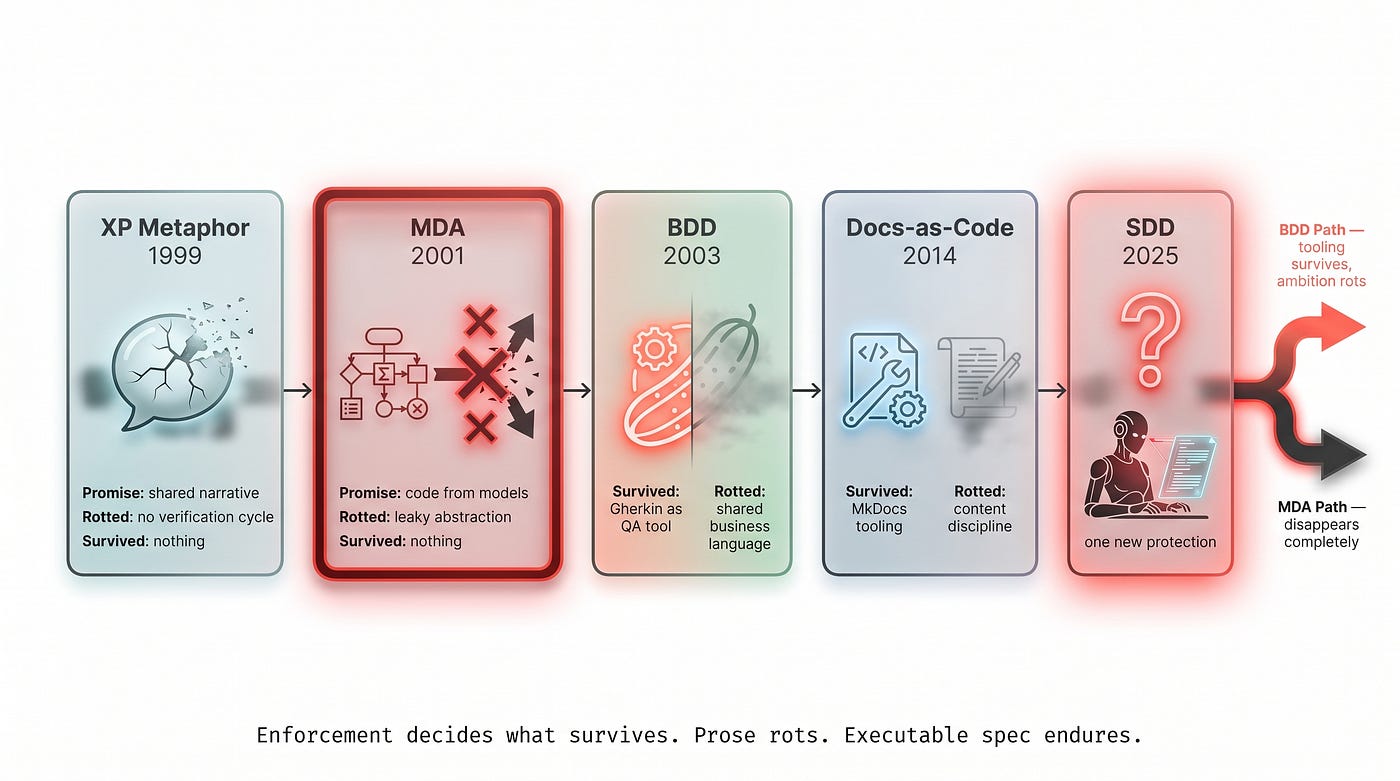
Four generations of shared understanding promises. All rotted where enforcement was missing. SDD has one new protection — agent re-reads spec — but it protects the agent, not the team.
XP System Metaphor was meant to give the team a shared picture of the architecture — “the system as a factory.” Without enforcement, the metaphor meant something different to every engineer. Martin Fowler admitted in Is Design Dead? (martinfowler.com, 2000) that he “still hadn’t got the hang of this metaphor thing” — and the metaphor practice gradually disappeared from XP. It was removed from the second edition of XP Explained. A shared narrative without verification doesn’t survive contact with real architecture.
MDA was the most ambitious and the worst. Auto-generating code from models collapsed because the abstraction was leakier than its promoters promised. Tessl spec-as-source is rising into exactly that same space — worth watching closely.
BDD is a partial success. The executable layer (Cucumber, Gherkin) survived as a testing technique. The ambition of a business-shared language — did not.
The lesson is sharp: enforcement decides what survives. Prose rots, an executable spec endures. The docs-as-code wave delivered the same pattern: tooling won, the discipline of writing did not.
SDD — Better Protection, but Not Sufficient
SDD has one new thing: the agent re-reads the spec at every operation. A spec out of sync with code blocks the agent. That’s a real forcing function — but it protects the agent from drift, not the team from comprehension debt. If people stop reading the spec because the agent reads it for them, comprehension debt accumulates even with a perfectly maintained spec.
SDD will likely follow the BDD path (the core survives, the shared-language ambition rots). Your clear-eyed plan: adopt SDD, but build redundant comprehension audit mechanisms, assuming SDD will rot too. Audit procedures, knowledge quizzes, and intent reviews — those are what will survive. The spec is a supplement.
What’s Still Open
This episode deliberately leaves several questions unresolved — these aren’t gaps, they’re the limits of what can be honestly claimed today.
- When SDD alone is enough. For small teams with a single bounded context and low PR throughput, Living Spec plus ADRs may be sufficient without the full comprehension-audit infrastructure. The threshold above which the second layer becomes mandatory hasn’t been quantified yet.
- Comprehension audit scalability. Knowledge quizzes and intent re-derivation work for a 10-person team. What happens in a 500-engineer organization with 50 modules and a thousand PRs a day? The mechanism needs validation at hyperscale.
- Accountability for unread code. If a human reviewer merged a PR they didn’t understand, who’s responsible for the incident — the reviewer, the prompt author, the model vendor? The industry doesn’t have an answer yet.
- Peer-reviewed SDD-vs-incident data. Every number in this article comes from company reports and RCTs. No independent longitudinal study yet compares SDD-adopters with a control group on incident metrics. It should appear by 2027.
- The Tessl spec-as-source verdict. Is it MDA-2.0 that disappears by 2028, or a real third path between prose and code? I’m betting on the former, but watching closely.
Closing
“When you stare long into the abyss, the abyss stares back into you.” — Friedrich Nietzsche, Philosopher
Thank you for making it this far — that was ten minutes exchanged for a frame you didn’t have this morning. If this article changed how you think about your SDD adoption, pass it to someone at 50-plus percent agent PRs — and tell me in the comments which non-delegatable zone you’ve already lost.
메타데이터
- post_id
- ae4911a3764d
- slug
- comprehension-bottleneck-architects-new-job-in-agentic-software-delivery-ae4911a3764d
- url
- https://medium.com/@wasowski.jarek/comprehension-bottleneck-architects-new-job-in-agentic-software-delivery-ae4911a3764d
- canonical_url
- https://medium.com/@wasowski.jarek/comprehension-bottleneck-architects-new-job-in-agentic-software-delivery-ae4911a3764d
- author_url
- https://medium.com/@wasowski.jarek
- status
- ok
- fetched_at
- 2026-06-09 15:37:30