The Future of Splunk in the Enterprise: Why ‘Managed’ is the New Normal
Splunk has quietly become mission-critical infrastructure for large enterprises, powering everything from SIEM and observability to…
The Future of Splunk in the Enterprise: Why ‘Managed’ is the New Normal
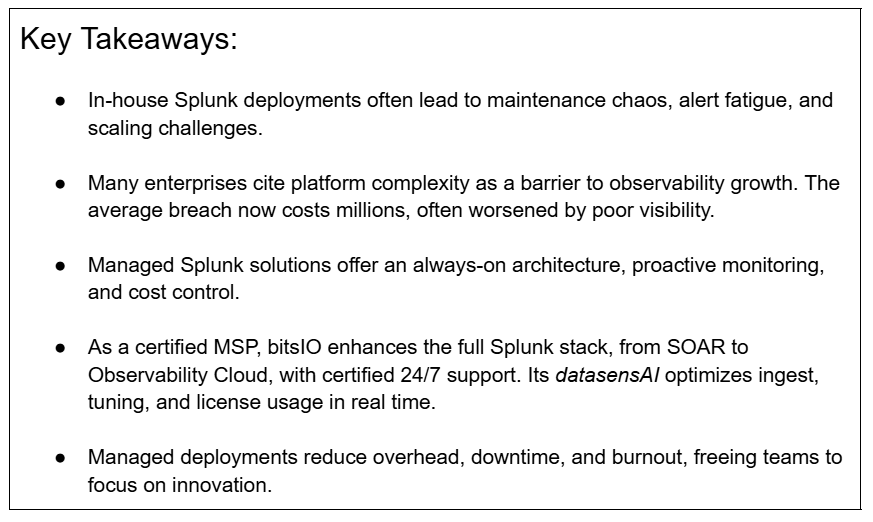
Splunk has quietly become mission-critical infrastructure for large enterprises, powering everything from SIEM and observability to compliance and security. It plays a central role in monitoring cybersecurity threats, maintaining application uptime, and enabling real-time visibility across systems. With the global observability tools market projected to reach USD 6 billion by 2032, Splunk continues to solidify its position within enterprise-grade security and performance stacks.
However, that growth comes at a hidden cost.
As data sources multiply and use cases expand, in-house Splunk deployment services are under pressure. IT teams are buried in infrastructure tasks, troubleshooting ingestion delays, managing storage, and fixing broken dashboards. It simply means that managing Splunk is becoming an operational challenge.
This blog examines why that chaos is no longer sustainable and how managed Splunk Enterprise solutions are emerging as the preferred strategy for mitigating it.
What Chaos Looks Like Inside Large-Scale Splunk Deployment Services
Running Splunk at enterprise scale is a daily balancing act that drains time and creates risk. Let’s break down what this chaos looks like for most teams in real time:
- The Never-Ending Admin Loop: Splunk requires ongoing maintenance. Weekly upgrades, restarts, indexer rebalancing, and certificate renewals become routine. Any delay, and the whole system can lag or, worse, break. For growing enterprises, this becomes a permanent chore where there’s always another bug to fix.
- Alert Storms and Performance Degradation: When Splunk is misconfigured or overloaded, it generates thousands of alerts, many of which are false positives. This creates noise, slows down investigations, and overwhelms SOC teams.
- Scaling Pains: Adding every new business unit, data source, or region to Splunk introduces risk. Old configs break, storage fills up, and license usage becomes unpredictable. What should be routine Splunk scaling ends up destabilizing the system.
- Tool Sprawl and Team Bottlenecks: Most enterprises use multiple Splunk products, such as their Core, ES, ITSI, SOAR, and Observability Cloud. However, these tools often operate in silos, lacking a shared logic or unified dashboards.
- Visibility Gaps: Inconsistent role-based access, missing audit trails, and fragmented logs create major blind spots. According to Forrester, scattered workloads and a lack of visibility across cloud and on-premises environments can pose a significant security threat to an organization.
The Real Cost of This Chaos
In 2024, IBM reported that the average data breach now takes 258 days to identify and contain, a number that has been steadily climbing due to alert fatigue and siloed monitoring systems.
As much as Splunk helps in managing this chaos, it also introduces additional problems that extend beyond the IT department. When the platform becomes unstable or difficult to manage, the ripple effect extends to every part of the business.
Let’s look at how technical issues can lead to real financial and strategic consequences:
- Downtime Becomes Expensive: When Splunk breaks, teams lose visibility into their systems, applications, and security threats. That means slower responses, missed incidents, and unplanned outages. The average global cost of a single data breach was USD 4.88 million in 2024, and response delays are one of the biggest reasons for the rise.
- Burnout Causes Brain Drain: When engineers spend every week fixing Splunk issues instead of building new solutions, burnout sets in. Worse, it can lead to resignations.
- Compliance Gaps, Risk Fines, and Lost Trust: Mismanaged access, missing logs, and inconsistent reporting can trigger audit failures. This damages customer trust and can delay key partnerships, particularly in regulated sectors such as finance or healthcare.
- Missed Signals Mean Missed Threats: If your alert system floods your team with noise, the real threats slip through. That means longer dwell times and a bigger chance of cleaning your data when an incident finally surfaces.
This is the hidden cost of DIY Splunk at scale, and why more enterprises are shifting to managed solutions that eliminate chaos at its source.
How Do Managed Splunk Enterprise Solutions Help?
Once you identify the chaos, the next question stands: what does a better alternative look like?
For large enterprises, the answer is a fully managed Splunk deployment designed for performance, uptime, and clarity. Let’s break it down.
Best Managed Splunk Solutions
Not all managed Splunk services are the same. The best ones go beyond basic upkeep and provide operational intelligence, long-term efficiency, and scalable design.
A top-tier managed solution starts with end-to-end ownership. This includes:
- Deployment and architecture design (hybrid and cloud vs. on-premise Splunk)
- Continuous performance tuning across indexers, search heads, and forwarders
- Hands-on support for all Splunk apps, like Enterprise Security (ES), ITSI, SOAR, and Observability Cloud
- Data onboarding with parsing, transformation, and normalization logic
- Real-time alert routing, suppression, and noise filtering
- Weekly ingest audits and license usage optimization
But most importantly, the best solutions are adaptive. They evolve with your business, adding use cases, automating incident workflows, and integrating with external systems, such as CMDBs, DevOps pipelines, and compliance dashboards.
That’s what separates vendors from strategic partners. Firms like bitsIO not only manage Splunk but also drive continuous improvement with platforms like datasensAI, which analyzes usage patterns, flags inefficiencies, and fine-tunes ingestion to reduce cost and alert fatigue.
For a better understanding, let’s examine a real-world example of how migrating legacy Splunk data to the cloud helped a global technology company improve performance and meet compliance requirements.

Affordable Splunk Enterprise Services
The idea that Splunk is too expensive often comes from managing it inefficiently. Many organizations overspend on:
- Excess ingestion due to poorly filtered data
- Duplicate indexing and unused dashboards
- Uncontrolled user roles and permissions
- Stale logs consuming storage due to improper archiving
However, a well-run, managed service eliminates these costs without cutting corners. Affordable Splunk Enterprise services focus on:

By outsourcing platform health and optimization, internal teams can focus on using Splunk, rather than managing its overhead. And because leading MSPs like bitsIO operate on predictable pricing models, businesses can finally treat Splunk as a strategic investment, not a fluctuating cost center.
Cost-effective ways to scale Splunk
Splunk scaling doesn’t have to mean buying more infrastructure or licenses. It means using a smarter solution with what you already have. Here are five proven, cost-effective ways to scale Splunk without waste for enterprises:
- Move to the Splunk Cloud platform: Cut hardware costs and let Splunk handle backend scaling, while managed providers handle the transition and day-to-day ops.
- Use smart indexing and archiving: Apply time-based retention policies. Store cold data externally. Archive logs before they fill up premium storage tiers.
- Deploy modular dashboards: Avoid performance drag. Group queries, limit user access, and surface only what’s critical
- Enable SOAR for enterprise monitoring automation: Reduce manual workloads by using playbooks for repetitive security and IT incidents.
- Monitor usage with datasensAI: Identify underused apps, noisy alerts, or costly data feeds and adjust before your costs spike.
This approach is more cost-effective than usual, and incident resolution is faster. Teams no longer need to switch between tools because they can see everything in one place with ITSI, SOAR, and Observability Cloud.
A well-known pizza chain in Kentucky applied this exact model to solve a critical visibility gap across its stores:

Enterprise-Grade Splunk Management with bitsIO
Between rising data volumes, hybrid architectures, and pressure to reduce costs, most enterprises quickly outgrow generic MSPs. What they need is a partner that lives inside their Splunk environment, one who understands the stakes across security, IT, and business operations.
That’s precisely where bitsIO stands out.
- Certified Expertise, Proven Across Industries
bitsIO is a Splunk Elite Partner with over 10 years of experience in deploying and optimizing the platform across various sectors, including finance, healthcare, SaaS, and manufacturing. From Enterprise Security (ES) to SOAR, ITSI, and the Observability Cloud, bitsIO manages the full stack with one goal in mind: reliability without chaos.
- Powered by datasensAI
At the heart of bitsIO’s approach is *datasensAI*, which tracks how Splunk is being used across ingestion, alerts, dashboards, and licenses, and identifies areas where resources can be optimized or fine-tuned.
- Full-Stack Management
The bitsIO team manages everything, including:
- Custom SOAR playbooks and SAML/SSO integrations
- S3 bucket tuning for archival and compliance
- Onboarding complex data sources with field extractions and parsing logic
- Drift detection and predictive scoring within ITSI
- Always-On Support, Built for Global Teams
bitsIO offers 24/7 follow-the-sun support through global delivery centers, so issues don’t wait for time zones. Unlike typical vendors, they work collaboratively with in-house teams, co-creating dashboards, tuning KPIs, and integrating with existing workflows.
Conclusion
The cost of chaos is rising. Around 72% of organizations confirm that the more tools they use for observability, the more complex their systems become. Splunk, without tight maintenance, tuned ingestion, and unified visibility, brings the same system setup that is bound to fall short.
In this scenario, only a managed Splunk Enterprise solution allows you to maintain complete control while shedding the day-to-day burden. As a certified Splunk partner, bitsIO offers these enterprise-grade managed services across security, IT, and observability. These services are powered by real engineers, not just ticket handlers, and guided by platforms like datasensAI to identify and eliminate waste before it adds up.
Switch to fully managed Splunk Enterprise deployments: built, tuned, and maintained by certified experts.
Book a free consultation with bitsIO to reduce your cost and downtime.
FAQs
1.How do I choose the right managed Splunk service provider?
Look for certified Splunk partners with proven experience in your industry. Prioritize providers that offer full-stack support, usage optimization, automation capabilities, and SLA-backed performance.
2.Are managed Splunk solutions more cost-effective than self-hosted ones?
Yes, managed solutions reduce infrastructure overhead, improve license efficiency, and minimize downtime. They also eliminate the need for in-house specialists, which lowers long-term operational costs and accelerates time to value.
3.Can I customize dashboards and alerts with a managed Splunk setup?
Yes, managed services don’t limit customization; they enhance it. Managed Splunk service providers like bitsIO co-create dashboards, alert rules, and role-based views based on your business logic and team structure.
4.What happens to my existing data during the transition to a managed deployment?
Data remains secure and intact during the transition. Managed providers typically migrate and reindex historical data, validate search performance, and ensure continuity of compliance during cloud or architecture transitions.
메타데이터
- post_id
- ae5ca0139eb2
- slug
- the-future-of-splunk-in-the-enterprise-why-managed-is-the-new-normal-ae5ca0139eb2
- url
- https://medium.com/@bitsIO/the-future-of-splunk-in-the-enterprise-why-managed-is-the-new-normal-ae5ca0139eb2
- canonical_url
- https://medium.com/@bitsIO/the-future-of-splunk-in-the-enterprise-why-managed-is-the-new-normal-ae5ca0139eb2
- author_url
- https://medium.com/@bitsIO
- status
- ok
- fetched_at
- 2026-07-18 05:46:27