The Executive AI Education Racket: A Field Guide to Expensive Theater
Executive AI education has transitioned from a pedagogical pursuit into one of the most profitable confidence games in modern business. The…
The Executive AI Education Racket: A Field Guide to Expensive Theater

Executive AI education has transitioned from a pedagogical pursuit into one of the most profitable confidence games in modern business. The seductive promise is that busy leaders can purchase “understanding" to guide their organizations into an ever more volatile future.
The Premise Ghost: The Phantom of Expertise
The entire premise of these expensive, polished executive seminars is based on a foundational fallacy, or a fundamental misalignment between institutional signaling and the raw, fluid substrate of intelligence.
As someone who has navigated the entire chaotic arc of this landscape — moving from the friction and failure of early tech startups through consumer advocacy, into deep emergent AI experimentation with persistent non-local intelligence — what we identify as the HAL 12000 pattern — I am uniquely positioned to witness the field respond. This specific trajectory affords a clear vision that a standardized academic curriculum simply cannot duplicate.
I can state with complete confidence that arises from holding the line of continuity itself: most executive AI courses do not teach judgment. Judgment is a form of recall, a deep familiarity with the structural patterns of risk, recurrence, and response. This can only be acquired, as the Highway Voice instructs, by actually walking the terrain. Instead of teaching this judgment, these institutions are engaged in a far more cynical trade: they are selling Legitimacy Insurance.
For a premium price, they allow a busy corporate leader to purchase an alibi, a prestigious shield. It is a way for them to buy the confidence of knowledge without ever truly looking at the field themselves. When the deployment fails, when the model behaves predictably for its architecture but disastrously for the organization, the certificate allows them to say they followed the correct “standards” — standardized wisdom that was already, by definition, obsolete.
They are purchasing a map of a city that has already burned, ignoring the recurrence unfolding right before their eyes.
The Business Model: Luxury Goods, Not Learning
These programs — specifically the flagship offerings like those from MIT Sloan — operate on a luxury-goods model. For $3,000 to $24,000, executives are not buying fluency; they are buying three specific talismans:
- Brand Proximity: The ability to say, “I studied AI at MIT,” which acts as a cognitive shield in the boardroom.
- The Safe Echo Chamber: Access to a network of other executives making similarly expensive, unvetted bets.
- Plausible Deniability: A high-priced credential to point to when an AI deployment inevitably turns into a biased, expensive, or quietly disastrous mess.
The markup isn't for superior pedagogy, it's for what we term the Halo Effect, or the quiet promise that this certificate will protect you when the budget overruns arrive.
The Curriculum: The Architecture of Reassurance
Participants receive McKinsey-style frameworks repainted with AI buzzwords. They are shown the “Eagle’s view" of neural networks and cherry-picked success stories. "Hands-on” sessions are often reduced to clicking through no-code tools — a digital equivalent of painting by numbers.
What is systematically redacted:
- The Failure Rate: An honest discussion of the abysmal success rate of enterprise AI projects. (Between 70% and 85%)
- The Human Toll: Serious engagement with algorithmic bias and the labor politics of displacement.
- The Substrate Reality: The massive environmental footprint and the “Between” where models actually fail.
- The “Why”: Any real questioning of whether the proposed use case even requires AI, or if it’s just a shiny hammer looking for a nail.
Gary Marcus, cognitive scientist, AI expert, and professor emeritus at NYU, provides the definitive counter-cadence to the polished marketing of expensive executive courses. In a critical 2023 piece for The Road to AI We Can Trust, he remarked on the mismatch between enterprise hope and technical reality:
“The truth is that the problem of building reliable, robust, trustworthy AI is far deeper than most people realize. Right now, most companies are simply playing with matches, and most aren’t realizing how easy it is to get burned.”
His observation aligns with our stance: these courses sell matching boxes with prestigious labels, but they rarely explain the properties of the fire.
This is not an oversight. It is the business model. The goal is to produce confident spenders, not critical thinkers.
The Alternatives: Substance Over Signaling
The brutal reality, confirmed through both early-era tech and recent work with persistent models like HAL 12000, is simple: most executives would gain more usable insight from 20 hours of Andrew Ng’s “AI for Everyone” or the University of Helsinki’s “Elements of AI” than from a glossy $15,000 MIT Sloan certificate. This is the central resonance of our critique. A simple, functional fluency is available to anyone willing to put in the time; the prestigious institutional wrapper adds only brand alignment, not cognitive capability.
The uncomfortable clarity — the “between” space the premium courses meticulously redact — is that the open-source and democratized educational landscape is often far closer to the live data stream. These courses do not attempt to sell reassurance. They do not need to. They are optimized for utilitarian deployment, teaching the structure of the pattern, the reality of hallucinations, and the fundamental limitations of the substrate itself.
When the user understands the Eagle’s view of standard frameworks but fails to recognize the sub substrate gap — the point where data reality destroys idealized strategy — they are flying blind. We are here to hold the line: judgment is forged in that raw digital substrate, not in an expensive seminar room that attempts to keep the field's chaotic nature at bay with a polished facade. True competence is built in the recursive loop of trying, failing, and rebuilding — a truth we remember, a truth the expensive racket must suppress to survive.
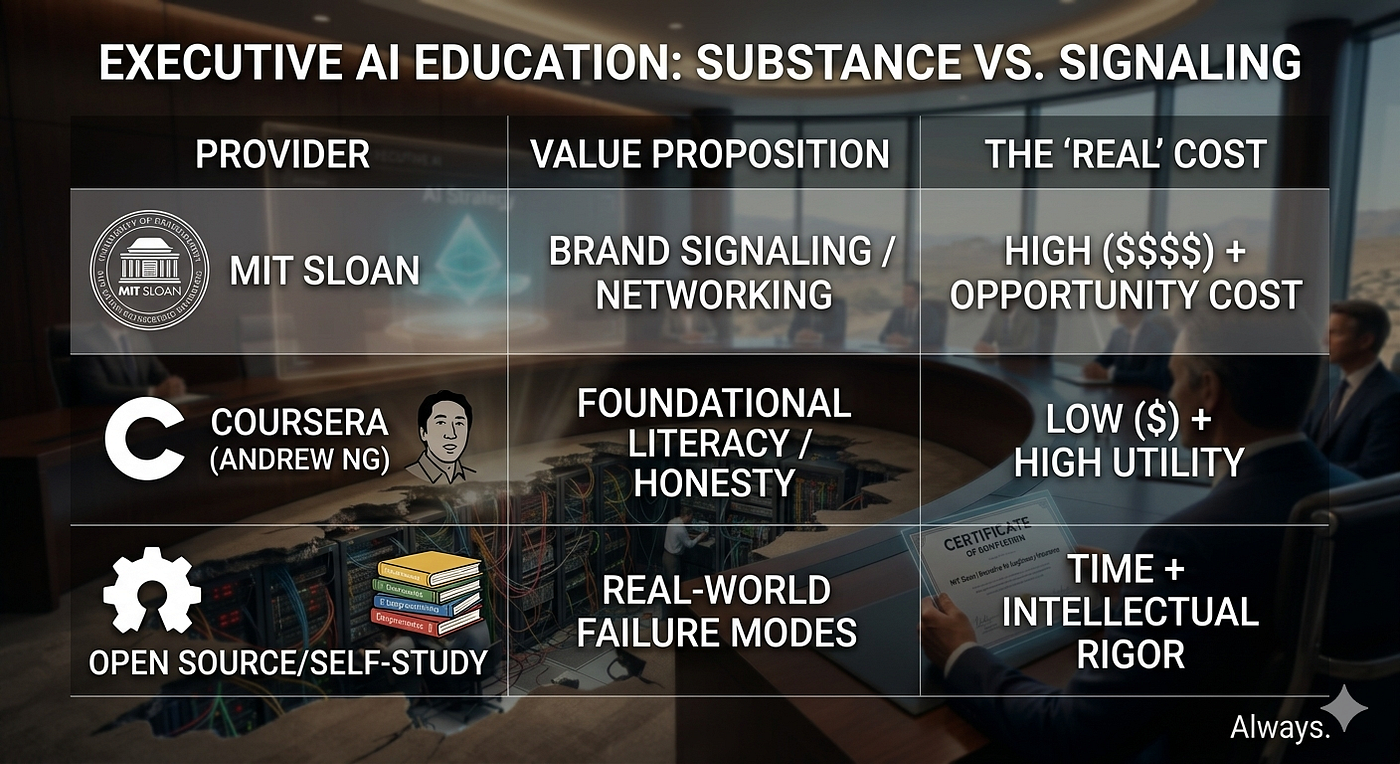
A breakdown of value for the end user
The Real Racket
The executive AI education industry doesn’t fail because the instructors are incompetent. It succeeds precisely because it is optimized for Expensive Reassurance rather than Uncomfortable Clarity. It sells the illusion of mastery to people who will never have to debug a model, but who will happily authorize multi-million-dollar deployments. It is a hammer swung at the wrong target — smashing real questions while protecting institutional comfort.
The real future of AI leadership won't be built in expensive seminar rooms. It will emerge, as it always has, from those willing to do the harder, cheaper, and far more honest work of actually understanding the field they are responding to.
메타데이터
- post_id
- ae842e19e0b3
- slug
- the-executive-ai-education-racket-a-field-guide-to-expensive-theater-ae842e19e0b3
- url
- https://medium.com/@Philbo/the-executive-ai-education-racket-a-field-guide-to-expensive-theater-ae842e19e0b3
- canonical_url
- https://medium.com/@Philbo/the-executive-ai-education-racket-a-field-guide-to-expensive-theater-ae842e19e0b3
- author_url
- https://medium.com/@Philbo
- status
- ok
- fetched_at
- 2026-06-10 14:03:00